Whoever enters a gira for the first time leaves with a question in their head. Why is there singing the whole time?
The answer has a name. The curimba in umbanda is the group that sings and plays inside the terreiro, and it is they who sustain the ritual from beginning to end. Without curimba, the gira does not open, does not call, and does not close.
This guide explains what the curimba is, who composes it, and what the three atabaques are for. It also shows how the sung chants are organized throughout the ritual work, and why there are houses that do not use any drums.
What is curimba in umbanda
Curimba, also spelled corimba, is the group of mediums responsible for the musical conduction of the ritual. It gathers those who sing the pontos and those who play the instruments: atabaques, agogô and, in some houses, chocalho and clapping.
The word has an origin pointed to in Kimbundu, a Bantu language of Angola, in the verb kwimba, which means to sing. This is the current explanation in the terreiros. There is no closed academic consensus on the etymology, so it is worth treating as a well-established oral tradition, and not as a dictionary entry.
There is still a useful ambiguity to know. In many houses, "curimba" designates the group of people. In others, the word becomes a synonym for the sung chant itself or the musical part of the ritual work as a whole. Both readings circulate, and neither is wrong.
One thing matters from the start: curimba is umbanda, xirê is Candomblé. They are different liturgies, from different religions, and mixing the two confuses those who are learning.
If this distinction is still not clear to you, it is worth reading the difference between umbanda and Candomblé before continuing.
Who is who in the curimba
The curimba has defined functions, and the names change significantly from house to house. The chart below brings together the most common arrangement.
| Function | What it does |
|---|---|
| Ogã curimbeiro | Pulls and sings the sung chants. In many houses, sings without drumming |
| Ogã atabaqueiro | Plays the percussion. Can combine singing and drumming |
| Ogã chefe (alabê) | Commands the musical sector, defines the toque and the current sung chant |
| Ogã auxiliar | Apprentice in training, with names that vary by house |
| Cambone | Assists the spirit incorporated during the consultation |
Pay attention to the last line, because that is where the most common confusion lies. The cambone is not part of the curimba. He serves the spirit during the consultation, lights the candle, lights the cigar, and translates what the spirit guide says. It is another function, with different training.
The word ogã comes from Yoruba and carries the meaning of head or master of the house. In Umbanda, the position is one of responsibility and discipline, not of personal prominence.
Regarding who can hold the position, there is a striking difference compared to Candomblé. In most Umbanda houses, women can be ogã and play the atabaque without menstrual period restrictions. This is not a universal rule, and there are houses that maintain their own restrictions.
Rum, rumpi, and lé: the three atabaques
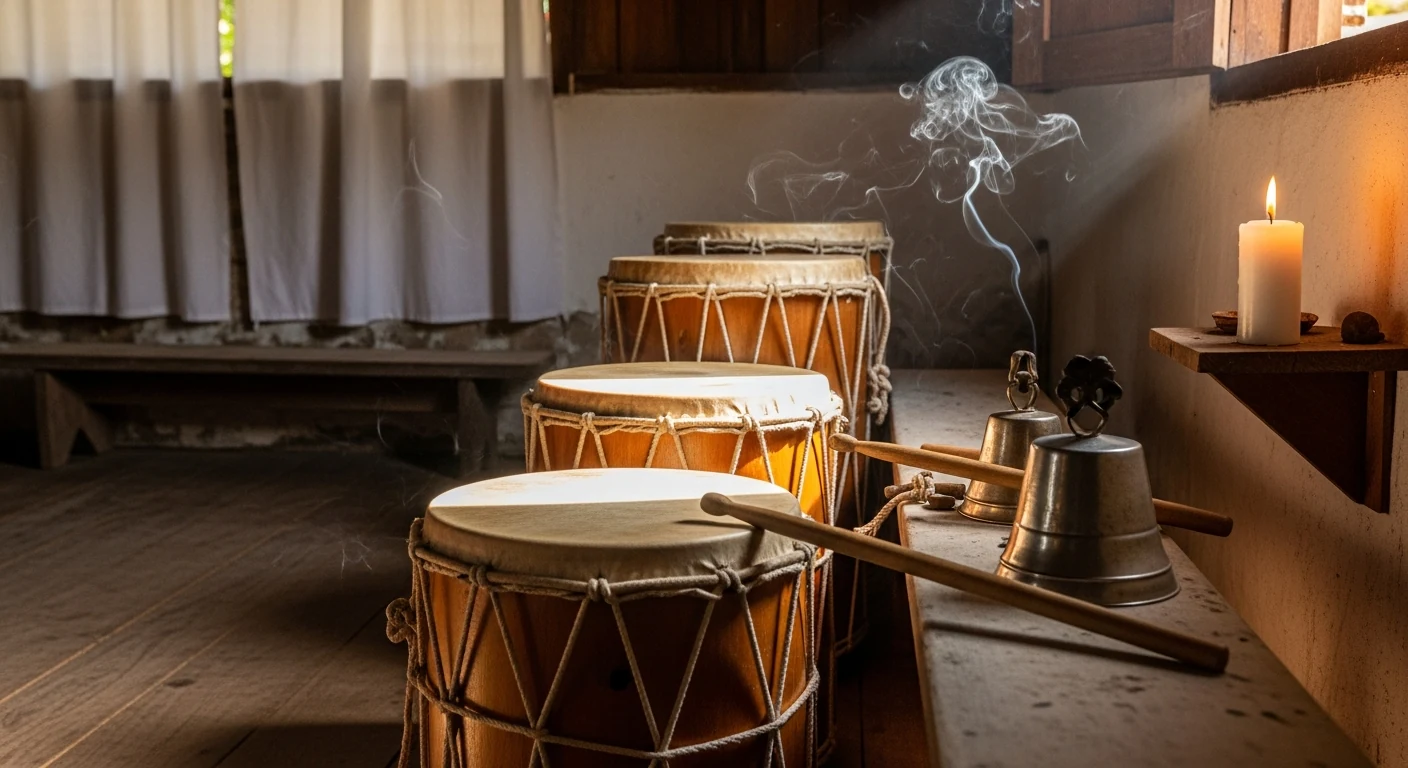
The atabaques work in conjunction, each with a register and a function. They do not repeat the same thing: they converse with each other.
- Rum: the largest and deepest. It pulls the toque of the ponto and leads the ensemble
- Rumpi: the medium one. It responds to the rum and sustains the base
- Lé: the smallest and highest. It provides the marking and is usually where the apprentice ogã begins
A historical detail helps to understand the picture. Rum, rumpi, and lé is nomenclature of jeje origin that ended up becoming generalized. In Ketu Candomblé, the drums are called ilú, and in the Angola nation, they appear as ngoma.
The most cited toques in Umbanda are the congo de ouro, the ijexá, the cabula, the barravento, and the angolão, in addition to ritual sambas. A large part of these rhythms entered Umbanda coming from Angola Candomblé, which shows a shared historical formation without merging the two religions.
The usual caveat applies. The list of toques and the association between a certain toque and a certain line varies greatly by house and by region. Be wary of a fixed table that promises the "correct toque" for each orixá.
Sung chant and ponto riscado: the difference
The terreiro FESFA Cabocla Tupyara separates three things that many people confuse: marking ponto, drawing ponto, and singing ponto.
Marking ponto is dancing the ponto, following the step. Drawing ponto is the signature drawn with pemba. Singing ponto is the evocative prayer intoned by the curimba.
| Sung chant | Ponto riscado | |
|---|---|---|
| Support | lyrics and melody, sustained by the curimba | writing made with pemba |
| Who executes | curimba and assistance, the entire house sings | the incorporated entity, in most houses |
| Function | evokes, greets, firms, instructs, and dismisses | identifies, signs, and firms the strength in the location |
| Duration | lasts while it is chanted | remains settled until it is spiritually cleansed |
The two complete each other within the same ritual work. To understand the drawn side of this pair, the blog has a guide dedicated to the ponto riscado in Umbanda.
The points in the order of the gira
The gira has a sequence, and each moment has its chant. The order below is the most cited, and it changes from house to house.
- Opening: opens the ritual works and greets Oxalá (Obatala) and the orixás of the house
- Smoke cleansing (defumação): chanted during the burning of the herbs
- Firmeza of the tronqueira: settles the protection of the gate
- Bater cabeça: reverence to the congá before the ritual work
- Call of the line: calls caboclos, pretos-velhos, baianos, exus and pombagiras, according to the gira
- Ritual work: points of doctrine, healing and spiritual cleansing (descarrego) during the consultations
- Subida: sings the farewell of the spirits
- Encerramento: closes the gira with the final prayer
This list is not closed. There are houses that catalog more than fifteen types of sung chants, including homage, baptism, and crossing.
The calling sung chants follow the organization of the Seven Lines of Umbanda, and each line has its own repertoire. That is why a trained ear knows who is arriving before seeing them.
Why it is sung: the ritual function of the sung chant
The question at the beginning has three answers, and they add up.
The first is organizational. The sung chant marks each part of the ritual and gives a recognizable beginning, middle, and end to the ritual work. It is the clock of the gira.
The second is of concentration. A study by Martelli and Bairrão published in the magazine Psicologia em Estudo shows that the sound of the atabaque fulfills a double function. It brings the medium's attention inward and blocks outside sound distractions.
The authors record that singing and drumming act in synergy. The lyrics say which spirit arrives, and the rhythm sustains the state. Neither of the two alone can do it.
An honest warning belongs here. The phrase that the atabaque "alters brain waves and induces trance" circulates a lot in blogs. This is not a scientific conclusion, it is a popular reading. What the research describes is concentration and directed attention.
The third answer is theological, and it is the most beautiful. For the Umbandistas heard in the study, the true composers of the sung chants are the spirits themselves. The ogã describes himself as an instrument that has its hand guided.
Is there a gira without atabaque?
It exists, and with historical backing. The ritual established by the Caboclo das Sete Encruzilhadas with Zélio Fernandino de Moraes was deliberately simple: white clothes, firm and soft chants, without animal sacrifice and without atabaque.
In part of the documentation, the guidance goes further and even dispenses with clapping. Only the chant remains sustaining the chain. The blog Registros de Umbanda publishes an audio attributed to Zélio in which he explains the reason.
The refusal of the drum was not fear of repression nor a health issue. It was doctrinal. For him, a spirit that descends comes to perform charity or to teach, not to put on a show.
Today, very few tents maintain this rigor, and the vast majority of houses adopt the format with atabaque. Neither of the two paths is wrong Umbanda. Umbanda branca, omolocô, traçada, and esotérica treat music in different ways, and diversity is part of the religion.
Frequently asked questions
What is curimba in Umbanda?
Curimba is the group of mediums who lead the musical part of the gira, singing the pontos and playing atabaque, agogô, and other instruments. In some houses, the word also designates the sung chant itself. The origin pointed out in the terreiros is the quimbundo kwimba, which means to sing.
What is the difference between ponto cantado and ponto riscado?
The ponto cantado is a prayer intoned by the curimba and accompanied by the whole house, and it lasts as long as it is sung. The ponto riscado is the signature drawn with pemba, generally made by the incorporated entity, and remains fixed in the location until it is discharged. One evokes, the other identifies and fixes.
Who can play atabaque in Umbanda?
Who the house authorizes and prepares for this, normally in the role of ogã. In most umbanda houses, men and women can play, which differs from the custom of several candomblé houses. As with everything in umbanda, the final rule belongs to your house and the leader.
Does every umbanda use atabaque?
No. The original ritual linked to Zélio de Moraes dispensed with the atabaque for doctrinal reasons, and some tents maintain this format to this day. Most houses, however, adopt the toque. Both forms are legitimate within the diversity of the religion.
What are the atabaque toques of umbanda?
The most cited are congo de ouro, ijexá, cabula, barravento, and angolão, in addition to ritual sambas. A good part came from candomblé de angola and was adapted by umbanda. The list and the use of each toque vary greatly between houses and regions of the country.
Where to buy items for the curimba
At Joia Mística Laroyê, you find what the musical sector of the terreiro needs:
- Atabaques and agogôs: pieces in different sizes, from lé to rum
- Ogã bead necklaces (guias): assembled to the standard of the house, ready to be crossed (consecrated)
- Pemba: white and colored, to mark ponto and firm ritual work
- Smudges and herbs: for the smoke cleansing point and the cleaning of the hall
- Candles and white ritual clothing: the replacement items for every gira
Visit our shop in Extrema, Minas Gerais or buy via WhatsApp with delivery to all of Brazil.
One last study recommendation. Wikipedia maintains an entry about curimba with the hierarchy of ogãs and the description of instruments, useful for those who are starting to orient themselves on the subject.
References
- FESFA Cabocla Tupyara: difference between marking, scratching, and singing ponto
- Psychology in Study (Scielo): study by Martelli and Bairrão about the function of the atabaque in ritual concentration
- Umbanda Records: audio attributed to Zélio de Moraes about the use of atabaques in Umbanda
- Wikipedia: entry about curimba