Pombagira is a feminine Exu: the woman-Exu of Umbanda and Quimbanda, also worshipped in a large part of the candomblés, mistress of the T-shaped crossroads and, in the houses studied, a force of her own, without hierarchy with Exu.
The name comes, very likely, from Bongbogirá, one of the names of Exu in candomblés of Bantu tradition. She has dozens of falanges, such as Maria Padilha, Maria Mulambo and the Cigana. The colors are red and black, the gira happens at night, on Monday or Friday, and the day, the bead necklace and the offering are defined by the house.
What is Pombagira: the woman-Exu
Pombagira is the feminine form of Exu. The sociologist Reginaldo Prandi, from USP, summarizes: "Pombagira is considered a feminine Exu". In another point of the same text, he records that she is "a woman-Exu, as she herself likes to be called".
Nature: feminine Exu | Colors: red and black | Day: Monday or Friday at night, according to the house | Place: T crossroads | Greeting: Laroyê
She is not subordinate to Exu. In a survey in six terreiros of Umbanda in São Paulo, Mariana Leal de Barros and José Francisco Bairrão did not find hierarchy between the feminine and the masculine. A mãe de santo summarized it like this: they are different forces, "but one is no more than the other".
Each person of the house has their own. Prandi records that, in candomblés of Angola nation and in the majority of terreiros of Umbanda, the initiate has a masculine Exu and a Pombagira, in addition to the orixá (orisha). Part of Umbanda goes further and teaches that every human being has their Exu and their Pombagira, responsible for the opening of the paths.
Where the name Pombagira comes from
The name is of Bantu origin. In the Angola and Congo nation candomblés, one of the names of Exu is Bongbogirá, also written as Bombogirá or Bambojira. Prandi concludes that Pombagira "is certainly a corruption" of this name, which ended up being reserved only for the feminine quality of Exu.
The historian Alexander Vianna, in the magazine Afro-Ásia, even goes to the inquice Pambu Njila, Portuguese-ized as Bombojira: a deity without a fixed gender, protector of paths and passages. The name comes from the Kimbundu pambu-a-njila, which means crossroads. Vianna recalls that the pombagira of Umbanda is something else: a spirit that manifests in mediums, distinct from the Central African deity.
Even so, the etymology is an accepted hypothesis, not proof. Cristiane Amaral de Barros's dissertation at UFJF records that Edison Carneiro noted "Bombojira" as an invocation to Exu in Congo candomblés in 1948 and that Monique Augras found the worship of Pombagira already established in Rio de Janeiro in 1961. She concludes that the transition from Bombonjira to Pomba-gira "is still only a hypothesis that lacks confirmation."
The spelling changes from house to house: Pomba Gira, Pomba-gira, Pombajira. In the blog we use Pombagira, Prandi's form.
Pombagira is not an evil spirit
The image of Pombagira as a figure of evil was not born in the terreiros. It comes from the same religious racism that, since the colonial era, treated what was of Afro-Brazilian origin as witchcraft. Pombagira deals with themes that Christian morality treats as taboo: desire, the body, the woman who decides her own life. That is why she became a caricature.
Within the tradition, she is a working spirit. Prandi describes the consultation with her during the gira, with the spirit present through trance. He also records that every request always corresponds to some type of offering, and that discovering the right offering is the task of the fathers and mothers of santo who lead the house.
More recent research also reads Pombagira as a figure of female autonomy. Letícia Reis's review in the Sacrilegens magazine, from UFJF, gathers this reading based on Prandi's studies.
Worth remembering: a serious house works with preparation and guidance, not with deadlines or promises. Whoever guarantees results in three days is selling something else.
Pombagira in Umbanda, in Quimbanda, and in Candomblé
Pombagira appears in more than one religion, and the role changes in each one.
In Umbanda, she is from the left line and works incorporated in the mediums, alongside the Umbanda spirit guides. Prandi recalls that it was Umbanda that "developed and systematized the worship of Pombagira as a spirit endowed with its own identity." In Umbanda, Exu is the spirit of a deceased person, and not an orixá, and many pombagiras are also considered spirits of the deceased.
In Quimbanda, the worship is directed precisely to exus and pombagiras, and she is worshiped as a female Exu. Prandi writes that, in practice, "there is no Quimbanda without Umbanda nor quimbandeiro without Umbanda practitioner." In Rio Grande do Sul, Quimbanda gained a weight that it does not have in another state, and it is there that the pombagiras entered the official calendar of Porto Alegre. The rest of the tradition is in what is Quimbanda.
In Candomblé, especially in the Angola nation houses, she is also worshipped. There, her food stays "at the foot of the Pombagira", next to the Pombagira consecrated foundation, away from the eyes of those who are not initiated. To understand the male pair, see who is Exu.
The spiritual legions (falange) of Pombagira
Pombagira is a name for many. Each spiritual legion (falange) has its own name, taste, and ponto (sacred song), and several spirits can respond by the same name.
“Pombagira is singular but is also plural. They are many, each with its own name, appearance, preferences, symbols, and particular chants (cantigas).” Reginaldo Prandi, Herdeiras do Axé, 1996
Among the most well-known on Prandi's list are the Queen, Maria Padilha, Sete Saias, Maria Mulambo, Cigana, Maria Quitéria, Dama da Noite, and Menina. Many take the name of the place where they live, such as those of the Souls, of Calunga, and of the Beaches, and the spiritual legion (falange) can be divided: Maria Padilha do Cabaré, Maria Padilha do Cruzeiro das Almas.
The pombagiras crossed with the souls, such as Rosa Caveira, form their own family. The complete list, family by family, is in Pombagira names.
Colors, bead necklace, and day of the Pombagira
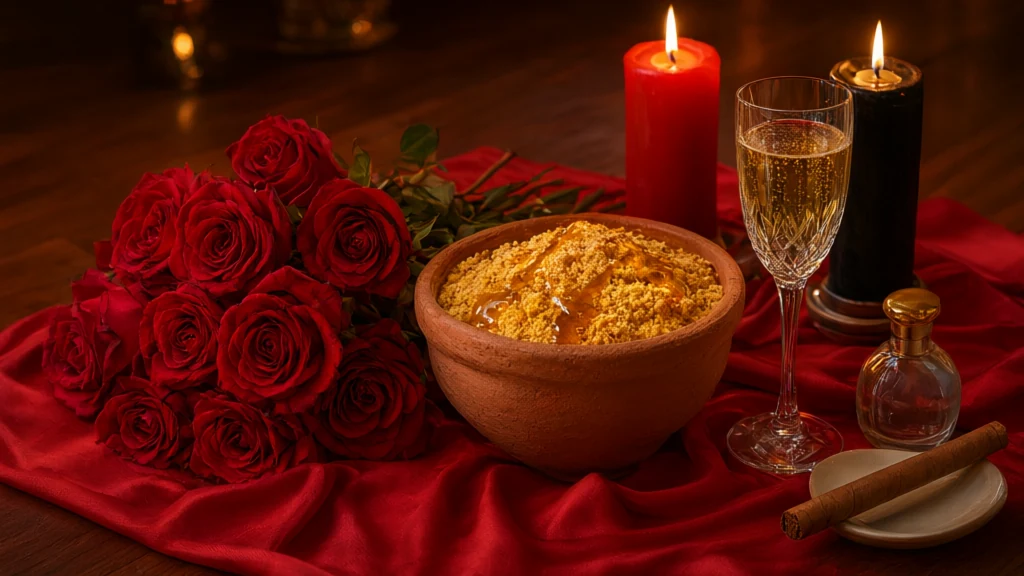
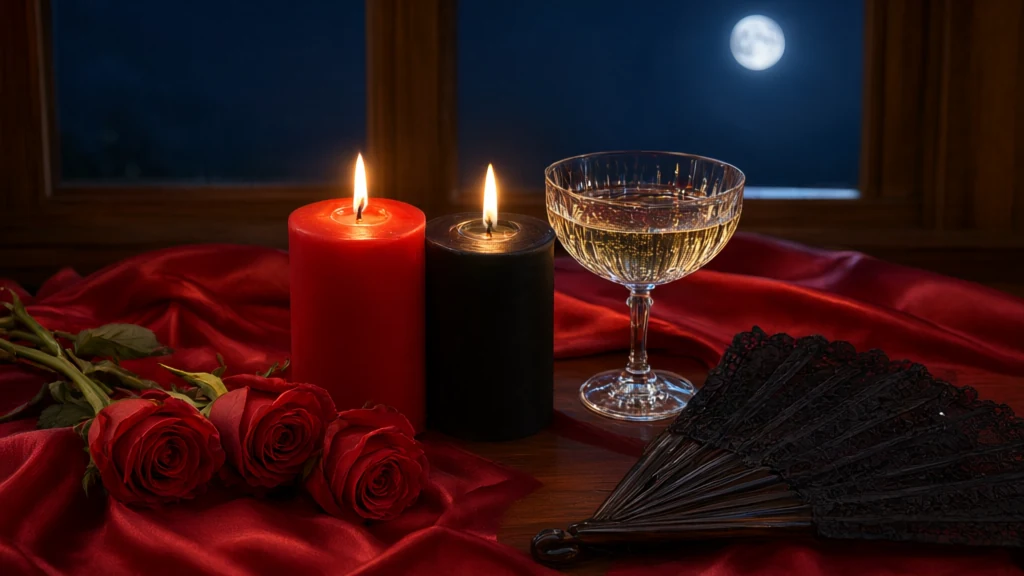
The colors of the Pombagira are red and black, in the fabrics, in the candles, and in the bead necklaces. Prandi records red, black "and, sometimes, white" candles. The color also changes by spiritual legion (falange): in Porto Velho houses, Nilza Lagos saw the Marias Padilhas in red, black, and gold and the Marias Mulambos in black and colorful, and noted that "nothing is rigid".
On the bead necklace (guia), Barros records that the pombagiras crossed with the souls add white to the red and the black, also in the mediums' bead necklaces. And Lagos records that, in Porto Velho, the necklace is one of the objects that belong to Pombagira, and the medium uses it in a moment of need. The one who makes and crosses the bead necklace is the house, as explained in Exu's bead necklace.
The day is Monday or Friday, at night, according to the terreiro. Prandi records the consultations "very late at night, usually on Fridays." Barros found giras on the first or last Mondays or Fridays of the month, or after midnight, and writes that each terreiro is free to choose the day. The August 13 circulating on social media has no source for Pombagira: the law with this date in Porto Alegre is for Exu Sr. Velho Omulu (Law 13.416/2023). The dates by spiritual legion (falange) are in Pombagira day.
Offering and crossroads: where Pombagira receives
Pombagira receives at the T-shaped crossroads. Prandi records the rule, and Barros repeats it: "All open crossroads belong to Exu. All T-shaped crossroads belong to Pomba-gira." The pombagiras of the souls receive at the cemetery or at the wayside cross, and some prefer the beach or the woods. The rest is in crossroads in Quimbanda.
The present is what she uses on land: red and black fabric, perfume, jewelry or costume jewelry, champagne, a cigarillo, and open red roses, never buds. Barros explains why: the bud symbolizes purity and virginity. In the food, Prandi records the padê and the manioc farofa with honey. In the shop there is a red candle and a black candle of solid color, perfume, a goblet, and a cigarillo, and if the house asked for a material and you want to check before buying, Joice clears up the doubt via WhatsApp.
The house decides. Asked about what is not given, a babalorixá from Porto Velho answered Lagos: "we do not give to Pombagira what we would not like to receive." The complete list is in offering for Pombagira, and the drink has its own text in Pombagira drink.
Frequently asked questions
Who is Pombagira and what does she represent?
Pombagira is a female Exu, the Exu-woman of Umbanda and Quimbanda, also worshipped in a large part of Candomblé. She works at the T crossroads and attends the gira at night. Research reads in her the strength of desire and of the woman who decides her own life.
Is Pombagira evil?
No. The reputation of an evil spirit comes from Christian prejudice and religious racism against African-rooted religions. In the terreiros, she is a working spirit, who advises those who seek her with respect.
What is Pombagira's day?
It is Monday or Friday, at night, depending on the terreiro. Prandi records the giras generally on Fridays, and Barros shows that each house chooses between Monday and Friday. August 13 has no source for Pombagira.
What are Pombagira's colors?
Red and black. The pombagiras of the souls add white, and in Porto Velho the Marias Padilhas also use gold. The exact color belongs to the falange and the house.
What is the difference between Pombagira and female Exu?
None in principle: "female Exu" or "Exu-woman" is the concept, and Pombagira is the name given to it in Brazil. What changes is the religion: in Umbanda she is a spirit of work of the left; in Candomblé of Angola nation, she is worshipped together with the assentamento.
References
- Reginaldo Prandi, Herdeiras do Axé: Pombagira and the unconfessed faces of Brazil
- Reginaldo Prandi, Esboços (UFSC): Heart of Pombagira
- Alexander Martins Vianna, Afro-Ásia (UFBA): The sacred feminines of Pombagira
- Cristiane Amaral de Barros, UFJF: Iemanjá and Pombagira
- Mariana Leal de Barros and José Francisco Bairrão, Revista do IEB (USP): Gender performances in Umbanda
- Nilza Lagos, UMESP: Move over man, a woman is coming
- Giumbelli and Almeida, Revista de Antropologia (USP): The enigma of Quimbanda
- Letícia Reis, Sacrilegens (UFJF): The figure of Pombagira: transgression and female empowerment
- Porto Alegre: Law 13.416/2023, Exu Sr. Velho Omulu