The pombagira names are spiritual legion (falange) names, such as Maria Padilha, Maria Mulambo, Sete Saias, Cigana, and Dama da Noite. Various spirits respond by the same name without sharing the same history. Pombagira is Exu (Eshu)-woman, as she herself likes to be called. What she is is in who is Pombagira.
How Pombagira names are formed
Each name is a spiritual legion (falange). The falange is divided: there is the Maria Padilha of the Cabaré and the one of the Cross of Souls. Four patterns repeat in the field lists:
- The place where she lives: of the Souls, of the Beaches, of the Forests, of the Crossroads, of the Crosses, of the Calunga. Barros also records the one of the Fig Tree, the one of the Sepulcher, and the one of the Road.
- The name Maria: Padilha, Mulambo, Farrapo, Quitéria.
- The rose: Rosa Caveira, Sete Rosas, Rosa Vermelha, Rosa Negra.
- The royalty: the Pombagira Rainha opens the list by Reginaldo Prandi. There is also the Rainha do Cabaré and the Rainha das Sete Encruzilhadas.
In a house in Pato Branco (PR), the researcher Jean Favaro separates the names by the force of each one. The Cigana Sete Estradas is of the passage; Rosa Caveira, of the limit between the living and the dead. The Pombagira Gato comes from the animal kingdom, and the Figueira, from a tree.
“Pombagira is singular but is also plural. They are many, each one with a particular name, appearance, preferences, symbols, and chants (cantigas)."
Reginaldo Prandi, Herdeiras do Axé, 1996
In a house, the name changes the offering little. In a terreiro in Bocaiuva (MG) with ten pombagiras, the offerings follow the same pattern. What is taken is in offering for Pombagira. Those of Exu have their own article in names of Exu.
The Marias: Padilha, Mulambo, Quitéria, and Navalha
Many falanges of Pombagira use the name Maria.
Family: Marias | With source: Padilha, Mulambo, Quitéria, Navalha, Farrapo, Caveira | Spellings: Molambo, Mulambo, Mulamba
- Maria Padilha: unfolds in various paths. In Porto Velho (RO), Nilza Lagos found the Padilha of the Cross of Souls (Cruzeiro das Almas), the Queen of the Cabaret, the one of Calunga, and the one of Fire. There, the Padilhas wear red, black, and gold. For Barros, anise is her preferred drink.
- Maria Mulambo: in a house of Pato Branco, she commands the people of the trash and is called the Queen of the favela. In Porto Velho, the Mulambos like black and colorful.
- Maria Quitéria: in a tenda (temple) in Ribeirão Preto (SP), her statue stays on the altar of the pombagiras, and she is linked to the baianos of the house. At the opening of the gira, the same tenda hails: "Hail Maria Mulamba, Hail Padilha".
- Maria Navalha: still without a profile on the blog. In the sanctuary of Zé Pelintra, in Lapa (RJ), her statue is the same size as his. The local graffiti artist calls her the "feminine version of Seu Zé", and an informant links her to the malandragem of Lapa. Porto Alegre gave her September 30th (Law 13.133/2022). The people of malandragem are in malandros in umbanda.
Pombagiras of the souls and of the calunga
According to the Umbanda doctrine that Barros recorded, some pombagiras are crossed with the souls. They are the one of the Cross, the one of the Cemetery, the one of Calunga, the one of the Seven Calungas, Rosa Caveira, the one of the Souls, and a quality of Maria Padilha. In them, white enters along with red and black, in the clothing, in the bead necklace, and in the candle. The ebós usually go to the cemetery or to the Cross of Souls (Cruzeiro das Almas). The house provides the guidance for the delivery.
The shop has the red, black, and white candle in a single color. Joice checks via WhatsApp the material that her house requested.
- Rosa Caveira: is on Barros' list of souls. In Porto Velho, an ialorixá's Rosa Caveira has hot pink as her color and sings that she is the "Queen of Omolu (Omulu)". Municipal day in Porto Alegre: July 13.
- Maria Caveira: no entry in the blog. In a terreiro in Curitiba (PR), her sung chant (ponto cantado) calls her "Queen of the cemetery" and "messenger of Omolu". Porto Alegre gave her November 13 (Law 13.088/2022).
- Rainha do Cruzeiro: no entry. Prandi puts the Pombagira do Cruzeiro among the most well-known. Porto Alegre gave the Rainha do Cruzeiro May 26 (Law 13.112/2022).
- Rosa Negra: no entry. Her sung chant (ponto cantado) in Curitiba puts her in the calunga, where she "is the light that gives us a path". In Porto Alegre, the day is March 8 (Law 13.123/2022).
Pombagiras of the crossroads and the beach
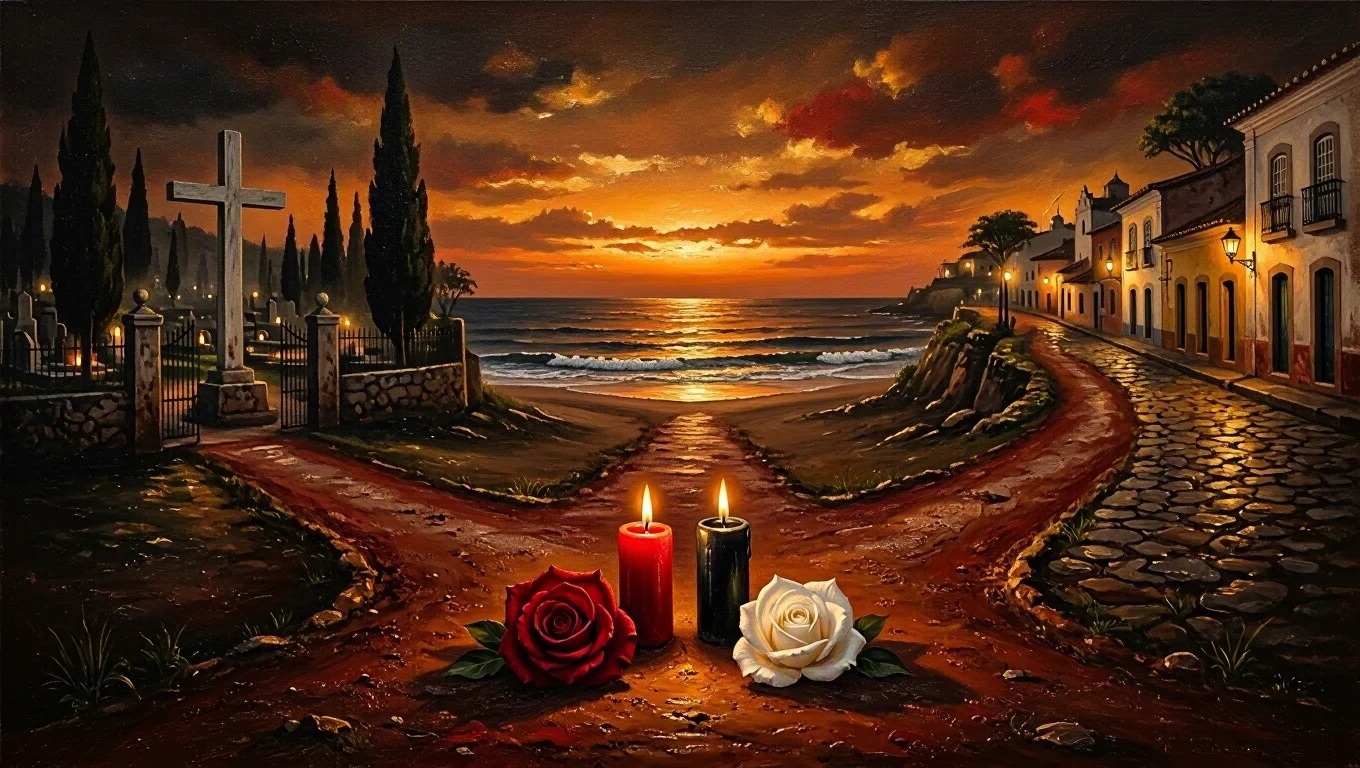
For Prandi and Barros, the T-shaped crossroads is of Pombagira, and the open, cross-shaped one is of Exu. In a house in Pato Branco, the kingdom of the crossroads gathers Sete Ventanias, Sete Saias, Cigana, Maria Padilha, Rosa Vermelha, and Dama da Noite. The formats are in crossroads in Quimbanda.
- Rainha das Sete Encruzilhadas: in a terreiro in Fortaleza, her festival has taken place since 1987, on the second Saturday of November. In Porto Alegre, the law gives the Sete Encruzilhadas June 27.
- Sete Saias: stays on the altar of the tent in Ribeirão Preto, where the cups hold champagne, cinzano, or anis.
- Rosa Vermelha: no entry. She is one of the ten pombagiras of a terreiro in Bocaiuva, and in Curitiba she becomes Rosa Vermelha da Encruzilhada, whose "crown shines in the crossroads". In Porto Alegre, the day is November 11 (Law 13.132/2022).
- Dama da Noite: is on Prandi's list and among the ten of Bocaiuva.
- From the Beach: in a terreiro in Curitiba, she sings that "the beach is my home, together with Iemanjá (Yemoja)".
Romani pombagiras and girl pombagiras
There are many Pombagiras Ciganas. Each medium has their own, with their own dress, hair, footwear, drink, and cigarette. In Porto Velho, Lagos found the Cigana da Praia, the Nina, the one of Love, the Rosalinda, the Esmeralda, the one of the Road, and the one of the Roses. Prandi lists the Cigana dos Sete Cruzeiros. The general profile is that of the Pombagira Cigana, and the Cigana Esmeralda has her own.
The Pombagira Menina and the Menina da Praia are on Prandi's list. The plaster statue of the Menina da Praia brings a shell and a blue and white base, and Tadeu Lopes links her to the sea and Iemanjá.
The names that each city records
Each house has its own cast, and field research finds names outside the famous lists:
- Bocaiuva (MG): Maléva and the Pombagira do Oriente.
- Porto Velho (RO): Maria Padilha do Fogo, Salomé, and Pomba Juçara.
- Curitiba (PR): Maria do Balaio and the one from Maceió, with a sung chant (ponto cantado).
- Pato Branco (PR): Sete Ventanias and Pombagira Gato.
In the gira described by Barros, Sete Alcovas, Rosa de Maio, and Libertina also appear.
Porto Alegre put eleven falanges on the municipal calendar between 2020 and 2022. It is a tribute from the city, proposed by a councilor, and does not date from foundation; the dates are on pombagira day.
Frequently asked questions
What are the most well-known Pombagira names?
In Reginaldo Prandi's list: Pombagira Rainha, Maria Padilha, Sete Saias, Maria Molambo, da Calunga, Cigana, do Cruzeiro, Cigana dos Sete Cruzeiros, das Almas, Maria Quitéria, Dama da Noite, Menina, Mirongueira and Menina da Praia. Each house works with its own.
Is there a pombagira of Obaluaê or of Iemanjá?
The connection with the orixá (orisha) changes from house to house, and no source closes a list. A Rosa Caveira from Porto Velho calls herself "Rainha de Omolu". A sung chant from Curitiba calls Maria Caveira the "messenger of Omolu". The Pombagira da Praia lives "together with Iemanjá".
How to know the name of my Pombagira?
Who tells you is the house where you develop. The Exu and Pombagira test shows affinity with Maria Padilha or with Pombagira in general. It does not give the name of the falange. The spirit test shows if the affinity is with the Pombagira line.
References
- Reginaldo Prandi: Pombagira and the Unconfessed Faces of Brazil, 1996
- Cristiane Amaral de Barros: Iemanjá and Pombagira, UFJF, 2006
- Nilza Lagos: Pombagira in Porto Velho, UMESP, 2007
- Fábio da Silva Gonçalves: terreiros de Bocaiuva, UFMG, 2017
- Brito and Takaki: Pombagiras and the ancestral feminine, UFF, 2025
- Pablo Ojeda: kimbanda in Buenos Aires, UFRGS, 2021
- Jean Favaro: the axé in the southwest of Paraná, UTFPR, 2023
- Alice Macedo: crossroads of interpretation in Umbanda, USP, 2015
- Carlos Maia: Hail, Seu Zé! Hail, Lapa!, UFAL, 2022
- Lages and D’Ávila Neto: Romani life, UFSJ, 2007
- Tadeu Lopes: the Pombagira girl, UERJ, 2010
- Jean Souza dos Anjos: the Queen's gesture, USP, 2021
- Terreiro de Umbanda Pai Maneco: lyrics of the pontos