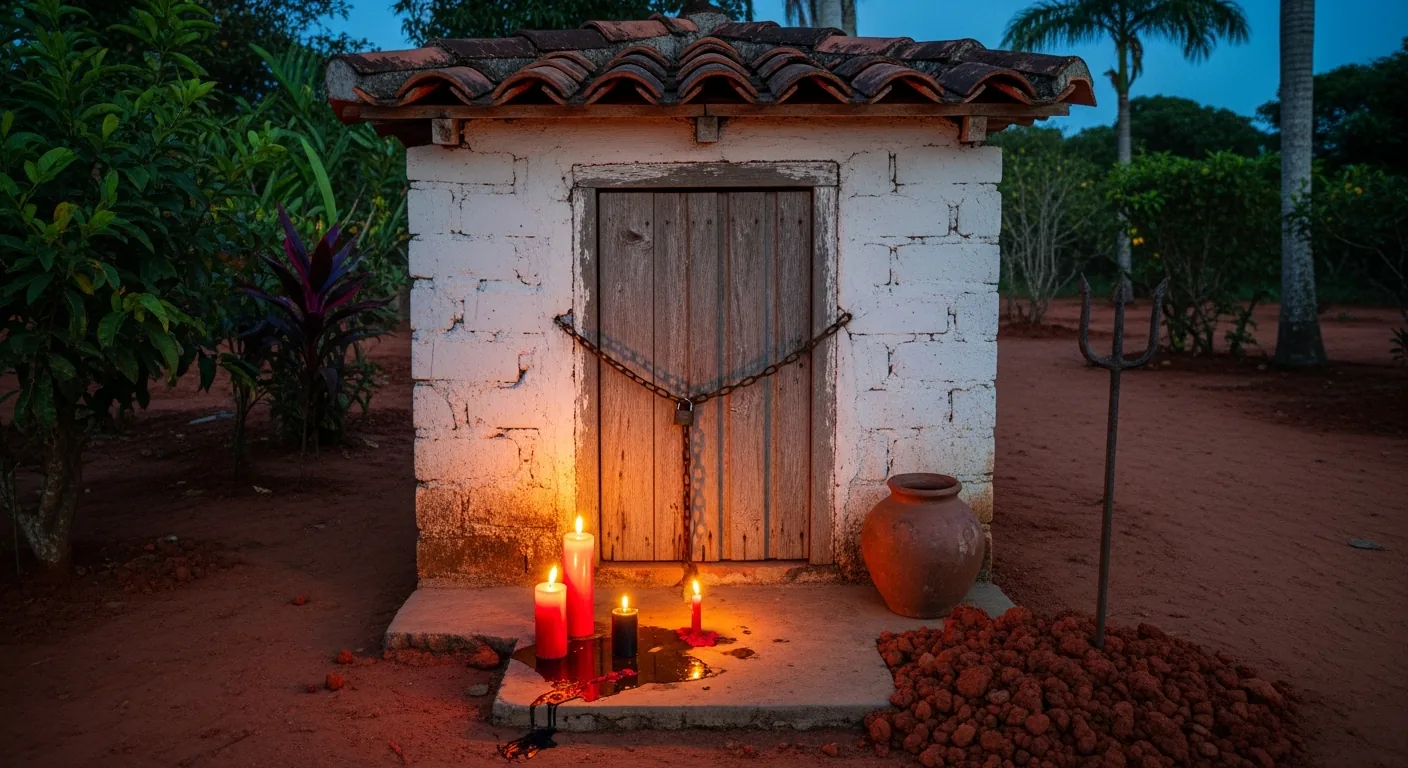
The pombagira assentamento is the ritual object that fixes the spirit's presence in matter and functions as a permanent channel between it and the person. It is not an altar decoration, it is not an amulet, and it is not a piece that is bought ready-made.
Here you see what it is for, what it usually gathers, who can have one, and why this foundation is not assembled at home.
What is the pombagira assentamento for
It serves to give the spirit a fixed point of presence and ritual work, which remains active even when there is no gira or lit candle. The study by Emerson Giumbelli and Leonardo Oliveira de Almeida on Quimbanda in Rio Grande do Sul uses a precise word for this: the assentamentos operate as binders between people and spirits.
In practice, the houses point out five functions that add up:
- To set the presence of the spirit in a point that does not depend on a session or a schedule.
- To give the medium a place of ritual work, where she talks, asks, thanks, and fulfills obrigação.
- To sustain the bond with the Exu (Eshu) de guarda, because in Quimbanda the assentamentos usually come in pairs and not separately, a matter of exu de guarda and exu assentamento.
- To mark a two-way commitment, because whoever performs the assentamento assumes the maintenance from then on.
The word that summarizes everything is relationship. Whoever has an assentamento did not win an item, they entered a routine of worship.
What the assentamento usually gathers
The repertoire below is what ethnography and the terreiros themselves already publish, and it varies by root and by house. Describing what is usually there is one thing, and teaching how to assemble it is another.
- Clay vessel or base, which can be an alguidar, quartinha, or a piece of pottery, depending on the house custom. The use of the pieces is in what the alguidar is for.
- Earth and stone, linking the assentamento to the ground that sustains the foundation.
- Iron items, such as a spear tip, knife, stake, and a worked trident.
- Statue or silhouette of the spirit, when the root works with a figure.
- The elements of her table, that is, cup, perfume, mirror, roses, and drink.
- Red and black candles, colors of the line, theme of what the black candle is for.
Deliberately left out of this list: quantity, order, layer, chant, and consecration. This is house foundation and is not published. In some roots, the obrigação involves animal offering, and that is also a house decision.
Research records that these pieces remain reserved, even when the spirit incorporation is public. Assentamento exposed on the internet is usually that of another person. Reservation is not a secret, it is respect.
What a Pombagira assentamento is not
Much of the confusion about the theme is resolved by saying what it is not.
- It is not a despacho. The despacho is delivered and left in the place the spirit asks. The assentamento stays, lives, and feeds.
- It is not a love binding ritual. To consecrate does not bring anyone back, does not bind a person, and does not solve a concrete cause. It is a religious bond, not a service with a deadline.
- It is not a purchase. A ready-made kit sold is material, and material does not replace foundation.
- It is not an orixá consecrated foundation. The igbá of Candomblé is another pantheon and another structure, a theme of orixá consecrated foundation. The parallel is of vocabulary, never of equivalence, and Pombagira is not an orixá.
It is also worth undoing the underlying misunderstanding. The reading that transforms the spirit into a figure of evil comes from hegemonic Christian morality, and not from Afro-Brazilian tradition. Juliana Carvalho and José Francisco Bairrão show this in a study published in Psicologia USP. Right and left refer to the mode of manifestation, and not to an opposition between good and evil.
Who can have it, and why it is not set up at home
Quimbanda assentamento is for those who have initiation and a house. Both things together, and in that order.
The Nagô Quimbanda temple Cova de Tiriri states without compromise that an assentamento can only be done by a Quimbanda master. The Rama dos 4 Caminhos terreiro, in Rio Grande do Sul, describes the same: the assentamentos are of initiated people, delivered after the ritual specific to the house. Academic research confirms from the other side, by recording that whoever conducts a Quimbanda ritual needs to be initiated and linked to the assentamentos of the spirits with whom they work.
The real path, then, is always this:
- Consultation at the house, with the spirit or with the leader.
- Divination (jogo), which identifies the spirit and says if it is the time.
- Her authorization, which is neither anticipated nor rushed.
- Prepared by the leader or by the master, within the foundation of the root.
Note that the date is not chosen by the person: the game and the house determine it.
And who is at home, without a terreiro, and wants to get closer to the spirit? The honest answer is firmeza, a simple and temporary support point, made by the person themselves with guidance. Firmeza is not a cheap version of an assentamento, it is another instrument, and its step by step is in firmeza na umbanda.
| Firmeza | Assentamento | |
|---|---|---|
| Nature | simple and temporary support | permanent structure |
| While it lasts | vibrates with the lit candle | stays active without a candle |
| Who does it | the person themselves, guided | the leader or master |
| Who can have it | any practitioner | initiated, with a house |
Where it stays and how to care for it
Inside the terreiro, the assentamento lives in a reserved space, which can be the tronqueira, the cafua, or the quarto de esquerda. This geography is in what is tronqueira: that article covers the room, and this one covers what lives inside it.
Maintenance is regular worship, not cleaning. What the houses describe:
- Candle lit on the spirit's days, according to the root's precept.
- Drink and offering renewed, without letting what turned sour accumulate.
- Space cleaning, with defumação and organization of the corner.
- Periodic obrigação, on the calendar the house determines.
The list of what is not done is short. Do not touch another's assentamento, do not move the piece on your own, and do not abandon the worship for an indefinite period. Undoing an assentamento or assuming another person's are cases that are resolved in the jogo, with the leader. We do not find a public record of the procedure, and it is honest to say that instead of inventing.
The most settled Pombagiras and the variation by root
The falanges that appear most in assentamento are the same as the giras: Maria Padilha, Maria Mulambo, Rosa Caveira, Cigana, Sete Saias, and Dama da Noite. Each has its own taste and treatment, and who defines what enters is the house's fundamento.
The variation by lineage is real. In Nagô Quimbanda, the first consecrated foundations delivered form a trinity, with Exu in front, Pombagira in front, and the guard in the back. In left-side Umbanda, many houses work with firmeza and do not deliver a personal consecrated foundation to every medium, and the difference between the traditions lies in what is Quimbanda.
If you still do not know who your guard is, the test of your Exu serves as a curious entry point, and it does not replace a consultation or a reading.
Frequently asked questions
What is the purpose of a Pombagira consecrated foundation?
It serves to set the presence of the spirit in a fixed point and create a permanent channel of relationship with her. Academic research on Gaúcha Quimbanda calls this object a binder. In the practice of the terreiro, that is where the medium speaks, asks, thanks, and fulfills the obrigação agreed upon with the spirit.
What goes inside a Pombagira consecrated foundation?
The most cited repertoire includes a clay vessel, earth, irons such as a spearhead, knife, or trident, a statue or silhouette, seeds and beans, a cup, perfume, a mirror, roses, and red and black candles. The exact composition varies by lineage and by house, and the assembly itself is a foundation that is not published.
Who can have a Pombagira consecrated foundation?
Those who are initiated and have a house. The terreiro sources converge: the consecrated foundation is prepared by a leader or master of Quimbanda, after consultation and reading, and it is not delivered to those who arrive from outside. Those who do not have a house and want to get closer to the spirit work with firmeza.
Can a Pombagira consecrated foundation be made at home?
No. Handouts and videos with step-by-step instructions circulate, and none of them carry what gives life to the consecrated foundation. This comes from the authorization of the spirit and the hand of someone who has foundation. Assembling it alone creates an arrangement of objects, not a bond. The path is to seek a serious house.
Where to buy left line materials
The shop sells current use materials. The fundamento comes from your leader, and no purchased piece replaces the authorization of the spirit. At Joia Mística Laroyê you find what the houses usually request:
- Raw clay alguidar and quartinha: liturgical pottery
- Red and black candles: individual, seven-day, and stick candles
- Statues and figures of the falanges: Padilha, Mulambo, Cigana, Sete Saias
- Cup, mirror, fan, and perfume: the items of her table
- Red and black bead necklaces
- Pemba, defumador, and herbs: for the ponto riscado and for the space
Stop by the shop, at Rua Benedito Zingari, 460, Bela Vista, in Extrema-MG, or message on WhatsApp with delivery to all of Brazil.
A final word. The internet is full of ready-made consecrated foundation kits, and none of them deliver what matters. Our role ends at the counter, and that is how it should be.
References
- Emerson Giumbelli and Leonardo Oliveira de Almeida: the study on Quimbanda in Rio Grande do Sul, which describes the assentamentos as binders between people and spirits, Revista de Antropologia, USP, 2021
- Juliana Carvalho and José Francisco Bairrão: the research that shows the demonization of Quimbanda as an effect of Christian morality, and not of tradition, Psicologia USP, 2019
- Mariana Leal de Barros and José Francisco Bairrão: the study on gender performances and the pombagira as an Afro-Brazilian interpretation of woman, Revista do Instituto de Estudos Brasileiros, USP, 2015
- Wikipedia: the Pombajira entry, with the Kimbundu etymology of pambu ia-njila and the spelling variations