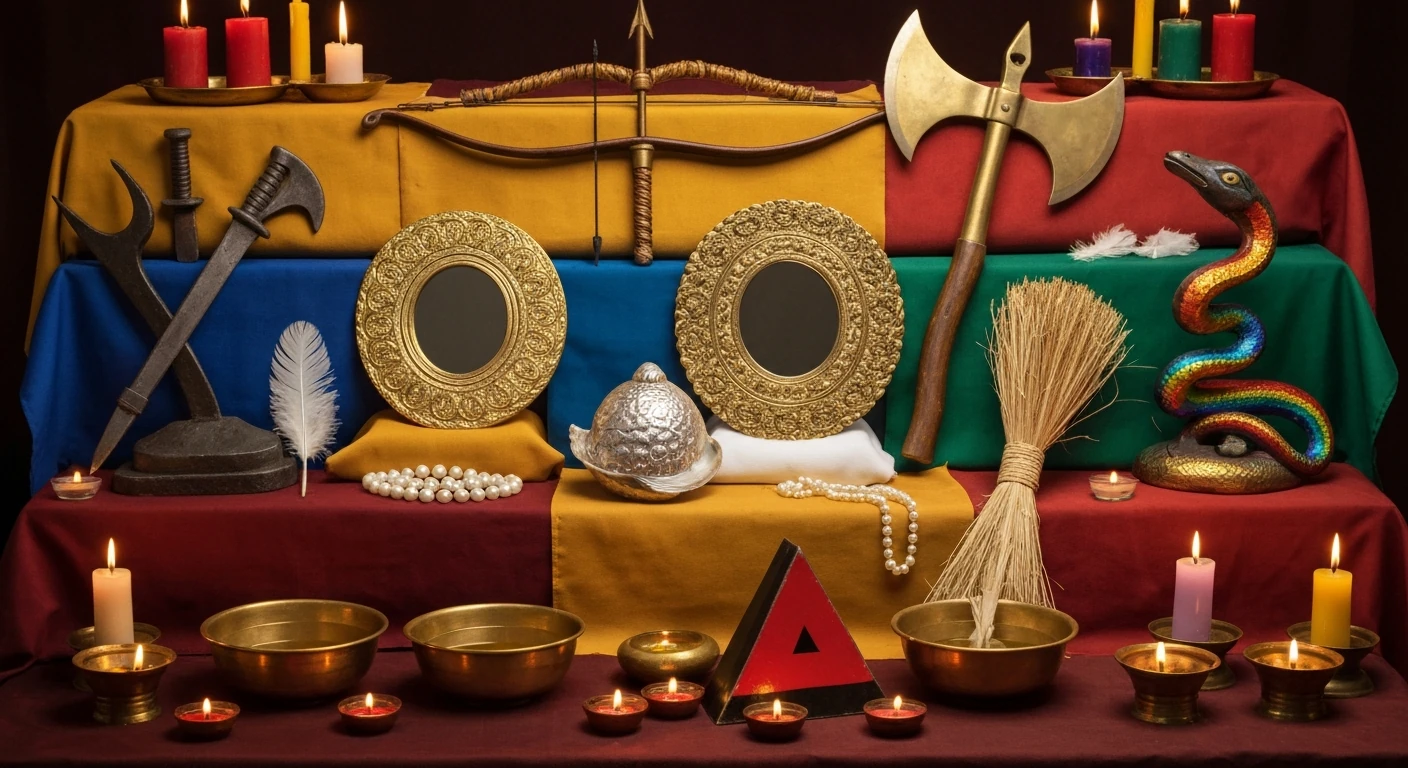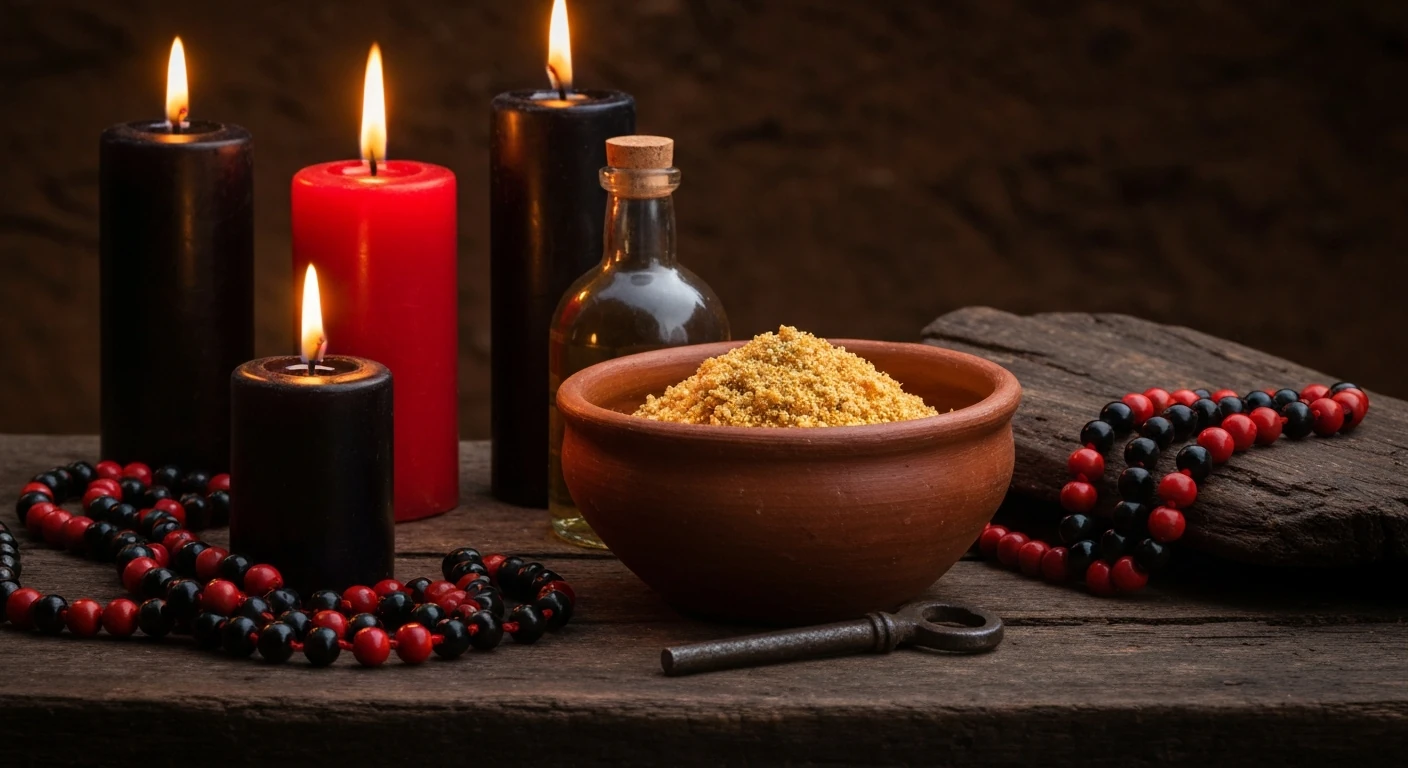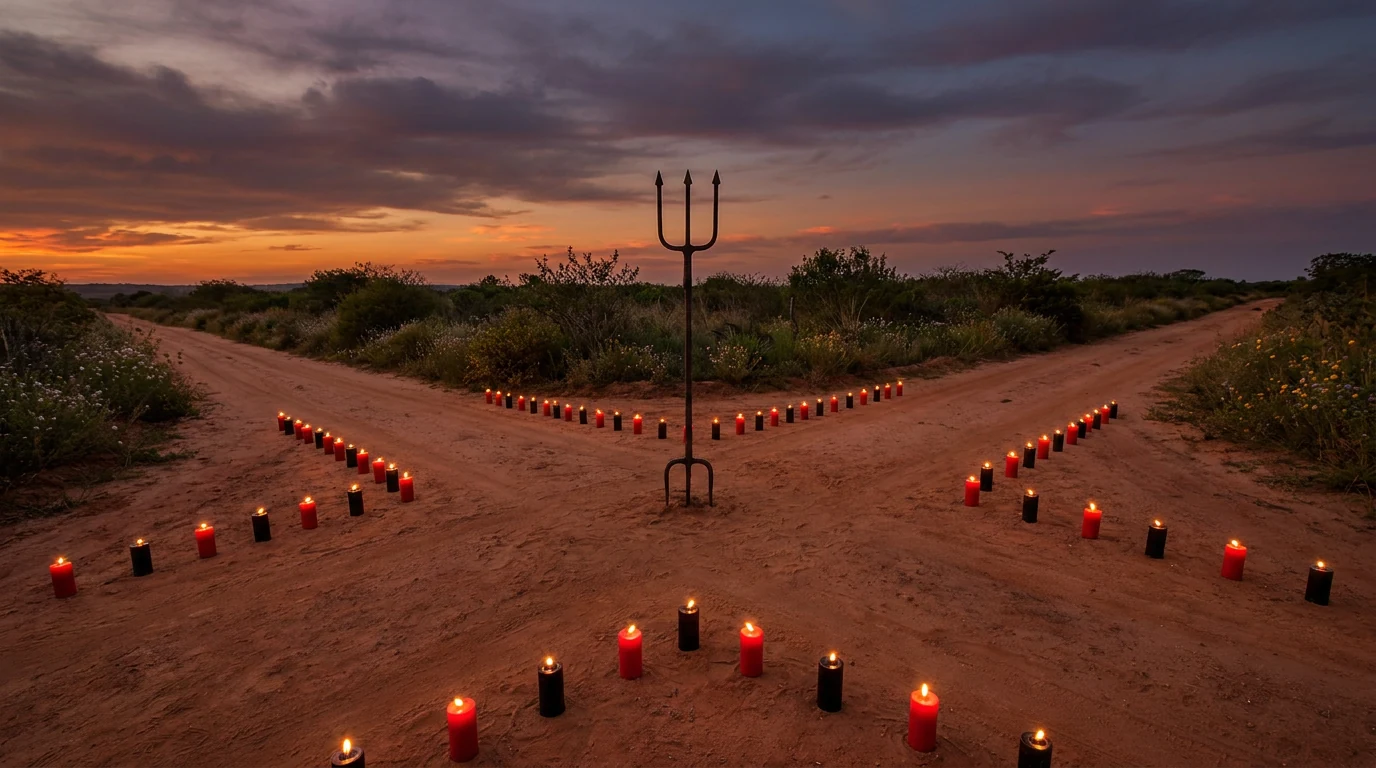
Quimbanda is not black magic. This is the oldest and most unjust confusion that persists about the tradition and perhaps it is what brought you here. Quimbanda is an Afro-Brazilian religion that worships Exu and Pombagira centrally, with its own cosmology, rites, and organization. This guide explains what it truly is: its origin, the doctrine of Exu and Pombagira, and the 7 kingdoms. It also brings the difference from Umbanda and why the label of "evil witchcraft" says more about the country's prejudice than about the religion.
What is Quimbanda
Quimbanda (also written as Kimbanda) is an Afro-Brazilian religion centered on the worship of Exus and Pombagiras. The word comes from Kimbundu, a Bantu language from Angola, in which kimbanda designates the healer, the priest, the specialist in rituals and healing. At its origin, therefore, there is no sense of "evil magic"; on the contrary, the term names whoever masters the knowledge to treat and guide the community.
As a religion of Bantu and Yoruba roots, Quimbanda has a pragmatic logic: it works on concrete issues of life, protection, personal justice, prosperity, love, and sexuality. This differentiates it from the ethics of charity and evolution that organizes Umbanda, but does not make it "negative." They are distinct purposes, not a scale of good and evil.
Laroyê, Exu! traditional greeting directed to Exu, of public domain in terreiros. It means, in general terms, "hail the messenger," the one who opens the paths.
The origin of Quimbanda: from Rio Grande do Sul to Brazil
The deepest root of Quimbanda lies in the African cults of Exu, especially among the Bantu peoples, reinterpreted in Brazil throughout the centuries of the diaspora. But it is as an autonomous religion with its own symbols, initiatory rites, and dogmas that it structured itself in Rio Grande do Sul, in the Porto Alegre region, starting in the mid-1960s.
It was during this period that the cult of Exu and Pombagira began to be celebrated in an independent way, and not just as a "line of work" within another tradition. Academic research records exactly this consolidation of quimbanda as a distinct religious modality in the South of the country. This is what the study O enigma da quimbanda, published in the Revista de Antropologia da USP shows. The systematization of the kingdoms and the phalanges appears in popular works from the 1960s and 1970s, widely circulated literature that helped organize the cosmology. The authorship and exact dates of these founding publications vary depending on the source.
It is worth keeping an important distinction: the Exu of Quimbanda (spirit, entity that works) is not the same as the Exu orixá (orisha) of Candomblé (force of nature, Yoruba divinity linked to crossroads and communication). They are figures from different traditions, with different natures.
Exu and Pombagira: the two poles of Quimbanda
At the heart of Quimbanda are two complementary forces, and it is fundamental to understand them without the lens of prejudice.
- Exu male spirits associated with crossroads, paths, exchanges, and communication between the material and spiritual worlds. They are agents of movement, mediation, and justice. Exu opens and closes doors according to the intention of whoever seeks him.
- Pombagira (or Pomba Gira) are feminine spirits linked to love, sexuality, female autonomy, and emotional justice. They are usually associated with women who challenged moral and patriarchal norms: figures of strength, wisdom, and freedom, never of promiscuity in the moralistic sense.
Exu and Pombagira are poles that complete each other, masculine and feminine of the same spiritual gear. They are not a pair of "good" and "evil". Among the best known spirits are Maria Padilha (the most famous of the Pombagiras), Exu Tranca-Ruas (protection and opening of paths) and Zé Pelintra, the malandro of the terreiros. He is bohemian and playful, but a demanding worker, and his classification varies between houses.
Those who are starting to study these figures may also find it useful to know the bead necklaces of Umbanda and what each one represents, since many spirits move between the two traditions.
The 7 kingdoms of Quimbanda and the 63 peoples of Exu
The most widespread organization of Quimbanda divides the pantheon into 7 kingdoms, each with 9 peoples (also called falanges) totaling 63 peoples of Exu. Each kingdom and each people is headed by an Exu-Rei and a Pombagira-Rainha, in a structure that resembles monarchical and tribal organizations and which absorbed, through syncretism, layers of ancient European demonology.
| Realm | Leadership (Exu-Rei / Pombagira-Rainha) | Dominion |
|---|---|---|
| Encruzilhadas | Exu Rei das Sete Encruzilhadas / Pombagira Rainha das Sete Encruzilhadas | Opening of paths; "entry door" of the ritual works |
| Cruzeiro | Exu Rei dos Sete Cruzeiros / Pombagira Rainha dos Cruzeiros | Cruzeiros and connection with the souls |
| Matas | Exu Rei das Matas / Pombagira Rainha das Matas | Forests and places with trees |
| Calunga (Cemetery) | Exu Rei das Sete Calungas / Pombagira Rainha das Sete Calungas | Cemeteries, deaths and souls |
| Souls | Exu Rei das Almas / Pombagira Rainha das Almas | Souls and high places (lombas) |
| Lira | Exu Rei das Sete Liras / Rainha (syncretic: Maria Padilha) | Urban life, bohemian life, pleasure and love |
| Beach | Exu Rei da Praia / Pombagira Rainha da Praia | Beaches and proximity to waters |
An honest warning: the names and the exact list of kingdoms vary between houses and lineages (traditional Gaúcha quimbanda, Nagô quimbanda, among others). The 7 kingdoms and 63 peoples model is the most widespread, but it should be read as a reference map and not as a single universal dogma.
Quimbanda and umbanda: what is the difference?
Although they walk side by side in many houses, quimbanda and umbanda are distinct things. The difference is not in "good versus evil," but in purpose and structure.
- In umbanda, the Brazilian syncretic religion that brings together popular Catholicism, Spiritism, Candomblé, and indigenous traditions, the axis is charity, spiritual evolution, and healing. Exus and Pombagiras act as spirit guides within a table guided by Caboclos and pretos-velhos. If you want to go deeper into this tradition, see the difference between umbanda and candomblé.
- In quimbanda, Exu and Pombagira are the center of the worship, not supporting actors. It is the "house of Exu" its reign, its direct and pragmatic logic for solving life's demands.
The famous division between "right" (umbanda) and "left" (quimbanda) is, in fact, a historical-moral construction, not a theological truth. The sociologist Renato Ortiz, in the classic A Morte Branca do Feiticeiro Negro, shows how Brazilian society morally hierarchized black religions as it tried to "whiten" them and bring them closer to European Christian values. Right and left, in this reading, complement each other and do not oppose each other like light and shadow.
Is Quimbanda black magic? Removing the stigma
No. Quimbanda is not black magic, satanism, or a "thing of evil". It is a religion, and deserves the same naturalness with which we treat Catholicism or Buddhism.
The most serious mistake is confusing Exu with the Christian devil. When some realms receive names like "Lucifer" or "Maria Padilha do Inferno", these are syncretic labels, heraldry absorbed from European demonology throughout colonization, and not an affirmation that Exu "is the demon". Exu is a messenger, guardian of paths, agent of justice. Nothing in him corresponds to the absolute evil of Christian theology.
The stigma of "black magic" was born from the religious racism that persecuted terreiros for more than a century. Studying Quimbanda with seriousness, its Bantu etymology, its historical origin, its cosmology is also a gesture of reparation and respect. As in any serious religion, there is no infallible formula or promise of guaranteed results here: there is faith, responsibility, and spiritual ritual work.
Frequently asked questions
What is the difference between Umbanda and Quimbanda?
In Umbanda, the axis is charity and spiritual evolution, and Exu acts as a spirit guide within a mesa. In Quimbanda, Exu and Pombagira are the center of worship, with a pragmatic logic aimed at concrete demands. The "right and left" division is historical-moral, not an opposition between good and evil.
How many are the kingdoms of Quimbanda?
There are 7 kingdoms, each with 9 peoples (falanges), totaling 63 peoples of Exu. Each kingdom is headed by an Exu-Rei and a Pombagira-Rainha. The names vary between houses and chains, so this structure should be understood as the most widespread model, not as a single rule.
Is the Exu of Quimbanda the same Exu orixá of Candomblé?
No. The Exu orixá of Candomblé is a Yoruba deity, a force of nature linked to communication and crossroads. The Exu of Quimbanda is an entity, a spirit that works. They share symbolism of paths and messenger, but belong to different traditions and natures.
Is Quimbanda dangerous?
Quimbanda is a religion like any other, it requires respect, seriousness, and guidance. It is not "dangerous" by itself; what requires care is seeking an honest house and a responsible leader, instead of sensationalist promises. Serious ritual work never guarantees instant magical results.
Where to buy items for Quimbanda
At Joia Mística Laroyê, you find everything for the worship of Exu and Pombagira with respect and quality:
- Red and black candles the traditional colors of Exu, in various sizes
- Statues of Exu and Pombagira altar pieces and firmas
- Ritual cigars and cigarettes for offerings and firmezas
- Bead necklaces (guias) and necklaces in the colors of the spirits
- Herbs and incense for baths and spiritual cleansing (descarrego) of the environment
Also check out our page dedicated to Quimbanda and its traditions. Visit the shop in Extrema, Minas Gerais or talk to us via WhatsApp and we ship all over Brazil.
References
- Wikipedia: entry about Quimbanda
- USP Anthropology Journal (Scielo): The enigma of Quimbanda