Religious racism is the discrimination and violence against Afro-Brazilian religions, such as Candomblé and Umbanda. It combines racial prejudice and religious intolerance in the same act. Brazilian law treats discrimination based on religion as a crime, with imprisonment of one to three years and a fine in art. 20 of Law 7.716/1989. In 2024, Disque 100 received 2,472 reports of religious intolerance, 66.8% more than in 2023.
On September 30, 2026, the news of a possible wave of attacks on religious statues and terreiros, in seven states, drew attention to the theme.
What is religious racism and what is the difference from religious intolerance
Religious racism is the prejudice and discrimination that combine racism and religious intolerance, directed mainly at African-rooted religions. Religious intolerance is the attitude of disrespect, discrimination, or violence against individuals or groups because of their religious beliefs, practices, or symbols. The difference lies in who is attacked and why. In religious racism, the religion is rejected because of the Black origin it carries.
Religious intolerance: disrespect, discrimination, or violence against people or groups for their beliefs | Religious racism: racism added to intolerance, directed at Afro-Brazilian religions | In the law: art. 20 of Law 7.716/1989, which speaks of religion
The babalorixá Sidnei Nogueira writes that racism is the nuclear component of violence against traditional terreiro communities. For him:
“Religious racism condemns the origin, the existence, the relationship between a belief and a black origin.”
Sidnei Nogueira, Religious intolerance, 2020
Some prefer the word intolerance and some find it too short. The Afro-theologian Jayro Pereira, cited by Nogueira, says it reduces the dimension of violence against terreiros. Academic research already describes this shift from one expression to the other. A study by the Revista Direito GV analyzed police reports from Minas Gerais, from 2016 to 2018, and found "religious intolerance" in only 14 of 168 records. Those who report usually write discrimination, prejudice, or violence. This text uses religious racism because it is the expression that Law 14.532/2023 brings in the summary.
This racism hits houses and people of Candomblé, in the ketu, jeje, and angola nations, and of Umbanda. The notebook's research also heard terreiros of Quimbanda and of Batuque. They are different religions, as shown in the text about the difference between Umbanda and Candomblé. In the Disque 100 reports, Umbanda and Candomblé appear side by side, with Umbanda in front.
The notebook's glossary includes the demonization of Afro-Brazilian religious expressions among the forms of religious racism. To know Exu and Pombagira as the religion presents them, there is a text about each one.
What the law says about religious racism
The Constitution protects belief and places of worship:
[...] the freedom of conscience and belief is inviolable, the free exercise of religious worship is guaranteed and, in the form of the law, protection to places of worship and their liturgies is guaranteed
Federal Constitution, art. 5, VI
The crime is in Law 7.716/1989. Art. 20 punishes practicing, inducing, or inciting discrimination or prejudice based on religion, with imprisonment of one to three years and a fine. The same penalty applies to those who obstruct, prevent, or use violence against religious practices, without prejudice to the penalty for violence. If the crime is committed through means of communication, social networks, or the internet, the penalty increases to two to five years. Law 14.532/2023 is the one that mentions "religious racism" in the summary.
The Penal Code brings two articles that usually appear in occurrences. Art. 140, §3º, deals with insult with religious elements. The penalty is imprisonment of one to three years and a fine, and the action depends on the victim's representation. Art. 208 deals with outrage to worship. It includes mocking someone for their belief, disturbing a ceremony, and desecrating an object of worship, with detention of one month to one year or a fine.
In the acts of the process, the victim of a crime of racism must be accompanied by a lawyer or a public defender. The law does not say which classification applies in each situation: this depends on a lawyer, a public defender, or the Public Prosecutor's Office. Article by article, with the penalties, the subject is in the text about the law against religious intolerance.
Where to report: Dial 100, police station, and Public Defender's Office
Crime in progress: 190 | Dial 100: call 100, free, 24 hours, can be anonymous | WhatsApp of Dial 100: (61) 99611-0100
When a crime is happening, the path is 190, according to the Agência Gov. Then comes the police report. The Ministry of Human Rights handbook advises seeking a police station specialized in racial crimes and, in its absence, a common police station. In Minas, the Decrin, in Belo Horizonte, is the police station for crimes of racism, xenophobia, LGBTphobia, and related intolerances. The head delegate told BHAZ that the report can be registered at any police station in the state.
Disque 100 accepts anonymous reports, does not require proof, and generates a protocol number. On the internet, the handbook instructs to save the link and capture the screen. Research in Minas reports shows the difficulty of translating this type of occurrence into law. The handbook also indicates the Public Defenders of each state for those who need guidance.
The path is to register and contact the competent body. The complete step by step is in the text about how to report religious intolerance.
The numbers of religious intolerance reports
Disque 100 registers these cases as religious intolerance, of any religion. This is the category of the numbers below.
In 2024, according to Agência Brasil, there were 2,472 reports, a 66.8% increase over the 1,481 from 2023. Between January 2025 and January 2026, there were 2,774, according to a note from the Ministry of Human Rights reproduced by Click Guarulhos. In both periods, Umbanda leads among the reported religions, and Candomblé follows:
| Religion | 2024 | Jan/2025 to Jan/2026 |
|---|---|---|
| Umbanda | 151 | 228 |
| Candomblé | 117 | 161 |
| Evangelical | 88 | 72 |
| Catholic | 53 | 37 |
| Total reports | 2.472 | 2.774 |
The table is a selection: the source provides other categories, such as spiritist and other Afro-Brazilian religions, and therefore the lines do not sum to the total. The periods have 12 and 13 months. In 2024, the majority of reports, 1,842, did not report the religion. In the most recent period, Minas Gerais appears in third among the states, with 323 records, behind São Paulo (667) and Rio de Janeiro (446).
The 2022 Census shows the size of the population involved. According to the preliminary sample results, released by the IBGE, the umbanda and Candomblé group, which includes other Afro-Brazilian religions, went from 0.3% in 2010 to 1.0% in 2022. The ISER assesses that there may be considerable underreporting of followers of these religions, linked to religious racism.
The terreiros also tell their own story. The notebook Respeite o meu terreiro, from November 2025, heard from 511 terreiros. The collection took place from April 30 to August 5, 2024, via an online form. The notebook does not describe a statistical sample, so the percentages apply to the terreiros that responded, not to the entire country. According to the notebook, only 26% of cases of religious racism were recorded in a police report. Only 12% of those who suffered religious racism used Disque 100, and 38% of this group had a negative perception of the service.
The wave of attacks reported on September 30, 2026
On September 30, 2026, ConJur reported that an STF minister notified the Federal Police and the Prosecutor-General of the Republic. The request is to investigate an "apparent wave of attacks" on religious statues. The states mentioned are Bahia, Minas Gerais, Rio Grande do Sul, Mato Grosso, Pará, Alagoas, and Paraná. The minister mentioned outrage to worship, from art. 208 of the Penal Code, and religious discrimination, from art. 20 of Law 7.716/1989.
The targets are Catholic statues and terreiros. In Minas, the report from O Tempo lists the depredation of an Umbanda terreiro in Greater Belo Horizonte. The newspaper also lists possible crimes: outrage to worship, religious prejudice, insult based on religion, threat, theft, damage, arson, and trespassing.
An open investigation does not indicate culprits, and the information here comes from the reports, not from the decision. What the news shows is that the same law protects the statue of a saint and the object of worship of the terreiro. Art. 208 covers any act or object of religious worship. Art. 20 speaks of religion without distinguishing which one.
The terreiro as heritage, knowledge, and organization
Casa Branca do Engenho Velho, in Salvador, was the first terreiro listed as heritage by the federal government, according to Ferreira e Santos. The Anais do Museu Paulista record the two dates. The Advisory Council decided on May 31, 1984, and the inscription in the Tombo Books came in 1986.
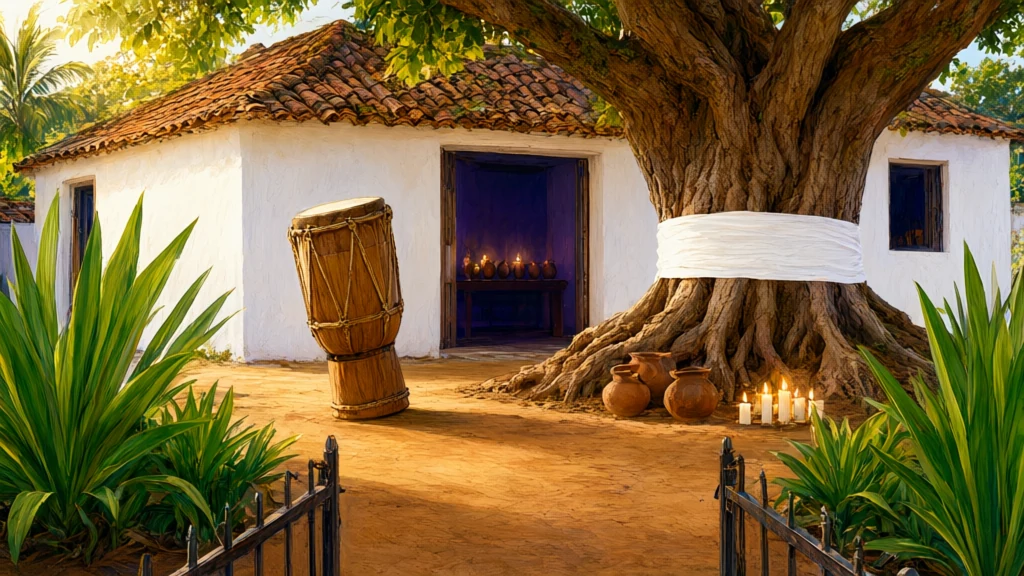
The heritage listing brings rules for the protected asset. Decree-Law 25/1937 prohibits destroying, demolishing, or mutilating the listed asset. It requires prior authorization from the heritage agency, today IPHAN, to repair, paint, or restore it (art. 17). The same authorization applies to building in the vicinity in a way that reduces the visibility of the asset (art. 18).
Until 2018, there were at least eleven terreiros listed by IPHAN, according to Souza, in the annals of COPENE 2018. The list continued to grow. On November 26, 2025, the IPHAN Advisory Council approved the listing of Terreiro Palácio de Ogum (Ogun) e Caboclo Sete-Serra, in Lençóis (BA), according to Bahia Notícias. It is the oldest jarê temple still in operation in the country.
There is also state and municipal protection. In São Paulo, Condephaat listed the Santuário Nacional da Umbanda, in Santo André, in 2019, according to Jornal da USP. In Belo Horizonte, the municipality listed Ilê Wopo Olojukan in 1995. In July 2020, according to O Tempo, the municipal heritage council published protection rules that include planting trees on the property boundaries, the so-called "pano verde," to maintain the privacy of the rituals. The list of listed terreiros and what listing means is in the text about the terreiros listed by IPHAN.
The community produces knowledge about itself. The notebook Respeite o meu terreiro was designed by Renafro and Ilê Omolu (Omulu) Oxum (Oshun), in partnership with the ministry and UNIRIO, with support from DPU. The Military Police of Paraná decided, in a meeting in early June 2026, to revise the service protocols in terreiros of umbanda and Candomblé. The Paranaense Forum of Afro-Brazilian Religions participates in all stages, according to Brasil de Fato from June 23. The measure followed the repercussion of an operation in Curitiba, on May 8. According to religious leaders, the operation reportedly interrupted an umbanda gira of 13 people with 14 vehicles.
What is at stake is a living tradition, with its own nations, the toque of the atabaques, and the care with the leaves and the foundations of each house. For those arriving now, what is Candomblé and what is Umbanda are the starting point.
January 21: the day to combat religious intolerance
Law 11.635, of December 27, 2007, established the National Day to Combat Religious Intolerance on January 21. The date entered the Union's Civic Calendar. It reminds ialorixá Gildásia dos Santos and Santos, the Mãe Gilda of Ogum, of the Ilê Axé Abassá de Ogum, in Salvador. She died on January 21, 2000. The law does not mention her name.
In October 1999, a report exposed the image of Mãe Gilda, with a strip over her eyes, under a title that called practitioners charlatans, according to the house's page. The family took the case to Court. In 2008, the Fourth Chamber of the STJ condemned, for moral damages, the institution responsible for the publication, according to A Tarde. The newspaper records that the sentence was still subject to appeal. Professionals in the legal field, the report says, considered the decision the first from the court regarding intolerance committed by an institution. The text about the national day to combat religious intolerance tells this story in more detail.
Frequently asked questions
Are religious racism and religious intolerance the same thing?
Not exactly. Religious intolerance is the disrespect, discrimination, or violence against people or groups because of their beliefs. Religious racism combines racism and intolerance and is primarily directed at Afro-Brazilian religions, such as Candomblé and Umbanda. Law 7.716/1989 speaks of discrimination by religion, without separating the two terms.
Is religious racism a crime? What is the penalty?
Yes. Art. 20 of Law 7.716/1989 provides for imprisonment of one to three years and a fine for religious discrimination or prejudice. On the internet or social networks, the penalty is two to five years. Insult with religious elements, art. 140, §3 of the Penal Code, carries a penalty of one to three years and a fine.
Where to report religious racism?
In a crime in progress, call 190. Then, file a police report at a police station, preferably one specialized in racial crimes. Disque 100 receives reports 24 hours a day, for free and anonymously, and generates a protocol. The ministry's notebook indicates the Public Defenders' Offices for guidance. Each case depends on a professional.
Which religions appear most in Disque 100 reports?
Between January 2025 and January 2026, Umbanda had 228 reports and Candomblé, 161. Evangelical religions totaled 72 and Catholics, 37. In 2024, the order among those who reported their religion was Umbanda, Candomblé, Evangelical, and Catholic. These are registered reports, not the total number of cases.
References
- Presidência da República: Federal Constitution, art. 5
- Presidência da República: Law 7.716/1989, arts. 20 and following
- Presidência da República: Law 14.532/2023
- Presidência da República: Penal Code, arts. 140 and 208
- Presidência da República: Decree-Law 25/1937, arts. 17 and 18
- Presidência da República: Law 11.635/2007
- IBGE: Religions, preliminary results of the 2022 Census sample
- ISER, 06/06/2025: A more plural Brazil, first look at the religion data from the 2022 Census
- MDHC, Renafro and Ilê Omolu Oxum: booklet Respect my terreiro, 2nd edition, November 2025
- Agência Brasil, 21/01/2025: Disque 100 registers 2.4 thousand cases of religious intolerance in 2024
- Click Guarulhos, 01/21/2026: Disque 100 data on religious intolerance
- Agência Gov, 08/26/2026: Disque 100, the report can be anonymous
- Governo de Minas Gerais: Decrin, Polícia Civil
- BHAZ, 09/15/2026: religious intolerance in Minas and the feeling of impunity
- Camila Silva Nicácio, Revista Direito GV, 2021: religious intolerance in Minas Gerais based on police reports
- Sidnei Nogueira: Religious intolerance, Pólen, 2020
- ConJur, 09/30/2026: investigation of attacks on religious images
- O Tempo, 09/30/2026: investigation in Minas and six other states
- Ferreira and Santos, Revista de Políticas Públicas (UFMA), 2018: protection and preservation of the cultural heritage of Afro-Brazilian religions
- Anais do Museu Paulista, 2022: the heritage listing of Terreiro da Casa Branca
- Luciane Barbosa de Souza, COPENE 2018: African-rooted terreiros in IPHAN processes
- Bahia Notícias, 11/26/2025: Iphan approves heritage listing of Terreiro Palácio de Ogum and Caboclo Sete-Serra
- Brasil de Fato, 06/23/2026: review of Paraná Military Police protocols in terreiros
- Jornal da USP: book about heritage listings of São Paulo terreiros
- O Tempo, 2020: the green cloth of the first heritage-listed terreiro in Belo Horizonte
- Ilê Axé Abassá de Ogum: Mãe Gilda
- A Tarde, 09/19/2008: conviction for religious intolerance