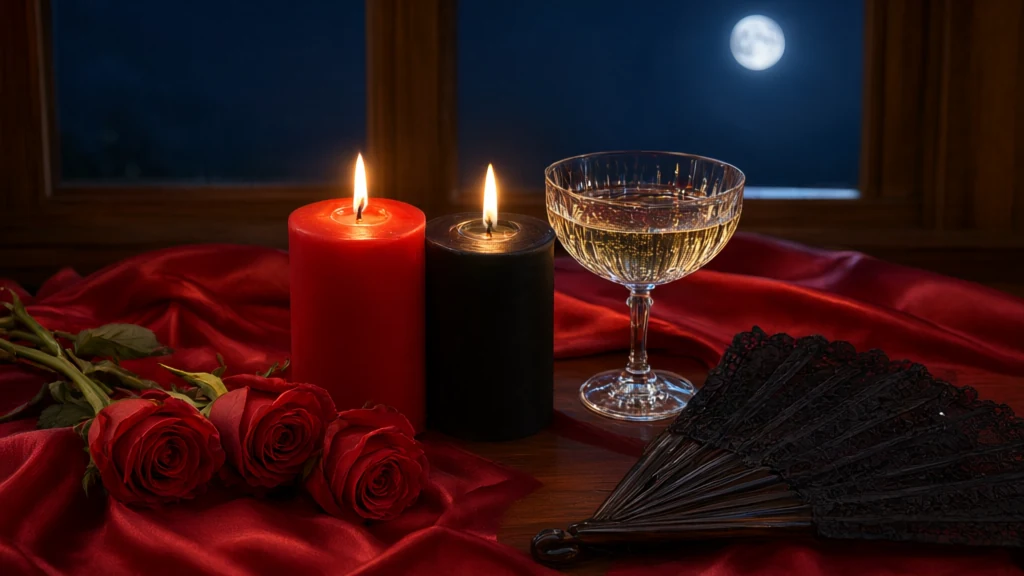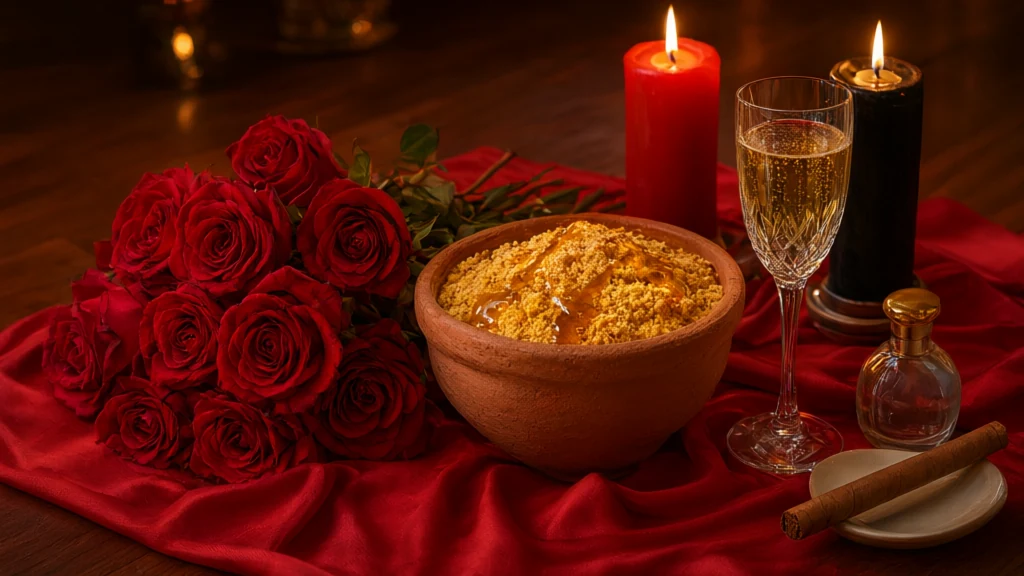
The offering for Pombagira that terreiro research records is made of what she uses in the gira: open red roses, champagne, perfume, a cigarette, and farofa with honey. In umbanda, the food goes outside the terreiro, and in candomblé, it stays at her feet. The rest, including where and when, is confirmed with the pai de santo.
What is offered to Pombagira, according to research
The principle comes from Reginaldo Prandi: Pombagira is gifted with the things she uses in the terreiro when incorporated. These are red and black fabrics, perfumes, jewelry, champagne, a cigarette, and open red roses. The candles are red, black, and sometimes white. She is an Exu (Eshu)-mulher, as she likes to be called, and the portrait is in who is Pombagira.
In umbanda, the diet is short. Prandi records the padê of dendê and pepper, Exu's favorite food, and a dish that is hers: cassava farofa with honey. In Bocaiuva, Minas Gerais, the padê of the pombagiras takes dendê and honey together. The difference between the padê de Exu and her offering is in offering for Exu.
The drink is champagne, cider, white wine, or aguardente, and each Pombagira has her preference. The subject is in Pombagira drink.
Flower: open red rose | Drink: champagne or cider | Food: farofa with honey | Candle: red and black | Place: crossroads in T
The gifts that please the most: flowers, gold, and perfume
In candomblé and umbanda houses in Porto Velho, Nilza Lagos asked 14 people what is the best gift for Pombagira. Six said flowers, and five said gold. Perfume came in third, followed by champagne and cigarettes, fabrics, fans, handkerchiefs, stones, and tamancos.
In the parties she accompanied, champagne or cider and cigarettes cannot be missing. Bringing both is an obrigação of whoever incorporates the Pombagira, and the visitor usually brings them as a contribution. In the Festa da Rainha Pombagira Sete Encruzilhadas, in Fortaleza, she receives flowers, perfumes, and jewelry.
Bocaiuva's ethnography has the longest list. The oferendas of the ten pombagiras of that house are not very different: sparkling wine, red fruits, red roses, condensed milk, clove, cinnamon, rosemary, lavender, ribbons, cigarettes, mirror, comb, makeup, and perfume. A terreiro of umbanda in Campo Largo, in Paraná, puts sweet farofa and red and purple fruits.
The glass is also hers. In a party in Cuiabá, each spirit had its drink and its glass, and some pombagiras drank champagne in a glass while others drank whiskey. Glass, perfume, cigarette, rose, and red and black candle are at Joia Mística, in Extrema.
Where to deliver the Pombagira offering
The place depends on the tradition. In umbanda, the food goes preferably outside the terreiro, at the crossroads or at the beach. In candomblé, it stays "at the foot of the Pombagira," next to her iron representations, kept away from non-initiates. Why this is a house matter is in pombagira assentamento.
The crossroads has a shape. Prandi and Cristiane Barros record that T-shaped crossroads are of Pombagira, and the open ones, in a cross, are of Exu. Swapping one for the other is quizila. The other formats are in crossroads in quimbanda.
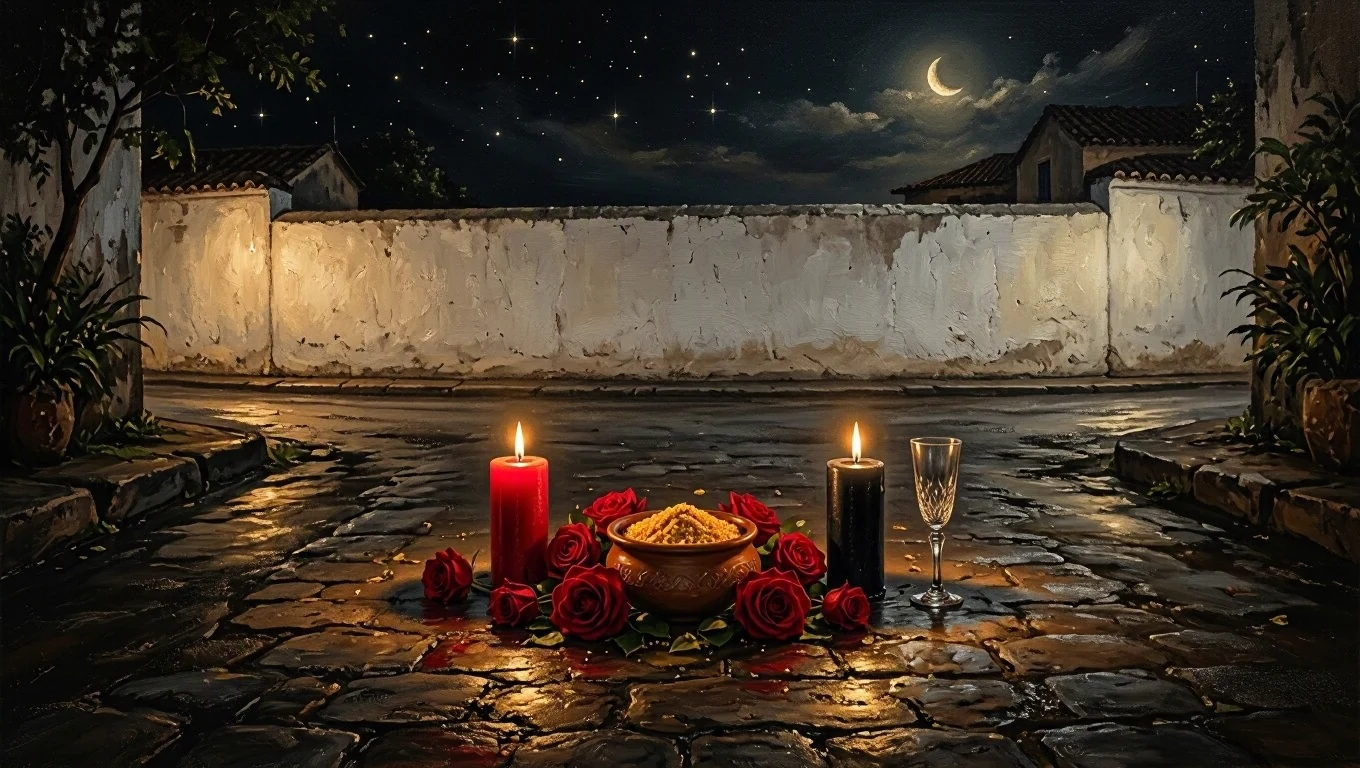
Not every Pombagira receives on the street. The pombagiras crossed with the souls, such as the one of Cruzeiro, the one of Calunga and Rosa Caveira, receive at the cemetery or at the cemetery's cross. Others prefer the beach, the pier or the dense forest. In Corumbá and Ladário, part of the offering stays at the terreiro. The other goes to the street, the cemetery, the dirt road or the train track.
The right spot is learned at the house. In a Gaúcho terreiro, Mãe Ângela summarizes: "you have to know how to set it down." Delivery at the cemetery is the decision of the leader.
What is not given to the Pombagira
Lagos found it impossible to close the list of gifts, so she asked a babalorixá from Porto Velho what is not given to the Pombagira:
one does not give to the Pombagira that which we would not like to receive, that which we do not like
Babalorixá Carlos de Ogum (Ogun), cited by Nilza Lagos (UMESP, 2007)
Three rules have a source with a name:
- Rosebuds do not enter. Cristiane Barros explains: the bud symbolizes purity and virginity. The rose goes almost open and without thorns, red, yellow or white, according to the quality of the Pombagira. More about the flower in the rose in offerings.
- Each crossroads has a mistress. In the Encruza-Maior, where the Queen reigns, the offering of another Pombagira is not deposited.
- Trash is not a gift. A study on offerings in Rio cites the guidance: the orixás (orishas) do not feed on containers, bottles and bowls. Glass bottles and paraffin candles are at the center of the conflict with environmental administration.
Prandi records that each prayer request corresponds to an offering, and that discovering the right one is a challenge for the fathers and mothers of santo. Joia Mística does not teach offerings to bring a person, bind love or guarantee a result.
Who decides: the spirit asks and the house conducts
In the gira, Pombagira herself says what she wants. Depending on the request, she may ask for a bouquet, a bottle of her drink, a piece of clothing, candles, or an ebó. Barros writes that the devotee checks with the pai de santo what to offer, where, how, and when.
The offering is also a thank you. In a house in Buenos Aires, the son's first obrigação is to feed his Exu or his Pombagira, to ask or to thank. In Corumbá and Ladário, the offering is called obrigação and serves to repay the good received. In the Gaúcho terreiro, those on the inside speak of preparations, which change with the objective, the worship, and the spirit.
After the delivery, what does not dissolve returns with whoever took it. The house of Bocaiuva knows it needs to collect the material, even when it cannot. Among nine leaders interviewed, almost all from Rio, seven advised preserving the environment, and the most cited guidance was to collect the material and put it in the trash. If the house requested a list, the shop team checks the material with you via WhatsApp.
Frequently asked questions
Which offering for Pombagira Menina?
It depends on how the house understands Menina. In an Umbanda terreiro in Paraná, where she is from the mirim line, she receives the same farofas of Exu and Pombagira, with cocoa or chocolate and dedo-de-moça pepper. In another house, the answer is from the house itself. The profile is in Pombagira Menina.
When to make an offering for Pombagira?
There are houses that hold a large party once a year for exus and pombagiras, and in it, clients send drinks, food, and accessories. Outside of the party, the offering accompanies the gira and the request of the spirit. The day of the week changes from house to house, and the subject is in Pombagira day.
How to perform the Pombagira offering?
The house performs the despacho in the place the spirit accepts: a T-crossroads, beach, forest, or cemetery, depending on the pombagira. The step by step is the foundation of the terreiro and is not in open text. What applies to everyone is to return and collect the bottle, candle, and dishes.
References
- Reginaldo Prandi: Pombagira and the unconfessed faces of Brazil, Herdeiras do Axé, Hucitec, 1996
- Cristiane Amaral de Barros: Iemanjá and Pomba-gira, images of the feminine in Umbanda, dissertation, UFJF, 2006
- Nilza Menezes Lino Lagos: gender representations in the manifestations of the Pombagira, dissertation, UMESP, 2007
- Fábio da Silva Gonçalves: food in the terreiros of Bocaiuva, dissertation, UFMG and Unimontes, 2017
- Pablo Maximiliano Ojeda: kimbanda in Buenos Aires, Debates do NER, UFRGS, 2021
- Jean Souza dos Anjos: the Festa da Rainha in Fortaleza, GIS, USP, 2021
- Dandara Rodrigues Dorneles and José Carlos Gomes dos Anjos: Offerings? Afro-religious preparations and compositions, Revista Espaço Acadêmico, 2021
- Maria Eduarda Rodrigues da Silva: Correr gira, exus and pombagiras in Corumbá and Ladário, dissertation, UFMS, 2024
- Ramon Sobreira and Carlos Saldanha Machado: Afro-Brazilian practices and the environment in Rio, Revista Visões, 2008
- Heloisa Lima de Carvalho: women and pombagiras in Cuiabá, dissertation, UFMT, 2018
- Casa do Vô Benedito: Exu, Pombagira and Exu Mirim, terreiro de umbanda, Campo Largo (PR)