Whoever types Pombagira Maria Quitéria on Google receives two women in the same list: the spirit that works in the gira and the Bahian heroine of Independence. The two share the name. The Maria Quitéria of quimbanda and Umbanda is a falange of pombagira, and her name appears in the research by Reginaldo Prandi.
This guide shows where she is registered, separates the spirit from the heroine, and says what there is source for regarding colors, offering, and greeting. What changes from house to house appears with this name.
Who is Pombagira Maria Quitéria
Maria Quitéria is a falange: several spirits respond by the same name, without necessarily sharing the same history and life. For Prandi, pombagira "is an Exu, or rather, an Exu-woman, as she herself likes to be called." The general concept is in the guide about who is Pombagira.
“They are many, each with their own name, appearance, preferences, symbols, and particular chants.”
Reginaldo Prandi, Herdeiras do Axé, 1996
She appears by name in three independent records:
- Reginaldo Prandi, from USP, includes her among the most well-known pombagiras in the text Pombagira and the unconfessed faces of Brazil.
- Fábio da Silva Gonçalves, in the UFMG dissertation, found her in first place on the list of ten pombagiras worshipped at the Zambi-Iris terreiro, in Bocaiuva (MG).
- Pablo Ojeda, in the Debates do NER magazine, from UFRGS, registered her among practitioners of quimbanda in Greater Buenos Aires.
She is part of the group of the "Marias" of the pontos cantados (sacred songs), alongside Maria Padilha, Maria Mulambo and Maria Farrapo. The record is by Ana Laura Brito and Nara Takaki, in the Sede de Ler Magazine.
Maria Quitéria and the heroine of Independence
The other Maria Quitéria has a public record. The baiana Maria Quitéria de Jesus lived from 1792 to 1853, fought in the Independence, and is the patron of the Complementary Officer Corps of the Army. Dressed as a soldier, she entered the Batalhão dos Periquitos and stood out in the battles of the Independence of Bahia, which occurred on July 2, 1822. The Law 13.697, of 2018, inscribed her name in the Book of Heroes and Heroines of the Fatherland.
The connection between the two is disputed. Pai Beto de Ogum (Ogun), leader of the Centro Pai João de Angola, in Maringá (PR), writes that the pombagira "has no relation to the heroine." A spirituality website says the name is a reference to the heroine, but that the spirit is distinct. No academic research addresses this link.
The qualities and the stories that do not match
Like other pombagiras, Maria Quitéria receives a name based on the place where she works. The house in Maringá cites Maria Quitéria das Almas, linked to the cemetery, da Encruzilhada and da Estrada. Ojeda recorded the same custom in Buenos Aires, with pombagiras named after the places where they live.
The Zambi-Iris combines with the quality of the Almas. There, Maria Quitéria's food goes to the calunga, the cemetery, along with that of Rosa Caveira and Maria Padilha das Almas.
The life stories attributed to her contradict each other. One site says she was born in Lisbon and inherited the name from her grandmother's devotion to Saint Quitéria. Another fixes the year as 1624. An Argentine blog says she comes from a rural area of Europe. Prandi recalls that many pombagiras are considered spirits of the dead, "some with very popular mythical biographies."
The image also escapes the cliché of the young woman. A ponto cantado (sung sacred song) of Maria Quitéria, analyzed by Brito and Takaki, describes her as "a kind old woman" during the day.
Colors, day and greeting: what converges and what varies
Nature: pombagira spiritual legion (falange) | Colors: red and black | Object: cup | Greeting: Laroyê Maria Quitéria, Maria Quitéria é Mojubá
The colors follow Prandi's general record, which speaks of red and black in the clothes and candles of the pombagira. The Maringá house confirms red and black candles for Maria Quitéria and also accepts purple. The greeting follows the form Gonçalves recorded in the field: Laroyê followed by the name, and the name followed by "é Mojubá".
The rest diverges between sources:
| Item | What circulates |
|---|---|
| Line and kingdom | Line of Almas on one site; radiation of Ogum in the quality of the Road on another; kingdom of the Lyre on an Argentine blog |
| Orixá | "Messenger of Iansã (Oya), Obá (Oba) and Oxum (Oshun)" on one site, without research to support it |
| Day | Monday on one site; Prandi records pombagira giras in general on Fridays, late at night. In Porto Alegre, Law 13.114/2022 marks June 6 as the Day of Pomba Gira Maria Quitéria das Almas, a municipal date (pombagira day) |
| Exu | The search links her to Lodo, Caveira, Tiriri, Veludo and Capa Preta |
If five exus appear as her pair, none is the pair of all houses. The same applies to line and kingdom, which each house organizes by its own foundation. The general structure of the kingdoms is in the guide of the kingdoms of quimbanda.
What the Pombagira Maria Quitéria receives
The same as the other pombagiras of the house. In Zambi-Iris, where she is worshipped, the offerings of the pombagiras "are not very different" and include padê, sparkling wines, red fruits and red roses. Prandi records these gifts for pombagira:
- Open red roses, never buds
- Champagne and other drinks
- Perfumes, jewelry and costume jewelry
- Red and black fabrics
- Red and black candles
The cup has a special place. In Zambi-Iris, the only spirit piece on display in the room was the cup that Maria Quitéria uses in the giras. The pombagira drinks the sparkling wine, pours a little into the cup of the assentamento, and offers a sip to the seeker. The first external offering from that house, on July 19, 2013, was for her.
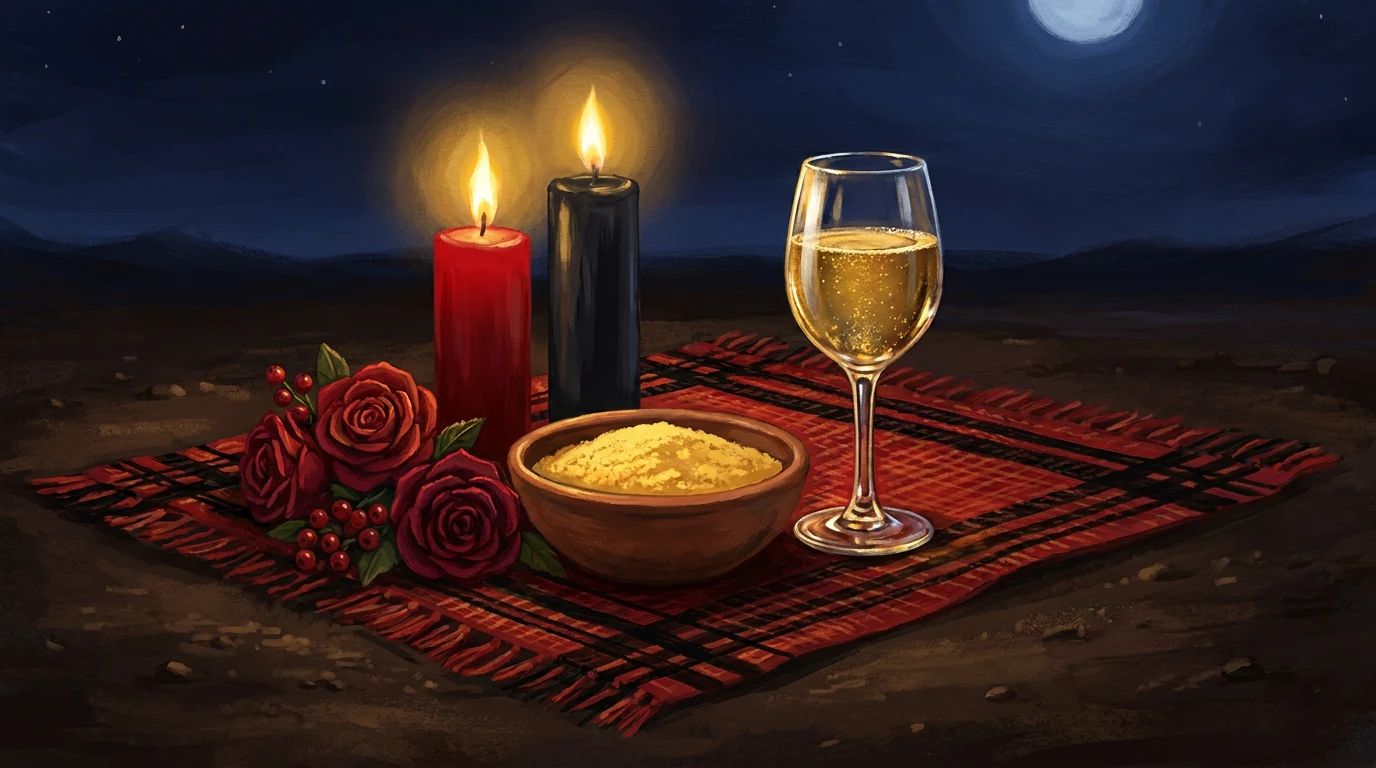
The Maringá house adds black beer and cherry liqueur, her custom. Melina Gomes's ethnography, presented at the Brazilian Anthropology Meeting, links fine drinks, such as champagne and martini, to pombagiras. The detail by spirit is in Pombagira's drink.
Where and when to deliver is the house's decision. The Zambi-Iris rule applies anywhere: collect the offered material whenever possible. This guide does not deal with love binding ritual or ritual work with a promise. The Pombagira's assentamento stays with the house: in Quimbanda, the assentamentos are kept reserved, and whoever conducts the rite needs to be initiated, according to Emerson Giumbelli and Leonardo Almeida in the Revista de Antropologia.
Frequently asked questions
Which orixá is Pombagira Maria Quitéria from?
No research answers. One site calls her a messenger of Iansã, Obá, and Oxum, and another puts her in the radiation of Ogum. These attributions change from house to house. Whoever says how your house understands it is the leader.
How many Pombagiras Maria Quitéria exist?
Many. Maria Quitéria is a falange, and several spirits answer by the same name without sharing the same history. That is why there are qualities such as those of the Almas, of the Encruzilhada, and of the Estrada, each linked to a place of ritual work.
Is there a prayer for Pombagira Maria Quitéria?
There is no single official prayer, as the Maringá house reminds us. The conversation with the spirit happens in the gira, with guidance from the house.
Does the spirit test show Maria Quitéria?
No. The spirit test has a Pombagira result, but it does not point to a falange. The spirit that works with you is known in the gira, with the house leader.
Where to buy items for Pombagira Maria Quitéria
At Joia Mística Laroyê you find what your house uses in the left line:
- Red and black candles, taper and seven-day
- Cups for the Pombagira table
- Pombagira statues in resin, in various models and sizes
- Perfumes and essences for the altar
- Bead necklaces assembled in the colors your house uses
Stop by the shop, at Rua Benedito Zingari, 460, Bela Vista, in Extrema-MG, or message on WhatsApp with delivery to all of Brazil.
References
- Reginaldo Prandi: Pombagira and the Unconfessed Faces of Brazil, 1996
- Fábio da Silva Gonçalves: food in the terreiros of Bocaiuva, UFMG, 2017
- Brito and Takaki: Between words and pontos, Revista Sede de Ler, UFF, 2025
- Pablo Ojeda: kimbanda in Buenos Aires, Debates do NER, UFRGS, 2021
- Giumbelli and Almeida: The enigma of Quimbanda, 2021
- Melina Sousa Gomes: drink in an Umbanda terreiro, ABA, 2016
- Porto Alegre: Law 13.114/2022, Day of Pomba Gira Maria Quitéria das Almas
- Chamber of Deputies: Law 13.697 of 2018
- Chamber Agency: Maria Quitéria in the Book of Heroes of the Homeland, 2009
- Senate Agency: heroes of the Independence of Bahia, 2018
- Pai João de Angola Center: who is Pomba Gira Maria Quitéria, text by Pai Beto de Ogum