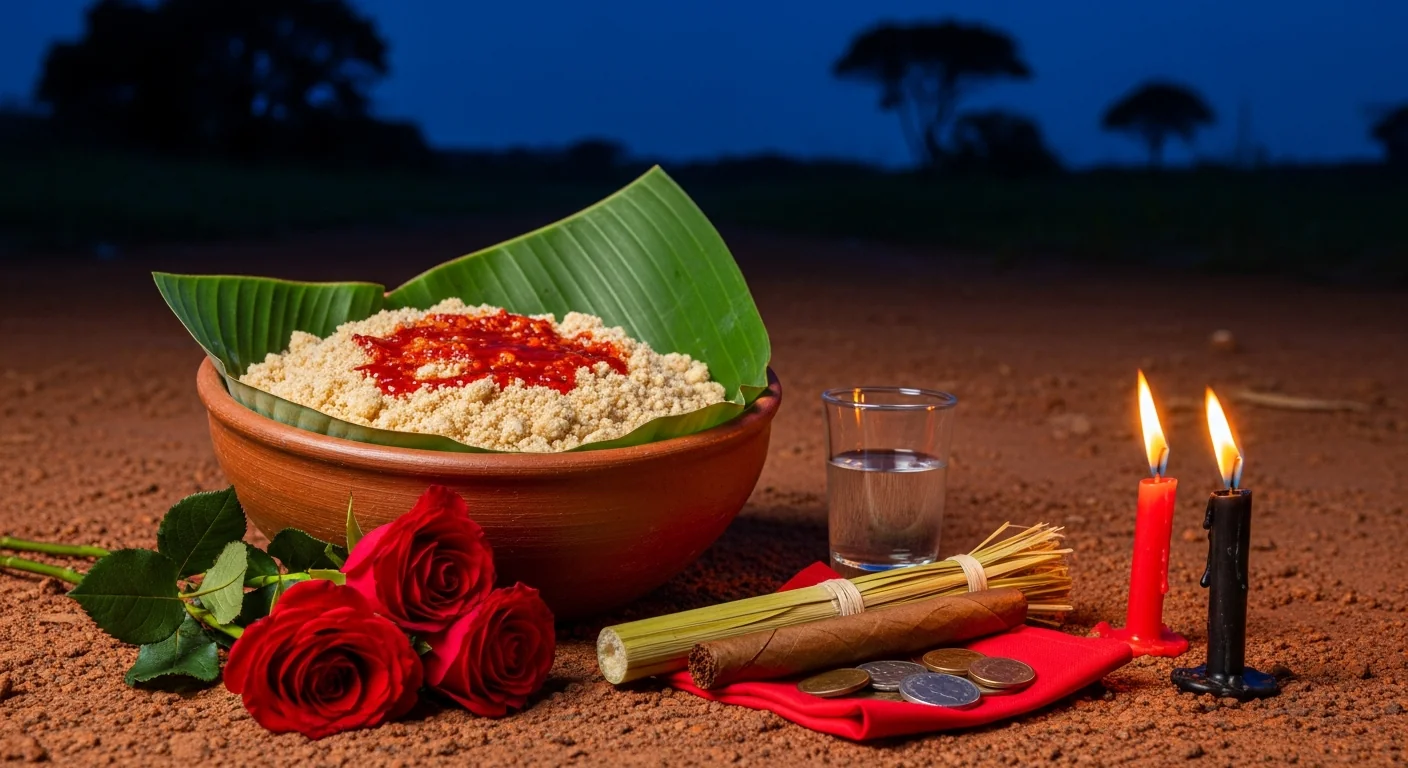
The Pombagira drink recorded in terreiro research is always from the same family: toast drinks, sweet or flavored, served in a glass. Sparkling wine, champagne, white or sweet wine, vermouth, and cider appear in four different field works.
This guide shows what the sources support, why the choice changes from one entity to another, and what is not offered.
What the sources record
Four independent studies arrive at the same type of drink, even if the label changes.
- Reginaldo Prandi, in Pombagira and the unconfessed faces of Brazil, records aguardente, white wine, or champagne, and defines cider as a kind of cheap champagne made from apples.
- Melina Sousa Gomes, in research presented at the Brazilian Meeting of Anthropology, records champagne and martine, the vermouth, as drinks linked to luxury and associated with Pombagiras.
- Fábio da Silva Gonçalves, in the dissertation on food in the terreiros of Bocaiuva, records sparkling wine in the giras and Pomba-Gira parties.
- Geraldo de França Alves Júnior, in ethnography on the ritual use of drink on the coast of Paraíba, records vermouth served in a chalice and the highly esteemed cider.
Cider deserves its own paragraph because it dismantles a complex. It is not an improvised substitute or a makeshift solution for those without money, it is a legitimate and ancient record, with a name and function within the cult. An expensive drink does not please more than a cheap drink.
The portrait rules the glass
The choice is not the taste of the one who brings it nor a whim of the entity. It is her portrait.
Prandi summarizes the logic: one gifts the Pombagira with the things she uses in the terreiro when embodied, that is, silky fabrics in red and black, perfumes, jewelry, champagne, cigarillos, and open red roses. The glass is on the same list as the perfume because both compose the same figure.
Gonçalves formulates this in a more direct way: the food offered is an archetype of the spirit itself. And it shows the rule working in the entire house. Sweets and soda for the erês, popcorn and coffee for the pretos-velhos, sparkling wine and red fruits for the Pombagiras, farofa de dendê for the Exus.
That is why the same force asks for different things in different houses. Prandi describes a spirit of many portraits, who from time to time is the great lady, refined and sophisticated. The lady asks for a glass, the street spirit asks for what the street has, and the cemetery spirit asks for what the calunga accepts. The portraits are in who is Pombagira.
By name: what can and what cannot be stated
Here the internet promises a table that the sources do not support. Gonçalves accompanied ten Pombagiras worshipped in the same terreiro and wrote that their offerings are not very different.
What exists of named record is little, and it is worth saying with the source next to it:
- Maria Padilha receives vermouth in a chalice, passed from hand to hand, in the house that Alves Júnior accompanied. It is one house, it is not a national rule. The profile is in Maria Padilha.
- Sete Saias appears linked to champagne in a popular manual that Prandi reproduces as an illustration. It is the only named record for her, and the weight is low. See Pombagira Sete Saias.
- A Cigana appears with cachaça, wine, or champagne, at the choice, in the same manual. The profile is in Pombagira Cigana.
- Rosa Caveira and Maria Mulambo do not have their own drink in academic sources. The dry red wine and the marafo that circulate are current house records, and that is how they should be treated.
The house defines the drink, and the spirit speaks at the moment. Internet lists replace neither one nor the other.
How it is served, and what is done with the rest
The container separates the spirits even before the drink. Alves Júnior observed the difference on the same night: for the Pombagira, a chalice; for caboclo and master, a rustic clay cup; for preto velho, the typical shot glass.
The rhythm is also specific. He records that they drink slowly, unlike other spirits, who finish the cup in one gulp.
There is also the gesture of sharing, which appears in two different fields with the same form. The spirit drinks, pours a little into the chalice of the assentamento, and offers a sip to whoever came to ask. Part stays with her, part returns to the seeker.
Regarding where it is placed, Prandi notes the difference: in umbanda the offering goes outside the terreiro, at the crossroads or on the beach, and in candomblé it stays at the foot of the Pombagira. Her territory is in the crossroads in quimbanda.
The disposal is the point that no competitor covers. Gonçalves records as a house norm that he studied the collection of the material a few hours later. He discusses the environmental cost of candles, plastic, and bottles left in nature. Glass in the forest is not an offering, it is trash.
What is not offered
This is the part that avoids error, and each item has a source.
- Beer is not her portrait. Gomes places beer in the field of the caboclo, and none of the four sources record it as a drink of Pombagira. It is not an absolute veto, because the house is in command, but it is not the standard.
- Strong distillate outside the profile. The same researcher writes that cachaça and whiskey are more linked to Exus. Their guide is offering for Exu.
- Rosebud. Prandi is specific: open red roses, never buds. Barros explains why: the bud symbolizes purity and virginity. The flower has its own text in the rose in offerings.
- Drink that the spirit did not ask for. Alves Júnior records that the spirit defines the type and quantity it accepts. Bringing on your own what it did not ask for is not a favor.
- Alcoholic drink where the house does not work with alcohol. This changes everything, and there is a specific section below.
A vocabulary confusion crosses the subject and is worth undoing. The anise in Bocaiuva's offering list is star anise, the spice. But anise as a drink also has a record: Cristiane Amaral de Barros, at UFJF, notes "aniz" among the drinks of the pombagira, as "preferred drink of Maria Padilha". What else is taken along with the drink is in offering for pombagira.
Houses that do not work with alcohol
This is not a rare exception, it is a real divergence, and the same research documents both sides in the same city. In one of the terreiros that Gonçalves studied, drink and cigarettes are constants in the rite and daily life. In the other, smoking during the gira is treated as disrespect, and the house works with coffee, saffron, and coconut oil.
Gomes gives the general rule: each center has its own way of operating, and the heterogeneity between terreiros is great. There is no national norm on this.
It is worth noting how the houses themselves explain the use. A mãe de santo interviewed by Alves Júnior says that she does not drink and does not smoke, and that it is the entidade who consumes. Gonçalves records the same belief: the elements are instruments of energetic ritual work, not for drinking.
The practical conclusion fits into one sentence. If you have a house, ask the leader before bringing a drink, and if you do not have a house, bring the simplest and do not invent. Those who want to go deeper find the path in assentamento de Pombagira, which is a matter of the house and not of text.
Frequently asked questions
Which Pombagira likes beer?
None of the four field studies consulted record beer as a drink of Pombagira. Melina Sousa Gomes places beer in the field of the caboclo. Where beer appears in the terreiro, it is as a drink for social gathering of the house, not as an offering for the entidade. The recorded pattern is a toast drink in a glass.
Which Pombagira likes wine?
White wine appears in Prandi as a drink of Pombagira in general, and sweet wine circulates in house records for the Cigana. There is no reliable list that separates the Pombagiras by label. The most detailed ethnography on the theme records that their offerings vary little among themselves.
What does the Pombagira Sete Saias like to drink?
The only named record is champagne, and it comes from a popular manual that Prandi reproduces only as an ethnographic illustration. It is too little to become a rule. The honest path is to ask at the house that cares for you, because the entidade indicates in the gira what it accepts.
Can you offer non-alcoholic drinks to Pombagira?
You can, and there are houses that work exactly like that. Fábio Gonçalves' research documents terreiros that do not use alcohol or tobacco and substitute them with coffee and other elements. Non-alcoholic sparkling wine circulates as a house practice for entities with a young appearance. Confirm with your leader.
Where to find the offering material
At Joia Mística Laroyê you can find the items that appear in these sources:
- Cup and chalice for the agrado and for the assentamento
- Red and black candles, stick candles and seven-day candles
- Clay alguidar in various sizes
- Cigar and cigarillo
- Perfume, red rose and ribbon in her colors
Stop by the shop, at Rua Benedito Zingari, 460, Bela Vista, in Extrema-MG, or message on WhatsApp with delivery to all of Brazil.
If you still do not know which spirit walks with you, the Exu test is the gateway. The contrast is in what preto velho likes to receive, where the consensus is coffee.
References
- Reginaldo Prandi: the chapter describing the Pombagira agrado, the champagne and the cider, Herdeiras do Axé, Hucitec, 1996
- Melina Sousa Gomes: the research on beverage consumption in umbanda terreiro, Reunião Brasileira de Antropologia, 2016
- Fábio da Silva Gonçalves: the dissertation about food in the Bocaiuva terreiros, UFMG and Unimontes, 2017
- Geraldo de França Alves Júnior: the ethnography on the ritual use of beverages in umbanda centers, Reunião Brasileira de Antropologia, 2018
- Cristiane Amaral de Barros, UFJF: Iemanjá and Pomba-gira, dissertation, 2006