Look for the meaning of the seven skirts of Pombagira Sete Saias and you will find five different answers, each written with the same confidence. One says they are seven mysteries. Another, seven layers of protection. Another still, seven loves from a legend.
None is lying, and none is the answer. Brazilian oral tradition does not work by canon, and Sete Saias is one of the cases where variation is greater than consensus.
This guide organizes the readings side by side, separates legend from foundation, and shows the little that holds up in more than one source. It is study material, not a ritual work recipe.
Who is Pombagira Sete Saias
Sete Saias is a falange, a line within the feminine of Exu, and not a person with a biography. This applies to every pombagira, as the guide about who is Pombagira explains, and it is the first thing that undoes misunderstandings.
Falange means that many spirits work under the same name and the same vibration. Two houses may receive Sete Saias and each one know a Sete Saias with its own way. Both are correct.
The name is not a recent invention of the Brazilian internet. It appears nominally in the lists of recognized pombagiras in English academic bibliography, alongside Maria Padilha and Maria Mulambo.
She is a ritual work spirit of quimbanda, also present in Umbanda, in the left line. She is not an entity of evil, she does not come from the Christian imaginary of hell, and the association with evil is a result of the religious racism that researchers like Reginaldo Prandi have documented for decades.
A serious pombagira does not take away anyone's freedom. A spirit that is a symbol of feminine autonomy does not work to imprison anyone.
What the seven skirts mean: the readings that circulate
Here is the heart of the doubt, and the honest answer is that there are several readings in circulation. These are the five that repeat most often:
- Seven fronts of ritual work: each skirt is a mystery or a line in which she transits.
- The numerology of seven: seven days, seven colors, seven virtues, the generic septenary.
- Seven layers of protection: a feminine force per skirt, from love to transformation.
- Transit between situations: the skirts as the capacity to circulate between planes and environments.
- Narrative reading: each skirt linked to an episode or a love from the legends told about her.
There are houses that teach one of them as the correct one. Others combine two. None has authority over the others, because there is no central authority in Quimbanda that fixes doctrine.
What gives weight to all of them is the number itself. The seven structures the entire Quimbanda, with seven kingdoms and seven peoples, as shown in the article about the kingdoms of Quimbanda. Sete Saias participates in this grammar, and it is not an isolated case.
The stories told about her
Two main legends circulate, and they contradict each other. This is not a flaw, it is how oral tradition works.
In the Romani version, a young woman is forbidden from loving someone outside her people and withers away. Her mother places her seven favorite skirts in the coffin, and on the spiritual plane, she receives the mission to support those who suffer from impossible love. This version speaks directly to the line of the pombagira cigana.
In the seven loves version, she is rejected by her father, becomes the lover of seven men, and uses a skirt of a different color for each encounter. Later, she turns against those who persecuted her.
There is also a third reading, more generic, which speaks of a woman who suffered injustice and returned as a spirit to give courage to those who need to break with an oppressive pattern.
None of these stories are historical facts, and none should be taken as her biography. They are narratives that devotion built to give a face to a vibration.
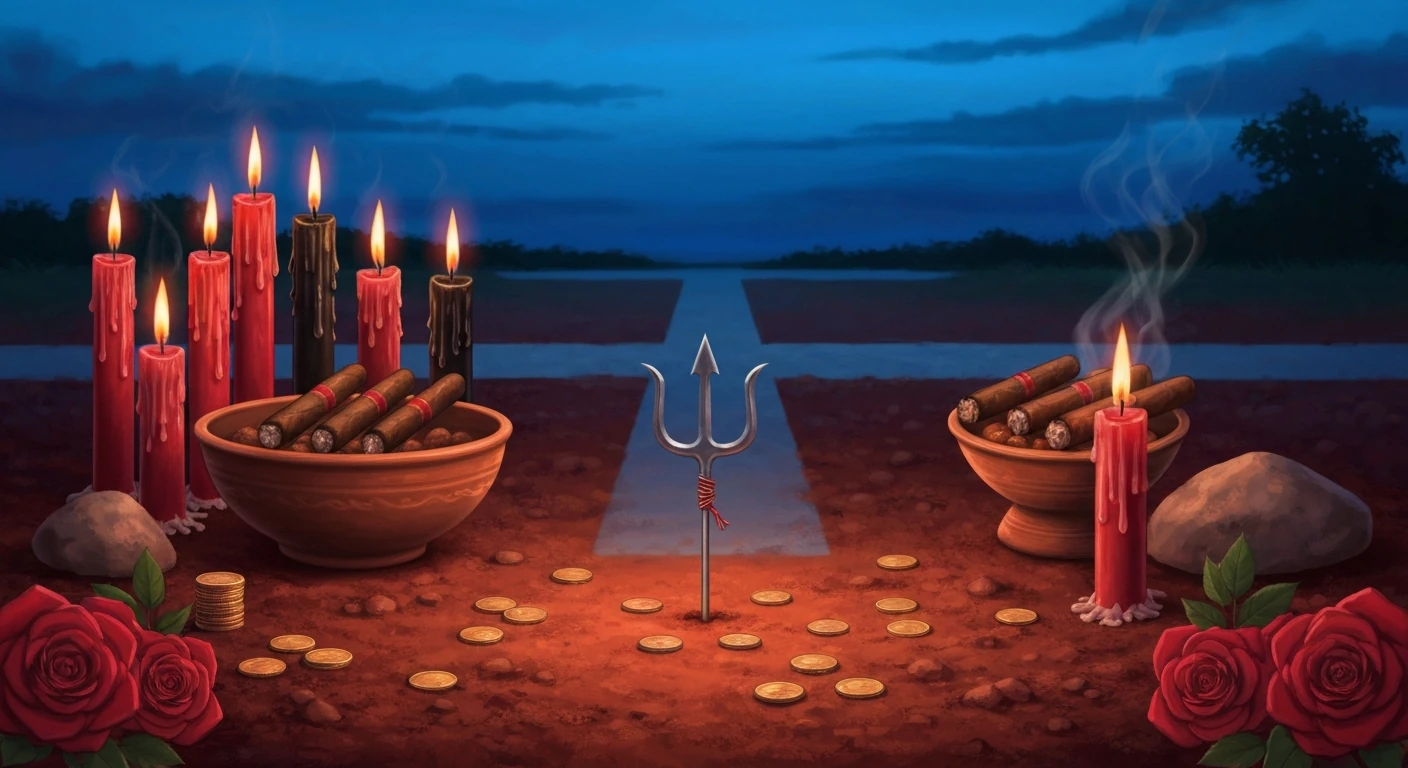
Where she works: the crossroads
The territory of work is the crossroads, a point of passage and of choice. The article about the crossroads in Quimbanda brings the distinction that the houses use: the T-crossroads is dealt with as a feminine pole, the cross-shaped one is linked to the masculine Exu.
Regarding offerings, what appears most frequently in independent sources is a small set. Red roses, candles in base colors, floral perfume, a cup of sweet drink, a mirror, a fan, and jewelry.
These items are here as cultural and symbolic elements, not as a ritual recipe. Delivering an offering has etiquette, location, and timing defined by the house, and the guide on offering for Exu explains the precautions, including collecting what is not biodegradable.
There are sung pontos (sacred songs) for Sete Saias in circulation, with recurring images such as the woman of seven husbands and the spinning of the skirts upon arriving at the terreiro. The versions vary greatly from house to house, and much of what is indexed on the internet is commercial recordings with authorship. Therefore the ponto is described, not transcribed. The liturgical function of the song is in the article about sung pontos.
Colors, day, symbols and greeting: the profile and what varies
Nature: Pombagira spiritual legion (falange), the feminine of Exu | Base colors: red and black | Most cited day: Friday | Territory: crossroads | Recurring symbols: the spinning skirts, the fan, the mirror, the red rose, the goblet | Greeting: Laroyê, Dona Sete Saias
Now for the part that almost no site admits. The table below shows where the sources truly diverge:
| Item | What varies |
|---|---|
| Colors | Red and black are supported by more than one source. Gold, purple, pink, blue and green appear in isolated houses, or as a color per skirt |
| Day | Friday is the most cited. Monday appears in houses that work the line together with the souls, and there is a record of Wednesday |
| Realm | No consensus. Crossroads, Lira and Cabaré appear, depending on the sub-spiritual legion (subfalange) |
| Exu who accompanies | Changes with the line, and is a house foundation, not a categorical affirmation |
The existence of sub-spiritual legions (subfalanges), such as Sete Saias do Cabaré and Sete Saias do Cemitério, already explains much of the divergence. The realm changes with the line, not with the spirit.
When someone presents one of these variations as a universal rule, they are speaking of their house's foundation. What is legitimate, as long as it is said with that name.
Sete Saias, Sete Facadas, Sete Véus: who is who
The number seven appears in the name of several spirits, and the public mixes everything up. They are different falanges, with their own work and vibration.
- Sete Saias: the skirts, the turn, the transition between situations.
- Sete Facadas and Sete Punhais: names linked to cutting and breaking, another line.
- Sete Véus: the veil, what is covered and what is revealed.
- Sete Catacumbas: line linked to the cemetery.
- Rainha das Sete Encruzilhadas: a distinct spirit, associated with dominion over the crossroads.
Sharing a number does not make two entities the same, just as Maria Padilha and Maria Mulambo are not confused by sharing the first name. The profile of Maria Padilha clearly shows how each falange has a distinct function.
Frequently asked questions
What is the true name of the Pombagira Sete Saias?
Sete Saias is a falange name, not a civil registration. The question stems from the idea that there is a person behind it with a documented identity, and that is not how the line works. No house has a secret name to give away, and be wary of anyone who offers one.
What does the Pombagira Sete Saias like to receive?
The most cited items are red roses, candles in base colors, floral perfume, a sweet drink cup, a mirror, and a fan. This is cultural information, not a recipe. What goes in, where it is delivered, and at what moment is defined by the house and by those who hold the proper foundation.
What is the day of Pombagira Sete Saias?
Friday is the most cited day in the houses. There are terreiros that work the line on Monday, along with the souls, and isolated records of Wednesday. There is no single rule, and the day follows the foundation of the house where the gira takes place.
Which Exu accompanies Pombagira Sete Saias?
It depends on the subfalange. Houses that work Sete Saias of the Cemetery point to an exu linked to that line, and houses that work the one of the Encruzilhadas point to another. It is a terreiro foundation, and any answer presented as definitive is generalizing the custom of only one house.
Are Sete Saias and Sete Facadas the same entity?
No. They are different falanges, with their own work and vibration, which only share the number seven in the name. Seven is a structuring element of Quimbanda and appears in various lines. Confusing the two is like confusing two orixás (orishas) for having the same day of the week.
Where to buy items for the left line
At Joia Mística Laroyê, you find items for your devotion and for your house:
- Pombagira statues in resin: various models and sizes
- Red and black candles: seven day, stick, and shaped formats
- Perfumes, essences, and lavender (alfazema): for firmezas (spiritual anchoring work) and for the altar
- Cups, fans, and mirrors: pieces for consecrated foundation (assentamento) and for the altar
- Bead necklaces and threads: assembled in the colors of the line
Visit our shop in Extrema, Minas Gerais or talk to us via WhatsApp with delivery to all of Brazil.
Ritual work of foundation is conducted in terreiro, with a leader and with responsibility. The shop provides materials, and the guidance comes from your house.
References
- Reginaldo Prandi, USP: Pombagira and the unconfessed faces of Brazil, on the archetype of the free feminine
- Anthropology Journal, USP: Giumbelli and Almeida on Quimbanda as a proper religious modality
- World Religions and Spirituality Project: Pombagira entry, which cites Sete Saias among the recognized falanges
- Sacrilegens Journal, UFJF: Letícia Reis on transgression and feminine empowerment in the figure of Pombagira
- UFAL Repository: research by Maciel Ferreira de Lima on the narratives from outside and inside the terreiro