



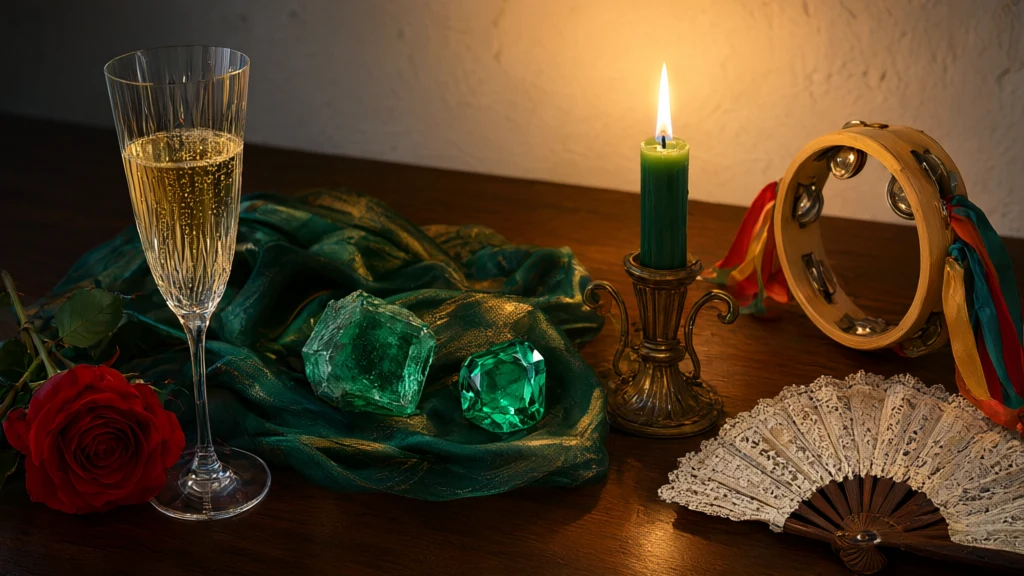
Cigana Esmeralda is one of the most called Romani spirits in terreiros, and in research she appears as Pombagira: the Pombagira Cigana Esmeralda. Almost everything circulating about her on the internet is a list without sources: color, day, drink, the story of her death. The sources say something simpler. Each medium has their own Romani spirit, with their own tastes. The house teaches what she receives.
Who is Cigana Esmeralda
She is a feminine spirit of the left that presents herself as a Romani woman. Four studies, in four places in Brazil, record the name:
- In a terreiro de umbanda studied by psychologists Sônia Lages and Maria Inácia D’Ávila, as "Pomba-gira Cigana Esmeralda", a spirit of "Umbanda/Quimbanda".
- In Porto Velho (RO), in the list of Pombagiras that researcher Nilza Lagos found in terreiros de candomblé and umbanda.
- In Ceará, among the "feminine Exus" seen in giras or mentioned by pais de santo.
- In Manaus, among the most well-known Romani spirits in the city.
In one of the cases, Esmeralda speaks of a life of road and freedom, in a country "with a lot of castanhola, a lot of joy, a lot of dancing." The medium who receives her, the researchers say, "knows nothing about the Romani people." For the Romani line as a whole, see the article about Romani spirits in umbanda.
Pombagira or Romani spirit of the Orient?
It depends on the house, and the houses themselves mix them. "Differentiating ciganas from Pombagiras is not an easy task," writes Lagos: the interviewees "referred to the Pombagiras as ciganas and to the ciganas as Pombagiras." Her conclusion serves for Esmeralda: "she is Pombagira and she is cigana".
In other houses, the Romani spirit line stays between the right and the left. A leader heard by USP says that the Romani spirits "do not like the left nor do they fit with the right". Therefore, the same Esmeralda can be Pombagira Cigana in one house. In another, she is a Romani spirit of the Orient. In your house, ask which of the two she is. Regarding the feminine left in general, see who is Pombagira.
Where does the name Esmeralda come from
No source says where the spirit took the name. What is known is that, in Brazil, it was already famous for two paths.
Victor Hugo's Esmeralda
She is the Romani woman of the novel Notre-Dame de Paris, from 1831, one of the most famous Romani characters in literature. In the book, the name comes from an amulet. It is a small green silk bag with a glass "imitant l’émeraude", which imitates an emerald. Asked why they call her that, she responds: "Je n’en sais rien" ("I do not know").
The novel also hides a secret: Esmeralda was born Agnès, daughter of a French woman from Reims, and was taken as a baby by Romani women. The plot repeats the European rumor of the Romani who steals children, the same stereotype that critical research examines. In the plot, the most famous Romani woman in literature was not even Romani by birth.
The testament of the cigana Esmeralda, from the cordel
In Brazil, O Testamento da cigana Esmeralda is a cordel leaflet by Leandro Gomes de Barros, "considered the Father of Brazilian Cordel". It is a book of dreams, palm lines, and stars. It was among the first leaflets printed in his typography at the beginning of the 20th century. In the 1950s, it was still sold as "the true book that gives the meaning of any dream". In 2024, it became the plot of the Imperatriz Leopoldinense.
How the Cigana Esmeralda died
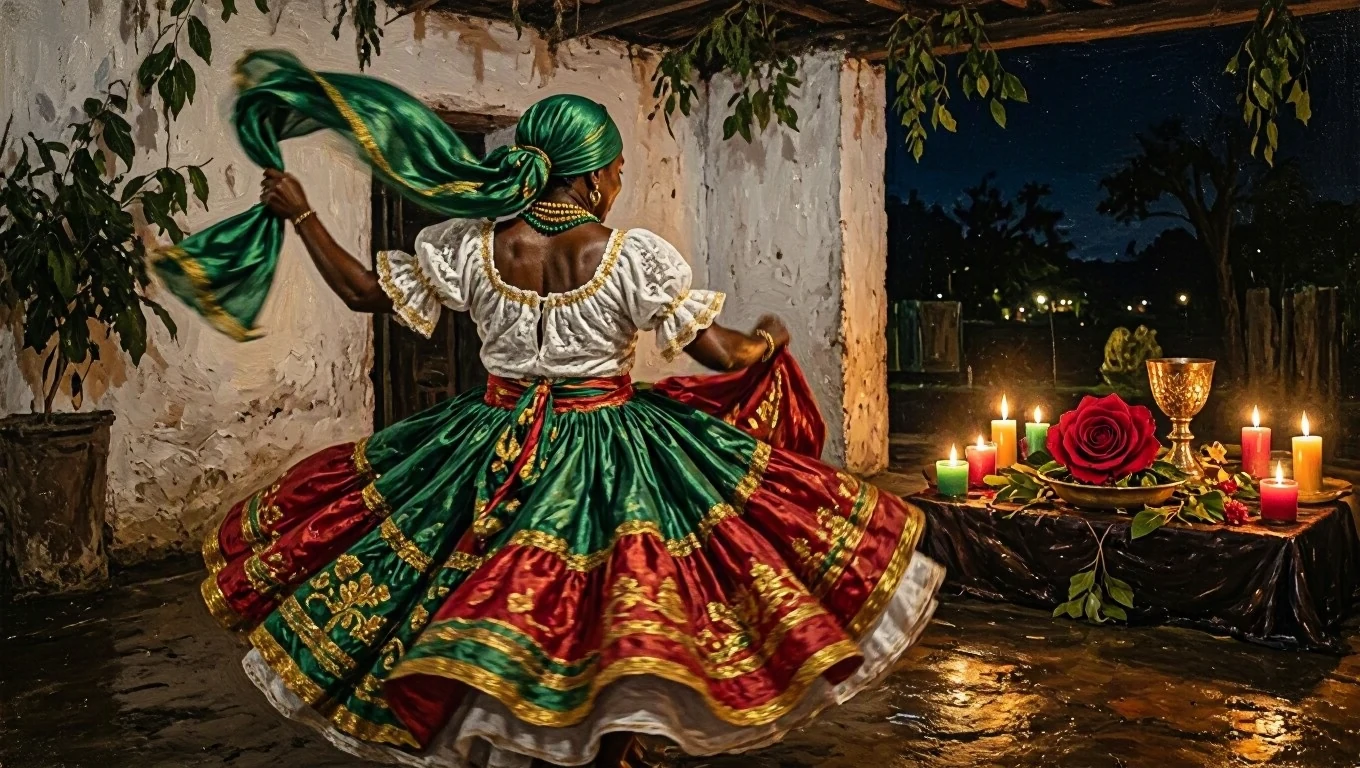
There is no single story, and there are three different answers circulating:
- On the internet, the most repeated story speaks of green eyes, betrayed love, and death by dagger "in the arms of her own mother." The very page that publishes it says that "there is no consensus" and that it is "a popular legend."
- In Hugo's novel, Esmeralda dies on the gallows, in Paris, torn from the arms of the mother who had just reunited with her.
- In the terreiros, each Romani spirit tells her story in her own house. Cigana Dulce, in a house in São Paulo, spoke of a fire in the camp; Lola "does not report her death."
The death of Esmeralda that you know is the one your house tells.
What Cigana Esmeralda likes
It depends on the medium and the house. The researchers who studied Pombagira Cigana Esmeralda summarize it like this: "Each medium has their own Cigana who has preferences regarding the details of the dress, the way to style the hair, the type of footwear, the preferred drink, and the cigarette."
Therefore, there is no, in published sources, "Esmeralda's drink," "Esmeralda's fruit," or "Esmeralda's flower." The list of "sweet wine and green roses" that circulates on social media has no known origin. Regarding drinks, the same rule for Pombagiras in general applies: there is no table by name, and the article about Pombagira drink explains why.
Offering for Cigana Esmeralda: what the houses offer
What can be said with a source is what the studied houses offer to the Romani spirits, according to the house's reading.
If the house treats her as Pombagira Cigana: in Maracás (BA), Pombagira Cigana receives perfume and bouquets of roses, and "her characteristic drink is champagne." In a tent in Rio, another Romani Pombagira receives red roses, moscatel champagne, costume jewelry, and makeup. The rose enters open, as requested by the left; see the Pombagira rose.
If the house treats her as a Romani spirit of the Orient: the table for the studied Romani festivals has fruits (papaya, strawberry, grape, apple, melon, cherry), sweet liqueurs, white wine, cider, roses of various colors, candles and coins. The Romani spirits of a house like "sweet drinks, such as mint liqueur." The details are in Romani table.
In both readings, the candle goes on a firm plate, of a single color, away from fabric. Anyone who wants a green candle through the site can find the green Romani spirit candle, for 7, 14 or 21 days. Cup, rose, perfume and handkerchief are the objects that repeat the most. And the rule that counts more than any list: ask your house. If you want to check the material that the house requested, Joia Mística Laroyê helps via WhatsApp.
What to ask the Romani spirit Esmeralda
Ask for what the house advises. No promise of results. In Porto Velho, a babalorixá heard by Lagos said that the Romani spirits "prefer to work for love," while the Padilhas take more care of "demands and defense." This is the word of one house, not a rule. Consultation with a Romani spirit is conversation and advice. The decision is up to the one who asks.
Esmeralda is also the name of a real Romani woman. The research cites the verses of a Romani woman named Esmeralda Liechocki, who has nothing to do with the spirit. The spirit is spiritual; the Romani people are another matter.
Frequently asked questions
Is the Romani spirit Esmeralda a pombagira?
In the four researches that record the name, yes: she appears as Pombagira Cigana Esmeralda, in terreiros of umbanda, candomblé and quimbanda. Some houses treat her as a Romani spirit of the Orient. The houses themselves mix the two readings.
What is the drink of the Romani spirit Esmeralda?
There is no drink for Esmeralda in published sources. Each medium has their own Romani spirit, with their own drink. In the houses studied, Pombagira Cigana usually receives champagne, and the table of the cigana do Oriente has sweet liqueurs, white wine, and cider.
How did Cigana Esmeralda die?
There is no single story. Death by dagger in her mother's arms is admitted as a legend even by those who publish it. The Esmeralda of Victor Hugo's romance dies on the gallows. In the terreiros, each cigana tells her story in her own house.
What is the day and color of Cigana Esmeralda?
No research records a specific day or color for Cigana Esmeralda. The green that appears in images and candles comes from the name of the stone. What matters is what your house teaches.
References
- Victor Hugo, Notre-Dame de Paris (1831), Project Gutenberg: full text in French
- Lages and D’Ávila, Pesquisas e Práticas Psicossociais (UFSJ, 2007): Romani life: women, possession, and transgression
- Lagos, dissertation (UMESP, 2007): gender representations in the manifestations of Pombagira
- Santos and Soares, Revista Homem, Tempo e Espaço (UVA, 2007): the Pombagiras in the researched terreiros
- Santos, Caderno Seminal (UERJ, 2021): Cordel literature and the stars
- Marques, Escritos e ditos (Humanitas, 2018): book record
- Agência Brasil (2023): Schools will bring legends and enchantments to the Sambódromo in 2024
- Macedo and Bairrão, Memorandum (UFMG, 2021): The Romani Orient in Umbanda
- Santos, Revista Wamon (UFAM, 2020): essay on marias-padilhas, witches and Romani spirits
- Aguiar and Machado, Odeere (UESB, 2017): The Romani pomba-gira in the sertão Candomblé
- Oliveira and Marques, REVER (PUC-SP, 2026): Between the gira and the networks
- iQuilibrio: the legend of Cigana Esmeralda, presented as a legend


