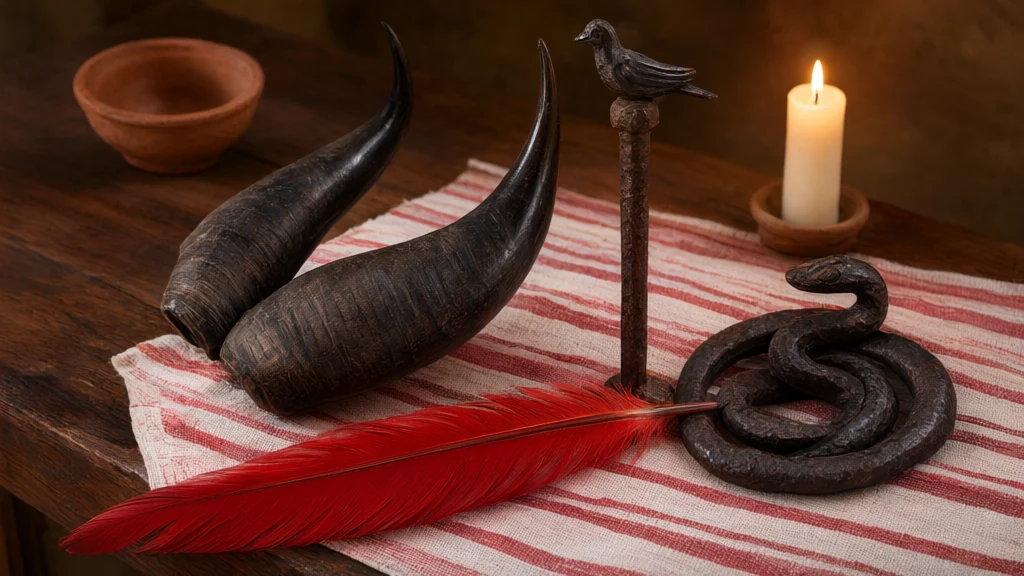
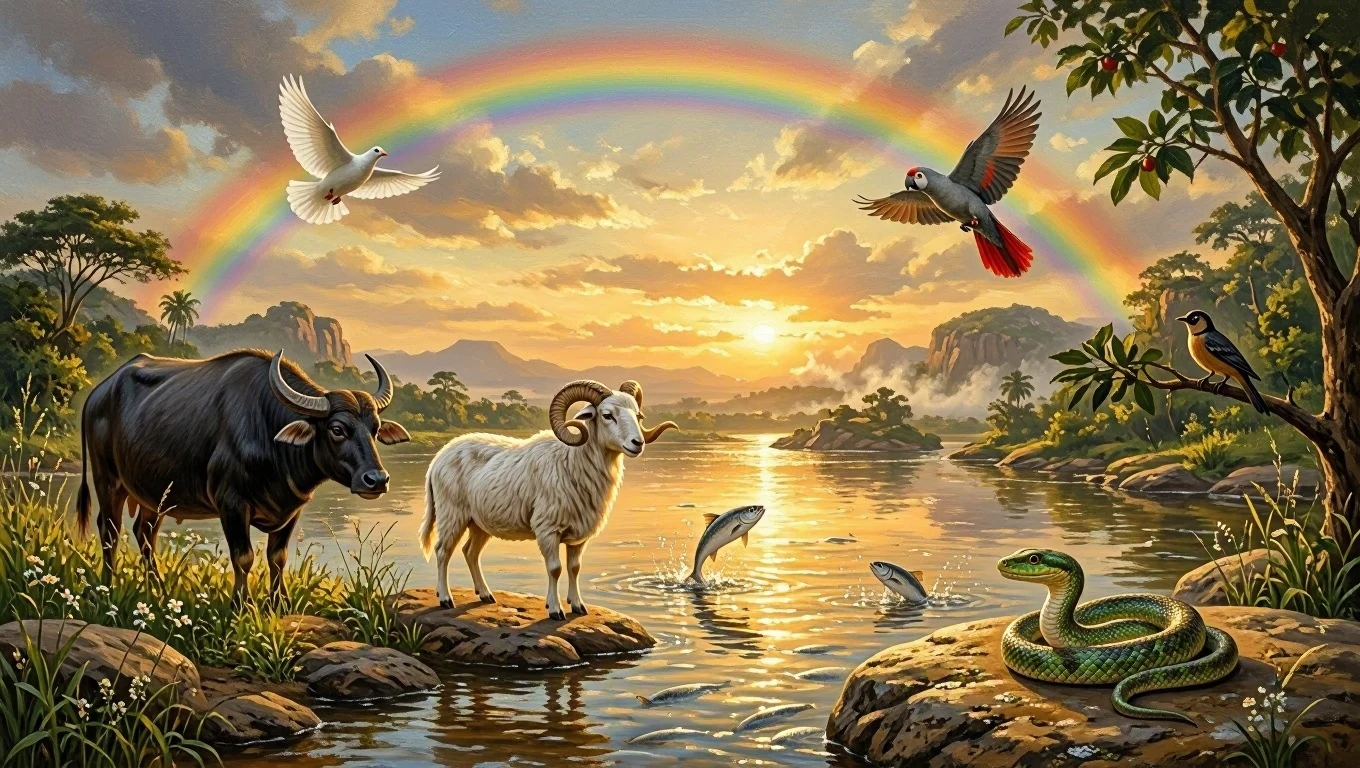
The most cited animals of the orixás are the buffalo of Iansã, the sheep of Xangô, the serpent of Oxumaré, and the dog of Ogum. Ossaim has the bird; Iemanjá and Oxum, the fish. Each animal comes from an itã, an oriki, or the assentamento of the orixá, and the list changes according to the house.
The animal is an emblem, not the form of the orixá.
Animals of the orixás: the table for each
The second column brings the animal of the itã, oriki, or assentamento, according to Pierre Verger and Reginaldo Prandi. The third brings the animal that the children do not eat in the table of Prandi for the Ketu nation. The last brings the "Animal" field from the pages of FUCESP, the Umbanda and Candomblé federation of São Paulo.
| Orixá | Linked animal | Where it comes from | Creature in the quizila of the children | Animal in the FUCESP |
|---|---|---|---|---|
| Iansã | buffalo | buffalo woman itã; horns in the peji | lamb or sheep | buffalo |
| Ogum | dog | praise of Ire, "Ogum eats dog" | no animal | dog |
| Xangô | lamb and elephant | symbol of the ancient Xangô; oriki of the elephant | no animal | turtle |
| Oxumaré | serpent | the rainbow serpent that bites its tail | crawling | snake |
| Ewá | snake | iron snake in the assentamento | female birds | does not bring |
| Ossaim | bird | iron bird on the rod | no animal | does not bring |
| Oxóssi (Oshosi) | bird and "horse" | itã of the name; eru of the horse tail | honey | deer, hare and jungle animals |
| Oxum | fish | itã of the foundation of Oxogbô | scaled fish | macaw |
| Iemanjá | fish | the name, "mother whose children are fish" | crab | saltwater fish |
| Oxalá (Obatala) | dove, parrot and snail | creation itã; Ecodidé itã | no animal | white dove |
| Obaluaê | no emblem in the sources | sheep (Verger) | dog | |
| Nanã (Nana Buruku) | no emblem in the sources | no animal | frog |
Table sources: Verger; Prandi; Verger for Obaluaê; FUCESP.
The table is a starting point. The animal of your orixá, and what it prohibits, is what your house teaches.
Does the orixá have the form of an animal?
No. In Candomblé, the orixá does not have a human or animal figure. Ana Maria Amaral, from USP, writes in the magazine Sala Preta that "the Orixás do not have anthropomorphic or zoomorphic representation": they are represented by the dwellings and the symbol-objects, the tools. Prandi says the same in Revista USP: the statue is secondary, and what represents the orixá are the symbols consecrated in the assentamento.
Therefore, the animal enters in three ways:
- Emblem: the animal of the itã, of the oriki, or of the tool, such as the iron bird of Ossaim.
- Quizila: the animal that the child of the orixá does not eat, such as the lamb for those of Iansã.
- Offering: the animal that is offered is a ritual of the initiate, performed inside the house. What is an offering is in what is ebó, and the right to worship is in law against religious intolerance.
The itãs behind each animal
Iansã and the buffalo skin
Verger tells a legend "known in Africa and Brazil": Ogum, while hunting, sees a buffalo take off its skin and turn into a woman. He hides the skin and marries her; once the secret is discovered, she returns to being a buffalo. Therefore, buffalo horns remain in the places consecrated to Iansã, and in Brazil they are the symbols of the peji, next to the alfanje.
What is Ogum's animal?
The dog. In Ire, the praises call Ogum Ògúnjajá, from the phrase Ògún je aja, "Ogum eats dog", which earned him the name Ògúnjá. The dog that appears in the dream, read by Ogum and Omolu (Omulu), is in dreaming about a dog.
Xangô: the lamb and the elephant
The ram is the symbol of an ancient Xangô, and Verger says its headbutt "has the speed of lightning". An oriki calls him "Elephant that walks with dignity", and FUCESP uses the same image.
Oxumaré, the serpent that bites its tail
Oxumaré is the rainbow serpent. Sometimes she appears as a serpent that bites its own tail and coils around the earth so that it does not fall apart. In ancient Daomé, where she is called Dan, she is a rainbow or a serpent, according to Vinícius Castro. Ewá also has an iron snake in the consecrated foundation (assentamento).
Oxóssi and the bird of the Iyami
The name of Oxóssi comes from an itã. At the new yam festival, a "gigantic bird" sent by the Iyami lands in the palace. Oxotokanxoxô, the hunter of a single arrow, takes it down, and the people sing "Oxowussi", which became Oxóssi. The eru he carries is made of horse tail.
Ossaim and the messenger bird
The symbol of Ossaim is an iron rod with an iron bird forged at the tip, surrounded by six rods in a fan. An Ifá story teaches that "the bird is the representation of the power of Ossain".
Oxum, Iemanjá and the fish
In the foundation of Oxogbô, the fish, "messengers of the divinity", eat the offering of Laro, and a large fish jumps into his hands. From there the title Atóója: "he extends his hands and receives the fish". It is the fish of Oxum. The name of Iemanjá comes from Yèyé omo ejá, "mother whose children are fish". The live fish, the dead one, and the fishing in the dream are in dreaming about fish.
Oxalá: the dove, the parrot and the snail
In the creation itã gathered by Prandi, Olorum (Olodumare) gives Orixanlá a dove and a five-toed hen. The two birds peck until the earth turns into ground. In another itã, the parrot Ecodidé, a friend of Orixalá, is expelled because the dendê fell from his tail, but Oxalá keeps a red feather as a memento. Oxalá is also the orixá of the snail.
Why does the filho de santo not eat the animal of the orixá?
Because the animal is a quizila, the prohibition that applies to those who are the filho de santo of that orixá. In the Prandi table for the Ketu, the filho de Iansã does not eat lamb or sheep. The one of Oxum does not eat scaled fish, and the one of Iemanjá does not eat crab.
The lamb of Iansã has two stories. One, told in quizilas of each orixá, is about the lamb that denounced her. The other is from Verger: Oiá had no children because she ate lamb, when the meat that belonged to her was goat; the babalaô showed the error, and she became a mother of nine.
What are the animals of the orixás in Umbanda?
Umbanda does not have a single list. FUCESP, which brings together Umbanda and Candomblé in São Paulo, gives one animal per orixá, and sometimes different from Candomblé: turtle for Xangô, macaw for Oxum, frog for Nanã, dog for Obaluaê, and white dove for Oxalá. The field mixes emblem and offering: it applies to that federation, and not as a rule.
The dog of Obaluaê in FUCESP stands next to a fact of syncretism: Saint Roch, one of the saints of Obaluaê in the Prandi table, is portrayed with a dog that brought him bread. No source says that one explains the other. The story of the saint is in Saint Roch and Obaluaê.
Animal offering also varies: the Santuário Nacional da Umbanda, in Santo André, does not allow it on site. The Exus of Umbanda with animal names are something else: they are spirits, such as Exu Gato Preto and Exu Morcego.
What the sources do not say
Some answers from the internet do not appear in Verger, in Prandi, nor in FUCESP: the lion of Xangô, the eagle of Ewá, the owl of Nanã or of Oxum, the animal of Logunedé (Logun Ede), and the one of Ibeji. If your house uses one of them, it is its tradition.
For the home altar, the shop has plaster images of the orixás. If your home asked for your orixá's tool and you want to check the material, Joia Mística Laroyê helps via WhatsApp.
Frequently asked questions
What is the animal of Iansã?
The buffalo. According to the legend that Verger records in Africa and Brazil, Iansã was a buffalo woman, and that is why buffalo horns are in her peji. FUCESP also gives the buffalo.
What is the animal of Oxum?
The fish, according to the itã of the foundation of Oxogbô told by Verger. FUCESP gives the macaw. The owl, which appears in searches, is not in Verger, in Prandi, nor in FUCESP.
What is the animal of Exu (Eshu)?
The sources consulted do not give an animal emblem for Exu. The goat appears in FUCESP, but coincides with an offering animal, and the horned figure came from the iconography of the devil, according to Prandi.
What is the animal of Oxalá?
The dove, which helps create the land in the itã gathered by Prandi, and the parrot Ecodidé, from whom Oxalá keeps a red feather. FUCESP gives the white dove.
References
- Reginaldo Prandi: African gods in contemporary Brazil, Horizontes Antropológicos, UFRGS, 1995
- Reginaldo Prandi: Exu, from messenger to devil, Revista USP, n. 50, 2001
- Reginaldo Prandi: Mythology of the orixás, excerpt of Oxalá, Companhia das Letras, 2001
- Pierre Verger: Orixás: Yoruba gods in Africa and the New World, Corrupio, 1981
- Ana Maria Amaral: Ritual objects in the Candomblé of Bahia, Sala Preta, USP, 2001
- Vinícius Vasconcelos Castro: Dan, the rainbow serpent, Diversidade Religiosa, UFPB, 2012
- FUCESP: orixá cards, the one of Ogum
- National Sanctuary of Umbanda: Valley of the Orixás
- Aleteia: Why is Saint Rochus represented with a dog, 2019