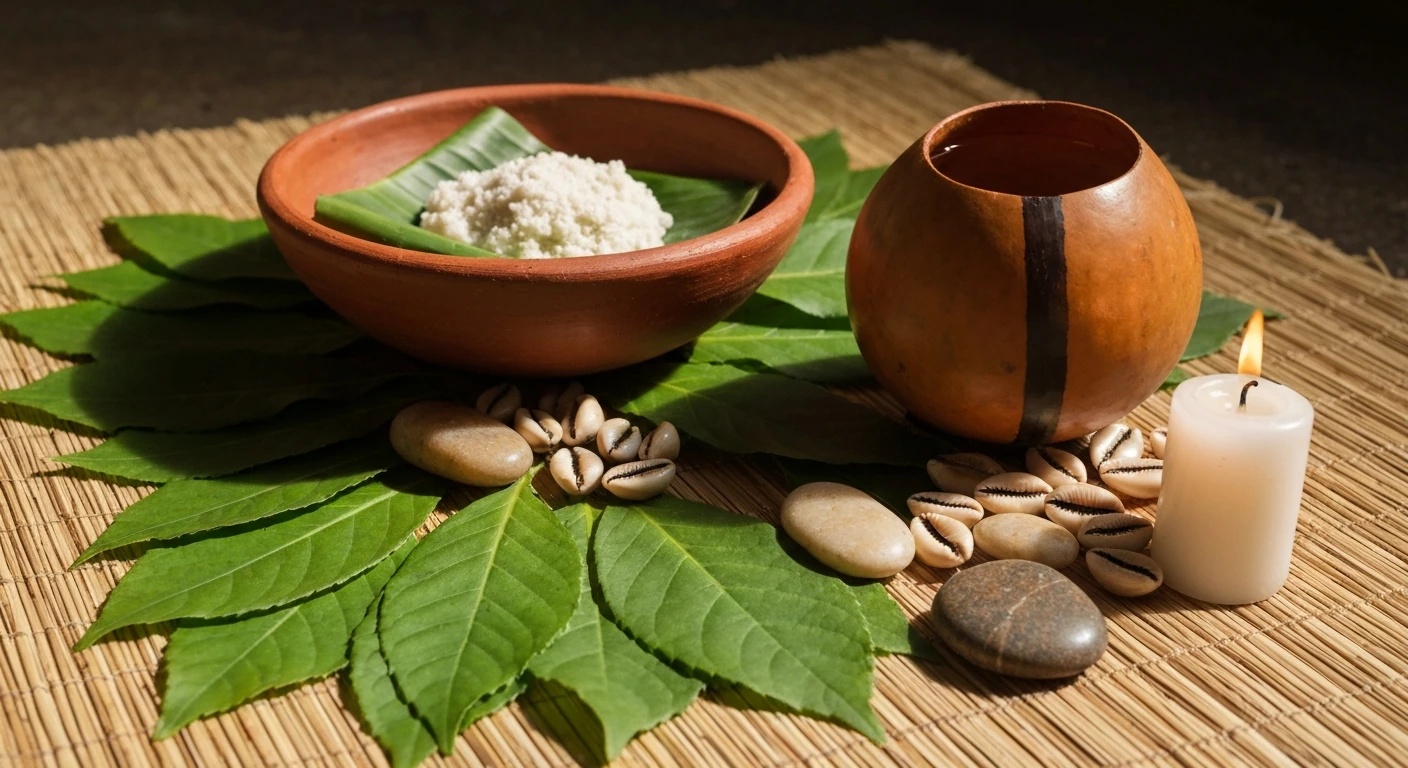
Ebó is a ritual offering of Afro-Brazilian religions, an exchange made with the orixás to cleanse, thank, ask, or rebalance life.
In Candomblé, it is said that without ebó, the religion does not exist. The offering at the crossroads that so many people associate with a spell for evil is part of this same sacred act, and who indicates the right ebó for each person is the pai or mãe de santo.
What is ebó
The word ebó comes from the Yoruba ẹbọ and means, at the same time, offering and sacrifice. As shown by Wikipedia, it is a ritual offering dedicated to an orixá or a spirit, which may or may not involve more complex elements, depending on what is being asked.
Academic research helps to understand the richness of the term. A study by the University of São Paulo recalls that the word evokes three senses that complement each other: sacrifice, offering, and food. The ebó is, at the same time, what is offered, the gesture of offering, and the sacred food that feeds the relationship between people and the orixás.
It is not something peripheral or mere superstition. In Candomblé, the offering is structuring.
“Without ebó, there is no Candomblé.” The phrase, repeated in terreiros, shows that the offering is not a detail: it is the beating heart of the relationship between the human being and the sacred.
The logic of exchange: ebó and axé
To understand ebó, it is necessary to understand the idea of exchange. Everything in Afro-Brazilian religions is balanced through exchanges: giving to receive, offering to move, cleansing to open. The offering is the gesture that puts this circle in motion.
What circulates in this exchange is the axé, the vital force that animates everything. By offering foods, fruits, herbs, and elements of nature, the person moves and restores this axé, rebalancing their own life and their connection with the orixá. It is not a mechanical payment, but rather a relationship. That is why it is said that the offering alone is not enough: it comes accompanied by responsibility, faith, and a change in attitude.
Another essential point: the correct ebó is not chosen on one's own. It is revealed in the jogo de búzios, which shows the pai or mãe de santo which orixá should be honored and with what. It is the orixá who says what is requested, and each offering has its own meaning.
Types of ebó
There are many types of ebó, and the way they are organized varies according to the house and the nation. In general, we can speak of some large categories:
- Ebó de limpeza ou sacudimento: the most well known. It serves to remove dense energies from a person or an environment, in a deep descarrego, when baths and defumações are not enough.
- Ebó de oferenda ou agrado: the comidas de santo dedicated to an orixá to thank for a grace or to make a request, as you see in the guide about oferendas aos orixás.
- Ebó de obrigação: linked to the fulfillment of ritual precepts, such as the obrigações de tempo that mark the life of a filho de santo.
- Padê de Exu (Eshu): the tribute to Exu, always the first to be greeted, so that he opens the paths and takes the offerings to their destination.
An important distinction is worth making. There are simple ebós, made with fruits, foods, and herbs, and there are ebós de fundamento, more complex, which belong to the world of the initiate. These latter are neither described nor taught in a public text.
When an ebó is performed
There is no fixed calendar of ebós for everyone. The right moment always depends on what the cowrie-shell divination reveals, but some contexts usually call for an offering. Among the most common are:
- Moments of difficulty: when life seems stuck, at work, in health, or in relationships, and the person seeks to clear the field and reopen the paths.
- Gratitude: after a grace achieved, as a way to give back to the orixá what was received.
- Ritual obligations: at the milestones of religious life, such as the obligations of Tempo of a filho de santo, which are not fulfilled without ebó.
- Important turning points: the beginning of a year, a move, a big decision, moments in which firmness and protection are requested.
In all cases, the same golden rule applies: it is not the person's will that defines the ebó, but the necessity revealed in the cowrie-shell divination and the guidance of those who care for the house.
Ebó is not a spell for evil
Here is the point that needs to be said most. The ebó is not a "spell to do evil" nor a "despacho to harm someone." This is a prejudiced reading, a legacy of the colonial vision that demonized everything that came from African religions.
The function of the ebó is always positive: to balance, cleanse, thank, and open paths. The confusion usually comes from the word "despacho," which began to be used, in a pejorative way, for any offering left on the street. In its origin, despachar is simply delivering the offering to Exu in the paths, the points of passage and communication. There is no spell against anyone in this.
Therefore, when finding an offering at a crossroads, the correct attitude is simple: respect it. Do not step on it, do not kick it, do not touch it. That is someone's act of faith, a sacred offering made with devotion, and not a curse waiting for you. Prejudice lives in the gaze of those who judge, and never in the sincere gesture of those who offer with faith.
Who prescribes and conducts an ebó
In light of all this, it is clear that an ebó is not an internet recipe nor something to be done on your own. It has fundamento, and fundamento must be respected.
The correct ebó is defined by the jogo de búzios, which reveals what the orixá asks, and it is conducted by a babalorixá or ialorixá, inside a serious house. It is the knowledge of the terreiro, passed down from generation to generation, that gives the gesture its strength. Trying to perform an ebó by copying a video is like taking medicine without a prescription: it may have no effect at all, or it could backfire.
In fundamento ebós, there may be the offering of an animal, in which blood is understood as a vehicle of axé. It is a theme that deserves respect and context: it concerns ritual food shared by the community, part of an ancient worldview, and not cruelty. As it is fundamento, it stays in the terreiro, with those who have the preparation to conduct it. What is taken from this article is the concept, and the path: seek a serious house, cast the búzios, and listen to what the orixá has to say.
Frequently asked questions
What does ebó mean?
Ebó comes from the Yoruba ẹbọ and means offering or sacrifice. It is the ritual act of offering something to an orixá or spirit in Afro-Brazilian religions, with the goal of rebalancing life, giving thanks, asking, or clearing dense energies. The word brings together three meanings: the sacrifice, the offering, and the sacred food.
What is ebó for?
The ebó serves to restore spiritual balance. It can function as a cleansing and descarrego, as a thank you for a grace, as a request, as the payment of an obrigação, or as an opening of paths. It is an exchange: something from nature is offered to move the axé and harmonize the life of the person who performs it.
Can I perform an ebó alone at home?
It is not recommended. The correct ebó depends on what the orixá asks, and this is only discovered in the jogo de búzios, with a pai or mãe de santo. Each offering has its own foundation, ingredients, and destination. Without this guidance, the gesture loses its meaning and efficacy. The safe path is to seek a serious house.
What is the difference between ebó and despacho?
Ebó is the general name for the ritual offering. "Despacho" began to be used, often in a prejudiced way, for the offering delivered on the street or at the crossroads. Originally, to despachar is simply to take the offering to Exu on the paths. Neither of them has anything to do with doing harm to someone.
Is ebó something evil?
No. This is a prejudiced idea, a result of the historical demonization of African religions. Ebó is a sacred offering of balance, cleansing, and gratitude, aimed at the well-being of the person who performs it. Finding an offering on the street does not bring bad luck or a curse: it is an act of faith that deserves respect.
Where to find items for oferendas
At Joia Mística Laroyê, you find what you need for your practices, always with the guidance of your house:
- Clay alguidares and quartinhas: for offerings
- Herbs and sacred leaves: for baths and cleansings
- Candles and dendê oil: offering items
- Bead necklaces and beads: in the colors of each orixá
Visit our shop in Extrema, Minas Gerais or talk to us via WhatsApp and we ship all over Brazil.
References
- Wikipedia: Offerings in Afro-Brazilian religions
- LISA, University of São Paulo: article on the meaning of ebó in Candomblé
- Candomblé: Without ebó there is no Candomblé