Those who enter a terreiro for the first time usually notice the metals. A double-bladed axe, a small iron bow, a round golden fan, a white scepter with a dove at the top. These are the tools of the orixás, and none of them are there for decoration.
This guide explains what a tool is, which one belongs to each orixá, and why the material matters. It also addresses where what is bought in the shop ends and what is the foundation of the house begins.
What is an orixá tool
A tool is the ritual object that materializes the function of an orixá. It is almost always made of metal and almost always reproduces, on a smaller scale, a work, hunting, or war instrument. And it always says something about what that force does in the world.
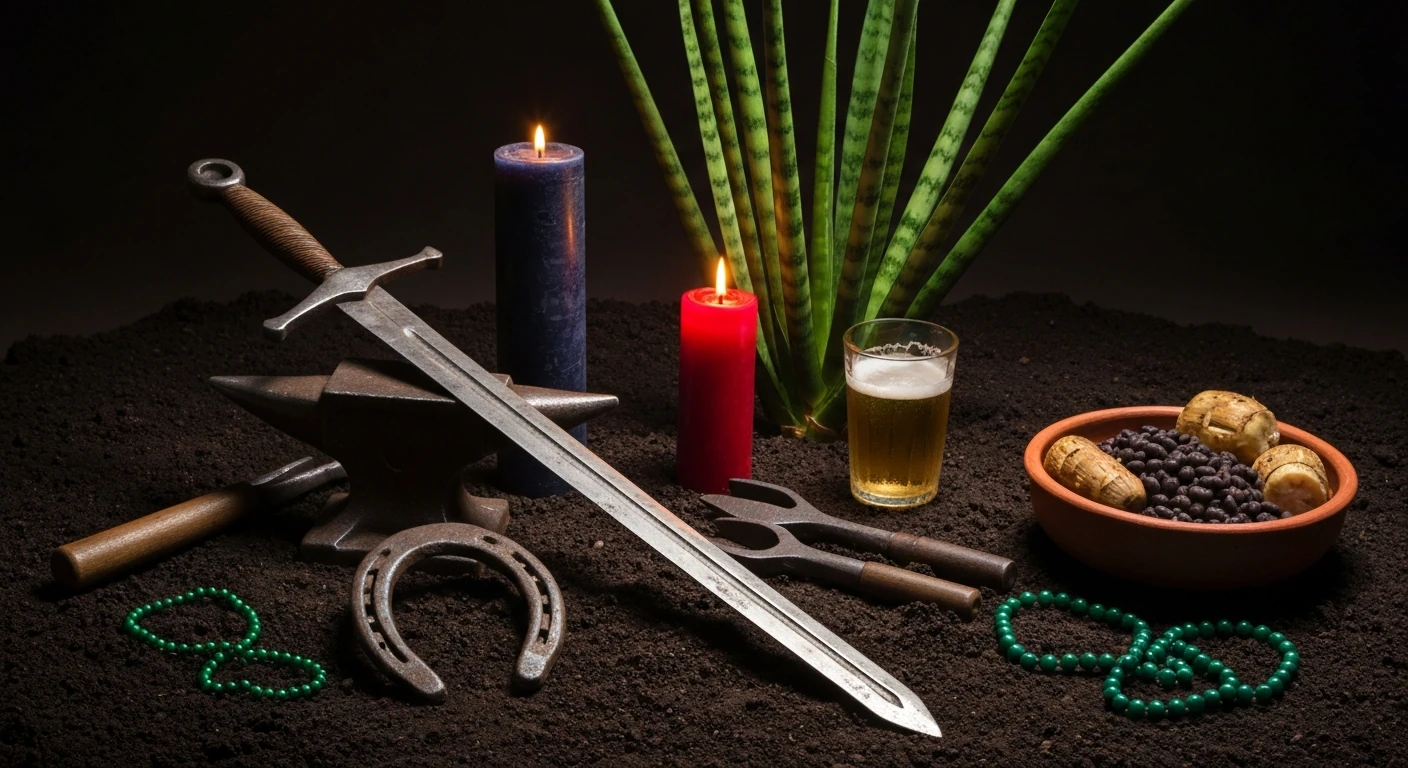
The logic is direct. Ogum is the lord of iron and the forge, so his tools are a hoe, shovel, anvil, hammer, machete. Oxóssi is a hunter, so his is the bow and arrow. The tool does not represent the orixá by poetic resemblance. It is his gesture, frozen in metal.
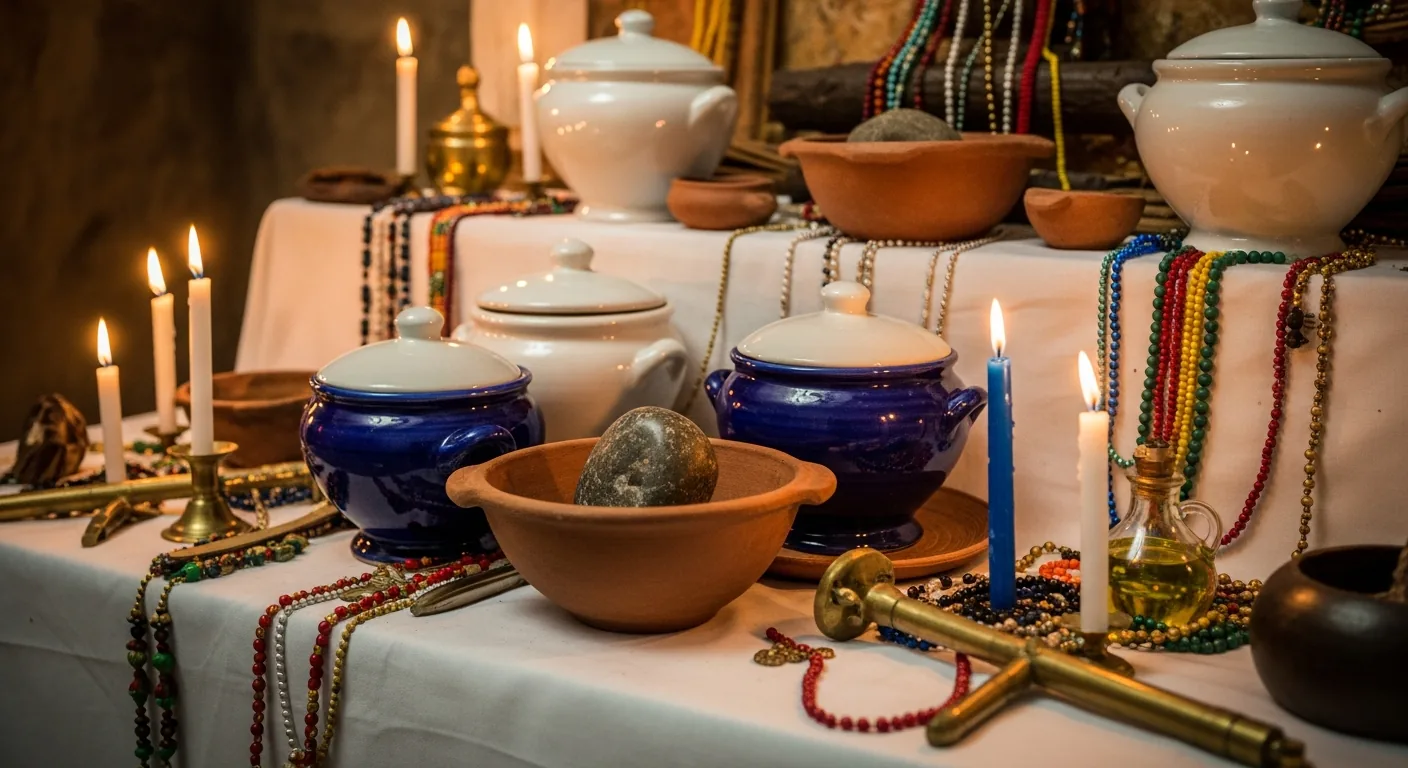
In Candomblé, the tool composes the assentamento, the material set that fixes the orixá in a point of the terreiro or the house. It stays next to the otá, the quartinha, the búzios, and the other pieces, and it does not circulate freely. To understand the entire set, it is worth reading the text about the orixá's assentamento.
In Umbanda, the use is more open. The tool can stay on the congá as a reference for the spirit, without the same weight of foundation that it has in the roça.
What is the tool of each orixá
The list below is the most common in the houses of the ketu nation. It is not a universal law, and you will find legitimate variations from house to house.
| Orixá | Tool | Current material |
|---|---|---|
| Exu (Eshu) | Ogó, the staff | Iron |
| Ogum | Sword, machete, hoe, shovel, anvil, hammer, scythe | Iron |
| Oxóssi | Ofá, the bow and arrow | Iron |
| Ossaim (Osanyin) | Haste with seven points and a bird on top | Iron |
| Xangô | Oxé, the double-edged axe | Wood, copper or brass |
| Iansã (Oya) | Eruexim, the animal tail, plus the sword | Iron and mane |
| Oxum | Round abebê with mirror | Golden brass |
| Iemanjá (Yemoja) | Abebê with fish | Silver metal |
| Obá (Oba) | Shield and sword | Iron |
| Obaluaê | Xaxará, the scepter of straw ribs with cowrie shells (búzios) | Coast straw and cowrie shells (búzios) |
| Nanã (Nana Buruku) | Ibiri, the curved scepter | Coast straw and cowrie shells (búzios) |
| Oxumaré (Oshumare) | Metal serpent and staff | Iron or bronze |
| Logunedé (Logun Ede) | Ofá and abebê together | Iron and brass |
| Oxalá | Opaxorô, the tall scepter with a dove | White metal, silver or tin |
Notice what the table tells without saying. Logunedé, son of Oxum and Oxóssi, carries the two tools of the parents. Nanã and Obaluaê, linked by myth and mud, are the two who do not use iron, but rather straw and cowrie shells (búzios). The tool is genealogy.
Why the material matters as much as the shape
The metal is not an aesthetic choice. It accompanies the nature of the orixá, and changing the material takes away the piece's character.
Iron belongs to the orixás who open paths, cut, and perform ritual work: Exu, Ogum, Oxóssi, Ossaim, Oxumaré. It is the metal of the street, the forest, and the forge. The site O Candomblé records the anvil, knife, shovel, and hoe among the main symbols of Ogum, linking the orixá to metallurgy and progress.
Golden brass belongs to Oxum. Her abebê is a round fan with a mirror in the center, and the mirror has a function: fresh water reflects, and whoever looks into it sees themselves. It is not vanity, it is self-knowledge.
White metal belongs to Oxalá and Iemanjá. Silver, tin, or polished aluminum. The opaxorô of Oxalá is the tallest of all, a scepter that sustains the world and ends in a dove.
Palha da costa and cowrie shells (búzios) belong to Nanã and Obaluaê. The xaxará sweeps. It removes what is excessive in the environment and in the person, and for this reason, it is not made of cutting metal, but of fiber.
Wood, copper, or brass on the oxé of Xangô. Wikipedia also records the two-mouthed mortar and the edun ara, the stone formed where the lightning struck, among the objects of the orixá, according to the entry for Xangô.
The right tool, on the right material, delivered by the right person. Outside of these three, it is just a pretty object and nothing more.
The case of Exu's trident
It is worth opening this parenthesis, because it is the most common confusion when buying. The readings about the origin of the trident are in tridente de Exu.
The traditional tool of Exu is the ogó, the staff he carries in his hand; his readings and other symbols are in symbols of Exu. For Reginaldo Prandi, the trident sold everywhere came from Christian iconography of the devil. Other researchers record images of Exu with horns in Africa since the 19th century.
This does not mean that the trident is prohibited. Many Quimbanda houses have adopted it, and it today has its own legitimate use within that tradition. It simply means that ogó and trident are not the same thing, and it is worth knowing which of the two your house uses before buying.
How many tools and who decides
Here is the point that generates the most questions in the shop, and the honest answer is always the same: who decides is the leader of your house.
The number varies. Ogum appears with seven tools in some houses and with fourteen in others. There are houses that consecrate with three pieces, there are houses that consecrate with the complete set. There are nations in which the tool of a certain orixá has another name and another shape. In the Angola Candomblé, inquices are worshipped, and the correspondence with the Ketu orixás is not a one-to-one translation, as explained in the text about the nations of Candomblé.
You buy the metal piece ready. What happens after it, the consecration, what is given to eat, where it is kept, is fundamento, and fundamento is not learned in an internet article. No one should consecrate an orixá alone by reading instructions on a screen.
What you can do on your own is the material care: keep the piece clean, dry, and away from moisture that corrodes the iron, without aggressive chemical products. And, if it is an offering, follow what your house commands. The text about how to make offering to the orixás covers this part.
Frequently asked questions about the tools of the orixás
Can I buy the tool before having a consecrated foundation (assentamento)?
You can. The piece is an object, and buying does not consecrate anything. Many people buy it to gift the leader, to compose the congá, or to keep until the right moment. What you should not do is set up a consecrated foundation (assentamento) on your own starting from it.
Tool rusts. Is that bad?
Iron darkens and rusts over time, and in many houses this is a sign of use and age, not of neglect. Even so, keep it in a dry place and clean it with a soft cloth. If the piece is made of brass or silver, ask your leader before polishing, because there are houses that do not like new shine on an old piece.
What is the difference between a tool and an insignia?
In practice, the people of santo use both words for the same thing. Insígnia usually names the piece that the filho de santo carries in their hand when the orixá dances, and tool usually names the one that stays in the assentamento. Often it is the same object in two uses.
Is a Umbanda tool the same as a Candomblé one?
The format is usually the same, because it comes from the same root. The use is what changes. In Umbanda, the piece generally stays on the congá as a reference for the spirit, without the ritual weight it has inside the roça.
I do not know what my orixá is. How do I choose?
Do not choose on your own. The one who says is the reading, performed by a leader. If you just want a first approximation, without any foundational value, you can start with the quiz Discover your orixá and then look for a house.
Where to find yours
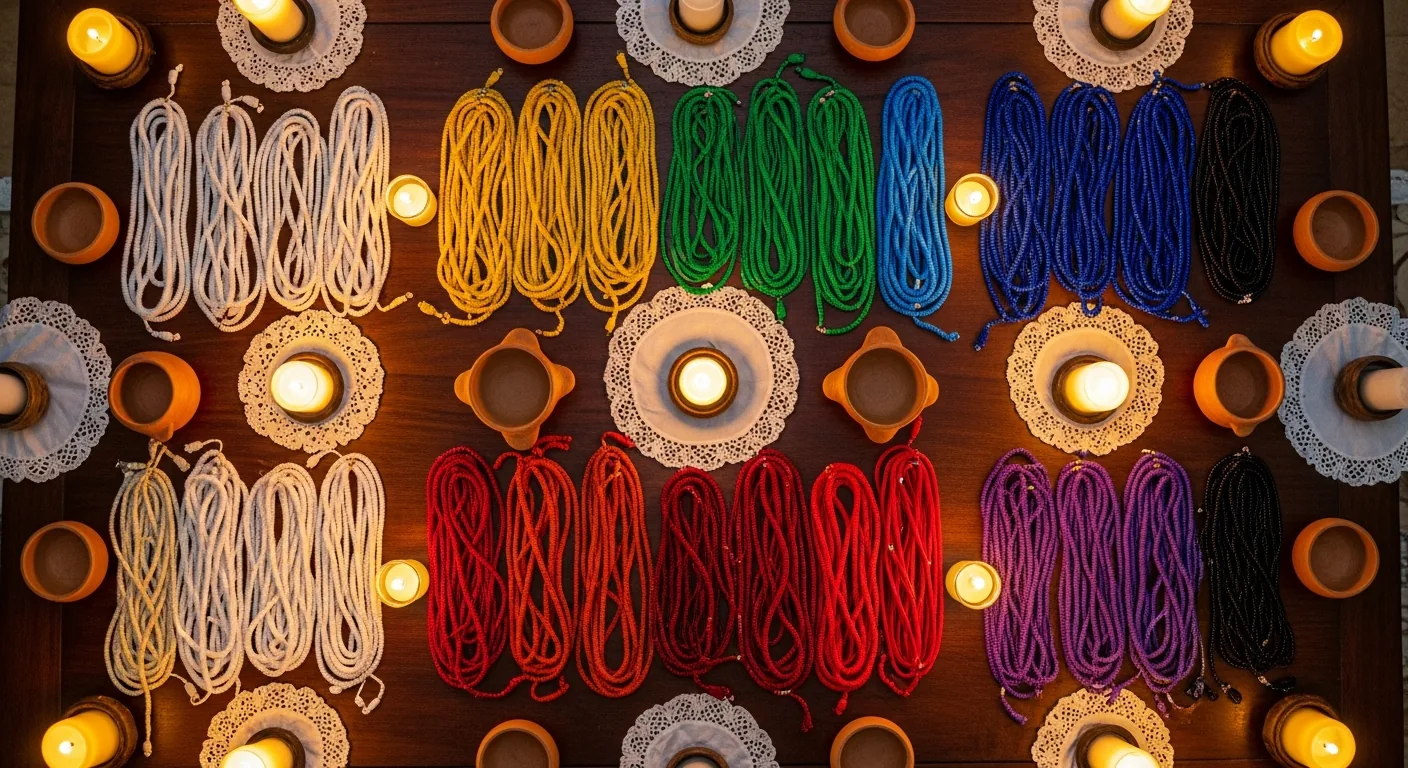
At Joia Mística Laroyê, in Extrema-MG, you can find orixá tools in iron and in golden metal: oxé, ofá, abebê, xaxará, and opaxorô. We also have clay alguidar, quartinha, otá, ritual candles, and bead necklaces to complete the set.
If you have doubts about which piece your leader asked for, send a photo or their message via WhatsApp (35) 99156-5228 and we will help identify it. Those who prefer to see it in person can stop by the shop at R. Benedito Zingari, 460, Bela Vista, from Monday to Friday from 9am to 6pm and Saturday from 9am to 1pm.
A tool is something that lasts a lifetime and passes from hand to hand. It is worth buying the right one.