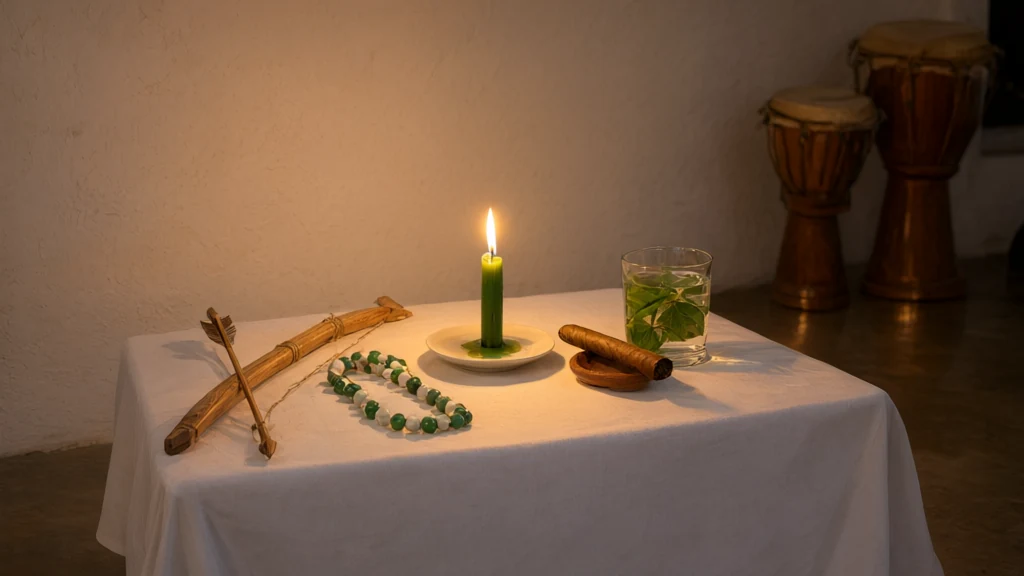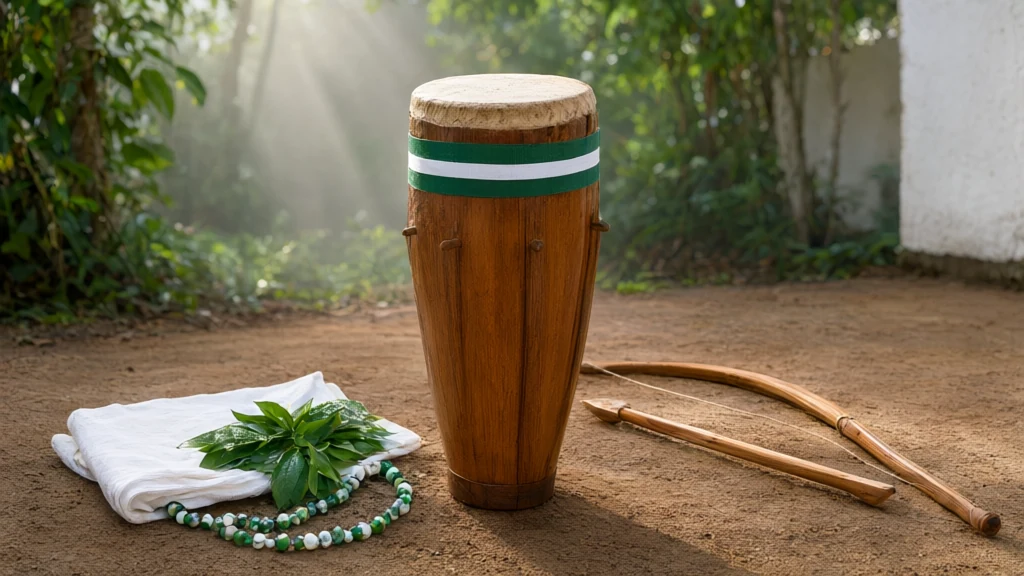
The ponto of Oxóssi is the Umbanda chant that greets the hunter orixá, king of the forests, and calls the caboclos of his line. The verses speak of dark forest, arrow, and Aruanda, and the greeting is Okê Arô. The lyrics change from house to house.
What is the ponto of Oxóssi and when is it sung?
The ponto of Oxóssi is the ponto cantado of the orixá and the caboclos of his line, led by the curimba. In the sources, it appears in four moments of the gira. Who is the orixá is in who is Oxóssi.
- Greeting: at the Terreiro de Umbanda Pai Maneco, in Curitiba, the Oxóssi booklet opens with a “GREETING PONTO”.
- Call: in the terreiros of Petrópolis (RJ) that Pedro Nogueira, from UFJF, studied, the call points are sung until the caboclos incorporate. Then the greeting "Okê, Caboclo!" is given.
- During the consultations: the pontos function as “a kind of soundtrack”. In general, the ones who choose are the ogãs.
- Departure: at the end, the farewell pontos take the caboclos back to the forest.
The Tenda Espírita Nossa Senhora da Piedade (TENSP), the house founded by Zélio de Moraes, publishes a section “OXOSSI Pontos” with 102 numbered pontos, without author. The role of who plays is in curimba in umbanda.
Greeting: Okê Arô | Book of Zélio's house: 102 pontos of Oxóssi | Date: January 20
Which are the pontos of Oxóssi with source registration?
Four pontos of Oxóssi are in the house book, without a marked composer, and three of them in two different houses. Here are only short excerpts. The first ponto of the TENSP section, the one of the bodoque, is already in Oxóssi in umbanda.
”The forest was dark”
It is sung chant 06 of the TENSP.
“The forest was dark / The angels lit up / In the middle of the virgin forest”
The next verse says that was where Oxóssi arrived, and the chorus repeats that he is king in Aruanda. In Pai Maneco, the same chant is the greeting sung chant of Oxóssi, the first in the booklet.
“I saw it rain, I saw it lightning”
Many people look for the lyrics of this sung chant. It is in the TENSP, as sung chant 13, and in the line sung chants of Pai Maneco.
“I saw it rain / I saw it lightning / But even so the sky was blue”
Then comes the request to set the sung chant, with the companions or the leaves of Jurema. The last verse changes from one house to another.
”Oxóssi lives under the gameleira tree”
It is sung chant 05 of the TENSP and says where each orixá lives.
“Oxóssi lives under the gameleira tree / Pai Ogum (Ogun) lives on the moon / Pai Xangô (Shango) there in the quarry”
In Pai Maneco, the tree is another: Oxóssi lives “In the root of the caneleira”.
”Your forest is far”
It is a rising point, sung when the caboclos leave. It is in the Oxóssi section of the TENSP, as point 11, and among the farewell points of the houses in Petrópolis.
“Your forest is far / He is already leaving / And he goes along the blue river”
Another rising point, the one of the caboclo who catches the arrow because the rooster has already crowed, is in the TENSP, in Petrópolis and in a tent in Dourados (MS).
How does the same point of Oxóssi change from one house to another?
The point of Oxóssi travels from terreiro to terreiro and changes words along the path, like the point of Xangô and the point of Iansã. Both open books, from the TENSP and from Pai Maneco, sing the same points with different verses.
| Ponto (sacred song) | In the TENSP | In Pai Maneco |
|---|---|---|
| The forest was dark | ”The angels lit up" | An angel illuminated |
| Where Oxóssi lives | ”under the gameleira" | "At the root of the caneleira” |
| I saw it rain | ”Oxóssi is the owner of the Aracajá" | "Oxóssi reigns from north to south” |
| Who arrived | ”When your Oxóssi arrived" | "It was your Oxóssi who arrived” |
Graminha and Bairrão, from USP, gathered about 1,200 points. Many circulate in only one house, which makes it “impossible to date or determine their authorship.” The correct version is the one from your house.
What do the verses of the sung chant say about Oxóssi?
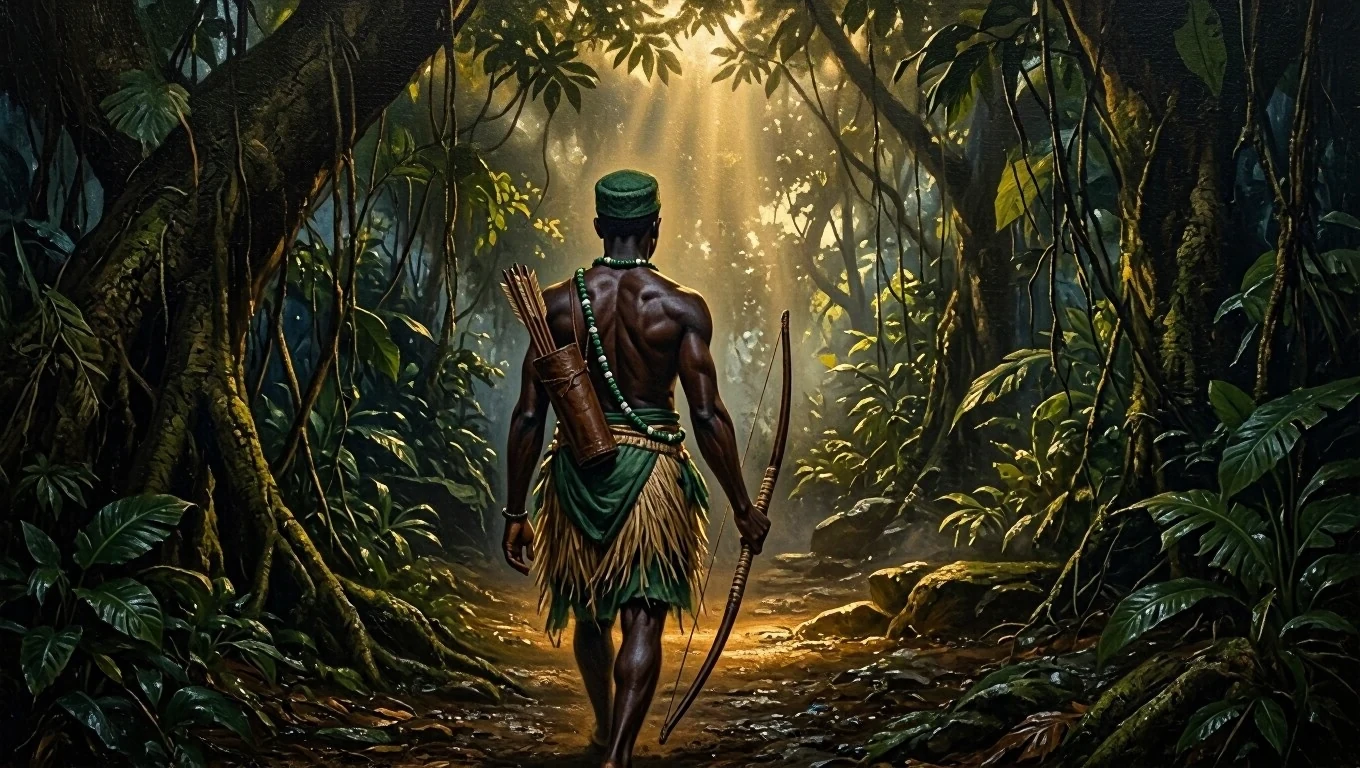
The verses of the Oxóssi sung chant always return to the forest, to the king, to the hunter, and to the arrow.
- The forest. It is his home: dark, virgin, far away. The gameleira and the caneleira are the trees where he lives.
- The king. He is king in Aruanda, owner of the Aracajá and reigns from north to south. In Dourados, a sung chant begins with "Oxóssi is king of the forests".
- The hunter. In a line sung chant of Pai Maneco, the one who was lost was found by Oxóssi, who is not the prey, he is the hunter.
- The arrow. In the caboclo sung chants, the caboclo shoots and only he knows where the arrow fell.
The greeting is Okê Arô, which TUCTVC uses for Oxóssi and Medeiros repeats when closing the dissertation. MASP translates: "Okê arô" means "Hail the great hunter". What is taken to the orixá is in offering for Oxóssi, and the bead necklace, in Oxóssi bead necklace.
Why are so many Oxóssi sung chants of caboclo?
Because the Oxóssi line is that of the caboclos, and in Umbanda, who manifests in the gira, for most houses, is the caboclo. The Revista Espírita de Umbanda, cited by Lourival Andrade Júnior, says that it is the caboclos who manifest, "not the Orixá itself". The Núcleo Umbandista São Sebastião (NUSS) says that the Oxóssi line "is famous for being the line of the great majority of the Caboclos". TUCTVC, from São José dos Campos, links Oxóssi to Caboclo Tupinambá.
That is why the Oxóssi section of TENSP is full of Sete Flechas, Ubirajara, and Pena Branca sung chants, and marks some as discharge sung chants. Pai Maneco has a block for each caboclo of the line, and in one of them Tupinambá is "warrior of Oxóssi".
Andrade Júnior, from UFRN, transcribes caboclo points in which Oxóssi appears and concludes that "in many cases the caboclo is placed on the same level as the orixá Oxóssi". Even the greeting passed from one to the other: "Okê Caboclo" came from "Okê Oxóssi". Who these guides are is in caboclos in umbanda, and the points of the entire line, from the call to the rising, in caboclo point.
Whom does the Oxóssi sung chant belong to?
The Oxóssi ponto does not have a single owner: some come from oral tradition, others have a composer. Diamantino Trindade, cited by Andrade Júnior, calls the former root pontos, "brought directly by the incorporated spirits." The others are "very common in curimba festivals."
Pai Maneco writes "Composition:" with the author's name in several caboclo pontos. In the Caboclo Flecha Dourada ponto, the credit is "Composition: Spirit." The greeting ponto and the line pontos cited here do not bring credit.
And famous pontos like "Sou filho de um guerreiro de uma flecha só"? We do not find them in house books or in research, only in recordings and lyrics pages. They stay out of here, like in the ponto de Ogum. The types of ponto are in pontos cantados na umbanda.
What is the difference between ponto cantado, ponto riscado, and Oxóssi cantiga?
The ponto cantado is voice and atabaque, the ponto riscado is a pemba drawing, and the cantiga belongs to Candomblé.
Ponto riscado. For Andrade Júnior, the riscado is the spirit's mark, "as if it were their signature," and in the caboclo ones, the arrow is "the most perceptible element." None of the cited houses publish an orixá riscado. The foundation is in ponto riscado na umbanda. To check the pemba or the green and white candle that the house requested, speak with Joia Mística via WhatsApp.
Cantiga do candomblé. Whoever seeks an Oxóssi ponto in Yoruba looks for the Ketu Candomblé cantiga. The Reflexão magazine, from PUC-Campinas, read the chants of 13 orixás through the Yoruba translation. In them, Oxóssi is "the hunter of a single arrow and this one is true." Two of his chants, translated, are in Arolè O Inaio and Farere Fibi Odé.
For January 20, the date of Oxóssi in many houses, the day is in Dia de Oxóssi.
Frequently asked questions
What is the most well-known Oxóssi sung chant?
There is no measurement of which is sung the most. "A mata estava escura" and "Eu vi chover, eu vi relampear" are in the books of the TENSP and of Pai Maneco. The rising point "A sua mata é longe" is in the TENSP and in houses in Petrópolis.
What does Okê Arô mean?
Okê Arô is the greeting of Oxóssi. According to MASP, it means "Hail the great hunter". TUCTVC uses the form "Okê Arô!", and in the gira of caboclos the greeting becomes "Okê, Caboclo!", an adaptation of "Okê Oxóssi".
Is an Oxóssi sung chant and a caboclo sung chant the same thing?
Not exactly, but they overlap a lot. An Oxóssi sung chant greets the orixá; a caboclo sung chant calls a spirit guide from his line, such as Sete Flechas or Tupinambá. Since the one who manifests in most houses is the caboclo, terreiro books keep both in the same section.
References
- Tenda Espírita Nossa Senhora da Piedade: Book of Chanted Points
- Umbanda terreiro Pai Maneco: handout of Oxóssi sung chants
- Pedro Antonio Pires Nogueira, UFJF: The intra-religious dialogue in Umbanda
- Lourival Andrade Júnior, Mneme (UFRN): The caboclos in Afro-Brazilian religions
- Haroldo Paulo Camara Medeiros, UFGD: Quebra o coco e arrebenta a sapucaia
- Graminha and Bairrão, Memorandum: Torrentes de sentidos
- Gomes et al., Reflexão: As representações sociais dos orixás
- MASP: Okê Oxóssi, by Abdias Nascimento
- TUCTVC: Oxóssi
- NUSS: Oxóssi Line