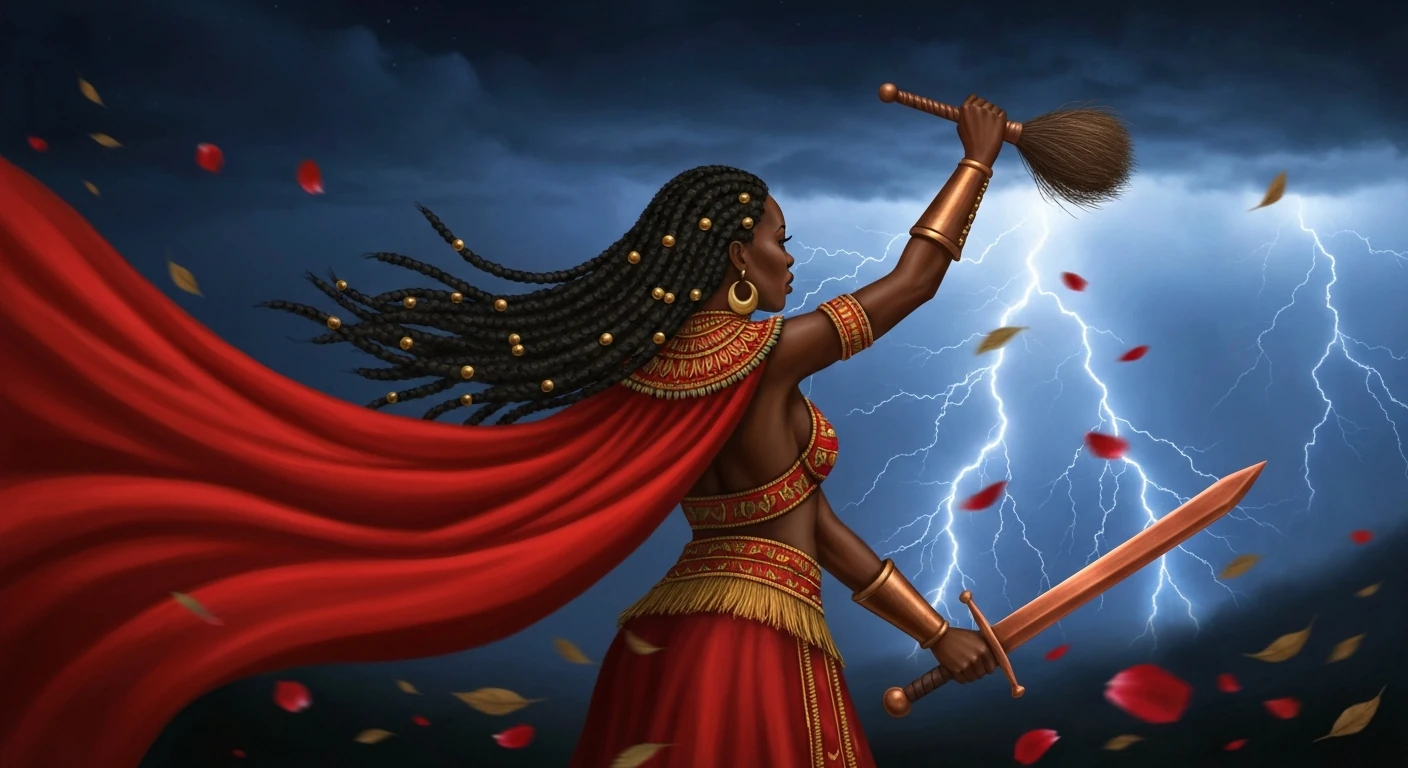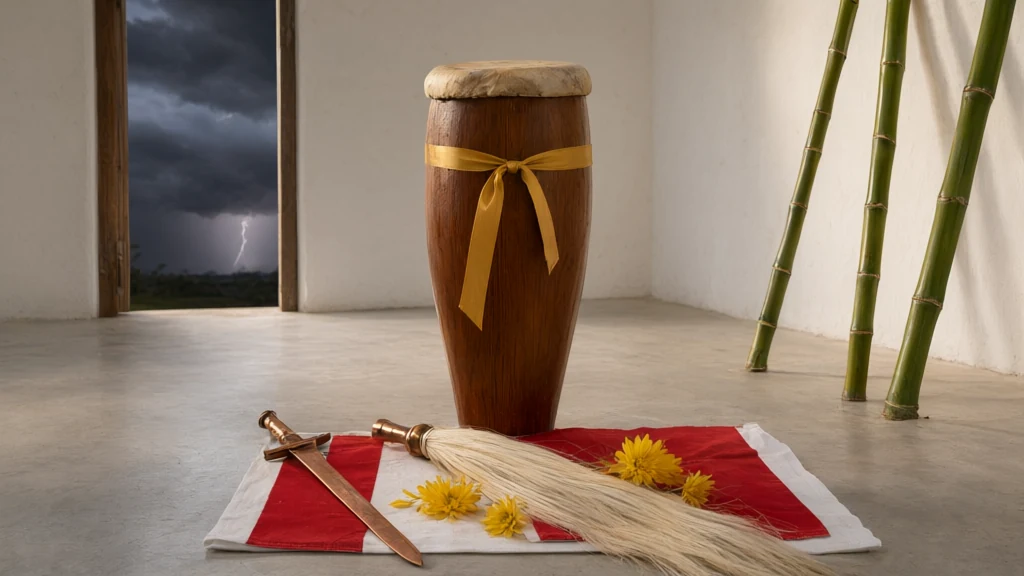
The ponto de Iansã is the Umbanda chant that calls, greets, and bids farewell to Iansã, the orixá of the winds, the lightning, and the storms. The verses with source speak of wind in the woods, of fire and thunder, and bring the Eparrei. Two houses publish these points without a marked composer.
What is the ponto de Iansã and when is it sung?
The ponto de Iansã is the ponto (sacred song) of the orixá, also called Oiá or Oyá. It appears in three moments of the gira: in the greeting to the orixás, at the time her line is called, and in the farewell, the subida. Who the orixá is can be found in who is Iansã.
The Terreiro de Umbanda Pai Maneco, from Curitiba, publishes the lyrics in booklets. The one for Iansã has 20 "pontos de linha" and a section "Subida de Iansã", with two points. None bring a composer. In the opening, the greeting to the seven lines gives her the role of defender, and another chant says she took the evil in the windstorm.
The Tenda Espírita Nossa Senhora da Piedade (TENSP), a house founded by Zélio de Moraes, publishes a Book of Pontos Cantados. The Iansã section has 13 numbered points, all without an author. The one who leads the chant and plays is the curimba, as is in curimba na umbanda.
Greeting: Eparrei | Where it is sung: greeting, line, and subida | Date: December 4
Which pontos de Iansã have a source record?
Four pontos de Iansã have a record in the house book, without a marked composer. Here are only short excerpts.
Iansã ela é dona dos ventos
It is the 6th line point of Pai Maneco. In three verses, it joins wind, fire, thunder, and the greeting:
Iansã ela é dona dos ventos / Dona do fogo, da faísca e do trovão / Eparrei Iansã na Aruanda
The last verse puts Saint Barbara with a sword in her hand, next to the orixá.
”The wind blew in the woods”
It is the 3rd line sung chant of the same booklet.
“The wind blew in the woods / The wind blew in the quarries / What a strong wind”
The wind also passes through the waterfalls. Then the sung chant says who arrived: it is not Oxóssi (Oshosi) nor Xangô (Shango), it is Iansã. Another sung chant of the house orders to look at the wind that turned.
“Saint Barbara virgin”
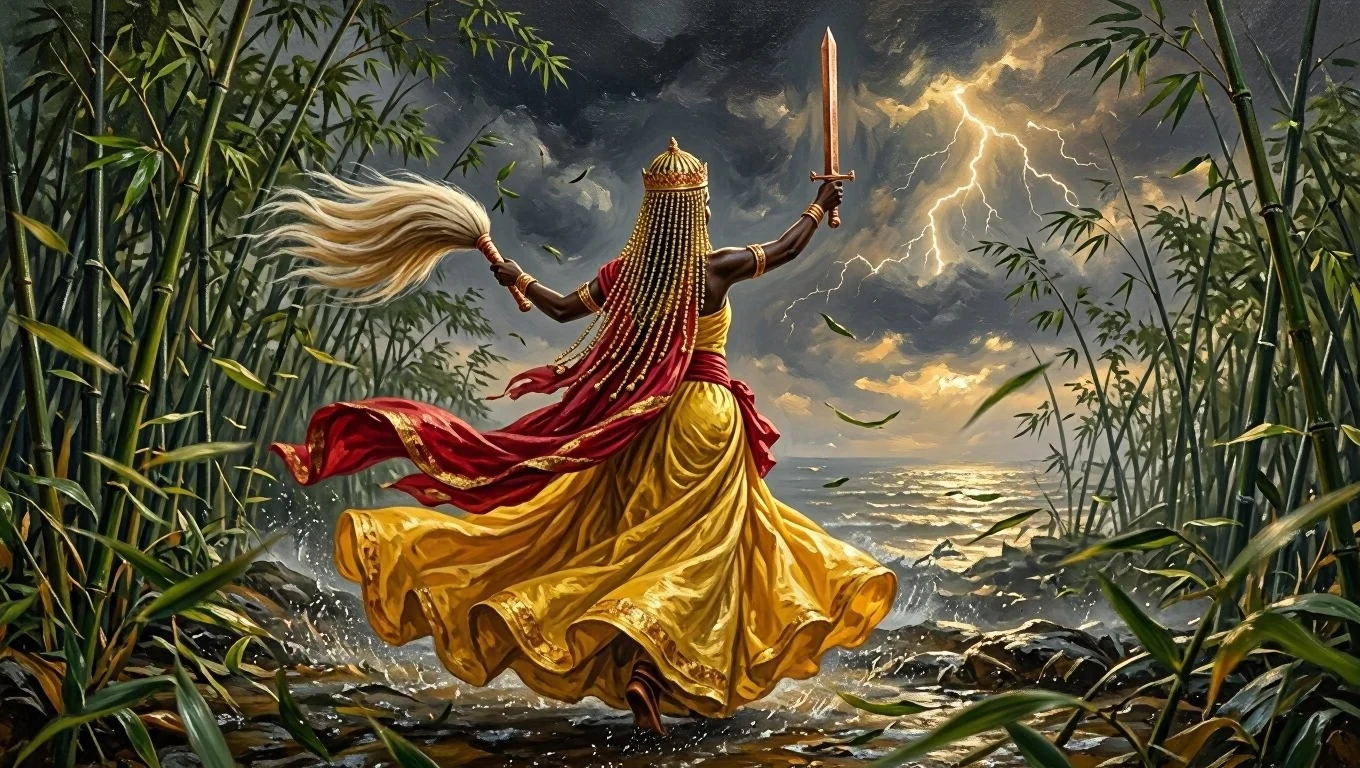
This comes from TENSP. It is the 08 sung chant of the Iansã section.
“Saint Barbara virgin / Of the blonde hair / She comes descending”
She descends the golden staircase. In Pai Maneco, the same reason appears with another figure: it is Iansã, virgin mother of blonde hair, who descends from the sky on a golden cord.
”The wind that brought you”
It is the second ascending sung chant of Pai Maneco, the one that bids farewell to the orixá at the end of the line:
“The wind that brought you / Is what takes you to the sea”
The first ascending sung chant sings that Iansã is already leaving, bordering the sea.
What does the sung chant of Iansã sing about her?
The sung chants of Iansã always return to the wind, the lightning, and the sword. Research says the same of the orixá.
- The wind. It blows in the forests and the quarries and hits Iansã's skirt for her to spin. Graminha and Bairrão, from USP, link Iansã to the winds and storms: she is "stormy".
- Lightning, fire, and thunder. The sung chant calls her mistress of fire, of the spark, and of thunder. In Reginaldo Prandi's table, she is the "Goddess of lightning, winds, and storms".
- Sword, gold, and blonde hair. In both books, Iansã has blonde hair. In Pai Maneco, her sword is silver. In TENSP, the fan is gold and comes from heaven, sent by Oxalá (Obatala).
- The Eparrei. The greeting is on the back, as in "Eparrei Iansã na Aruanda". TUCTVC writes it as "Eparrei Oyá!"
And the eguns? Prandi describes Iansã as "Warrior orixá who takes the souls of the dead to the other world". But none of the sung chants cited here speak of this. That side of her is in egum in Candomblé.
The sung chant also walks with other orixás. In both houses, there is the one of the two fans that blow in the sea: one is Iansã, the other is Iemanjá (Yemoja). Iemanjá's chant is in Iemanjá's sung chant, and the couple with Xangô, in Iansã and Xangô.
Why does Saint Barbara appear in Iansã's sung chant?
Saint Barbara appears because Umbanda sings the saint alongside the orixá, as a parallel. In Pai Maneco, one sung chant says Iansã is the virgin mother and Saint Barbara is the spirit guide. In TENSP, another asks where Saint Barbara lives and answers that inside the moon.
Paralelo is not the same figure. TUCTVC writes that syncretism brings symbols together, but "does not mean that the two figures are exactly the same divinity." For Edilece Souza Couto, from UFBA, what the two have in common is the power over the elements: "They are the ladies of wind, thunder, and lightning."
The saint was not always only of Iansã. Vagner Santos, in the Revista Ingesta, from USP, shows that until the 1930s Saint Barbara was also linked to Xangô. Only later did she stay with the orixá. The history is in Saint Barbara and Iansã.
The day of the two is December 4, which in 2026 falls on a Friday. What is done on the date is in day of Iansã. Those who want to pray can find the texts in prayer of Saint Barbara and Iansã.
Whom does the ponto of Iansã belong to?
The ponto of Iansã has no single owner: some come from oral tradition, without an author, and others have a composer. Diamantino Trindade, cited by Lourival Andrade Júnior, calls the first ones root pontos, "brought directly by the incorporated spirits." The others are "very common in curimba festivals."
Graminha and Bairrão gathered about 1,200 pontos de terreiro. Many have the influence of popular music, and in those that only circulate in a house it is "impossible to date or determine their authorship."
And the most sought after pontos, such as "A guerreira vai reinar", "Ela é Oyá" or "Relampejou"? We do not find them in house books or in open research, only on lyrics pages and recordings, without a composer or terreiro. Therefore, the lyrics stay out of here, as in the ponto of Xangô and in the ponto of Oxóssi. The one of the ventarolas also appears here without lyrics, because the author credit that circulates about it could not be verified. The types of ponto are in pontos cantados na umbanda.
What is the difference between ponto cantado, ponto riscado and cantiga of Iansã?
The sung chant is voice and atabaque, the ponto riscado is a drawing, and the chant belongs to Candomblé. Only the first is the chant that the Umbanda curimba pulls in the gira.
Ponto riscado. For Andrade Júnior, the riscado is a set of symbols that says who the spirit is: "It is as if it were their signature." None of the cited sources publish the riscado of Iansã. The foundation is in ponto riscado in umbanda. To check the pemba or the yellow candle that the house requested, speak with Joia Mística via WhatsApp.
Candomblé chant. Those seeking Oyá's point in Yoruba look for the Ketu Candomblé chant. The magazine Reflexão, from PUC-Campinas, read in Portuguese the chants of 13 orixás, Oyá among them. In one, "Oyá is the whirlpool of the rivers"; in another, she sweeps the leaves of Ossain. Two of her chants are on the site: Oyá Koro Un Le and Ajé Mito Ti Oyá.
Frequently asked questions
What is the most well-known point of Iansã?
There is no measurement of which is the most sung. In open sources, what is repeated most is that of the two fans, one Iansã and the other Iemanjá, published by TENSP and by Pai Maneco. The point that greets Iansã with blonde hair is also in both houses.
What does Eparrei mean in the point of Iansã?
Eparrei is the greeting of Iansã, sung in the verse or shouted in the middle of the chant. In a batuque terreiro of cabinda in Rio Grande do Sul, Carina Dias recorded the belief that, when lightning strikes, one shouts at that moment "eparrei, Oiá".
Is there a point of Iansã in Yoruba?
In Yoruba, what is sung is the Ketu Candomblé chant, not the Umbanda point. The research by Reflexão links Oyá and Xangô to lightning and analyzes the lyrics by translation. The chants Oyá Koro Un Le and Ajé Mito Ti Oyá are translated on the site.
References
- Tenda Espírita Nossa Senhora da Piedade: Book of Chanted Points
- Terreiro de Umbanda Pai Maneco: handout of Iansã points
- Terreiro de Umbanda Pai Maneco: opening booklet
- Edilece Souza Couto, RBHR (ANPUH): Festival of Saint Barbara and Iansã
- Vagner José Rocha Santos, Revista Ingesta (USP): The acará of Iansã in the festival of Saint Barbara
- Reginaldo Prandi, Horizontes Antropológicos: African gods in contemporary Brazil
- Carina Monteiro Dias, UCS: When myth gains body and voice
- Graminha and Bairrão, Memorandum: Torrentes de sentidos
- Lourival Andrade Júnior, Mneme (UFRN): The caboclos in Afro-Brazilian religions
- Gomes et al., Reflexão (PUC-Campinas): The social representations of the orixás
- TUCTVC: Iansã