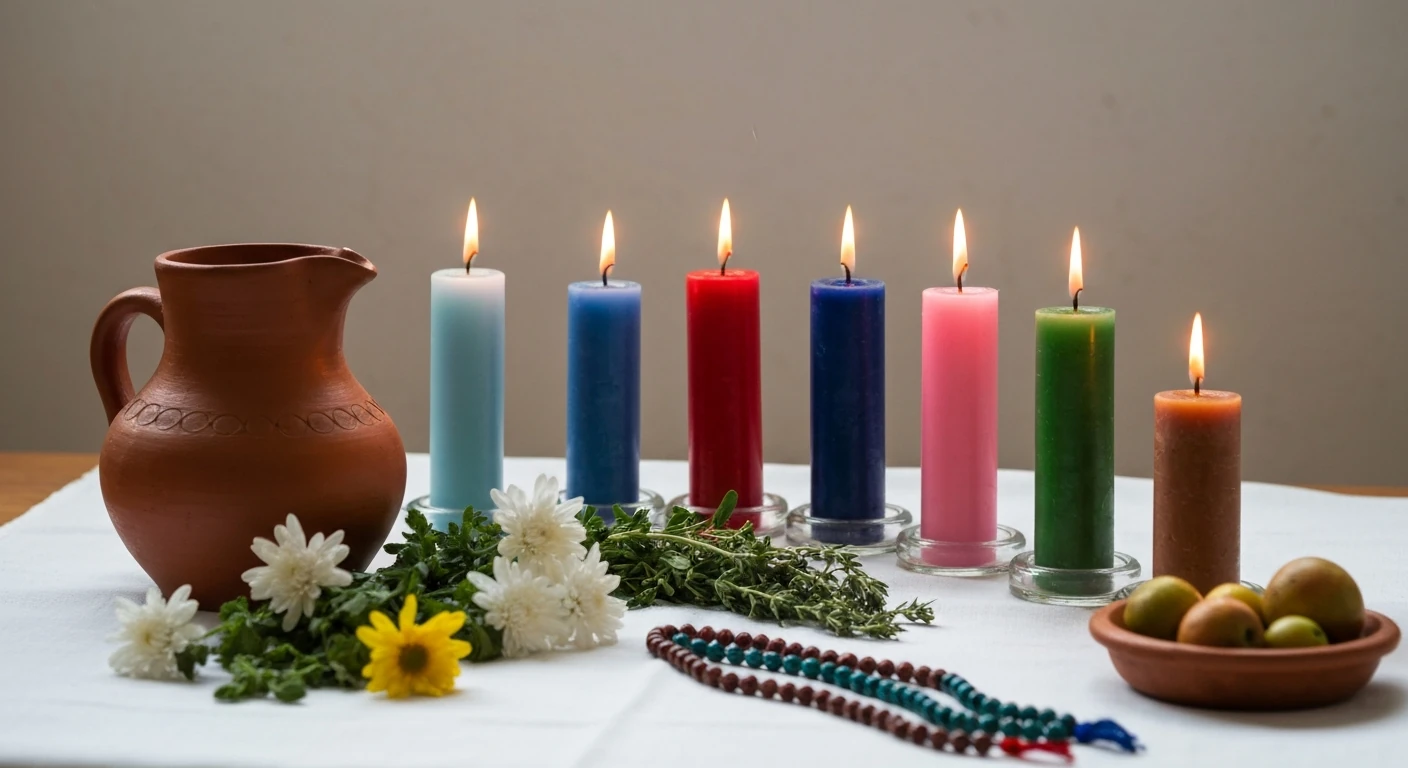
The caboclos are one of the most striking presences in any terreiro of Umbanda. When they arrive at the gira, they come with the strength of the forests, a firm posture, and the wisdom of herbs, bringing the ancestry of the original peoples of Brazil. They are rightly called the strong arm of Umbanda.
This article explains who the caboclos are, what line they come from, how they work in the gira, what are the most well-known names, and what the greeting "Okê Caboclo" means. All with the respect that these spirits and the heritage they carry deserve.
Who are the caboclos
The caboclos are spirits of light that present themselves in Umbanda with the appearance of Brazilian indigenous people, carrying the ancestry of the land, the forests, and the rivers. They are spirits who have lived and who return to work in charity, offering healing, protection, and knowledge of nature.
As Wikipedia describes, they form a line of work of spirits who show themselves as indigenous people who became guides of light. More than an image, the caboclo is the living memory of the strength and wisdom of the original peoples, preserved and honored within Umbanda.
The mark of these spirits is firmeza. They have an upright posture, a strong voice, and direct speech. Where the preto-velho welcomes with the patience of age, the caboclo works with the vibrant energy of the forest, and therefore the two complement each other within the house. To get to know the other peoples who act in the house, it is worth reading about the spirit guides of Umbanda.
What line do the caboclos come from
Within the seven lines of Umbanda, the caboclos belong mainly to the line of Oxóssi, the orixá (orisha) of the forests and hunting, lord of herbs and knowledge. Not by chance, Oxóssi is called the lord of all caboclos. Why, in most houses, the one who descends in the gira is the caboclo and not the orixá himself is in Oxóssi in Umbanda.
But they do not come from just one vibration. There are also the caboclos of Ogum, more linked to demanda, to struggle and protection, with an even more active and warrior energy. And there are caboclos under other irradiations, besides the caboclas, the feminine spirits, many linked to Iemanjá, Oxum (Oshun) or Iansã (Oya).
This variety shows that the caboclo is not a single figure, but a great people, organized in phalanges, that gathers under the force of nature. The exact way each house organizes these lines may change, and who guides this is always the leader of the terreiro.
How the caboclos work in the gira
Anyone who has watched a gira of caboclos knows that the energy changes when they arrive. The ritual work is firm, direct and full of strength. See what they usually do:
- Strong passes and healing: they apply vigorous passes and use herbs, baths and fumigations to cleanse and heal the body and the spirit.
- Descarrego and protection: they ward off dense energies, break demandas and protect against envy and spiritual attacks.
- Opening of paths: they help to unlock life in work, in health and in finances.
- Direct advice: they guide without beating around the bush, with a sincerity that is the mark of the people of the forests.
- Firmeza of the medium: the caboclo is one of the spirits that most help to firm and to develop the medium in Umbanda.
This firm way contrasts with the serenity of the pretos-velhos, and it is precisely this difference that enriches the ritual work of the house. Both heal, but each with its own energy, and many people seek one for strength and the other for comfort, depending on the moment they are living.
The names and types of caboclos
There are many caboclos, and each terreiro has its own. The names usually come from nature, the forests, and hunting weapons, and they function as phalanges, large spiritual families. See some of the best known, always remembering that this varies from house to house:
- Caboclos of the forests and of feathers: Caboclo Sete Flechas, Pena Branca, Pena Verde, Tupinambá, Cobra Coral, Arranca Toco, Rompe Mato and Caboclo da Mata.
- Caboclos linked to strength: Caboclo Sete Pedreiras, Sete Montanhas and the caboclos of Ogum, more warrior-like.
- Caboclas: Jurema, Jupira, Iara and Jaci, among the feminine spirits.
The name Sete Encruzilhadas deserves distinction, as it was the caboclo who, by tradition, announced the foundation of Umbanda in 1908. Each of these names carries a history and its own way of working.
The caboclo who announced Umbanda
No conversation on the subject is complete without mentioning a name: the Caboclo das Sete Encruzilhadas. It was through him, by tradition, that Umbanda announced itself to Brazil.
By tradition, the history took place in 1908, in Niterói. A young man named Zélio Fernandino de Moraes manifested a spirit that presented itself as the Caboclo das Sete Encruzilhadas and proclaimed there the beginning of a new religion, open to everyone, without distinction of color or class. It was born founded on charity and the ritual work of humble spirit guides, such as the caboclos and the pretos-velhos themselves. That is why it is said that Umbanda was born from the mouth of a caboclo. Who is this spirit guide, where does the name come from, and what is his line is in Caboclo das Sete Encruzilhadas.
This episode explains much of the place of honor that these spirits occupy. They are not just workers of the gira: they are in the very origin of the religion, as messengers of a Brazilian spirituality, popular and welcoming. Knowing this root is understanding why the strength of the forests is so revered in the terreiros.
The greeting and the profile of the caboclo
Knowing the symbols of these spirits helps to understand their energy. Everything here is presented as general tradition, remembering that each house has its own foundation:
- Greeting: "Okê Caboclo!". According to the historian Lourival Andrade Júnior (UFRN), who cites Luz (2002), it is "the result of an adaptation of the greeting Okê Oxóssi to Okê Caboclo".
- Colors: green predominates, linked to the forests of Oxóssi; the other colors vary according to the house and the line of the caboclo.
- Day: many houses associate these spirits with Thursday, the day of Oxóssi, although this varies.
- Elements: forest herbs, smoke cleansing (defumação), the cigar and, in some cases, the pipe, in addition to the green bead necklaces.
"Okê Caboclo!" When this cry echoes in the terreiro, it is the forest itself that announces itself. The greeting is a sign of respect to the strength and wisdom that arrive with the spirit.
The caboclos and the indigenous heritage
It is worth a word of respect, because it is the heart of this theme. The caboclo of Umbanda honors the ancestry of the original peoples of Brazil, their deep connection with the land, with the herbs, and with spirituality.
It is important not to reduce this figure to the stereotype of the "brave Indian" or "savage" that prejudice constructed. The caboclo is not a fantasy or folklore: it is a spirit of light that preserves and celebrates indigenous wisdom, an essential part of Brazilian identity. Many caboclos, especially the caboclas, are also linked to Jurema, the sacred science of Afro-Indigenous matrix from the Northeast.
To honor this spirit is, at its core, to revere the resistance and memory of a people. And that is why, in Umbanda, it occupies a place of such affection and respect. To receive a caboclo in a consultation is to receive, along with firm advice, an entire heritage of healing, of the forest, and of courage that crossed centuries to reach the circle.
Frequently asked questions
Who are the caboclos in Umbanda?
The caboclos are spirits of light that present themselves in Umbanda with the image of Brazilian indigenous people. They represent the strength of the forests, the wisdom of the herbs, and the ancestry of the original peoples. They are spirits who have lived and who return to work in charity, with healing, protection, and firm advice.
From which line do the caboclos come?
The majority of caboclos come from the line of Oxóssi, the orixá of the forests and herbs, called the lord of all caboclos. There are also the caboclos of Ogum, more linked to demanda and protection, and caboclos under other vibrations, including the caboclas, female spirits of the waters and the forests.
What does the caboclo do in the gira?
The caboclo applies strong passes, heals with herbs and fumigations, performs descarrego, opens paths, and protects against negative energies. He also helps to firm the medium and gives direct advice. His ritual work is marked by firmeza and strength, in contrast with the serenity of the pretos-velhos.
What is the greeting of the caboclos?
The greeting is "Okê Caboclo!". According to Lourival Andrade Júnior (UFRN), it was born from an adaptation of "Okê Oxóssi", the greeting of Oxóssi, the orixá of the forests. It is a cry of respect and reverence to the strength and wisdom that the spirit brings from the forests when it arrives at the terreiro.
What is the difference between caboclo and preto-velho?
Both are guides of light who heal and advise, but with different energies. The caboclo is firm, upright, and direct, linked to the strength of the forests. The preto-velho is serene, patient, and welcoming, linked to the wisdom of the elders. Together, they balance the spiritual ritual work of the house.
Where to find items for the caboclos
At Joia Mística Laroyê, you find what you need to honor your caboclos:
- Bead necklaces (guias) and green beads: the colors of the forests of Oxóssi
- Herbs and incense: for baths and cleansing
- Statues of caboclos: for your altar
- Cigars and candles: for the firmezas of the house
Visit our shop in Extrema, Minas Gerais or talk to us via WhatsApp and we ship all over Brazil.
References
- Wikipedia: entry about the Caboclo de Umbanda
- Umbanda Nuss: article about the Oxóssi line in Umbanda
- Andrade Júnior, Mneme (UFRN, 2014): The caboclos in Afro-Brazilian religions
- Wikipedia: entry about Cabocla Jurema