The spirit bows down, takes the conical chalk, and marks the ground. A cross, an arrow, a circle appears around it. Someone watching for the first time thinks it is a drawing. It is not.
The ponto riscado is writing. It is the signature of the spirit that arrived, the stamp it uses to identify itself and to firm the ritual work it will perform. Each stroke has a ritual function.
This guide explains what the ponto riscado is in Umbanda and what the difference is between it and the ponto cantado (sung sacred song). It also covers pemba, the families of symbols, and why copying pontos from the internet does not work.
What is the ponto riscado
Ponto riscado is the ritual script drawn by the incorporated spirit, made of combined lines and symbols. It is not an ornament or a separate amulet: it is language.
The most honest comparison is with a signature. It identifies who is signing and is valid by the gesture, not by the drawing itself.
In the practice of the terreiro, the ponto (sacred song) fulfills four functions at the same time:
- Identification: the spirit presents itself and confirms who it is before the leader and the chain
- Firmeza: the ponto anchors and sustains the ritual work while it lasts
- Delimitation: the layout marks the space and the time in which that energy acts
- Command: the combination of symbols orders an action, such as to open, cut, set, or cleanse
The ponto cantado calls. The ponto riscado signs and sets.
Who draws is the incorporated spirit, and in some moments the leader of the house, when authorized by the spirituality. A medium in development does not draw. You will see texts attributing the riscado to the babalorixá, but that is the vocabulary of Candomblé, not Umbanda.
Ponto riscado, ponto cantado (sacred song), and marcar ponto
Three different things carry the word "ponto", and the confusion is constant. The Terreiro de Umbanda Cabocla Tupyara separates the three with clarity.
| Ponto riscado | Sung chant | Marking point | |
|---|---|---|---|
| What is it | symbols that identify the spirit | sacred chant with lyrics and melody | reverence danced to the rhythm of the chant |
| Support | pemba, on the ground, board, or congá | voice and atabaque | the body, in the circle |
| Who does it | the incorporated spirit | the curimba and the chain | mediums and spirits |
| Duration | stays until being discharged | the chant lasts | the chant lasts |
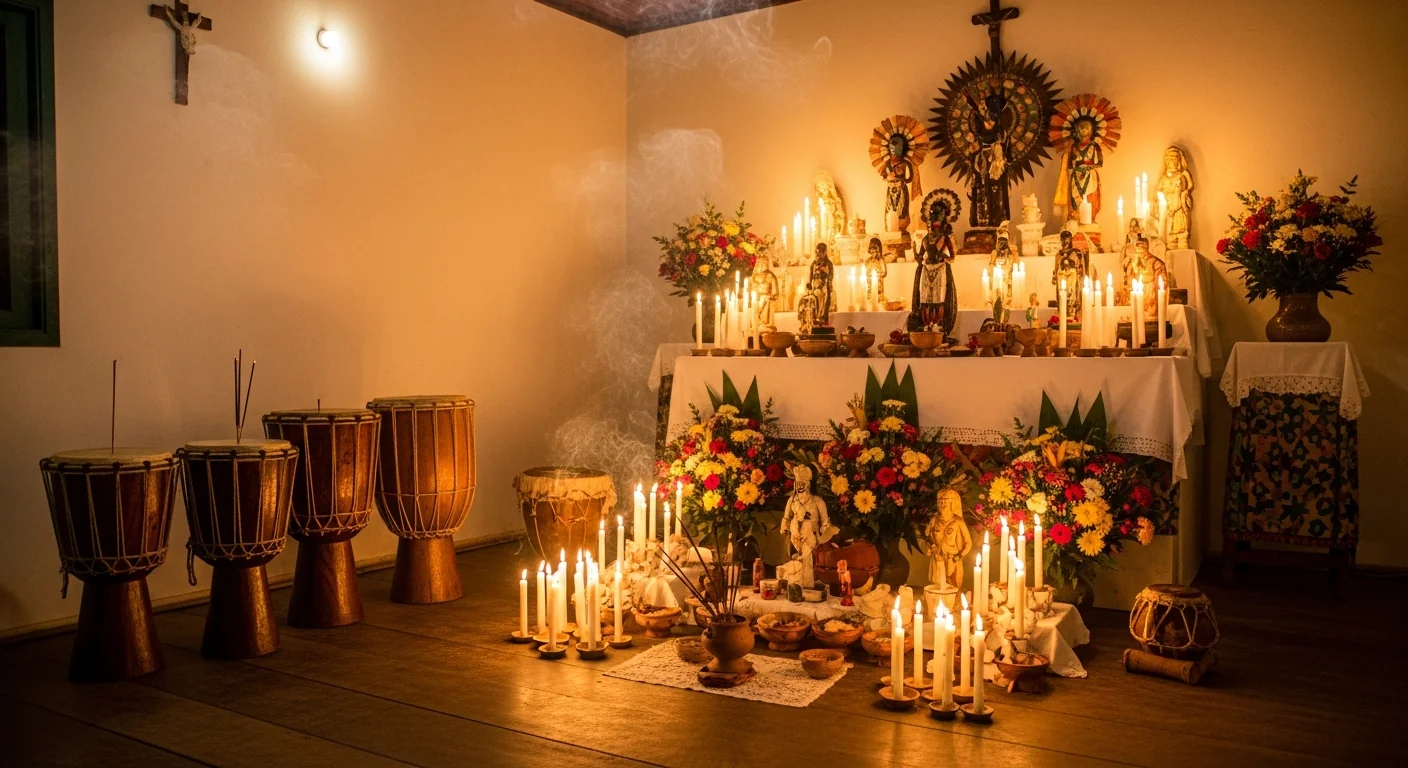
The curimba is the group of ogãs that sustains the chant and the atabaque in a gira. It calls and dismisses the spirits. The riscado enters later, when the spirit is already in the circle.
The pemba: the chalk that writes the ponto
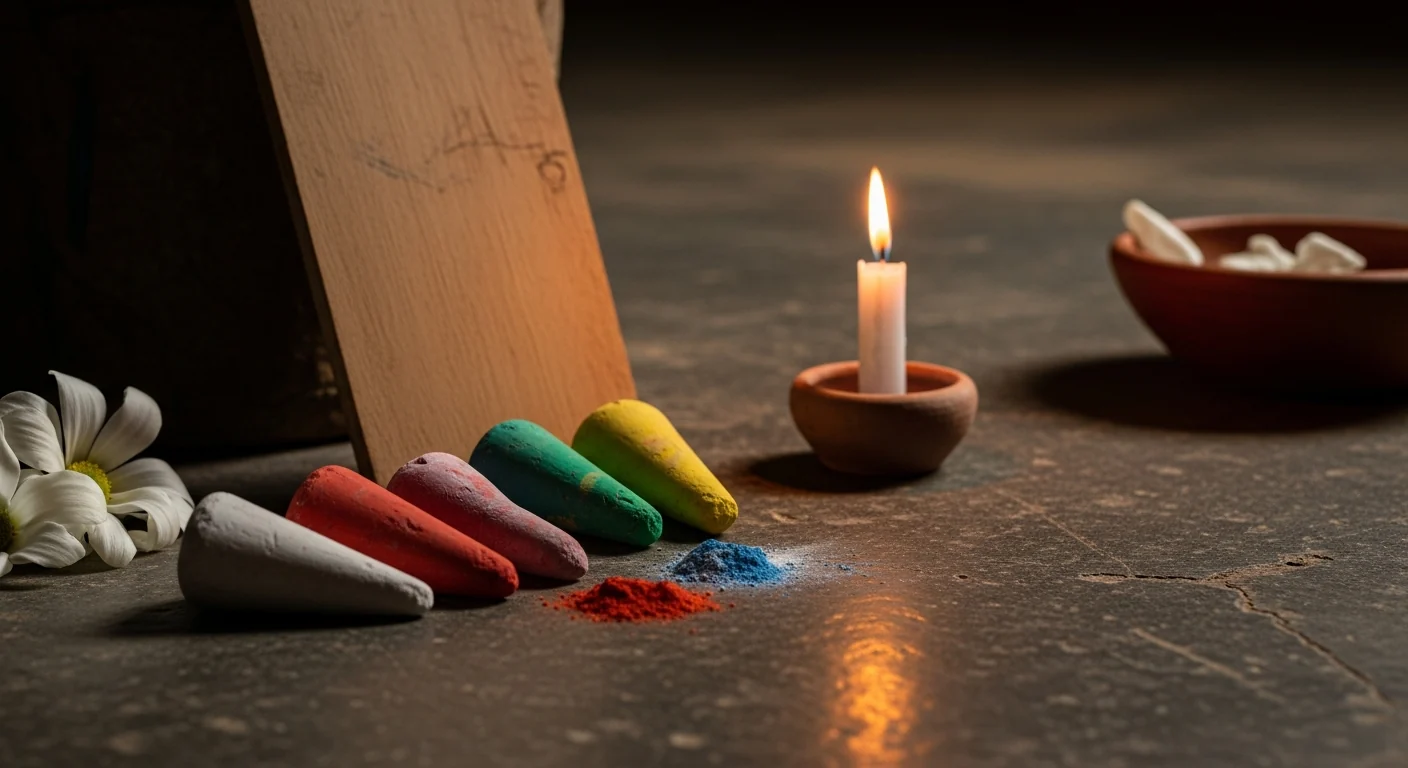
The pemba is the ritual chalk of Umbanda. It has a conical or oval shape, fits closed in the hand, and in Brazil is made of limestone. The word comes from the Bantu trunk and names the ritual white powder of the Kongo peoples.
The use goes beyond the riscado. The pemba powder, mixed with other elements, enters the cleansing of the environment and the mediums at the opening of the ritual work. Many houses consecrate the pemba before use, with herbal bath and prayer, and this varies from terreiro to terreiro.
The general rule of colors is simple: the color of the pemba accompanies the line of the spirit that is drawing.
| Color | Most cited use |
|---|---|
| White | the most universal; peace, opening, Oxalá (Obatala); serves any line |
| Red | guardians; strength and protection |
| Green | caboclos and Oxóssi (Oshosi) |
| Blue | Iemanjá; also peace and healing |
| Yellow | Oxum |
| Black | left line, ritual work of cutting and spiritual cleansing |
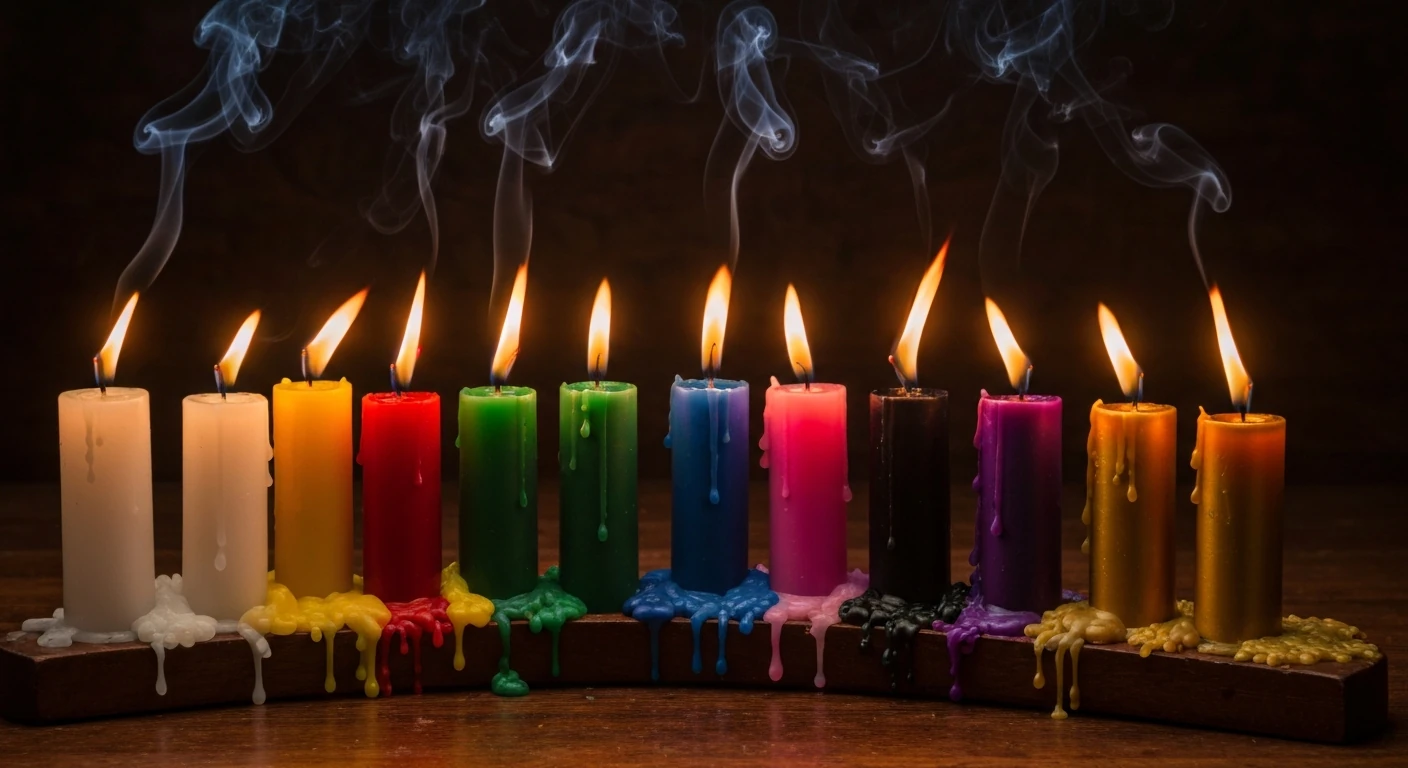
Two caveats are important here. The first: each house establishes its own correspondence, and guidance comes from the leader, never from an internet table. The second: pemba color is not candle color. They are parallel systems, and the correspondence does not always match, as you see in ritual candles and their meanings.
The families of symbols
Here lies the biggest misunderstanding of the theme. Websites deliver closed dictionaries, of the type "star means this." The reality of the terreiro is different: the reading is of the set, and it changes by line and by house.
The researcher Lourival Andrade Júnior, from UFRN, analyzed more than 300 pontos riscados and nominations of Exu in Brazilian terreiros. The size of the repertoire shows why a single catalog does not exist.
What can be said with certainty are the families of meaning:
| Symbol | Meaning family |
|---|---|
| Cross | crossroads, meeting between planes, closing |
| Circle | delimits the field of action of that ritual work |
| Arrow and spear | direction, target, opening of path |
| Five-pointed star | spiritual governance and command |
| Seal of Solomon | balance between the high and the material |
| Half-moon and waves | water lines, cycle, cleansing |
| Sun and rays | vital force, light, irradiation |
| Sword | cutting of demanda and defense |
| Trident | guardians, crossroads, command |
| Key and anchor | open path, to set, to fix |
The sword as a sign of Ogum is recorded in research. In the magazine Mneme (UFRN), Lourival Andrade Júnior shows that the ponto of Caboclo Ogum das Matas, "beyond the traditional arrow, has the espada de Ogum (Obé) in its structure". In a tenda in Dourados (MS), Haroldo Medeiros (UFGD) describes a set of pontos riscados in which the sword is "representative of Ogum". The ponto of Ogum, sung and drawn, is in ponto de Ogum.
The axe of Xangô (Shango) also appears. In the same article in Mneme, Andrade Júnior records that it is in the "Caboclo Pedra Roxa that the axe of Xangô (Oxé) with two edges appears in his ponto", "along with the arrows of Oxóssi". The pontos of Xangô, sung and drawn, are in ponto de Xangô, and the orixá (orisha), in who is Xangô.
For Oxum, no open source publishes the drawing of a ponto riscado, but the heart appears linked to her. On the flag of the Tenda Espírita Mamãe Oxum, in Juiz de Fora, the followers told Pedro Nogueira (UFJF) that the embroidered heart represents the Orixá Oxum; and Raphael de Jesus (PUC Minas) records that the abebé of Oxum is distinguished from that of Iemanjá by the cut, "for example, a heart". The songs and what is known of her riscado are in ponto of Oxum.
Note what is left out. The inverted star treated as negative comes from European esotericism and is not an Umbandist consensus. And numbers within the point do not have a fixed reading: each house reads it in a different way.
How the ponto is drawn, set, and discharged
The cycle has a beginning, middle, and end, and each stage is a foundation of the house. What follows describes what many houses do, it is not an instruction to the reader.
- The spirit draws with the pemba, on the beaten ground, on a drawing board or inside the congá
- A candle is lit over the ponto or next to it, and the ponto enhances the candle's firmeza
- Depending on the line, other elements enter, such as drink, cigar, or water
- The ponto remains as long as the ritual work lasts
- When the spirit rises, the cambonos extinguish the candle by pressing the wick, never by blowing
- At the end of the ritual work, the ponto is crossed with drink or alcohol in the shape of a cross and the material is collected
There is a known exception. When the spirit closes the ponto inside a circle, that energy must remain for a few days, and the ponto is not extinguished immediately.
The ponto riscado also exists in Quimbanda and, with a different logic, in the Angola nation Candomblé. They are distinct traditions, each with its own foundation.
From the Kongo cross to the terreiro chalk
There is a historical reason for the cross and the circle appearing in almost every ponto riscado. They are the oldest substrate of the system. In the preto velho's ponto riscado, a study counted the cross in 310 of 396 analyzed points, as shown in preto velho ponto.
The dikenga, cosmogram of the Bakongo peoples, is a cross inside a circle. It marks the cycle between the world of the living and that of the ancestors, with the four moments of the sun. From the same matrix comes the mpambu nzila, the crossroads.
The researcher Hertz Wendell de Camargo, in a study published by UNESP, followed a terreiro in Curitiba between 2016 and 2022. He identifies the Kongo cosmogram operating within the Umbanda opening ritual.
Upon this African layer, another was deposited starting in 1908. Umbanda is codified in Brazil by absorbing Kardecist notions and an esoteric and Masonic graphic vocabulary. From it come the five-pointed star and the Seal of Solomon. Renato Ortiz described the process in The white death of the black sorcerer.
Why a ponto riscado copied from the internet does not work
This is the question that arrives most often, and the answer is based on foundation, not on prohibition. Research on the pontos of Exu (Eshu), regarding what each house reads in the lines, is in ponto riscado of Exu.
The point is an act, not an image. The force lies in the ritual gesture and in the spiritual authorization at the moment the spirit draws. Reproducing the lines is like copying the calligraphy of a signature: it does not transfer anyone's identity.
The ponto is personal and situational. The same spirit draws differently depending on the ritual work, the house, and the current of the day. A ponto found in an image search belongs to another spirit guide, from another house, for another purpose.
Opening without knowing how to close helps no one. Umbanda orientation compares drawing a ponto riscado without permission to opening a spiritual door without knowing how to close it. It is not a threat or a punishment: it is a lack of foundation.
The path of someone who wants to understand their own ponto goes through the house, through the development of mediumship, and through the guidance of the leader. It does not go through a tutorial.
Frequently asked questions
What is ponto riscado in Umbanda?
It is the ritual writing drawn with pemba by the incorporated spirit, made of combined symbols. It works as a spiritual signature: it identifies who arrived, firms the ritual work, delimits the field of action, and commands the action of that energy. It is not a decorative drawing or a loose amulet.
Who can draw a ponto in Umbanda?
The one who draws is the incorporated spirit, and in specific situations the leader of the house, when authorized by the spirituality. A medium in development does not draw on their own. There are courses that teach how to draw outside of incorporation, but this is a minority position within Umbanda.
What is the difference between ponto riscado and ponto cantado?
The ponto cantado (sung ponto) is a song with lyrics and melody, sustained by the curimba, and serves to evoke, greet, and bid farewell to the spirits. The ponto riscado is a mark drawn with pemba, serves to identify and to set, and remains until it is discharged. One calls, the other signs.
What is pemba used for?
Pemba is the limestone ritual chalk used to draw the ponto. Additionally, its powder enters the cleansing of the environment and the mediums at the opening of the ritual work. The color follows the line of the spirit, with white serving any line in the absence of another.
Can the ponto riscado be erased later?
Yes, and in most houses the ponto is discharged at the end of the ritual work, crossed with drink or alcohol. The exception is when the spirit closes the ponto inside a circle, indicating that the energy must remain for a few days. The final word is always from the house leader.
Where to buy pemba and Umbanda items
At Joia Mística Laroyê, you find what the house uses in the ritual work:
- White pemba: the most used and the one that serves any line
- Colored pemba: red, green, blue, yellow, and black, for specific lines
- Drawing board: for houses that do not draw directly on the floor
- Ritual candles in varied colors: to set the ponto during the ritual work
- Incense burners and dried herbs: for the cleansing that opens and closes the gira
Visit our shop in Extrema, Minas Gerais or talk to us via WhatsApp and we ship all over Brazil.
Regarding the historical formation of the religion, the classic reference remains A morte branca do feiticeiro negro, by Renato Ortiz.
References
- Terreiro de Umbanda Cabocla Tupyara: differences between drawing, singing, and marking pontos in umbanda
- Lourival Andrade Júnior (UFRN): study on pontos riscados and nominations of Exu in Brazilian terreiros
- Lourival Andrade Júnior, Mneme (UFRN, 2014): The caboclos in Afro-Brazilian religions
- Haroldo Paulo Camara Medeiros (UFGD, 2019): Quebra o coco e arrebenta a sapucaia
- Pedro Antonio Pires Nogueira (UFJF, 2014): The intra-religious dialogue in Umbanda
- Raphael Felipe da Silva de Jesus, Em Sociedade (PUC Minas, 2022): No balanço do mar
- Hertz Wendell de Camargo (UNESP): research on the Kongo cosmogram in the umbanda opening ritual