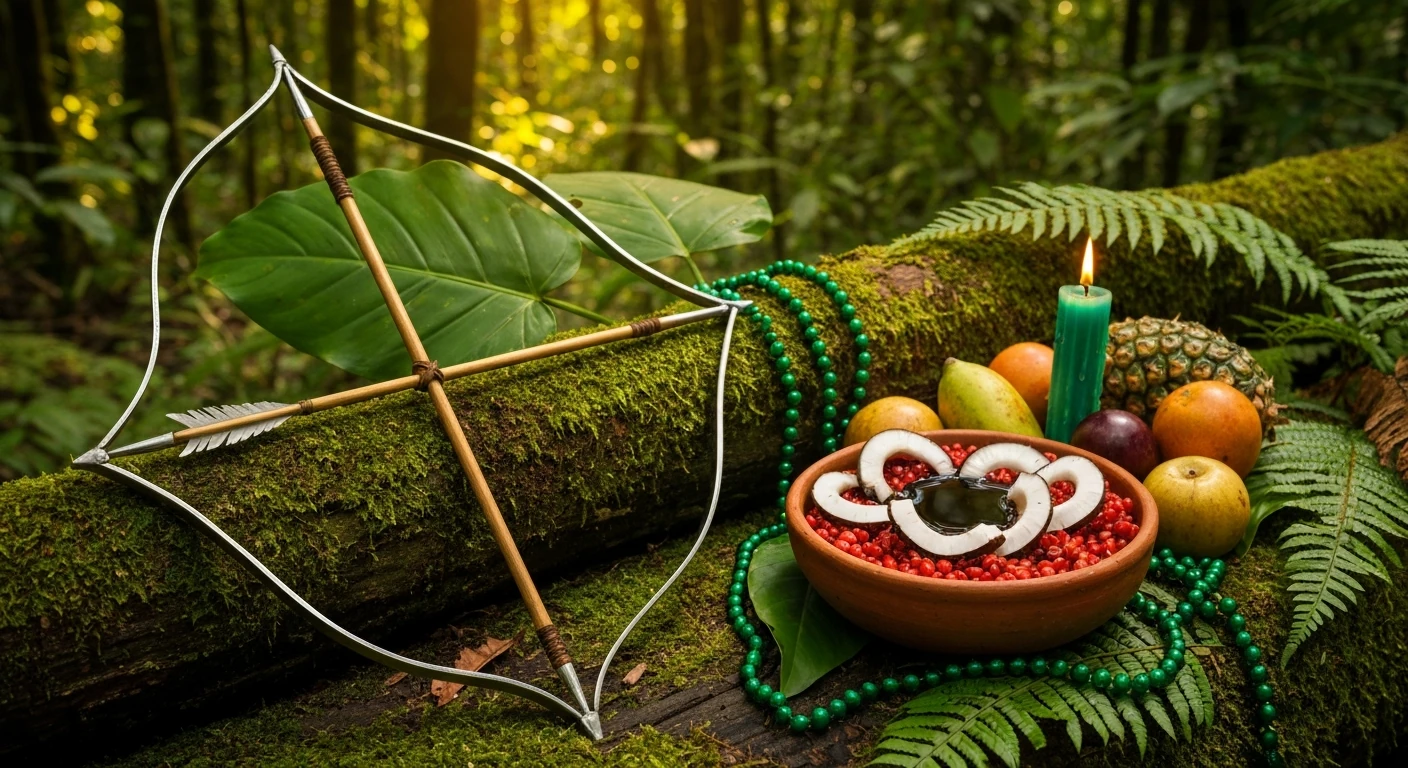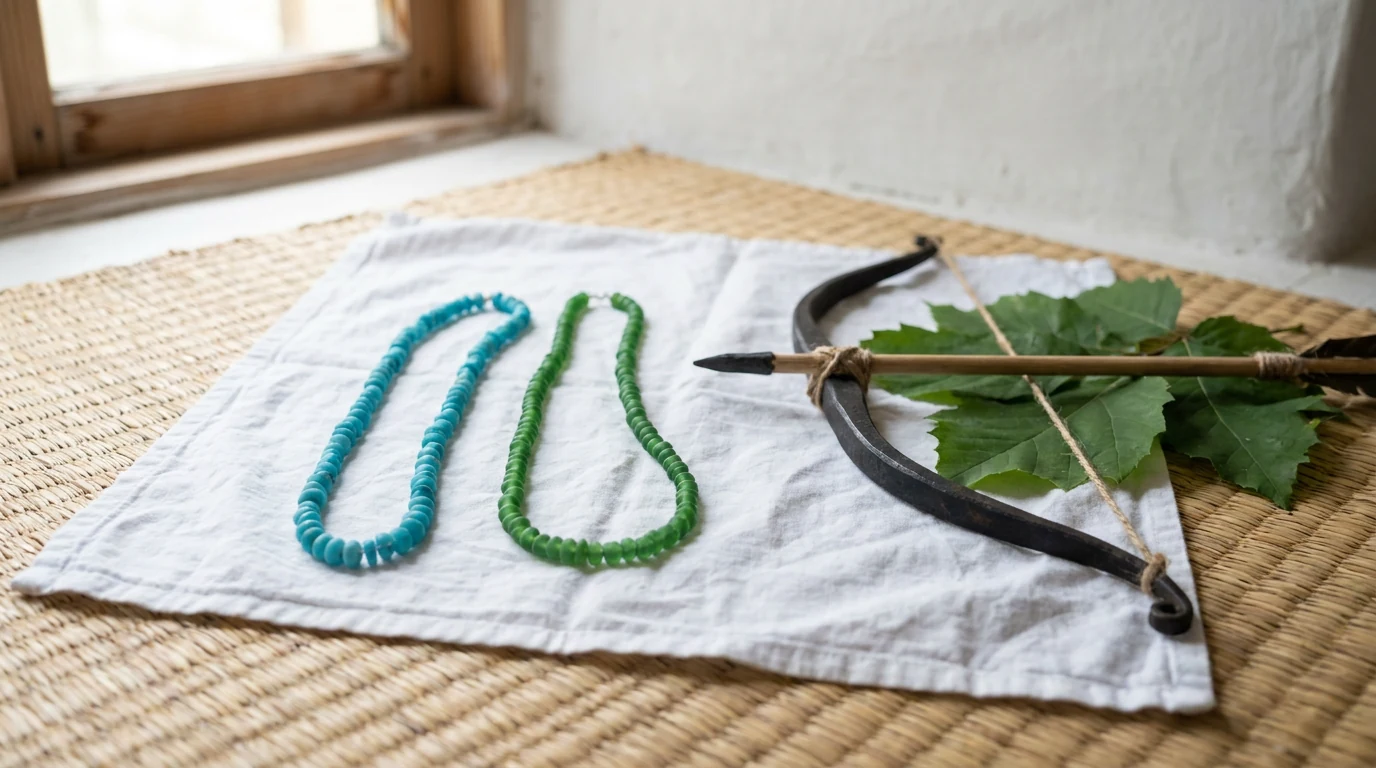
Whoever is looking for an Oxóssi bead necklace usually encounters the same doubt before buying: is the piece green or blue? Both colors are correct, each in its own tradition. In Candomblé ketu, Oxóssi's beads are turquoise-blue, and in Umbanda the necklace is green.
Next, where each color comes from and why green appears even within Candomblé. Then, who can use it, what the Oxóssi and Oxum bead necklaces are, and who consecrates the ready-made piece purchased.
Is the Oxóssi bead necklace green or blue
Turquoise-blue in Ketu Candomblé, green in Umbanda. Reginaldo Prandi registered the turquoise-blue beads in the attributes table of the Ketu rite that he published in Horizontes Antropológicos. The doctoral thesis of Patrícia Ricardo de Souza, defended at USP in 2007, places the two traditions side by side.
| Tradition | Color of the Oxóssi bead necklace |
|---|---|
| Candomblé ketu | Turquoise-blue, with turquoise-blue and green clothes |
| Candomblé, some qualities | Green |
| Umbanda | Green |
| Tambor de Mina | Agüe, the corresponding vodun: green, white and red |
The USP thesis provides a reading for each color. Turquoise reminds us that Oxóssi, hunter of the woods, is the younger brother of Ogum (Ogun), owner of dark blue. Green stays with the plants and the forest, and some qualities of Oxóssi use this color.
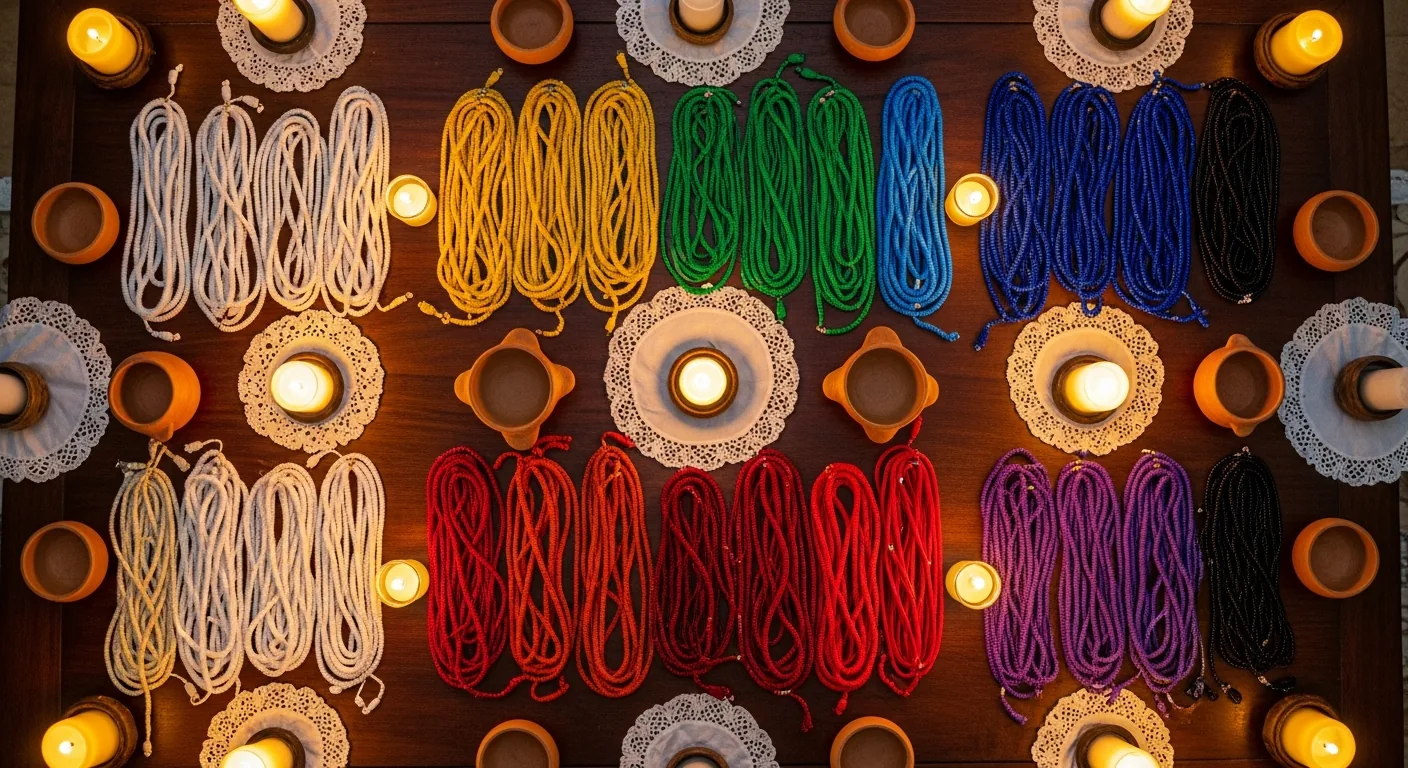
In tambor de mina, the necklace of the corresponding vodun carries the three colors of the table. The color of each orixá, side by side, is in colors of the orixás.
Why does a green Oxóssi bead necklace exist in Candomblé
The Ketu priests interviewed by Luciano Lima Souza in the UESB thesis speak in sky blue, turquoise blue, or light blue, sometimes mixed with white depending on the quality of the orixá.
“Oxóssi uses sky blue. Many use green depending on the quality of the Odé, but in the Ketu nation it is sky blue”
Pai João de Ossayin, babalorixá of ketu, in the UESB thesis
The color also changes by state. The researcher Raphael de Jesus, in the Sacrilegens journal, from UFJF, recalls the anthropologist Raul Lody: in the terreiros of Bahia, Oxóssi wears more light blue tones, and in the Carioca ones, green. The author notes that there are Carioca houses with blue and Baiana houses with green.
Jesus tested if syncretism would explain the exchange, with the Baiano Oxóssi linked to Saint George and the Carioca one to Saint Sebastian. He found no relation to the color and suggests noise in the transmission of tradition between the two states. The history of this correspondence is in Saint Sebastian and Oxóssi.
What is the purpose of the Oxóssi bead necklace
The Oxóssi bead necklace connects the person to the hunter orixá and protects the wearer, provided the house consecrates the piece. Manuel Papai is a Nagô babalorixá of the Pai Adão Culture Center, in Pernambuco. To the Continente Journal, he said that the threads make “a connection between the orixá and matter as an element of protection,” and that without consecration they have “only decorative value.”
Beads in ketu: turquoise blue | Umbanda: green | Day: Thursday | Tool: ofá, the bow and arrow | Taboo for children: eating honey
In Candomblé, the bead necklace also identifies. The person receives the ilequê (or ilequé), the Yoruba name for the bead necklace, consecrated in a ceremony called lavagem de contas. A priest heard in the USP thesis summarized the weight of this for the abiã, who has not yet been initiated: without the bead necklace, "he does not feel part of it".
In Umbanda, Oxóssi is the patron of the caboclos line, and the bead necklaces of his and of the caboclos can have feathers and seeds. The spirit guides of this line are in caboclos in umbanda, and the orixá, in who is Oxóssi.
Oxóssi and Oxum bead necklace: the two readings
The search for an Oxóssi and Oxum bead necklace has two answers with sources. It is worth knowing which is yours before buying.
- The Logun Edé bead necklace. The orixá son of Oxóssi and Oxum uses alternating beads, the turquoise blue of the father and the translucent gold of the mother. Prandi, the USP thesis, and the UESB thesis record this combination. Raphael de Jesus points out that gold with blue is possibly more common in Bahia, and there are houses that combine gold with green. The orixá is in who is Logun Edé.
- The bead necklace of someone who has both orixás. Some houses mix the colors of two orixás in the same piece. Mãe Valda de Pirapama, from ketu, gives the example of someone who is of Ogum and Oxalá (Obatala): seven white beads and seven blue ones.
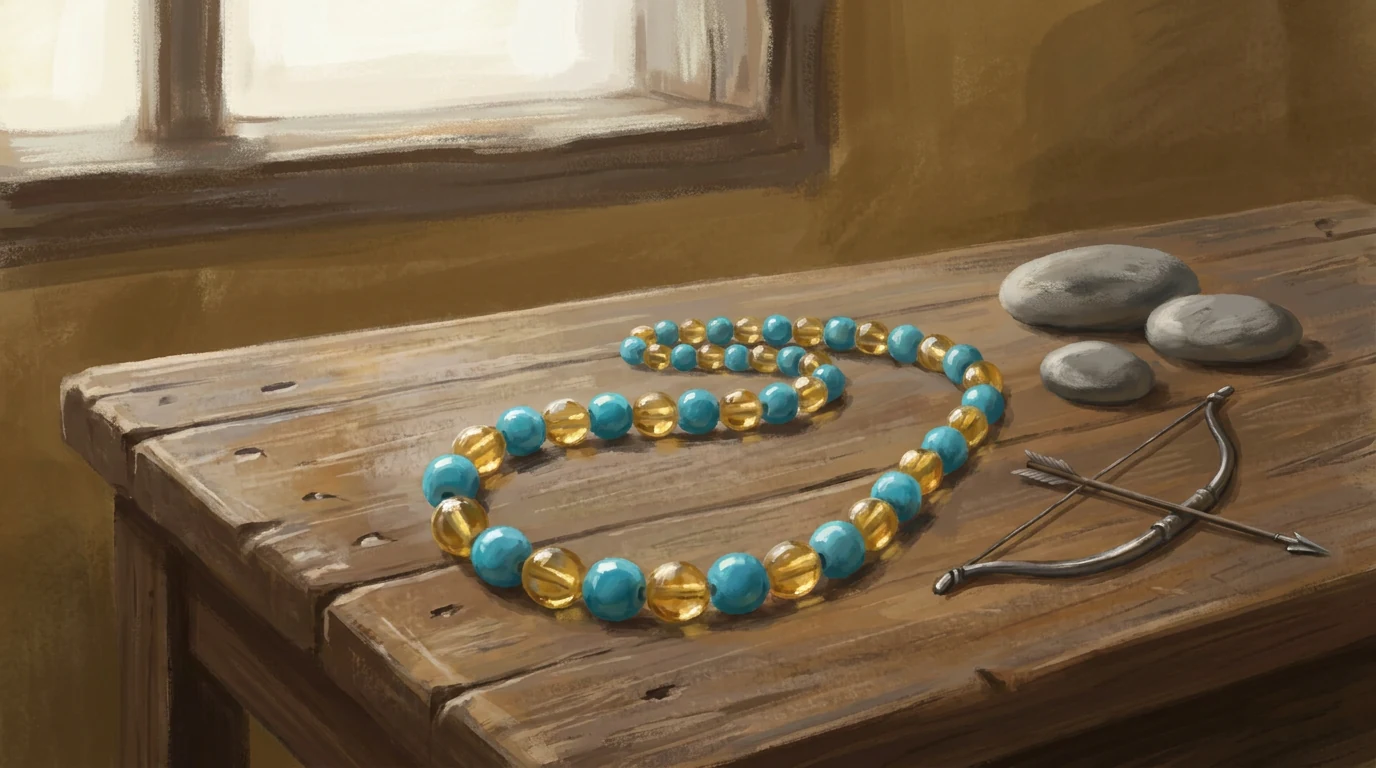
For the son of Oxóssi with Oxum in particular, the sources on bead necklaces do not bring color, order, or count. This bead necklace comes from your house, with the leader.
Who can use the Oxóssi bead necklace
It depends on the tradition and Oxóssi already having been identified as your orixá.
- Son of Oxóssi in Candomblé: the mother or the pai de santo identifies the head orixá in the jogo de búzios, and the person receives the consecrated bead necklace in his colors.
- Abiã: uses only a simple bead necklace, a white one of Oxalá and one of your orixá, when the orixá has already been identified.
- Those seeking Umbanda: the USP thesis records that no one needs to be a devotee to receive a bead necklace (guia). Whoever seeks help at the house can receive the piece, and the protection comes first.
- Those who bought a ready-made bead necklace (guia): can use it, but without consecration it serves as an ornament.
The purchase rule also changes from house to house. Mãe Valda does not accept a bead necklace bought outside the terreiro. Ivo de Xambá, from Olinda, allows the children to buy from any material, because what matters is the rite, and in his house the búzios come before the purchase.
If you still do not know who your orixá is, the orixá test helps open the conversation. The fundamental answer comes from the divination (jogo), performed inside a house.
Bought the ready-made bead necklace (guia): who consecrates it
The Oxóssi bead necklace that leaves the store is raw material for your house. In Umbanda, the head of the terreiro consecrates and crosses every bead necklace: the pai or the mãe de santo, or the spirit guides who head the house, as recorded by the Diário de Umbanda website.
In Candomblé, the consecration is the washing of the beads, done at the terreiro. This rite is done with the house, and no recipe for consecrating a bead necklace (guia) alone replaces the hand of the leader.
Even the number of strands changes. In Candomblé, the dilogum, the bead necklace of the iaô, joins several strands of beads, and the number varies with the nation. The daily use and what to do when the bead necklace breaks are in Ogum bead necklace and in bead necklaces in Umbanda.
Frequently asked questions
Is the Oxóssi bead necklace green or blue?
Both colors exist. In Ketu Candomblé, the Oxóssi beads are turquoise blue, and in Umbanda the bead necklace is green. Some qualities of Oxóssi use green within Candomblé, and blue is more common in Bahia, green in Rio. The correct color is that of your house.
Can someone who is not a child of Oxóssi use his bead necklace?
In Umbanda, a person can receive a bead necklace (guia) without being a devotee, when seeking help at the house. In Candomblé, the orixá bead necklace accompanies the orixá that the jogo (divination) identified, and the abiã uses only the one of Oxalá and that of their orixá. Ask the leader before putting it on your neck.
Can the Oxóssi bead necklace be made of crystal?
Yes, depending on the house. The Diário de Umbanda records bead necklaces made of porcelain or crystal, chosen by the orixá and by his position in the crown of the medium, within the pattern of the terreiro. Sources on the Oxóssi bead necklace do not bring a specific rule for crystal.
Where to buy the Oxóssi bead necklace
At Joia Mística Laroyê you find the material for your house to assemble and consecrate the piece:
- Assembled Oxóssi bead necklaces (guias), in turquoise blue or green, ready for the crossing in your terreiro
- Beads and loose beads in turquoise, green, and gold, for the house that assembles its own bead necklace
- Seven day candles in green and blue for the firmeza of the orixá
- Statues of Oxóssi and ofá, the small metal bow and arrow
Stop by the shop, at Rua Benedito Zingari, 460, Bela Vista, in Extrema-MG, or message on WhatsApp with delivery to all of Brazil.
References
- Reginaldo Prandi: attributes of the orixás in Ketu Candomblé, Horizontes Antropológicos, 1995
- Patrícia Ricardo de Souza: Axós and ilequês, doctoral thesis, USP, 2007
- Luciano Lima Souza: The sacred necklaces of memory, doctoral thesis, UESB, 2019
- Raphael de Jesus: The chromatics of the Orixás, Sacrilegens, UFJF, 2024
- Revista Continente: Threads and beads, 2013
- Diário de Umbanda: bead necklace (fio de contas)