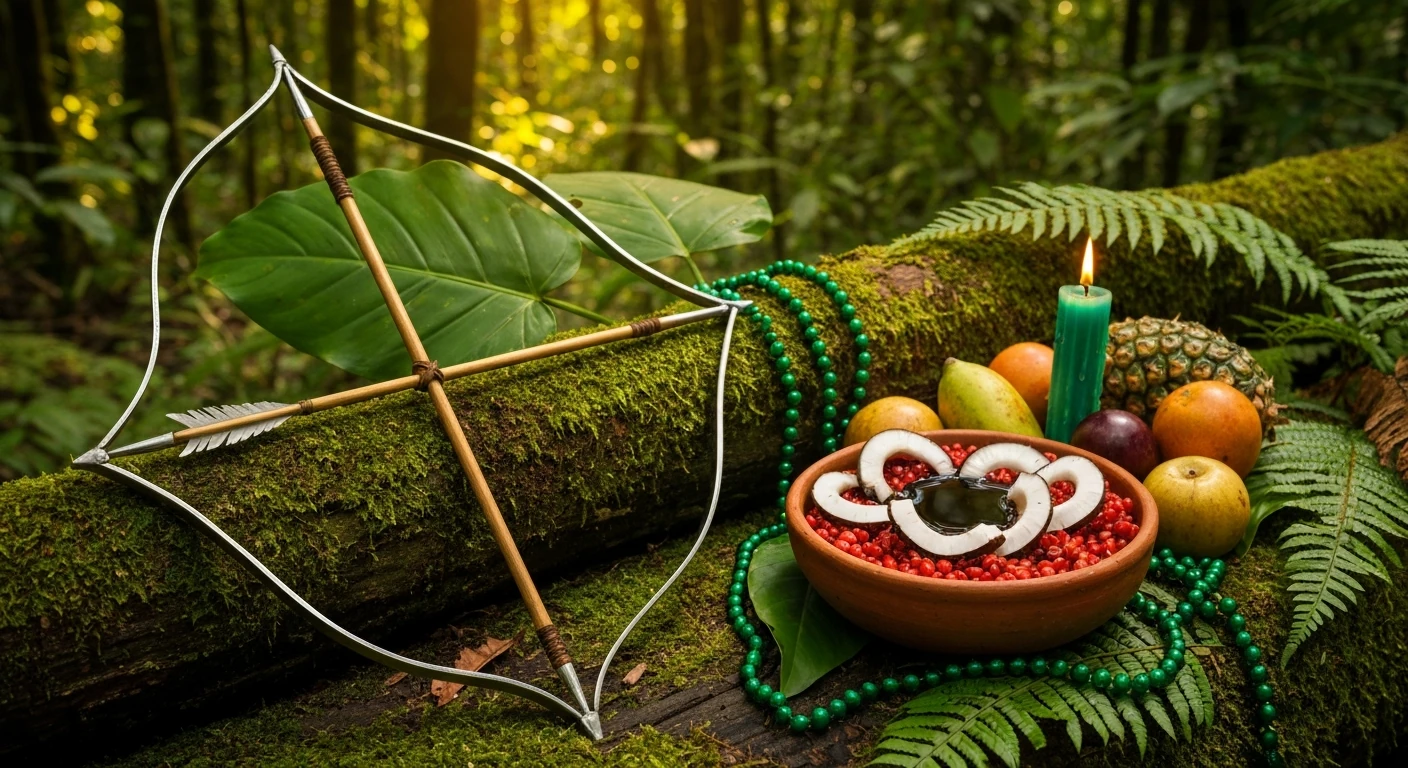
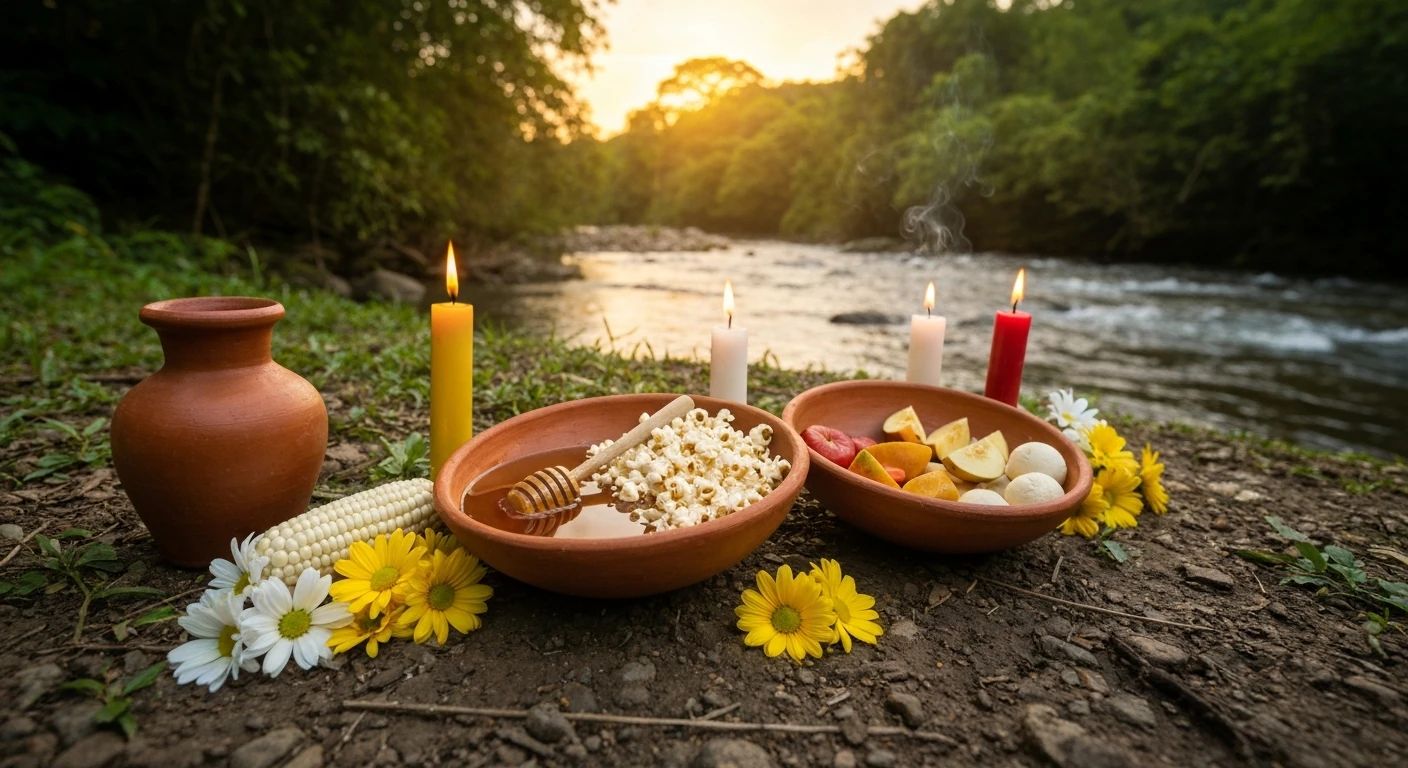
Setting up an offering for Oxóssi is thanking the orixá who sustains the house with what the forest provides. And here is an error that appears in almost every list on the internet: putting honey on Oxóssi's plate, the orixá who has bee honey as a quizila.
This guide shows what to bring, how to set up the axoxô, where to deliver it, and what to leave out. It also separates the offering that any devotee can make from the comida de santo which is terreiro liturgy.
What Oxóssi receives in an offering
The offering to the hunter orixá is made of things from the forest: corn, coconut, light fruits, and green leaf. No strong seasoning and no excess, because Oxóssi is the orixá of the exact hunt, of the single shot that resolves.
- Axoxô: cooked red corn with cane molasses and coconut, his signature food.
- Light and non-acidic fruits: melon in front, plus white guava, pitanga, white grape, green apple, pear, and sugar cane.
- Drink: here there is no consensus. Fruity white wine or moscatel, light beer served in a coité, and coconut water circulate.
- Candle: green in umbanda, turquoise blue or green in candomblé, depending on the house.
- Green leaves: a handful of fresh herbs lining the alguidar or composing the base.
Regarding the color, it is worth noting the divergence instead of fixing one. In candomblé ketu, Oxóssi runs in light blue and turquoise blue. In umbanda, green predominates. Both readings coexist, and the one who decides is the fundamento of the house.
Thursday is his day in most houses, as shown in the list of weekdays of the orixás. The greeting is Okê Arô, which also appears as Oké Arô and Okê Okê. And the container is the clay alguidar, with a quartinha or coité for the drink.
The axoxô, the food of Oxóssi
The axoxô is the dish that identifies the orixá, and it is simpler than it seems. There are three elements: red corn, cane molasses, and dried coconut.
The preparation:
- Cook the red corn only in water, without salt, without sugar, and without any seasoning.
- Drain well and let it cool down. Soaked corn ruins the dish.
- Arrange the corn in the clay alguidar, spread out evenly.
- Pour the cane molasses in a spiral, from the center to the edge.
- Cover with thin slices of dried coconut, without the shell, arranged on top.
A detail that almost no one explains: the axoxô is not exclusive to Oxóssi. The note about the axoxô also records the dish for Ogum (Ogun) and for Olocum, with a different preparation for each. For Ogum, the corn is sautéed with grated onion, dried shrimp, and dendê, without anything sweet. For Oxóssi, it is sweet. The complete recipe for the warrior's offering is in offering for Ogum.
Why honey is a quizila of Oxóssi
This is the point that separates those who studied from those who copied. Bee honey is the strongest quizila of Oxóssi, called the great euó of the orixá. The correct substitution is cane molasses, which is cane honey, a different thing.
A common version in the houses explains it with an itan. Oxóssi took his son Logunedé to the forest to teach him how to hunt. The arrow hit the bird and also a beehive, which fell on the boy's head. Father and son suffered many stings, and Omulu, passing through the forest, healed both with cane water and ginger. Since then, Oxóssi swore never to eat honey again, because the honey reminds him of his son's suffering. This version is not recorded in Verger or in Prandi, and there are other explanations: a kedi from São Luís (MA), heard by the newspaper O Imparcial, says that Oxóssi "does not eat honey because he was raised inside a bee cocoon."
Like every itan, this narrative has different versions and does not count as a historical fact. It serves as the foundation that tradition gives to a very concrete table rule: in Oxóssi's dish, molasses goes in, not honey.
In Ketu Candomblé, the taboo is not just on the plate: in sociologist Reginaldo Prandi's table, "eating honey" is a taboo for the children of Oxóssi. What this changes for those who belong to the orixá is in children of Oxóssi.
Here lies an honest divergence. Some Umbanda houses use honey in offerings to Oxóssi: the Terreiro de Umbanda Pai Maneco, in Curitiba, offers the orixá an amalá with "well roasted moganga with corn inside covered with honey". The majority norm is cane molasses, and those with a house follow the house's precept. If you are from a terreiro, ask first. The whole subject is in quizilas no candomblé.
Regarding citrus fruits, orange and lemon appear in several lists as things to avoid. This is a widespread custom, not established in a strong source. Stick to light fruits and move forward.
How to set up the offering step by step
The assembly is simple, and the intention weighs more than the flourish.
- Take a ritual bath and put on clean clothes, preferably light ones.
- Line the alguidar with fresh green leaves, if your house uses this resource.
- Place the axoxô in the center, already ready and lukewarm.
- Arrange the fruits around it, in 3, 5, or 7 qualities, washed and whole.
- Serve the drink in the quartinha, in the coité or in the gourd, next to the alguidar.
- Light the candle and speak your intention in simple words, without bargaining.
- Hail the orixá with Okê Arô and leave the dish settled firmly on the ground.
The count of 3, 5, or 7 types of fruits is a very common custom, with 7 being the most common. Treat this as a guideline for good practice, not as a closed rule. If you want to understand the gesture behind any offering, the base text is how to make an offering to the orixás.

Where to deliver and how to collect
Oxóssi is the lord of the forest, and the forest is his place. The delivery goes to the forest, the garden, or at the foot of a leafy tree.
Careful details that make a difference when choosing the spot:
- Ask for permission before entering the forest. The terreiro calls this asking for agô.
- Avoid termite mounds and anthills, because the plate will turn into animal food in minutes.
- Never leave it in the trash and never on the street. The street belongs to Exu (Eshu), not to Oxóssi.
- Do not use plastic under the alguidar or any packaging that remains in the forest.
- Collect the material on the third day, the most cited custom: alguidar, candle, and any packaging.
This last point is worth insisting on. Cleaning up afterward is part of the offering. Leaving broken dishes and melted candles in the forest is not a precept, it is litter, and it harms the image of Afro-Brazilian religions precisely where they need respect the most.
In Umbanda, Oxóssi appears very linked to the caboclos, the spirits of the forest who work in his line. And in syncretism, he receives Saint Sebastian in Rio and the South-Central region, Saint George in Bahia, and Saint Michael the Archangel in Pernambuco, a subject treated in Saint Sebastian and Oxóssi.
A devotee's favor and a santo's food are not the same thing
The distinction is worth making because it avoids frustration. What this guide teaches is the domestic offering, the gesture of reciprocity that the devotee makes at home or in the forest.
The comida de santo of the terreiro is something else. It requires prayer, oriki, and chants, and is prepared by the Iyá Basé, the one responsible for the ritual kitchen, with the quizilas of each assentamento observed case by case. This is the liturgy of the house, prescribed by the babalorixá or by the ialorixá.
Whoever has an obrigação to fulfill fulfills it at the house. An agrado does not replace an obrigação, and no offering buys a result. It gives thanks, firms the relationship, and organizes the intention of the one who offers. To know the orixá behind the dish, the text is who is Oxóssi.
Frequently asked questions
What can I offer to Oxóssi?
Axoxô, which is red corn cooked in water with cane syrup and sliced dried coconut. Next to it, place light and non-acidic fruits such as melon, white guava, white grape, and green apple. Add a drink without strong alcohol, fresh green leaves, and the candle in the color your house uses for its firmeza.
Does Oxóssi eat honey?
No. Bee honey is the strongest quizila of Oxóssi, registered as the great euó of the orixá. Use melado de cana, which is cane honey and not bee honey. Some Umbanda houses use honey, and in that case, the precept of the house is what counts.
What is the day of Oxóssi?
Thursday in most Brazilian houses, both in Candomblé and in Umbanda. The strongest festive date is January 20, linked to Saint Sebastian in the syncretism of Rio de Janeiro and the Center-South. Some lists mention other days, without consistent basis.
Where to leave the offering of Oxóssi?
In the woods, in a garden, or at the foot of a leafy tree, far from a termite mound and an anthill. Never in the trash and never in the street. Collect the alguidar, candle, and packaging on the third day, because the cleaning of the point is part of the ritual.
How many fruits should I take for Oxóssi?
The most cited custom speaks of 3, 5, or 7 qualities of fruits, with 7 being preferred. It is not a closed rule, it is guidance for good use. Prefer light, firm, and non-acidic fruits, washed and whole, and avoid quantities that will rot in the woods.
Where to buy the material for the Oxóssi offering
At Joia Mística Laroyê, you find forest material with provenance:
- Clay alguidares: in the sizes the offering requires, from small to gamela size
- Green and blue candles: individual, seven-day, and in pairs
- Quartinhas, coités, and gourds: for the pleasing drink
- Oxóssi bead necklaces: assembled in green or turquoise blue, or in loose beads for the house to consecrate
- Fresh and dry herbs, pemba, and statues: for the firmeza that your leader instructs
Stop by the shop, at Rua Benedito Zingari, 460, Bela Vista, in Extrema-MG, or message on WhatsApp with delivery to all of Brazil.
One last word. Oxóssi is the orixá of abundance conquered with aim, not with haste. A small, clean, and well-intentioned offering is worth more to him than an alguidar full of wrong things.
References
- Wikipedia: entry about the axoxô, with the ingredients, the preparation by orixá, and the note that bee honey is the great euó of Oxóssi
- Wikipedia: entry about Oxóssi, with colors, day of the week, greeting, and the syncretism by region
- Candomblé: text about the food of the orixás, the role of the Iyá Basé, and the delivery at the foot of a tree
- Prandi, Horizontes Antropológicos (UFRGS, 1995): Deuses africanos no Brasil contemporâneo
- Terreiro de Umbanda Pai Maneco: Oxóssi, King of the forests
- O Imparcial (2017): Find out which foods the orixás consume
- National Sanctuary of Umbanda: guidance for an offering to Oxóssi with fruits, cooked corn and beer served in a coité, plus the green of the forests and the day January 20