The Caboclo das Sete Encruzilhadas is the spirit of the medium Zélio de Moraes that tradition links to the foundation of Umbanda in 1908 [C8, C12]. In the house he founded, the Tenda Espírita Nossa Senhora da Piedade, he is called the Chief [C35, C50]. He is not Exu Sete Encruzilhadas: the names are similar, but the line and history are different.
Who is the Caboclo das Sete Encruzilhadas
He is the caboclo who, according to tradition, manifested in Zélio Fernandino de Moraes during a spiritist session in Niterói on November 15, 1908. The next day, according to the house's version, he founded the Tenda da Piedade in Neves, São Gonçalo [C8, C12]. The date became the Day of Umbanda, established by federal law in 2012.
Name: Caboclo das Sete Encruzilhadas | Nickname in the house: the Chief | Medium: Zélio de Moraes | House: Tenda Espírita Nossa Senhora da Piedade | Line: Ogum or Oxóssi, depending on the source
The Caboclo is not just a story. He appears in a 1933 book by Leal de Souza, who presided over one of the tents founded by him. Leal says that the Caboclo had been working "for twenty-three years" and directed four tents. The complete scene of 1908 was only published decades later, and there is no record of the session [C15, C18]. Therefore, researchers speak of an origin myth, without denying the value he has for those who are of Umbanda.
He is not Exu Sete Encruzilhadas
The name is the same, the spirit is not. The Caboclo is a spirit of the caboclo line. Meanwhile, "sete encruzilhadas" is a territory name used by many Exus and Pombagiras.
| Caboclo das Sete Encruzilhadas | Exu and Pombagira das Sete Encruzilhadas | |
|---|---|---|
| Line | caboclo | left |
| Name | a spirit guide linked to Zélio, with the name explained in 1933 | territory nickname of several Exus and Pombagiras |
| The crossroads | the place where he did not know which path to take | point of strength of the left |
| In the Tenda itself | point "Hail the Sete Encruzilhadas", in the Oxóssi section | point of Seu Sete Capas, "Owner of the Sete Encruzilhadas", in the Exu section |
The research by Jean Favaro and Hieda Corona, from UTFPR, lists several that bear the name. Among them are Exu Rei das Sete Encruzilhadas, Exu Sete Encruzilhadas and Pomba-gira das Sete Encruzilhadas. The Tenda da Piedade's own book of points separates the two: the Caboclo in the Oxóssi section and Seu Sete Capas in the Exu section. Who is the homonymous Exu is in Exu Sete Encruzilhadas.
Where the name comes from: the seven paths
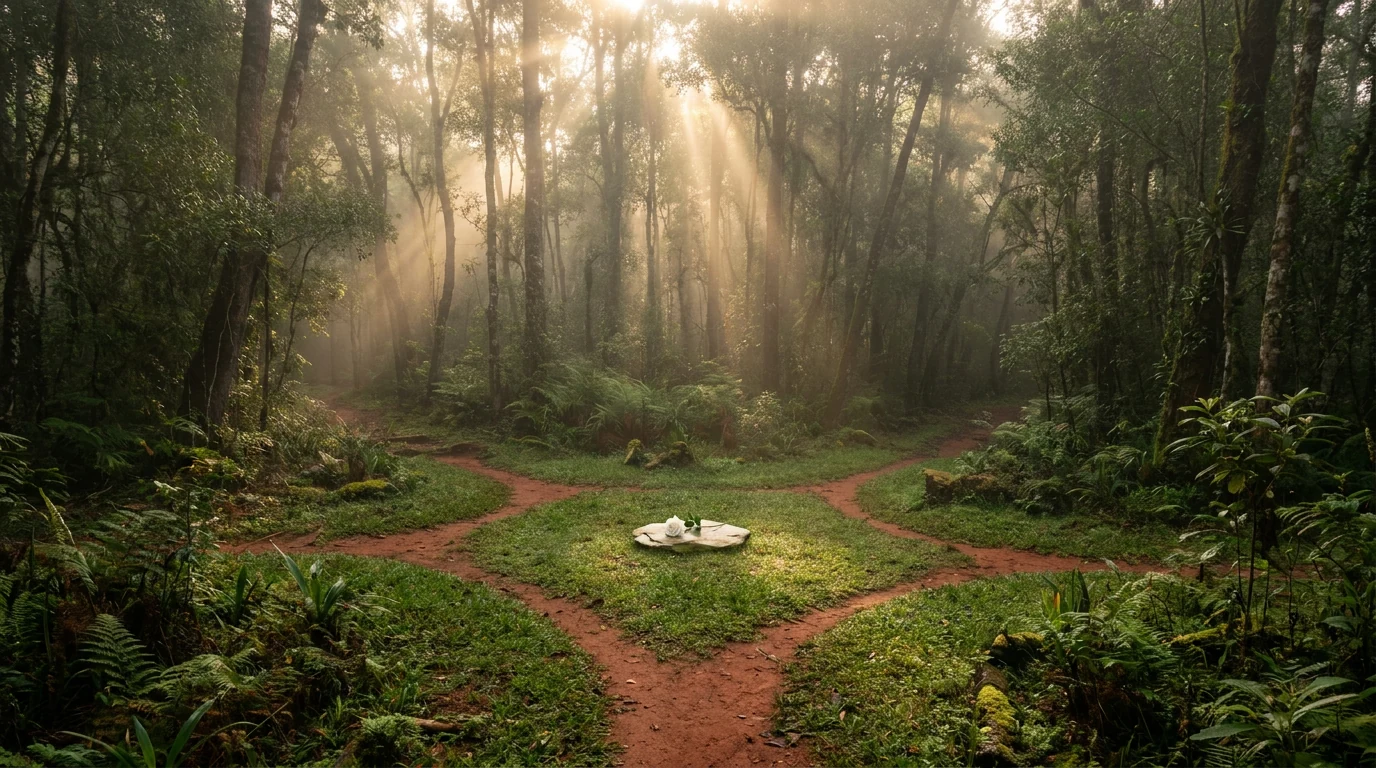
The oldest record of the meaning of the name is in the book by Leal de Souza, from 1933. The spirit was in space, "at the intersection point of seven paths, crying without knowing which way to go", when Jesus appeared to him. Jesus showed him the mission, and he took the name from the number of paths that disoriented him.
Leal also tells of the first appearance to the seers: a middle-aged man, in a white tunic, with a sash on which the word "Caritás" shone. And he supposes that, in some incarnation, he was a priest, without saying which one.
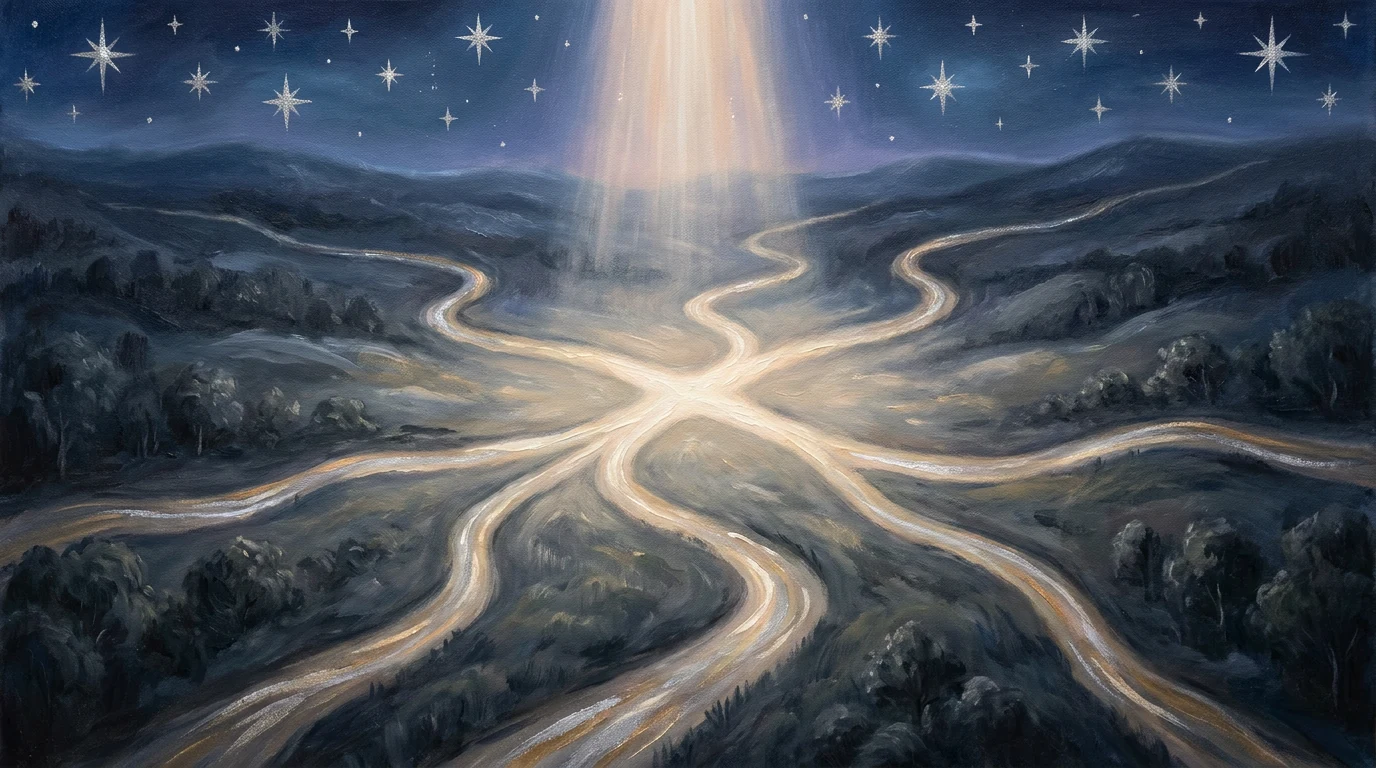
Tradition keeps another reading of the name, in the phrase attributed to the Caboclo in the 1908 session:
“And if you want to know my name, let it be Caboclo das Sete Encruzilhadas, because there will be no closed paths for me.” (phrase attributed by tradition, in Oliveira, 2013)
For the sociologist Fiorotti, heard by the BBC, the crossroads is where “there is no closed path”, and “seven crossroads” is “the infinity of possibilities”.
Ogum or Oxóssi: the Caboclo line
Sources diverge, and the house itself tells of the divergence. Leal de Souza places the Caboclo in the Ogum Line. In a recording of the Tenda's 63rd anniversary, the Caboclo himself, embodied in Zélio, says he is from the Oxóssi Line.
The Tenda's book of sung chants gives reason to both readings. The sung chants that name him are in the Oxóssi section. But the opening sung chant sings “Seven crossroads in your terreiro / And Ogum in every gira”.
In the houses, he is greeted like the other caboclos. “Okê Caboclo” is an adaptation of the greeting “Okê Oxóssi”, according to the historian Lourival Andrade Júnior. “Okê Arô” is also said to the caboclos [D7, D8]. No source records a greeting only for him. The entire line is in caboclos in umbanda.
Gabriel Malagrida: the past life that the account gives him
The account that was established later says that the Caboclo was, in a past life, the Jesuit Gabriel Malagrida. In the recording of the 63 years, the Caboclo himself speaks of the incarnation as Malagrida, according to the Tenda's description.
Malagrida had a strong source. He was born in Menaggio, in the Milan region, and became known as the "apostle of Brazil" for the missions in Pará and Maranhão, according to the National Archive. Condemned by the Inquisition, he was strangled and burned in Rossio, in Lisbon, in September 1761 [D3, C38]. He was the last defendant of the Portuguese Inquisition to suffer the death penalty, according to RTP. The process is in the Torre do Tombo.
A detail corrects many pages: Malagrida was not burned alive. The garrote came before the bonfire [C38, D3, D5].
The identification came with time. Leal de Souza, in 1933, only speaks of a priest. The historian Artur Cesar Isaia, from UFSC, records that Leal "does not assume" the Malagrida version. For the dissertation by André Pereira, from CEFET/RJ, it was first said that he had been "a priest in a past life". Only with time did the priest gain the name Malagrida.
Pai Antônio and the points: how the house remembers him
The Caboclo did not work alone. Leal de Souza already describes, in 1933, a preto-velho of the house, Pai Antônio, smoking a pipe during the ritual work. The narrative places Pai Antônio arriving shortly after the Caboclo, in 1908. Who the pretos-velhos are is in pretos-velhos in Umbanda.
In the Tenda da Piedade, today in Cachoeiras de Macacu (RJ), the spirit guides "act under the command of the Caboclo das Sete Encruzilhadas", and the service is individual and free. The house does not use atabaque, clapping, or dance. The mediums work in white and barefoot, "according to the determinations of the Chief".
The house also keeps what he left behind. There is a message from the Chief dated December 21, 1919, and a psychography called "Peace", signed as "the smallest of the spirits". And there are the points. One of them opens the sessions of the Tenda to this day:
“And at the break of dawn / Until the late early morning / The Caboclo turns / Of the Seven Crossroads” (Book of Chanted Points of the Tenda Espírita Nossa Senhora da Piedade)
In other houses, he is remembered especially on November 15, with a festive session in honor of the spirit guide and the medium. The medium's life is in Zélio de Moraes. In your house, does the tribute call for a white candle or white roses on the congá? Joia Mística confirms the material via WhatsApp.
Frequently asked questions
Which caboclo founded Umbanda?
According to tradition, the Caboclo das Sete Encruzilhadas, manifested in Zélio de Moraes on November 15, 1908, in Niterói. The next day, according to the house's version, the Tenda Espírita Nossa Senhora da Piedade was born. Researchers treat the episode as a myth of origin, because the religion was formed over decades.
Is the Caboclo das Sete Encruzilhadas the same as Exu Sete Encruzilhadas?
No. The Caboclo is a spirit guide of the caboclo line, linked to Zélio de Moraes. “Sete encruzilhadas” is also the name of the territory of several Exus and Pombagiras, from the left. The Tenda da Piedade's own book of points separates the two: the Caboclo in the Oxóssi section and Seu Sete Capas in the Exu section.
Who was the Caboclo das Sete Encruzilhadas in a past life?
The later account says he was the Jesuit Gabriel Malagrida, a missionary in Brazil, strangled and burned in Lisbon in 1761. Leal de Souza, in 1933, only said that he had been a priest. Researchers read the identification with Malagrida as a layer added over time.
What is the line of the Caboclo das Sete Encruzilhadas?
Sources diverge. Leal de Souza, in 1933, places him in the line of Ogum. In a recording from the Tenda's 63rd anniversary, the Caboclo himself says he is from the line of Oxóssi, and the house's point book places him in the Oxóssi section. If you want to know which line suits you, take the test discover your spirit.
References
- SOUZA, Leal de. Spiritism, Magic and the Seven Lines of Umbanda, 1933. PDF from Instituto Mata Verde
- ANDRADE JÚNIOR, Lourival. Mneme (UFRN), 2014. The caboclos in Afro-Brazilian religions
- National Archive. Glossary of Luso-Brazilian History. Malagrida, Father Gabriel
- RTP Ensina. Execution of Father Gabriel Malagrida, in Lisbon
- PEREIRA, André Luiz Freire. Dissertation, CEFET/RJ, 2023. History and memory of Umbanda