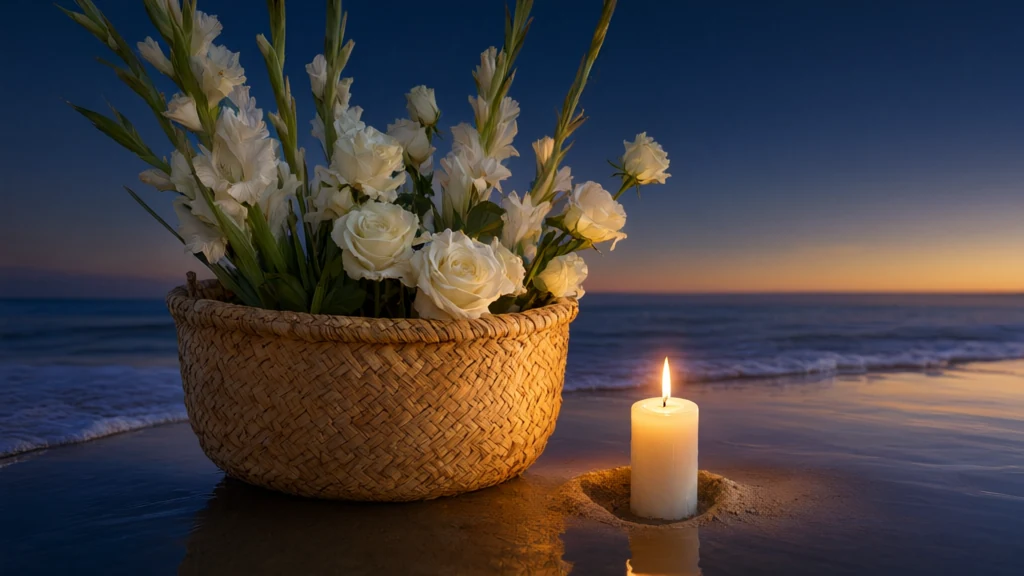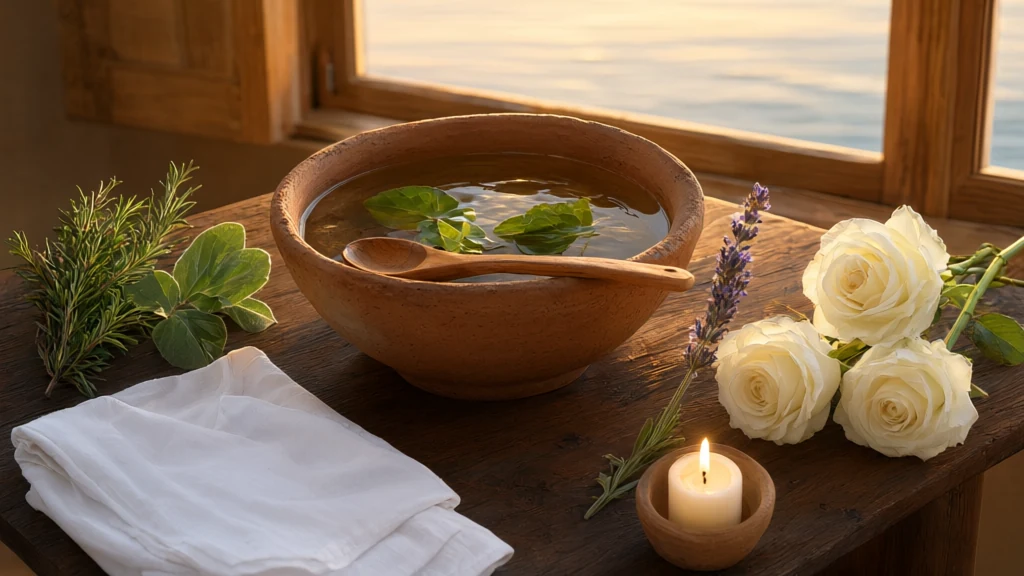
The new year bath is taken before the turn, in two stages: first a cleansing bath, then a sweet bath, linked to prosperity. In the researched terreiros, the cleansing uses rue and guinea hen weed, and the sweet bath, rosemary and lavender. Both go from the neck down. The leaves of the orixá (orisha) change from house to house.
Which herbal bath to take on the new year?
For the turn, take first a cleansing bath and then a sweet bath. In 27 terreiros on the Island of Santa Catarina, UFSC researchers record exactly these two types. The cleansing, or descarrego, removes dense energies. The harmonization, called sweet, serves to bring prosperity or joy.
Each one asks for different leaves, according to the same research:
- Cleansing: strong leaves, such as rue, path-opener herb and guinea hen weed.
- Sweet bath: soft leaves, such as rosemary, lavender and mint.
The order also appears in the market. In Ver-o-Peso, in Belém, the herb sellers sell the virada kit like this: descarrego bath, flame bath, scent bath and, finally, the house smoke cleansing (defumação). Those who prefer salt instead of strong leaf find the precautions in coarse salt bath.
Tip: the cleansing opens space. The sweet bath occupies that space. Taking only the descarrego on the night of the party leaves the second half of the path to be done.
The leaves of Oxalá, Iemanjá, and Oxum at the turn of the year
The leaves of the orixá depend on the house, and the published lists do not match each other. The Federation of Umbanda and Candomblé of the State of São Paulo (FUCESP) gives "some herbs" for each orixá, a list that it itself declares partial.
| Orixá | Leaves on the house list | What is most recorded |
|---|---|---|
| Oxalá | boldo (tapete de Oxalá), saião, white mallow, white rose | the boldo-de-Oxalá enters a cleaning ritual bath in Santa Catarina; in Rio in 1985, rosemary was a plant dedicated to Oxalá |
| Iemanjá | lavender, colônia, pariparoba, white rose | white roses and colônia perfume are her offering in the same record |
| Oxum | catinga de mulata, oriri, malmequer, jasmine | in Rio in 1985, colônia was called erva-de-oxum and entered the descarrego of the children of Oxum |
The colônia shows how the list changes: the São Paulo federation puts the leaf in Iemanjá, and the survey from the Rio Botanical Garden calls it erva-de-oxum. The Oxum record from FUCESP says it "gives wealth", a starting point for those who think of it for the sweet ritual bath. The colônia, the tapete de Oxalá, and the white rose have their own records on the site.
The white of Oxalá and the yellow of Oxum also go in the clothing, as the colors of the new year tell. Whoever rules the year in your house is in ruling orixá of 2027.
What the stalls sell for the turn of the year
In the center of Rio, the most sought after leaves at the end of the year are macassá, levante, basil, rue, lavender, rosemary and sage. At Ver-o-Peso, the turn of the year scent ritual bath includes basil, catinga de mulata, chama, manjerona and patchouli. It is the same catinga de mulata that FUCESP puts on Oxum.
When to take the new year bath?
The new year bath is taken on the 31st, before the turn, and there are houses that take it by the water. In an Umbanda house in Brasília, Mãe Cicera da Oxum takes the people to the edge of the lake, the river or the sea. There, she says, "we take our scent and herb ritual bath, before the turn".
Those who do not go to the water take the bath at home, in the same order, and wear light clothing. Mãe Nilce de Iansã (Oya), an ialorixá heard by Agência Brasil, suggests the sea, river and waterfall bath. What is taken to the sea on the night of the 31st is in Iemanjá in the new year. To pray after the bath, the six prayers of the turn are in prayer for the new year.
How to make the new year bath at home
The common leaf bath is prepared in two ways. The steamed one involves boiling water over the leaf. The cold one involves the fresh leaf macerated in water, without fire. The steps below combine rules recorded in houses in São Paulo and Pará:
- Separate a pot or basin only for the bath. A mãe de santo asked that the food pot never be used.
- Prepare the cleansing bath. Boil the water, put in the leaf, wait a few seconds and turn off the fire.
- Stir with a wooden spoon, without putting your hand in the water during preparation.
- Strain and wait to cool. Do the same with the leaves of the sweet bath, which can be cold, macerated in water.
- Pour each bath from the neck down, after the hygiene bath>
- Do not dry yourself and put on light-colored clothes. Return the used leaves to a garden or running water.
Fresh leaf or dry herb of known origin serve for both baths, and at Joia Mística there are dry herbs and a white candle for those who light one during the prayer request. The temperature of each leaf is in hot and cold herbs, and those who want another bath for their moment can use the test of which bath to take.

From head to toe or from the neck down?
From the neck down, the houses say. The São Paulo federation explains that a boiled bath does not go on the ori, because "nothing boiled should be placed" on the head. At the counter, the rule is different. The herbalist from Rio says to "throw from head to toe". In a Mina house in Pará, the cold leaf goes on the body and on the head, and the hot one is boiled beforehand.
What stays with the house: abô, amaci and the obligation of the turn
The simple leaf bath is yours; what goes on the head and the turn rite belong to the house. In the São Paulo terreiro studied by Pedro Carlessi, amaci and smoke cleansing (defumação) stay with mothers and fathers of santo and iabás. FUCESP says that the amaci follows the orientation of whoever directs the terreiro.
In Nagô Candomblé from Pernambuco, the herbal bath has a Yoruba name: abô, a process of purification and strengthening done in the terreiro. What it is and who prepares it is in what is abô; the amaci, in what is amaci.
Candomblé leaders heard by Alma Preta call the turn of the year "an act of renewal of life and cycles". It is time for jogo to hear the orixás about the coming year. There are houses that perform initiations and obrigações during this period. If your house scheduled an obrigação on the turn, the bath that counts is the one they provide. The other gestures of the night are in New Year rituals and in New Year simpatias.
What not to do in the turn bath
- Do not drink the ritual bath. Botanist Aline Saavedra, from UERJ, recommends caution with any ingestion.
- Do not buy ground dry leaves without knowing what they are. According to the same researcher, ground dry leaves are difficult to differentiate.
- Do not mix leaves on your own. A priest from a Mina house warns that the wrong combination can cause "shocks" and "aquizilamentos".
- Do not use raw toxic leaves. Comigo-ninguém-pode and espada-de-são-jorge, in a Mina house in Pará, only enter boiled.
- Do not expect a miracle. Mãe Nilce says there is no universal recipe, and the UERJ researcher reminds us that no research measures the protection of the ritual bath.
If the house you attend passed a leaf that you cannot find, Joia Mística helps check the material via WhatsApp.
Frequently asked questions
Can you take a New Year's ritual bath without being from Umbanda or Candomblé?
You can. In the terreiros of Santa Catarina studied by UFSC, common ritual baths are indicated for initiates and non-initiates, and the one who chooses the leaf is usually the priest. A simple leaf ritual bath from the neck down does not require initiation. Amaci and abô, yes, follow the house.
Rosemary or boldo ritual bath for the New Year: which to choose?
It depends on the moment of the ritual bath. Rosemary appears in the sweet ritual bath, for harmonization, and boldo-de-Oxalá, in the cleansing ritual bath, according to the UFSC research. Both have a connection with Oxalá in sources from different houses. One does not replace the other. One cleanses, the other sweetens.
Does a sea bath count as a New Year's ritual bath?
For Mãe Nilce de Iansã, ialorixá from Baixada Fluminense, yes: she indicates sea, river, and waterfall baths for those who want to take care of themselves at the end of the year. In an Umbanda house in Brasília, the herbal bath is taken by the water, before the turn.
References
- Pagnocca, Zank and Hanazaki, UFSC (2020): The plants have axé
- Pedro Carlessi, Museu Goeldi (2017): Ways, subjects and affections in Umbanda
- Barboza and others, UFPA (2021): Without the plants the religion would not exist
- Guedes and others, Rodriguésia (1985): Plants used in Afro-Brazilian rituals in Rio de Janeiro
- Rennan Peixe, UFPE (2016): Abô, the Ayran ritual bath
- FUCESP: Amacis and ritual baths, Oxalá, Iemanjá and Oxum
- Agência Brasil (2025): Ritual baths and herbs at the end of the year
- Correio Braziliense (2024): New Year's Eve at Prainha dos Orixás
- Alma Preta (2024): The end of the year in Candomblé and Umbanda
- Diário do Pará (2022): Scented ritual baths at Ver-o-Peso