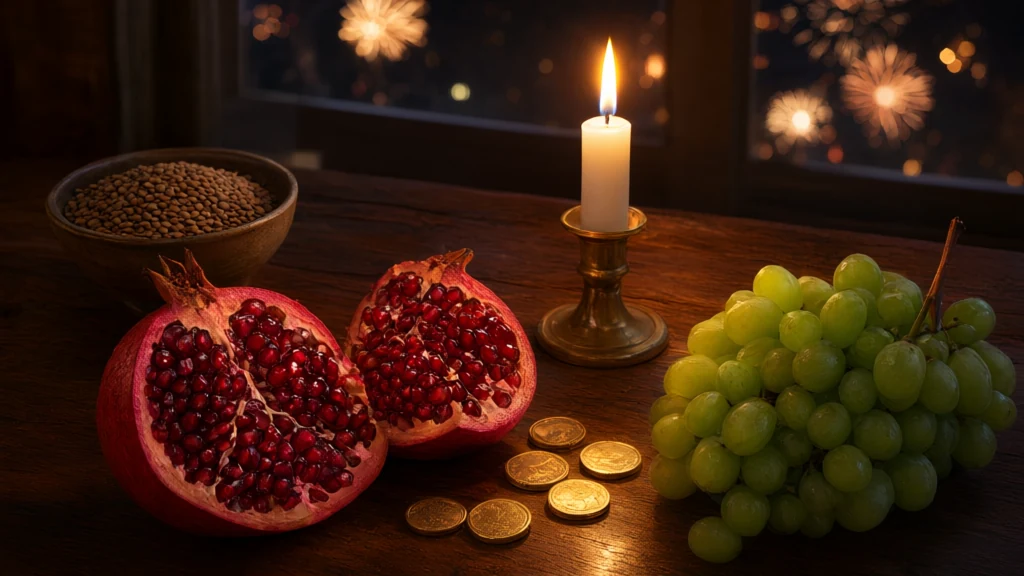
The most common New Year folk charms in Brazil are the pomegranate one, the 12 grapes one, the lentil one, and the note in the wallet one. Each one asks for a small gesture at midnight. The pomegranate one is also done on Three Kings Day, January 6. None of them come from Umbanda or Candomblé.
What are the New Year folk charms and how to do each one?
The four most sought after New Year folk charms use food or money as a sign of what is asked for the year:
| Folk charm | How to do it | Where it comes from |
|---|---|---|
| Pomegranate | seeds swallowed, thrown back, and kept in the wallet | popular Catholic custom of Three Kings Day |
| 12 grapes | one grape for each midnight chime, with a prayer request on each | Spain, late 19th century |
| Lentil | one spoon right after midnight | Italy, by the shape of a coin |
| Note in the wallet | a note kept in the wallet or in the shoe at the turn | origin not located |
The logic is the same in all four. Anthropologists Glenn Shepard and Helbert Prado studied folk charms in Brazil. They describe a reasoning in which the similarity of quality brings similarity of effect. The lentil resembles a coin, the pomegranate is full of seeds, and twelve grapes resemble twelve months.
No folk charm has a proven result, and the press itself that teaches the recipes says so. They are a way to mark the desire for the year.
Pomegranate folk charm: how to do it at the turn and on Three Kings Day
The pomegranate folk charm is done with three seeds swallowed, three thrown backward and three kept in the wallet. Meanwhile, it is said: "Gaspar, Belchior and Baltazar, may money not come to lack me." It is the version that the Estado de Minas recorded for Three Kings Day.
- Open the pomegranate and separate nine seeds.
- Swallow three, making the prayer request.
- Throw three back, over your shoulder.
- Wrap the last three in a piece of paper and keep them in your wallet until the next year.
How many pomegranate seeds to keep in the wallet?
Three is the most common count. Some double it to six, "in reference to day 6," when the Three Wise Men visited the Baby Jesus. There is no right number: each family passes down its own version.
Is the pomegranate for New Year or on Three Kings Day?
Tradition places the pomegranate on Three Kings Day, January 6, and many people move it forward to the New Year's Eve. A priest heard by the newspaper sees in the custom the hope for abundance in the new year. "That is also why the connection with the seed," he said.
The names Gaspar, Belchior, and Baltazar are not in the Bible. The Gospel of Matthew speaks only of "magi" coming from the East, with gold, incense, and myrrh. It does not say how many there were or what they were called.
The origin of the folk charm has no documentation. The press says the custom "came from Greece," where the fruit is broken on the ground, but without a source. In the Jewish New Year, Rosh Hashaná, pomegranate is also eaten. According to Rabbi Yehuda Shurpin, from Chabad.org, the desire is for a year with as many merits as the seeds of the fruit. It is a parallel, not the origin of the Brazilian folk charm.
Where does the folk charm of the 12 grapes come from?
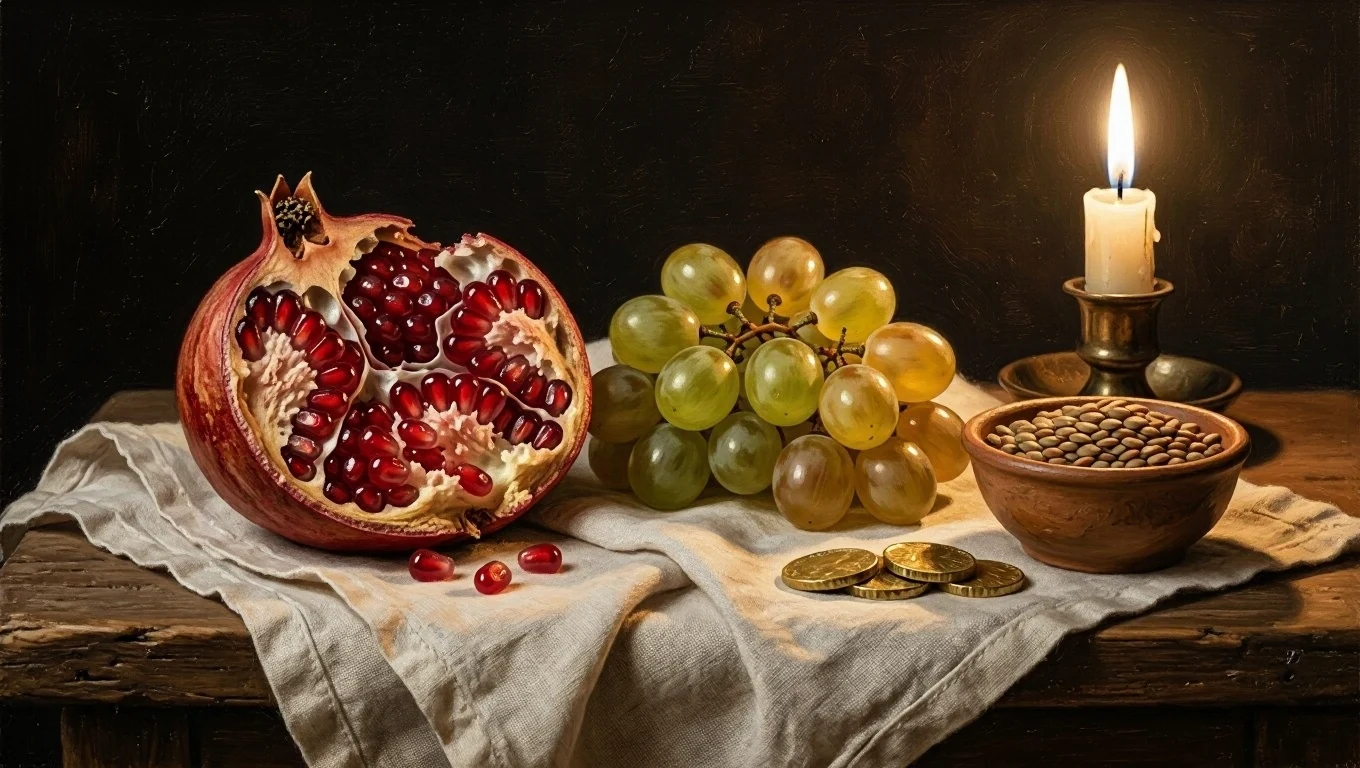
The folk charm of the 12 grapes comes from Spain, where one grape is eaten for each stroke of midnight. The custom has appeared in Madrid at least since 1895.
The most told story is that of a bountiful harvest in Alicante in 1909. Producers supposedly moved the grapes with the folk charm. The newspaper The Olive Press shows that newspapers at the end of the 19th century already spoke of the twelve grapes before that harvest. One of the versions links the custom to 1882, when people from Madrid supposedly mocked a mayor's order against street parties.
How to do it: separate 12 grapes before midnight. With each chime, eat one and make a prayer request. No one knows for sure if the twelve comes from the months or the chimes.
What to do with the grape seeds?
Versions circulating on the internet say to keep the seeds in your wallet until the next turn of the year, like the pomegranate. The sources we opened only record the custom of eating the grapes, and each family does it their own way.
Lentil folk charm: why eat it on New Year's
The lentil folk charm is to eat a spoonful of the grain right after midnight. The custom comes from Italy, brought to Brazil by immigrants, with the saying "lentils on New Year's, money all year long".
The Italian newspaper Il Post explains that the lentil resembles coins and therefore became a wish for wealth for the year. The same text says that in ancient Rome, small bags of lentils were given on the last day of the year. But it warns that this version comes from oral tradition, not from documents of the time.
Does the lentil have its origin in the Bible?
The story circulates that Esau traded his birthright for a plate of lentils and then became rich. The text of Genesis says something else: Jacob gave Esau bread and a lentil stew, and thus Esau despised his right as the firstborn. In the Bible, the lentil is Esau's loss, not his luck.
New Year's folk charm for money: the note in the wallet
The note folk charm asks for a note kept in the wallet or in the shoe during the turn. The idea is that money will not run out in the year. We do not find a documented origin for it. It is the same idea as pomegranate seeds in the wallet: keeping the sign of what is requested there.
Is the New Year folk charm from Umbanda or Candomblé?
No. Pomegranate, grapes, lentils, and a note in the wallet are popular and Catholic customs, without a terreiro ritual behind them. There is no source that links pomegranate to any orixá (orisha).
What Umbanda does on the turn is going to the beach. The meeting on December 31 in Copacabana was encouraged by Tata Tancredo Silva in the early 1950s. The white clothes, the offerings to Iemanjá, the seven waves, and the requests for prosperity came. Itaú Cultural dates the custom to the mid-1940s. Flowers, perfume, and jewelry are among the gifts to the Queen of the Sea. What to bring is in Iemanjá on New Year, and the reason for the white, in why wear white on New Year.
In Candomblé, the turn of the year is the renewal of life and cycles, in the various nations. This is what religious people heard by Alma Preta say. There are houses that consult the oracle about what the orixás, inquices, and voduns say about the year. Others perform initiations and obligations during the period.
“But it is difficult to speak about what the traditions think, because they are diverse.” Religious person heard by Alma Preta.
The ruling orixá of the year also comes from the house oracle. See ruling orixá of 2027. For the turn clothes, take the test which color of clothes to wear on New Year. The meaning of each color is in New Year colors.
At the São José Market, in Recife, what is most sought during the turn of the year are bouquets for offering and herbs for ritual bath. The leaves and the way to prepare them are in new year ritual bath, and the smoke cleansing and the candle, in new year ritual in the terreiro. If your house asked for a ritual bath or a candle, Joia Mística helps check the material via WhatsApp.
Frequently asked questions
What time to do the New Year's folk charms?
The 12 grapes and the lentils are done at midnight: the grapes one for each chime, the lentils right after. The pomegranate can be done on New Year's Eve or on Three Kings Day, January 6, which is the date of the tradition. The note goes into the wallet before midnight.
Can you do New Year's folk charms being from Umbanda or Candomblé?
Folk charms are not terreiro rituals, and no source prohibits them. Each house has its own rules for the New Year's Eve. Those who are part of the house follow what the zelador or zeladora instructs. In Umbanda, the New Year's Eve is usually at the beach, with Iemanjá.
How many grapes to eat on New Year's?
Twelve, one for each chime of midnight, with a prayer request in each. The number comes from Spanish custom, and no one knows for sure if the twelve represent the months or the chimes.
Pomegranate folk charm: what to do with the seeds afterward?
The stored seeds stay in the wallet until the next New Year's Eve or Three Kings Day. What to do afterward is a family custom, with no written rule in the sources.
References
- Shepard Jr. and Prado, Journal of Ethnobiology and Ethnomedicine (2022): Sympathetic science: analogism in Brazilian ethnobiological repertoires
- Estado de Minas, in Correio Braziliense (2023): Pomegranate folk charm on Three Kings Day
- Bíblia Ave Maria: Gospel of Matthew, chapter 2
- Holy See: Book of Genesis in Portuguese
- Wikipedia in Spanish: Uvas de la suerte
- The Olive Press (2021): How government scrooges in 1882 created the 12 grapes tradition
- Il Post (2025): Cotechino con le lenticchie
- Folha de Pernambuco (2025): Pomegranate, lentils, jumping waves: the origin of each custom
- Folha de Pernambuco (2024): São José Market has high demand for products for simpatias
- Alma Preta (2024): What the end of the year means for Candomblé and Umbanda
- Agência Brasil (2023): New Year's Eve in Rio started with Umbanda
- Itaú Cultural (2022): Copacabana New Year's Eve: the ritualization of the passage of Tempo