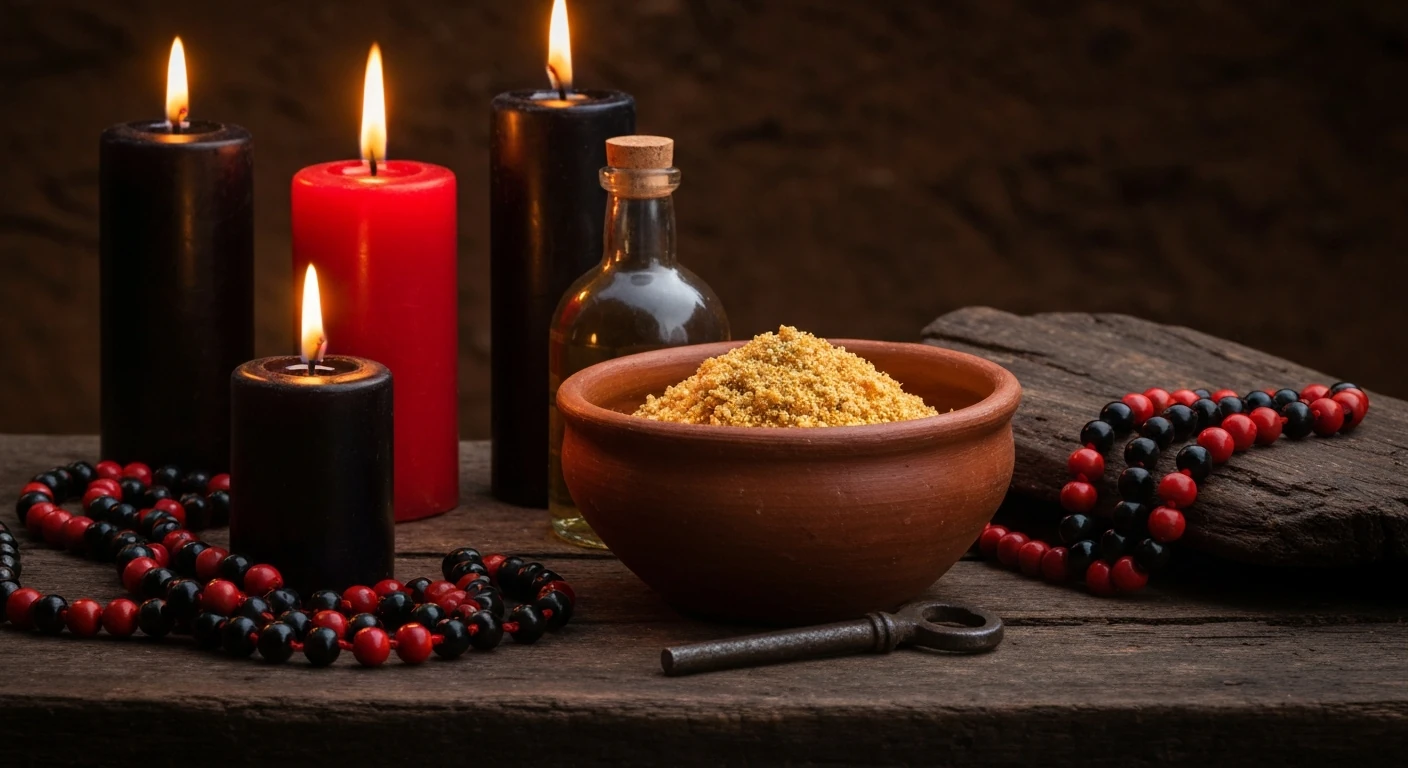
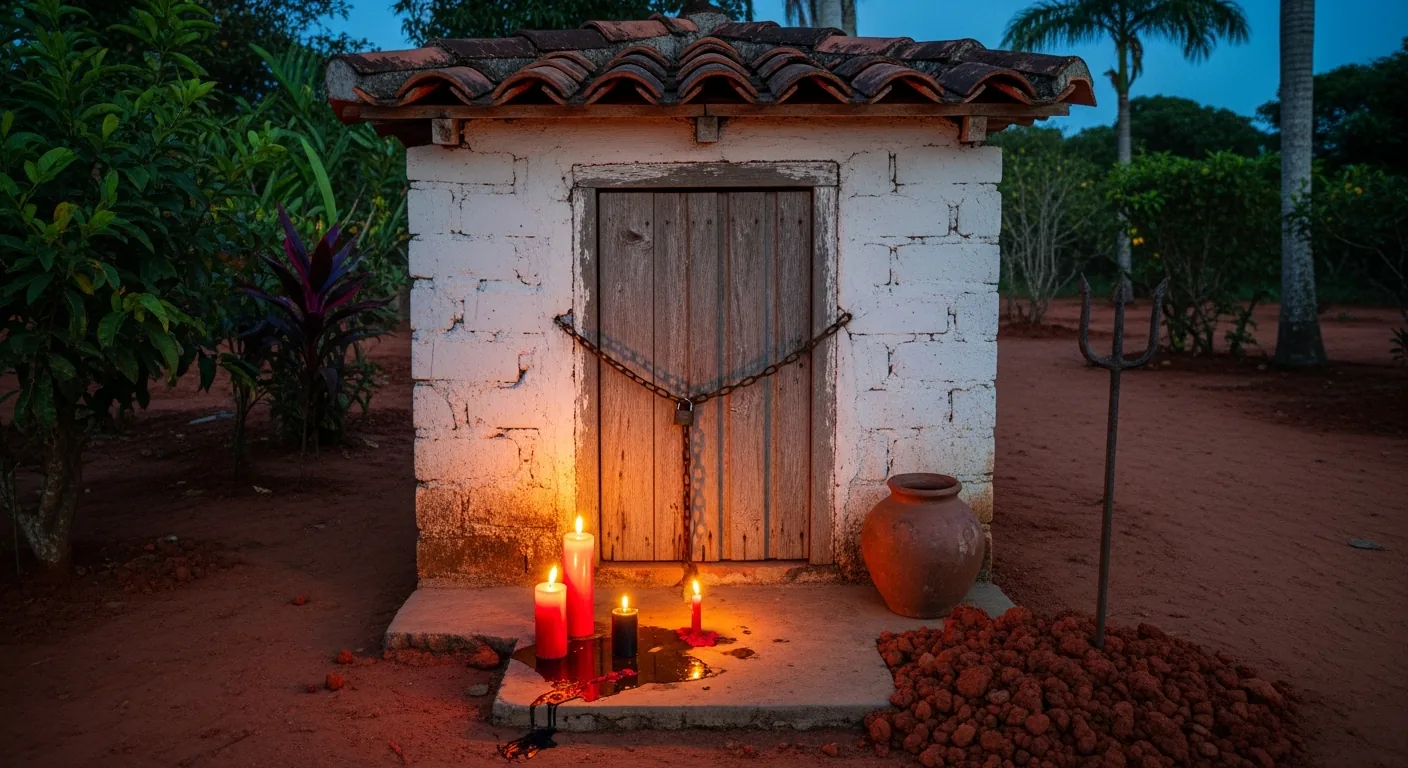
Few questions reach Google as much as "who is my Exu". The Exu de guarda is the guardian who responds for a person. Discovering his name is not something done through an internet test or by date of birth.
This guide explains what this personal bond is and separates the four figures that almost everyone mixes up. It also shows the types of exu that houses recognize and the real path of identification, which passes through the terreiro.
What is the guardian Exu (Exu de guarda)
Exu de guarda, also called exu de frente, is the guardian who leads the protection of a specific person. In quimbanda and Umbanda, he is understood as a spirit who already lived a human life and today works within the Law, taking care of whoever was entrusted to him.
To guard, here, has a concrete sense of vigilance: filtering what arrives, warning, opening and closing the path. It is not a contract for success nor an insurance policy against difficulty. The guardian accompanies the walk, and the walk continues to be yours.
A vocabulary caution is needed right at the start. The term "de frente" also exists in batuque, but there it designates something else, the orixá de frente of a filho de santo. They are similar grammars in different traditions.
Four figures that almost everyone confuses
A large part of the confusion about the theme comes from mixing things that occupy distinct places. The table separates the four.
| Figure | What is it | Where they act |
|---|---|---|
| Exu orixá (Bara, Elegbara) | Yoruba divinity, principle of communication and movement. Does not incorporate in gira | Candomblé, in the ketu, jeje and angola nations, each with its own name |
| Exu guardião | Spirit that once lived as a person and today works in protection. It is he who incorporates and gives consultation | Umbanda and quimbanda |
| Exu de guarda (personal) | The guardian who responds for a specific person | Umbanda and quimbanda |
| Exu da casa | Guardian of the terreiro, settled at the gate. Guards the space, not the individual | Terreiro |
The difference between the orixá and the guardian is detailed in who is Exu, and the guardian of the space has its own article in what is tronqueira. What matters here is the third line: the bond with a person.
Exu has no relation to the devil of Christian traditions. This association is the result of a historical process of persecution, studied by researchers such as Reginaldo Prandi, and repeating it is repeating prejudice, not describing the religion.
The types of Exu that the houses recognize
The classification below is the most widespread, and appears in both terreiro material and the Exu de umbanda entry on Wikipedia. It is not a national standard: each house has its own scale and its own doctrine.
- Exu batizado (or cruzado): has already assumed a commitment to the Law. It is the most common type to manifest in the terreiros.
- Exu de lei: works under an oath to fulfill the Law. Does not fulfill requests to harm someone. Some sources treat batizado and de lei as a single group.
- Exu coroado (or espadado): a rank of leadership of a falange. Some currents teach that few mediums have a coroado as a personal guardian.
- Quiumba: a spirit without commitment, who takes advantage of carelessness. It is not a guardian, and that is exactly what the terreiro filters out.
Notice the criterion that organizes the list: commitment. What makes a spirit a guardian is not strength or fame of name, but rather the bond assumed with the Law and with the house. A spirit known as Exu Tranca Ruas is a head of a falange. Thousands of people are guarded by exus of that line without the head being the personal guardian of each one.
How the terreiro identifies its guardian
There are two recognized paths, and both go through a house and a leader.
- The reading (jogo). The jogo de búzios, the cards, or the oracle of that house, conducted by someone who has the foundation to read. It is the most direct path.
- The presentation in the gira. The guardian names themselves when they incorporate, and the leader confirms. In many trajectories, this is how the name appears, throughout the mediumship development.
In both cases, there is a third variable: time. The name may take time to be revealed, and time is not rejection. In a gira de quimbanda, the spirit presents itself when the conditions are met, and the house usually holds the information until it is firm.
It is worth saying what this article does not do: it does not reveal the name of your guardian, because no text can. What it shows is the path.
Why the date of birth does not reveal your Exu
The "discover your Exu by date of birth" tests occupy a large part of the search results, and they have no basis in tradition. Neither Umbanda nor Quimbanda identify a guardian by calendar, by sign, or by the sum of numbers.
The reason is simple. The bond with a guardian is relational, built between a person, a spirit, and a house. It is not a fixed attribute that was born with you, the way eye color was born. Therefore, it is clarified in the reading (jogo) and in coexistence, not in a table.
Even commercial portals from the same field admit this point, recognizing that the date of birth is not capable of revealing this information on its own. When the source that sells quick consultation says this, the message becomes difficult to bypass.
What to do while the name does not come
Not knowing the name of the guardian does not leave anyone defenseless, and it also does not prevent religious life from moving forward. Some steps are indeed accessible:
- Attend a serious house, with an identified leader, and talk openly about the doubt.
- Light a candle and set your intention, a practice explained in firmeza na umbanda, which is something different from an assentamento.
- Have the reading (jogo) done with someone who has foundation, when the house understands that it is the right moment.
What should not be done on one's own is to consecrate Exu. The assentamento and firmeza of a spirit belong to the terreiro and the leader, with a foundation that does not fit in a blog post. Setting this up at home, through video or text, is the fastest way to attract exactly that quiumba that the house would filter out.
Quimbanda has documented history and its own academic study. This is what the research by Emerson Giumbelli and Leonardo Almeida shows about the forms of existence of quimbanda, published in the Revista de Antropologia da USP.
Frequently asked questions
How do I know who my guardian Exu is?
Through the divination reading (jogo) conducted by a terreiro leader, or through the presentation of the spirit itself when it incorporates in the gira. These are the two recognized paths. The name may take time to appear, and this wait is part of the development, it is not a sign of a problem.
Does everyone have a guardian Exu?
In the currents of umbanda and quimbanda, it is understood that everyone has a guardian, including those who do not attend a terreiro and those who follow another religion. The difference is that those who attend a house usually know the name and maintain a relationship of treatment with that spirit.
What is the difference between a guardian Exu and an Exu orixá?
The Exu orixá is a Yoruba divinity worshipped in Candomblé, in the ketu, jeje, and angola nations, and does not incorporate in the gira. The guardian Exu is a spirit that already lived as a person, acts in umbanda and quimbanda, incorporates, and gives consultations. They are distinct planes.
Can I discover my Exu by my date of birth?
No. No tradition of umbanda or quimbanda identifies a guardian by date, sign, or numerology. The bond is relational and is determined in the cowrie-shell divination (jogo) and in the coexistence with the house. The tests circulating on the internet are portal content, without basis in the religion.
Can I consecrate my Exu at home after knowing the name?
Not on your own. The assentamento has a foundation that belongs to the house and is conducted by the leader, at the time he determines. What is appropriate at home is to consecrate a candle with respect and intention, which is something else and has a much more limited reach.
Where to buy items to work with Exu
At Joia Mística Laroyê, you find what the houses usually request:
- Candles in the colors of Exu: red and black, in various sizes
- Ritual bead necklaces (guias) and prayer beads: in the colors of the lines of Exu and pombagira
- Cigars, cachaça and ritual drinks: traditional items for pleasing
- Alguidares, pottery and clay tools: pieces for liturgical use
- Incense burners, pembas and incense: for cleansing and for the work of the house
Visit our shop in Extrema, Minas Gerais or contact us on WhatsApp with delivery to all of Brazil.
References
- Prandi, Reginaldo: article about Catholic syncretism and the demonization of the orixá Exu, Revista USP, n. 50, 2001
- Giumbelli, Emerson and Almeida, Leonardo Oliveira de: study on Quimbanda as an Afro-Brazilian religious modality in Rio Grande do Sul, Revista de Antropologia, USP, 2021
- Wikipedia: entry Exu de umbanda, with the typology of exu batizado, de lei, coroado and quiumba