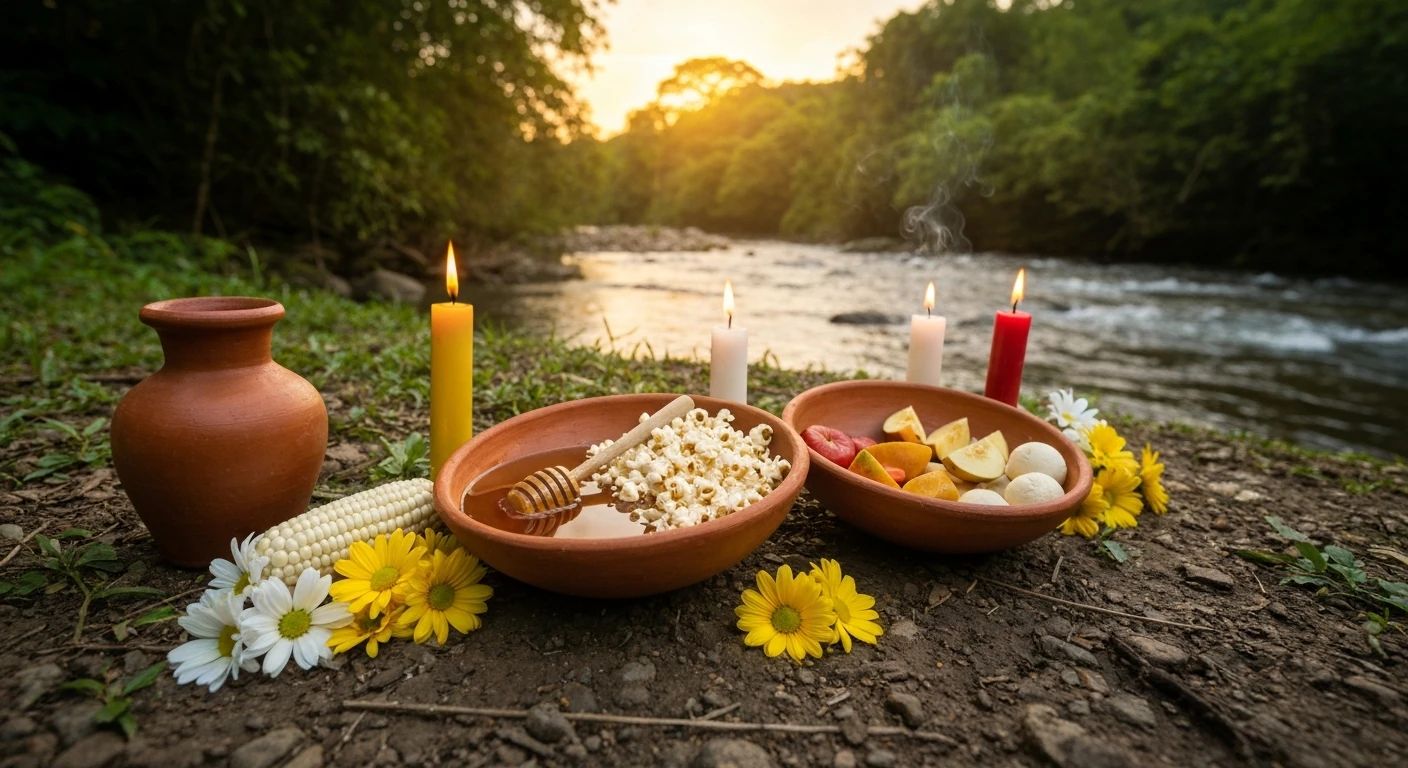
If you have ever seen a set offering, you saw an alguidar. It is that deep, raw clay plate, earth-colored, that carries the farofa de dendê, the canjica, the okra, the popcorn. It is so common in the terreiro that almost no one stops to explain what it is. And it is precisely for this reason that so many people buy the wrong size or the wrong material.
This guide explains what the alguidar is used for, why the clay must be raw, how to choose the right number, and how to care for the piece after use.
What is the alguidar
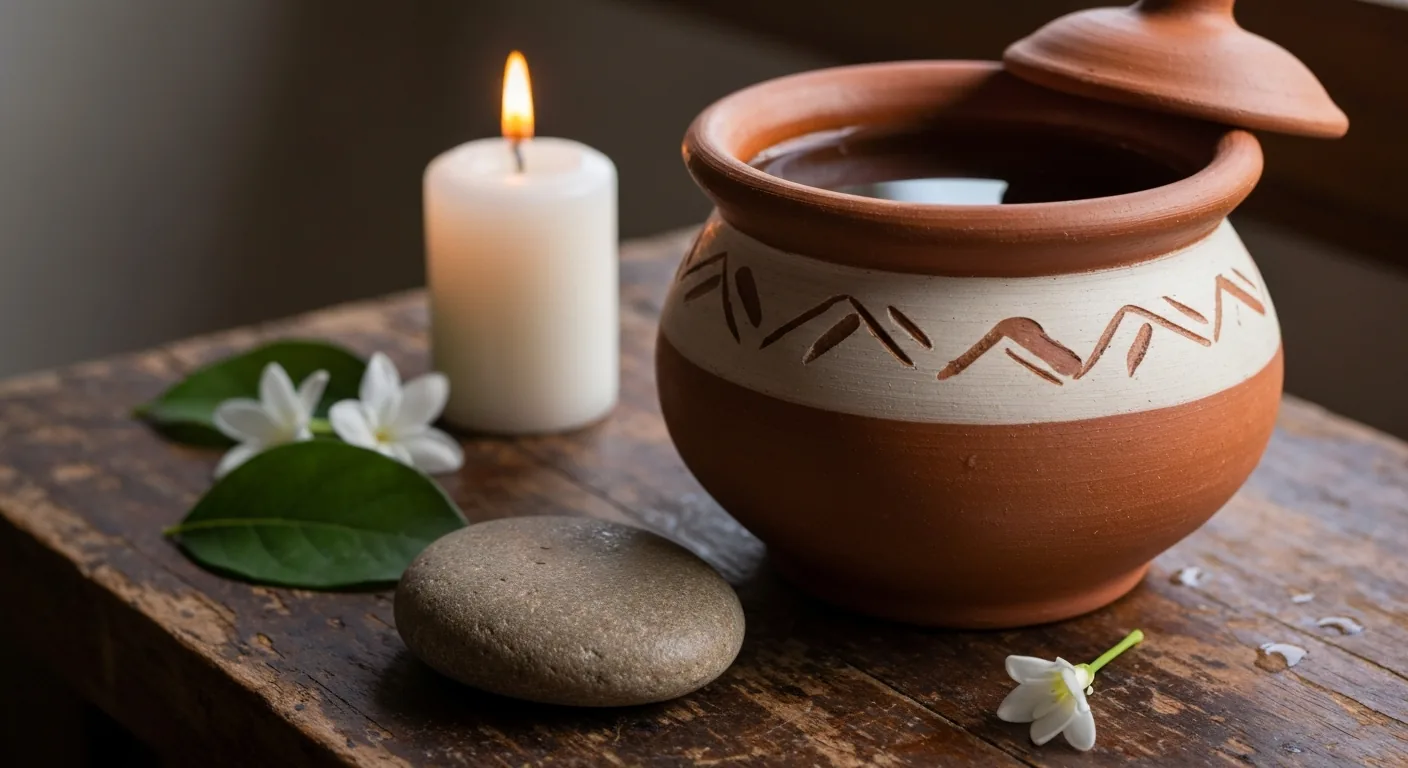
Alguidar is a round and shallow vessel, with a wide mouth and narrow base, made of clay. The word is Portuguese and comes from Arabic, and for centuries it named a common household utensil in Portugal, used to knead bread, wash dishes, and even bathe children.
In Brazil, the object was absorbed by Afro-Brazilian religions and became something else. Wikipedia records the alguidar as an indispensable object in Afro-Brazilian rituals, where it also receives the names of oberó and igba ebó, according to the alguidar entry.
Oberó is the name that the people of santo use in their daily lives. Igba ebó, in Yoruba, literally means offering gourd, and reveals the origin of the piece: before the Portuguese clay, the offering container was the gourd.
What is the alguidar used for
The alguidar is the serving plate of the orixá. Whenever a ritual food needs to be presented, it usually goes inside one.
Offering and ebó. This is the most common use. The food of the orixá or the spirit goes into the alguidar and follows to the place determined by the house: the santo room, the woods, the river, the crossroads. The ebó entry lists more than sixty ritual dishes served this way, from canjica to caruru. The text about what is ebó deals with the types of offering and what each one asks for.
Firmeza. Alguidar with a candle fixed in the center, often over farofa or sand, is a common setup for Exu and for the guardians.
Assentamento. In some houses, the alguidar enters as part of the igba orixá, the consecrated foundation itself, serving as a base or a lid for other pieces. Here the use is of fundamento and it is not improvised. It is worth reading about assentamento de santo to understand where this fits.
Amaci, ritual bath and sacudimento. The alguidar also receives macerated leaf, herb water and cleaning material during the ritual work.
Defumação. A small alguidar with embers and resin is the traditional defumador of many houses, older than any ready-made incense burner.
Alguidar is not an altar decoration. It is ritual work pottery, and like all ritual work pottery, it gets dirty, chips, and is replaced.
Why does the clay have to be raw
This is the question that appears most at the counter, and the answer is technical before it is spiritual.
Raw clay, without varnish and without glaze, is porous. It absorbs liquid, lets the food breathe and, when discarded in nature, returns to the ground without leaving residue. Glazed or varnished alguidar seals the surface, absorbs nothing and leaves a shell of synthetic material in the woods or in the river.
For this reason, in most houses, the alguidar for ritual use needs to be made of raw clay. The glazed, the painted and the plastic are for decorative or domestic use.
Two practical precautions from that:
- A new alguidar usually sheds dirt. Wipe it with a dry cloth before using. Many houses instruct to wash only with water, without detergent, because the clay absorbs the soap and returns the smell to the food.
- Raw clay cracks with thermal shock. Do not take it directly over fire or put boiling food inside a cold piece.
What size to buy
Alguidar is sold by number, and the numbering grows opposite to what intuition suggests: the higher the number, the smaller the piece.
| Number | Approximate diameter | Current use |
|---|---|---|
| nº 5 | 8 to 10 cm | Small individual offering, fixed candle |
| nº 4 | 11 to 13 cm | Padê, pipoca, erê offering |
| nº 3 | 14 to 16 cm | General use, best seller |
| no. 2 | 17 to 19 cm | Farofa de dendê, food of Exu |
| no. 1 | 20 to 22 cm | Amalá, food of orixá |
| no. 0 | 23 to 26 cm | Large offering, banquet |
| no. 00 and larger | above 27 cm | Festive obrigação, terreiro banquet |
Measurements vary from pottery to pottery, so treat the table as a reference and not as a fixed standard. If your dirigente asked for a specific number, take that number.
A tip from someone who works with this: when the person does not know the size, number 3 solves most everyday situations. For amalá de Xangô and orixá foods, number 1 usually serves better.
After use: what to do with the alguidar
Here the rule changes depending on the house, and it is worth asking your dirigente before deciding alone.
In general, the alguidar that took an offering to nature stays there, along with the food, because it is part of the delivery. This is why raw clay matters so much: it breaks down.
Alguidar for internal use, such as the one for amaci or the defumador, is washed and reused. A chipped or cracked piece is usually retired, because cracked clay leaks and does not hold what it receives.
A precaution that is almost a consensus today in serious houses: do not leave plastic, glass, or tape in the forest or in the river. If the offering takes flowers, take them without the cellophane. If it takes a drink, think if the bottle needs to stay in the place. Respecting the forest and the water is part of the respect for the orixá.
Frequently asked questions about the alguidar
Can I use plastic or glass alguidar?
For domestic use, yes. For ritual use, most houses do not accept it, and the reason is the disposal: plastic and glass do not return to the earth. If you have a doubt, ask your dirigente before buying.
Are alguidar and gamela the same thing?
No. Alguidar is made of clay and is shallow. Gamela is made of wood, is deeper, and has its own uses, the most well-known being the one that receives the amalá of Xangô in various houses. Many people use one instead of the other, but they are different pieces.
Do I need to bless or prepare the alguidar before using it?
That depends entirely on your house. There are terreiros that pass the piece through a simple cleansing with water and herbs. There are terreiros that do nothing, and there are terreiros that only use consecrated alguidar for specific purposes. Do not invent a procedure: ask.
Can I buy an alguidar without being part of the religion?
You can. It is a clay object, sold freely, and buying it does not obligate you to anything. Many people use it as an ashtray for smoke cleansing at home or as a plant saucer.
How many alguidares do I need to have?
There is no correct number. Those who frequent a terreiro usually keep two or three sizes at home so they are not left empty-handed. Those who are going to make a specific offering take only what that offering requires.
Where to buy yours
The Joia Mística Laroyê, in Extrema-MG, works with raw clay alguidar without varnish in various sizes, from small to festival size, as well as quartinha, gamela, otá, flour, dendê oil, ritual candles and whatever else the offering requires.
If your Pai or Mãe de santo gave you a list, send the list via WhatsApp (35) 99156-5228 and we will set everything aside before you arrive. Those who prefer to choose the piece by hand can stop by the shop at R. Benedito Zingari, 460, Bela Vista, from Monday to Friday from 9am to 6pm and Saturday from 9am to 1pm.
Clay is cheap and lasts as long as it needs to. It is not worth saving money by buying the wrong thing.