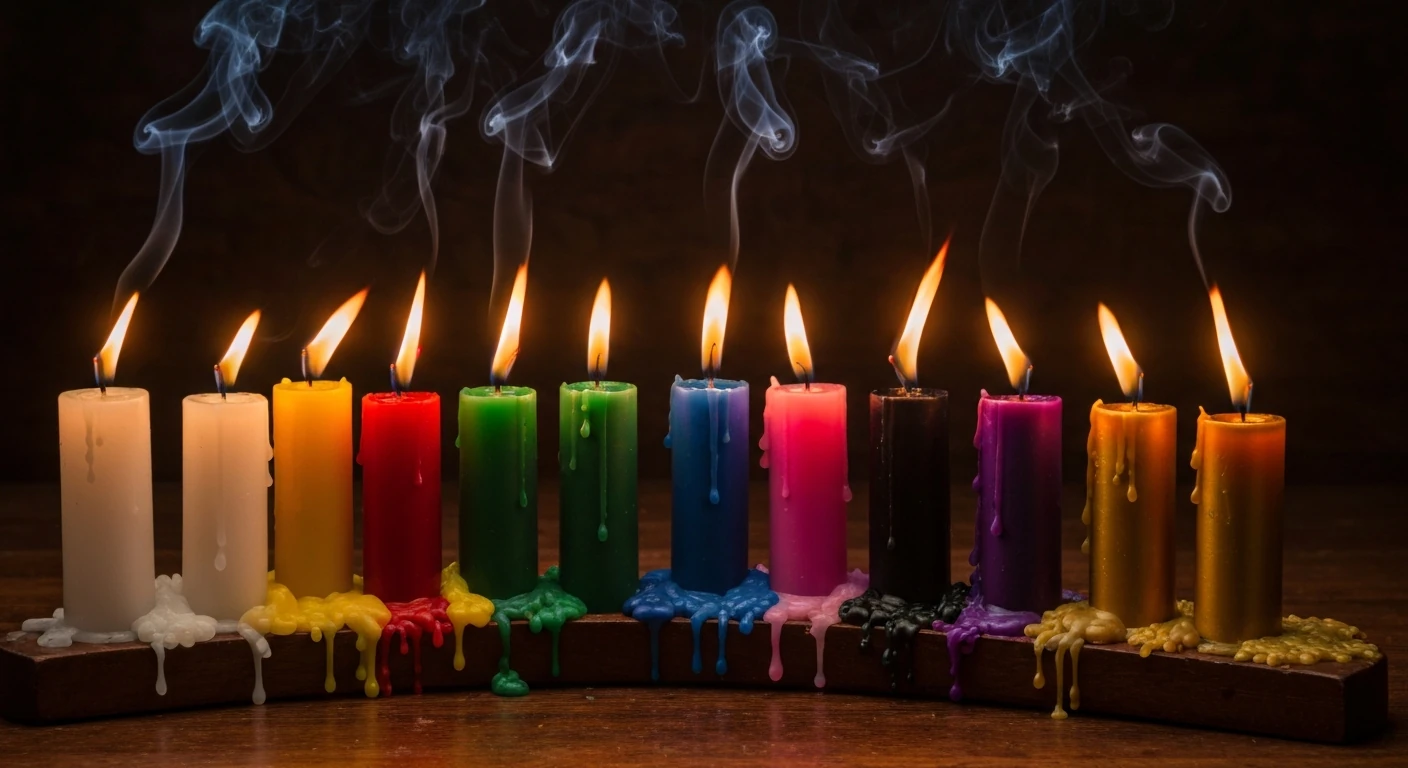
There is no candle that generates more misunderstanding at the counter of a religious items shop than the black candle. Half of the people arrive afraid of it and the other half arrive thinking it solves everything. Both are wrong, and both are wrong for the same reason: they learned about the color from someone who never lit one.
This guide explains what the black candle actually does, when it is used, why it almost always goes with the red one, and how to light it without running risks.
What the black candle does
The function of the black candle is to absorb. It collects what is heavy, cuts what is tied, and returns to the earth what no longer belongs to the person.
Notice that none of these three verbs is to attack. The black candle is not a weapon pointed at someone. It is a drain, and its work is to drain away.
The most common uses:
Descarrego and cleansing. The black candle pulls accumulated charge, from an environment or a person. It appears often in sacudimento, in new house cleansing, and after a period of illness or a fight.
Corte de demanda. When there is a love binding ritual, a persecution, or a ritual work done against, the black enters to cut the thread.
Firmeza de guardião. Exu (Eshu) and Pombagira receive black candles in firmeza, almost always accompanied by the red one. It is not to do harm to anyone: it is to set the guard.
Trabalho de calunga. In the lines connected to the cemetery, the black candle is the house color. It is where it is less of an exception and more of a routine.
Corte de vínculo afetivo. Ending of a relationship, grief that does not pass, attachment that has already become a weight. The black ends the cycle.
Black does not mean evil
Here is the point that needs to be said clearly: a black candle is not black magic.
The expression "black magic" was born outside of Afro-Brazilian religions and was pasted onto them from the outside. It is the same historical movement that criminalized the terreiro and called religion witchcraft.
This movement has a date and an author. The entry for Exu records that the translation of Èṣù as "devil" began in the Yoruba vocabulary of Samuel Ajayi Crowther, in 1843. It crossed almost two centuries of dictionaries until it was corrected by the Nigerian linguist Kọ́lá Túbọ̀sún, between 2016 and 2019. The error lasted more than one hundred and seventy years, and it still lives in the imagination of those who look at a black candle and see a threat.
The cosmology of Quimbanda does not work with the Western division between good and evil. As the Quimbanda entry on Wikipedia records, Exus and Pombagiras manipulate positive and negative forces, and this does not make them evil. The word Quimbanda, moreover, comes from Kimbundu and means healer.
Black, in this context, is the color of the night, of the earth, and of what is not seen. It is the color of what gathers. Whoever saw evil there was reading with the wrong alphabet.
The candle has no will. The color organizes the intention of the one who lights it, and the responsibility for what is asked remains with the one who asks.
Black and red: why they go together
The black and red duo is the best-selling and most used, and it is not for aesthetics.
Red is the force that acts. It is movement, blood, fire, life, desire. It is the color that pushes.
Black is what absorbs. It is what gathers, closes, and returns.
Together, they complete the full cycle of a ritual work: they remove what remains and put strength in its place. That is why the black and red two-color candle, divided in half lengthwise, is the most associated with Exu and Pombagira.
Other combinations that appear frequently:
| Combination | Current use |
|---|---|
| Black and red | Exu and Pombagira, firmeza, opening with spiritual cleansing |
| Black and purple | Calunga ritual work, line of the souls |
| Black and white | Spiritual cleansing (descarrego) with a prayer request for peace, closing |
| Black alone | Cutting, absorption, heavy spiritual cleansing |
| Black and green | Some lines of Exu linked to the forest |
These correspondences change from house to house and from line to line. The text about ritual candles and their colors provides the general overview, and it is worth checking with your house leader before assembling anything.
How to light without making mistakes
The practical part is where the real risk lies, and it is of fire, not of spirit.
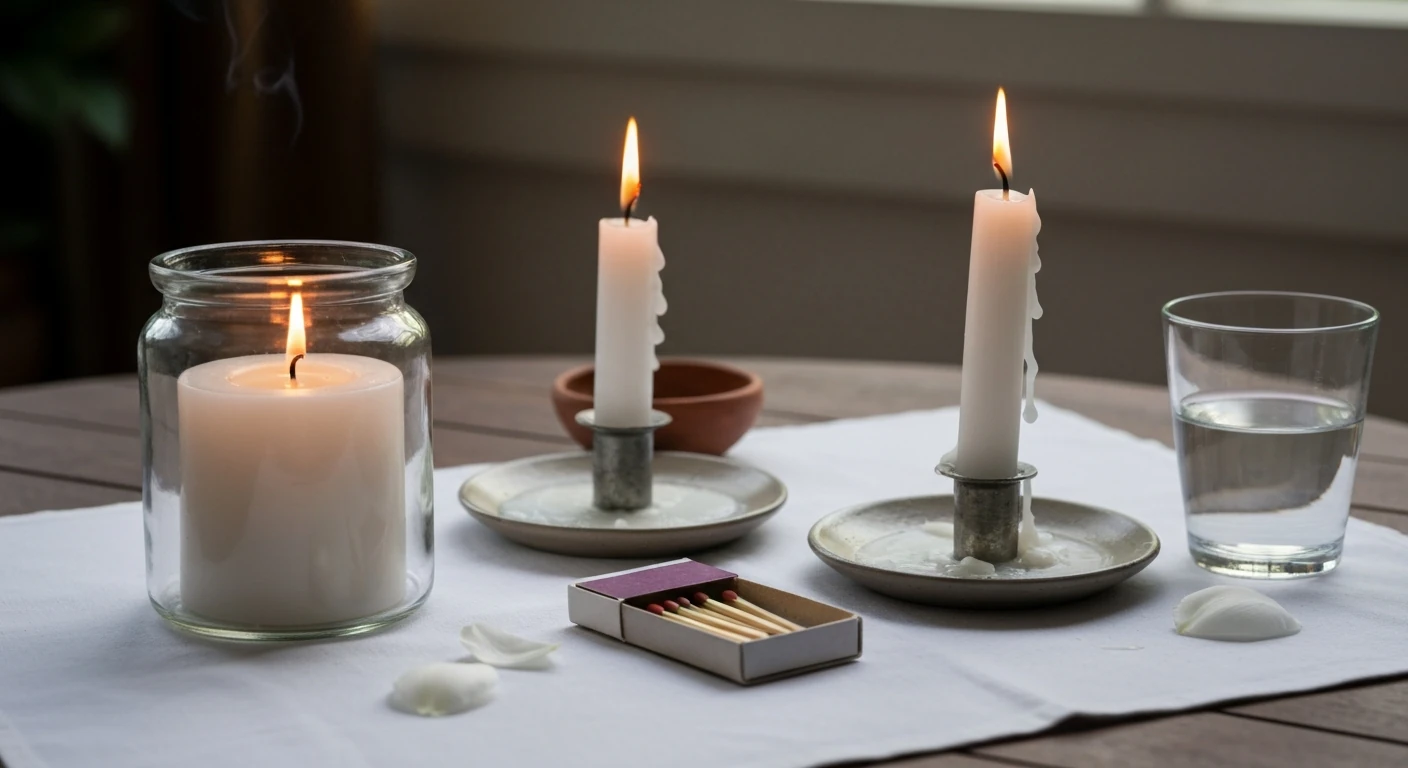
Where to light. Firm the candle in a container that does not catch fire: clay alguidar, ceramic plate, metal candlestick. Never directly on a wooden floor, on a rug, or on a plastic surface.
Never alone. A lit candle wants company. The glass of a 7-day candle cracks inside after hours of burning, and the melted wax spills. If you need to leave, put it out.
Do not blow. Use a snuffer, wet fingers, or a saucer on top. Blowing is a lack of etiquette in practically every house.
Glass of water nearby. An old custom, useful for two reasons: the symbolic, to absorb what is released, and the practical, to be there if something catches.
Discard. The wax left over from the cleaning ritual work does not go back inside the house. Ask your dirigente where to leave it. Do not throw glass or plastic in the woods or at the crossroads.
The text about how to use candles in rituals details the step by step from lighting to discarding, and it is worth reading before the first ritual work.
And the warning that no honest shop fails to give: lighting a candle does not replace the terreiro, a spiritual leader, or medical treatment. Cutting and calunga ritual work has its fundamento, and fundamento is learned inside the house, not on the internet.
Frequently asked questions about the black candle
Can I light a black candle at home?
You can, for simple cleaning and descarrego, with the material care mentioned above. What should not be done on your own is ritual work to cut a demanda, firmeza of a guardian, or anything related to calunga. This requires guidance from someone with fundamento.
Does a black candle attract bad things?
No. It collects what is already there. The confusion comes from associating the color with what it absorbs, like someone blaming the drain for the dirty water.
Can I use a black candle for Exu de guarda?
In many houses, yes, almost always together with the red one. But the color, the day, and the location change depending on the house and the spirit. Ask the leader of your house first.
What is the difference between a stick black candle and a 7-day candle?
It is duration and purpose. The stick candle serves for a specific ritual work, for one sitting. The 7-day candle stays lit for days and serves for a firmeza that needs to be maintained, with the vigilance that this requires.
The black candle went out by itself. Is it a bad sign?
Most of the time it is wind, a crooked wick, wax drowning the wick, or a glass without oxygen. Before reading a sign, look at the physics. If it persists and you are in ritual work of fundamento, take the matter to your dirigente.
Where to buy
The Joia Mística Laroyê, in Extrema, Minas Gerais, works with stick black candles, black and red bicolor candles, black 7-day candles, and the other color sets for firmeza. It also has clay alguidar, flour, dendê oil, pemba, bead necklaces, and whatever your house requires.
If you received a list from your Pai or Mãe de santo, send it via WhatsApp (35) 99156-5228 so we can set it aside before you arrive. Anyone who wants to see in person can stop by R. Benedito Zingari, 460, Bela Vista, from Monday to Friday from 9am to 6pm and Saturday from 9am to 1pm.
Here, no one will ask you why you want the black candle, nor will they look at you crookedly because of it. We work with respect for those who have faith.