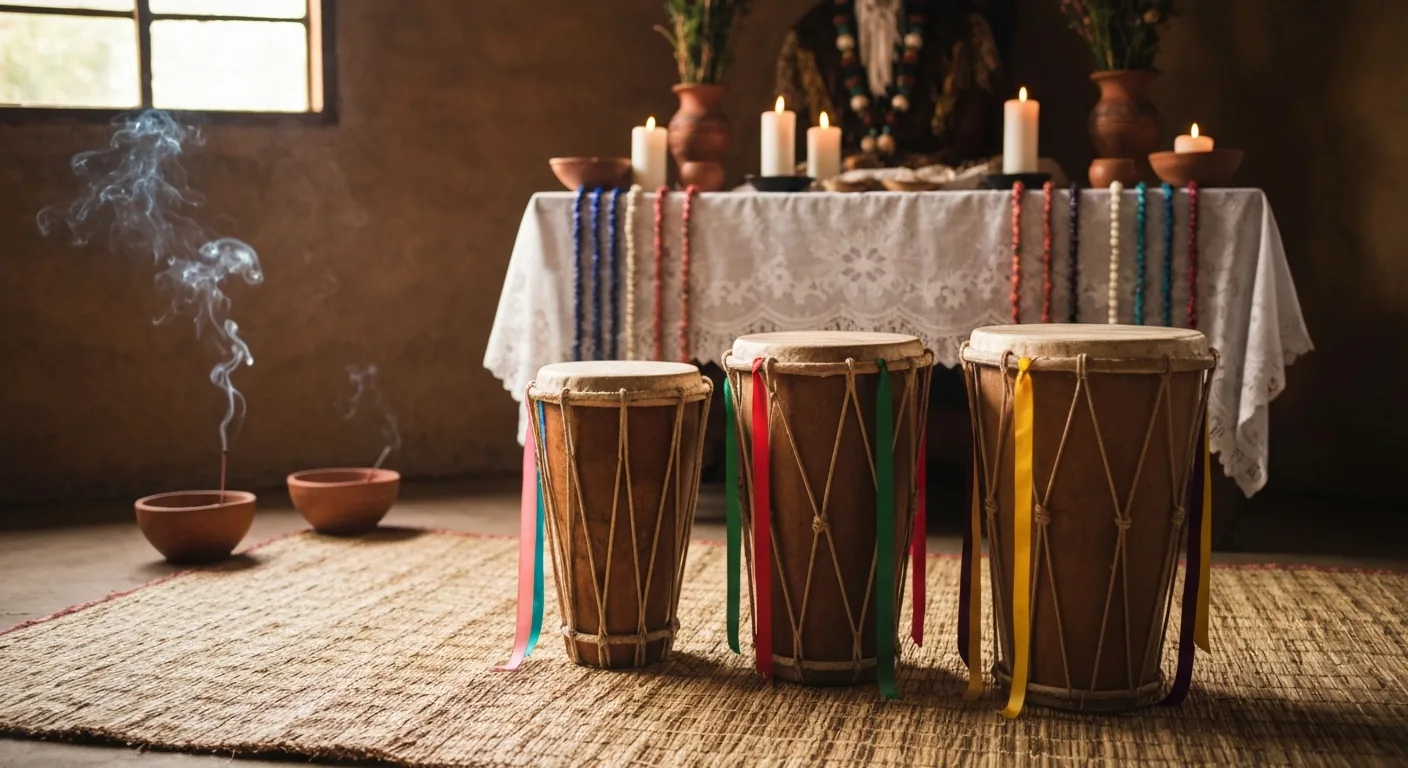
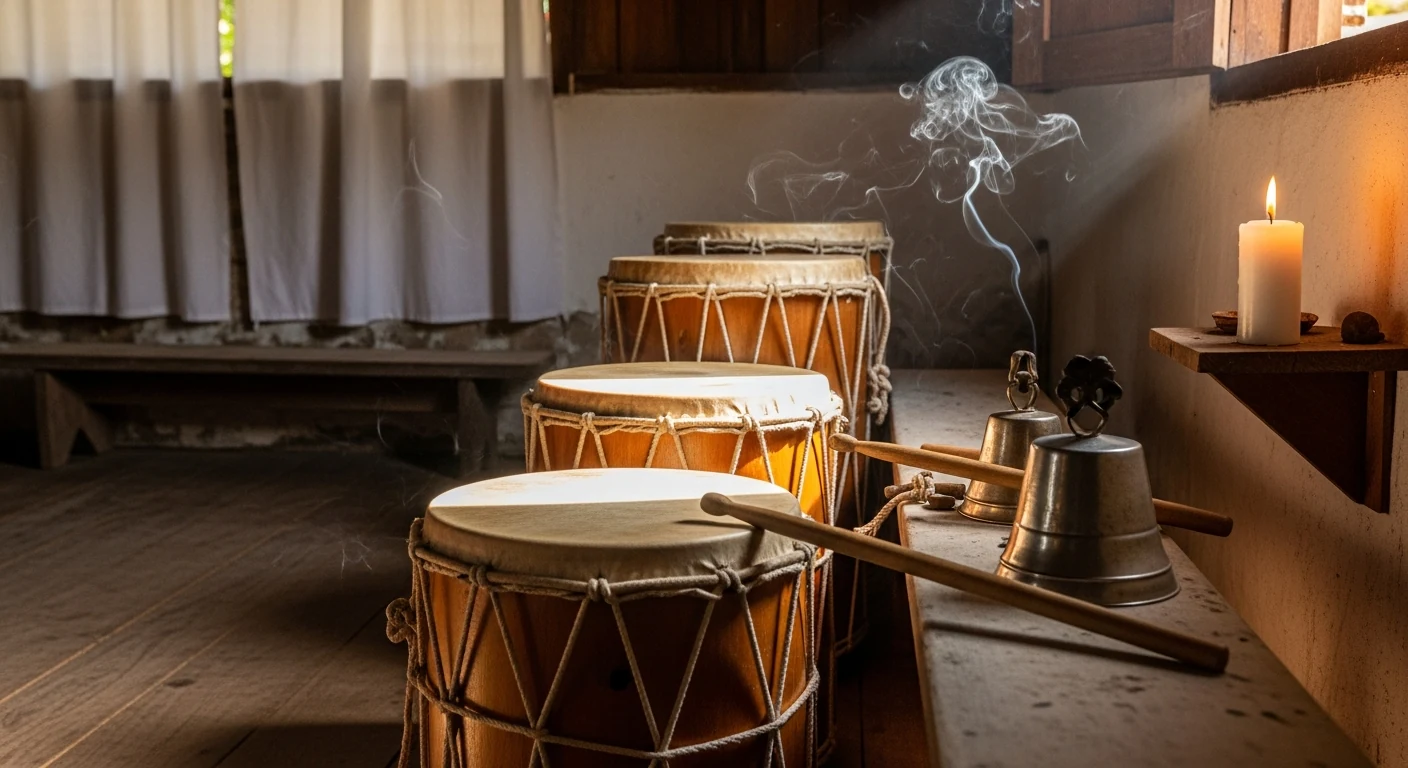
When the xirê begins, the first sound is not from leather. It is the iron of the agogô marking the line that everything else will follow. Only then do the atabaques do candomblé enter, and each of the three has an exact function within that circle.
This guide shows what rum, rumpi and lé do and who is authorized to play them. It also explains why the technique changes from one nation to another and which toques call each Orixá.
The three atabaques do candomblé and the iron that guides them
The set has three drums of different sizes, and the size defines the function:
- Rum: the largest and deepest. It is the soloist. It leads the toque, dialogues with the body of the one who is dancing, and marks the turns.
- Rumpi: the medium one. It sustains the structure of the toque and responds to the rum.
- Lé: the smallest and highest. It holds the base pulse from beginning to end, without letting go.
Along with them comes the agogô (also called gã in various houses), the double iron bell played with a metal rod. It is not an ornament. It is the guide-line that directs the three leathers, the rhythmic ruler upon which everything rests. What the instrument is, who plays it, and the difference between agogô, gã, and gonguê are in agogô: the iron that guides the toque.
The names rum, rumpi, and lé come from fongbé, a language of jeje origin, from hun, which means drum. From there come the variants hun, hunpi and hunlé. In ketu, the set is also called ilú. In the angola nation, the drums are the ngomas.
The set only works as a conversation. The lé holds the ground, the rumpi ties the middle, and the rum speaks over the top. Removing one of the three dismantles the entire toque.
Aguidavi or hand: the technique changes with the nation
This is one of the most repeated questions, and the answer depends on the house's nation.
In ketu and jeje, the drums are played with two wooden sticks, the aguidavi (also written as agidavi or laguidavi). Depending on the toque, the ogã uses a stick in one hand and the free hand in the other.
In the angola nation, it is played only with the hands, without a stick, in the line of Bantu traditions. This difference appears in testimonies from ogãs collected in the report The sounds of the sacred, published by the Instituto Humanitas Unisinos.
The wood of the aguidavi varies by house. Guava wood appears frequently due to its resistance, but there is no single rule, and each terreiro has its preference. To understand what changes most from one root to another, it is worth reading about the nations of Candomblé.
Who can play the atabaques: position, not talent
Here is the point that separates the terreiro from a percussion circle. Playing the atabaque in a house of Candomblé is not musical skill, it is a religious position.
The one who plays is the ogã de couro, confirmed by a specific rite. The head of the ensemble changes name according to the nation:
- Ketu: alabê (alagbê), the father of the toque, who opens and commands.
- Jeje: runtó (huntó), from hun (drum) and tó (father).
- Angola: xicarangoma, from the quicongo nsika (player) and ngoma (drum).
Being good with your hands does not grant access to the house's drum. One must be suspended and confirmed, as happens with the other positions and hierarchies of Candomblé. The responsibility is great: it is the toque that calls the Orixá within the liturgy.
The toques of Candomblé and the Orixás they call
Each toque is a rhythmic pattern with a name, tempo, and destiny. The table below gathers the most heard ones, with the nation of origin listed for each:
| Toque | Orixá or function | Nation |
|---|---|---|
| Vassi | Base toque, very linked to Ogum (Ogun) and Oxóssi (Oshosi) | Ketu |
| Aguerê | Oxóssi when cadenced, Iansã (Oya) when accelerated | Ketu |
| Alujá | Xangô (Shango) | Ketu |
| Opanijé | Obaluaê | Ketu |
| Ijexá | Oxum (Oshun), and also Oxalá (Obatala) in many houses | Ketu, of ijexá root |
| Adarrum | General call, associated with Ogum | Ketu |
| Bravum | Oxumaré (Oshumare), and Ogum in some houses | Jeje |
| Cabila | Repertoire of inquices | Angola |
| Barravento | Repertoire of inquices | Angola |
Two honest caveats. First: this correspondence is not national law, it changes by house and by root. The ethnomusicologist Ângelo Cardoso cataloged 18 types of toque only in queto, in the thesis The language of the drums, defended at UFBA in 2006. Any list of nine is a snippet, not an inventory.
Second: the sources diverge in some points. The aguerê appears sometimes linked to Oxóssi, sometimes to Iansã, and the most consistent reading is that the tempo changes the destination. The adarrum appears sometimes as a general call, sometimes as a toque of Ogum.
The ijexá is the most well-known case outside the terreiro. It crossed the wall and became the base of afoxé and much of Bahian music, a path studied by Alberto Ikeda in Revista USP.
Why the terreiro atabaque is not a common instrument
An atabaque of a house of the orixás (casa de santo) is a settled sacred object, not musical equipment. It undergoes consecration, has its own axé, and receives offerings in a reserved rite, which the terreiro language calls feeding the leather.
This axé is renewed periodically, generally in an annual obrigação of the house. Therefore, there are handling restrictions: it is not just anyone who touches, carries, tunes, or changes the drum's leather.
The detail of the rite does not fit in any blog, and this article will not enter into it. House foundations are learned in the house, with those who have the rank to teach. If you want to better understand the force that circulates in these objects, start with what is axé.
Candomblé atabaque is not Umbanda curimba
Confusion is common and worth clearing up. Both traditions use drums, but the role of the drum is different in each.
| Aspect | Candomblé | Umbanda |
|---|---|---|
| Group name | Body of ogãs under the alabê or runtó | Curimba |
| What is sung | Nation chants, in Yoruba, Fongbé, or Quicongo | Sung chants, in Portuguese |
| Role of the drum | The rum drum leads and dialogues with those in the circle | The atabaque sustains the pulled ponto |
| Technique | Aguidavi in ketu and jeje, hands in angola | Predominantly with the hands |
In Candomblé, the toque follows the ritual sequence of the xirê. In Umbanda, the chant commands and the atabaque accompanies, as we explained in the article about the curimba in umbanda.
Frequently asked questions
What are the three atabaques of Candomblé?
They are the rum, the largest and deepest, the rumpi, of medium size and sound, and the lé, the smallest and highest. Along with them, the agogô, or gã, a double iron bell that provides the guide line for the three drums, is played.
What is the difference between rum, rumpi, and lé?
The difference is in size, pitch, and function. The rum releases, improvises, and leads. The rumpi sustains the structure of the toque and responds to the rum. The lé maintains the constant, steady pulse from the beginning to the end of the chant.
Who can play atabaque in Candomblé?
Only the ogã confirmed for the leather. It is a religious position, with suspension and a confirmation rite, not a vacancy won by talent. The head of the ensemble is the alabê in ketu, the runtó in jeje, and the xicarangoma in angola.
Is the atabaque played with the hand or with a stick?
It depends on the nation. In ketu and jeje, the aguidavi, a pair of wooden sticks, is used. In the angola nation, the drums are played only with the hands. Neither technique is more correct; they are different traditions.
Why is the atabaque of Candomblé sacred?
Because it is settled, it has its own axé and receives offerings in a private ritual of the house. It is not an instrument that you buy ready-made and start playing. The terreiro drum is a foundation, and its handling is restricted to those who hold a position.
Where to buy atabaques and accessories
At Joia Mística Laroyê, you find what sustains the study and the daily life of the house:
- Atabaques in various sizes: for study and for the barracão
- Aguidavi: pairs of sticks made of resistant wood
- Agogô and gã: the iron that opens the line-guia
- Skins and tuning accessories: for instrument maintenance
- Guias, candles, and herbs: the rest of the kit for those who attend the house
An important caveat: a purchased instrument is a study instrument. It does not come sacralized and does not replace the settled drum of the terreiro, which undergoes its own ritual conducted by the house.
Visit our shop in Extrema, Minas Gerais or contact us on WhatsApp with delivery to all of Brazil.
It is worth remembering that these drums play in houses recognized as national heritage, such as the Terreiro da Casa Branca, with a heritage decision in 1984 and registration in 1986, as shown in the text about the terreiros listed by IPHAN.
References
- Instituto Humanitas Unisinos: report on the sounds of the sacred in Candomblé
- Federal University of Bahia (Institutional Repository): thesis The language of the drums, by Ângelo Cardoso
- USP Magazine: article by Alberto Ikeda on ijexá and Bahian music