The ponto de preto velho is the song that calls, sustains, and bids farewell to the spirit in the gira. The lyrics speak of captivity less than one might imagine. There is no lyrics page here, only what research reads in the verses.
The same ponto appears in a 1974 collection and in a terreiro in Ribeirão Preto, studied in a 2011 dissertation. One word changed: "o preto é quem vai dizer" in one, "o negro é quem vai dizer" in the other. The lyrics pass from mouth to mouth and vary, and knowing who chooses what remains is half the subject.
What is a ponto (sacred song) of preto velho and what is it for
A ponto de preto velho is a ponto cantado (sacred song): the particular religious song of one of the pretos-velhos in Umbanda. Research describes it as "musicalized verses, accompanied by the sound of drums." It calls and bids farewell to the spirit, sustains its presence in the medium's body, and opens and closes the sessions.
The ponto also has its time. In a festa dos pretos-velhos in Minas, a single ponto repeats while the feijoada is served and eaten. Others are only sung at specific moments. The stanzas are short and repeated, which helps with memorization.
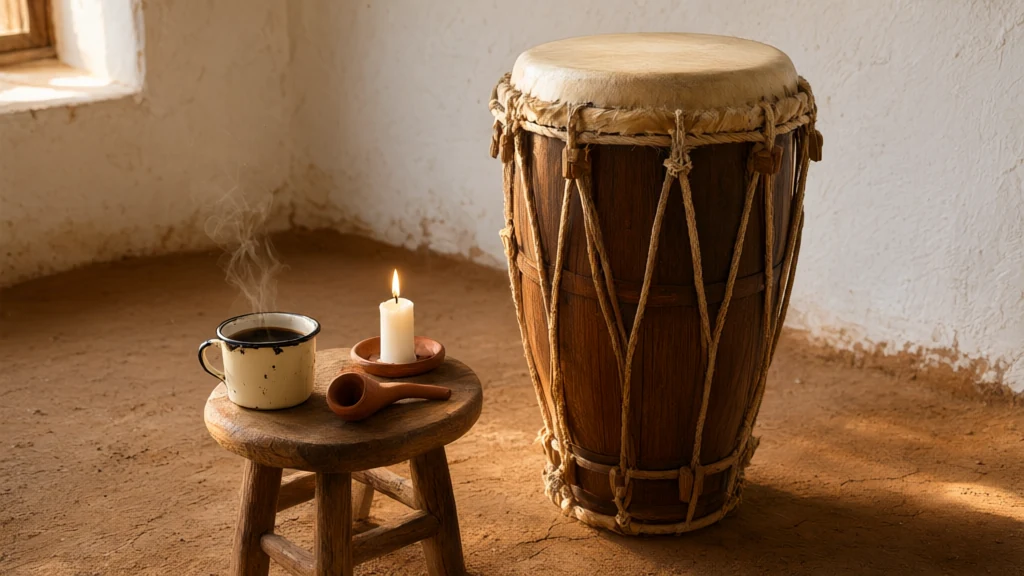
Not every house uses drums. In the Tenda Espírita Nossa Senhora da Piedade, the ritual is sustained by the pontos, without atabaques at any moment. In another house in Minas, an ogã played the atabaque and led the pontos. Who plays is a matter of the curimba in Umbanda. The types of ponto are in pontos cantados in Umbanda.
What the preto velho lyrics tell
The preto velho lyrics tell of suffering and faith, the liberation coming from Oxalá and the orixás (orishas), and a knowledge that the doctor does not have. Researcher Lourival Andrade Júnior, from UFRN, read 301 pontos cantados and 396 riscados of pretos and pretas velhas. The pontos he cites come from a 1974 collection.
Suffering appears in the senzala: "Preto velho na senzala / Padeceu, padeceu". Liberation comes from above, in a ponto that Andrade cites:
“Foi de Oxalá a ordem suprema / Mãe Yemanjá quem mandou”
In the doutorzinho's ponto (sacred song), the preto velho refuses the title and warns that captivity has ended. The white man knows how to read, the lyrics say, but only the black man says the day one dies. Baldiotti and Richartz cite another ponto and read the mark of slavery in "O preto por ser preto / Não merece ingratidão".
Andrade reads in this a "certain conformism" in the face of slavery. Problems seem to be resolved by the sacred, not by the liberation struggles of the black people themselves. On any date that celebrates the Dia de Preto Velho, he says, the pontos (sacred songs) do not change: Zumbi does not appear as a liberator, but rather the orixás.
How much of the lyrics speak of captivity: three researches, three answers
Little, according to the three studies, and each one looked at a different set of pontos (sacred songs). The counts do not add up: one comes from a collection, another from recordings, and the third from interviews.
| Research | What was looked at | What was found |
|---|---|---|
| Andrade, 2013 | 301 pontos cantados (sung) and 396 pontos riscados (drawn) | suffering, faith, liberation by Oxalá, "certain conformism" |
| Santos, 2022 | chants recorded in the Southeast, from 1960 to 2010 | only 6 of 78 preto velho chants mention tension with slavery |
| Rezende, 2017 | interviews with Mineiro attendees | they prefer light pontos and cut off captivity |
Santos says that the others treat the preto velho "through the lens of selflessness": he forgives, teaches, is serene. On a 1994 record from a Mineiro house, only 2 of the 18 chants mention slavery. The album is entirely dedicated to the preto velho, and the author says that other houses take him as a parameter.
Some read the set in another way. Rezende heard pretos-velhos mediums in São João del-Rei (MG) and in Montevideo. The reports begin in pain, pass through resistance, and end in values and advice taken from captivity. The author brings them closer to the concept of non-violent resistance.
The anthropologist Yvonne Maggie wrote, in 2016, that the worship of pretos-velhos inverts daily life. In the ritual they are revered. Outside of it, black old age does not receive this respect, and the majority live in poverty. Neither of the readings closes the issue, and the blog does not choose between them.
Who chooses what to remember
The one who sings chooses what remains. The research shows three filters: the house where one learns, the internet, and each person's memory.
According to Rezende, today the majority of pontos are learned in other terreiros or on the internet. Older people comment with sadness that pontos are no longer learned from the elders of the house. The author sees in this the loss of the monopoly of the elderly over this knowledge.
On the internet, writes Santos, authorship is treated as something secondary, in a forced "public domain." Cantigas like "Pai Joaquim, cadê Pai Mané?" circulate as being by an unknown author, and others, like those from the 1994 record, have an author. Therefore, this text only cites verses that research already cites.
The memory of those who listen makes another cut. In Rezende's interviews, those who remember a ponto prefer the light one, with flowers, perfumes, and birds. Even when the lyrics speak of suffering, the excerpt about captivity disappears. The two interviewees who most highlighted the struggle of the pretos-velhos remembered pontos of peace and calm.
The exchange can be of a single word. One interviewee sang "he is a seed" instead of "he is a chain" in the ponto (sacred song) of the rosary of Our Lady. Rezende reads the change as a heavy image replaced by a liberating one. Dias says he sang the last verse of the doutorzinho (a sacred song) wrong for two years, until the community corrected it.
The cross in the ponto riscado of the preto velho
The cross dominates the ponto riscado of the preto velho. It appears in 310 of the 396 points that Andrade analyzed. The star appears in 215, the waves in 53, and the rosary or the beads in 51.
He reads the cross as the suffering in Africa and in the senzala and also as a symbol of Christianity, a sign of "hybrid" pretos-velhos in practices and beliefs. The star marks elevation, the waves recall the sea of the crossing, and the rosary links the ponto to Our Lady of the Rosary.
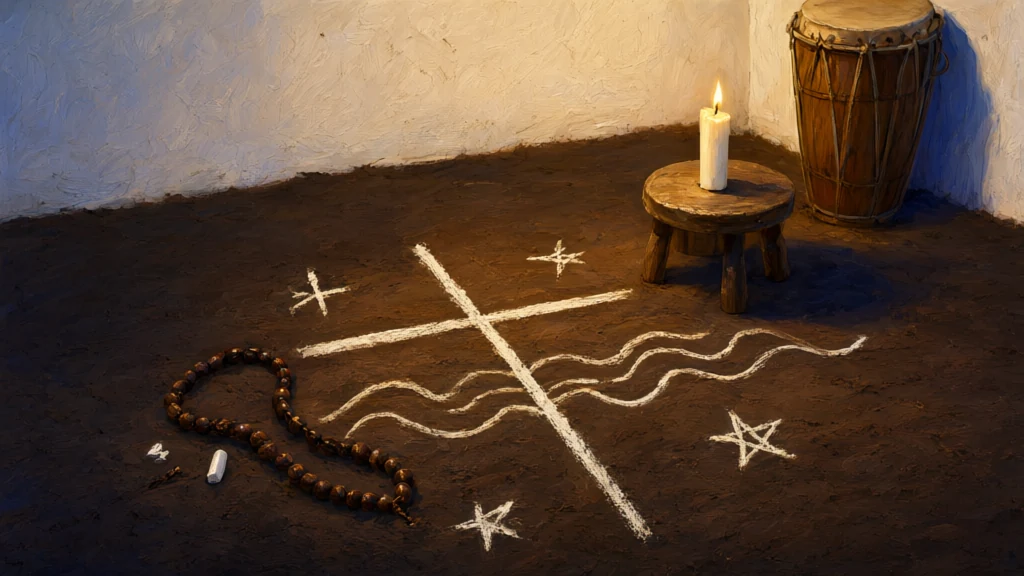
The ponto cantado (sacred song) and the ponto riscado complement each other. In a ponto that Moreira cites, “The white man told the black man / That the black man doesn't know how to read,” the black man takes the pemba and draws a ponto for the white man to read. The author reads in this the distance between white literate culture and black, essentially oral, culture. The foundation of drawing is in ponto riscado in umbanda. The names that appear in the verses, such as Pai Joaquim, are in preto velho names, and the preto velho who is also Exu (Eshu), in preto velho is Exu.
Where the house learns the ponto (sacred song)
The ponto is learned in the gira, listening and singing with the corrente. Each house keeps its own repertoire, with word variations like those of the two doutorzinhos at the beginning. Whoever wants the lyrics to sing learns from the house they attend.
Whoever sets up the curimba or the congá at home and has doubts about pemba, candle, or atabaque can speak with Joia Mística via WhatsApp.
Frequently asked questions
Why does the preto velho ponto speak of captivity?
The pretos-velhos present themselves as former enslaved Afro-descendants, and some pontos tell this story. Santos notes, however, that only 6 of 78 cantigas dedicated to them mention tension with slavery. Andrade reads in the pontos both suffering and a certain conformism.
What does “Adorei as almas” mean?
It is the greeting to the pretos-velhos. Dias records it as a brief greeting of the category, as “okê caboclo” is for the caboclos. Andrade gives the long form, spoken in most terreiros: “Hail Jesus Christ and Our Lady… Hail the Orixás… Saravá the Preto Velho… Adorei as almas”.
Does the ponto of a preto velho need an atabaque?
It depends on the house. In Tenda Espírita Nossa Senhora da Piedade, the ritual is sustained only by the pontos, without atabaques. In another house in Minas Gerais, an ogã played the atabaque and led the pontos.
References
- Lourival Andrade Júnior, ANPUH: I worshiped the souls, Umbanda, preto-velho and slavery
- Lívia Lima Rezende, ANPUH: Seeing the dead with the ears
- Lívia Lima Rezende, Afro-Ásia: The ethics of love in Umbanda pretos-velhos
- Rafael Sant’Anna Santos, UFF: Firma ponto, bambeia com fé
- Baldiotti e Richartz, África e Africanidades: Spirits and meanings in the lyrics of the pontos cantados (sacred songs)
- Carina Moreira, ABRALIC: Metaphors of memory and resistance
- Rafael de Nuzzi Dias, USP: Ancestral chains
- Yvonne Maggie, G1: Preto-velho day
- Tenda Espírita Nossa Senhora da Piedade: Pontos cantados (sacred songs)