The ponto of Oxum is the Umbanda sacred song that calls, accompanies, and bids farewell to the Oxum line in the gira. The most repeated one is “Eu vi mamãe Oxum na cachoeira”. The lyrics change from house to house. Sometimes, only one verse changes.
What is the ponto of Oxum (sacred song) and when is it sung
The ponto of Oxum is the ponto cantado (sung sacred song) of the orixá (orisha) and the entities of her line. Who is the orixá behind the song is in who is Oxum.
The house founded by Zélio de Moraes is the Tenda Espírita Nossa Senhora da Piedade (TENSP). In its Book of Pontos Cantados, the section “Pontos de OXUM (fresh water)” has only one ponto. The Terreiro de Umbanda Pai Maneco, in Curitiba, publishes an Oxum booklet. There are 20 pontos de linha and 3 pontos de subida. The first ponto de subida speaks of the river that brought Oxum and takes her to the sea.
In a tenda in Dourados (MS), the researcher Haroldo Medeiros records pontos at all moments of the worship. They serve as prayers. The one who opens each one is the ogã, according to the moment of the ritual. In the houses that Pedro Nogueira studied in Juiz de Fora, the pontos are “a kind of soundtrack” for the gira. In general, the ogãs choose the cantigas. Those who play are in curimba in umbanda; the types of ponto are in pontos cantados in umbanda.
In the tenda in Dourados, the orixás do not incorporate. Those who descend are spirits of the dead, such as caboclos and pretos-velhos. The Oxum line in the terreiro is in Oxum in umbanda.
Where it is sung: line and ascent | Book of Zélio's house: 1 ponto of Oxum | Pai Maneco's booklet: 20 of line and 3 of ascent | Toque in candomblé ketu: ijexá
”Eu vi mamãe Oxum na cachoeira”: the same ponto in three houses
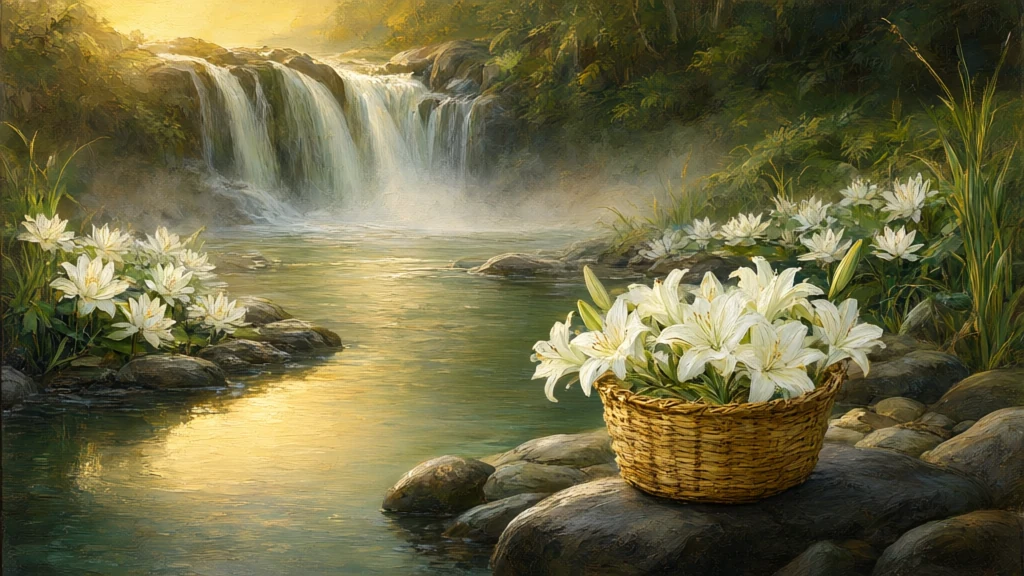
The most repeated Oxum ponto in open sources is the one of the waterfall with lilies. In TENSP, it opens like this:
“I saw mamãe Oxum of the Waterfall / Together with my Father Oxalá”
In Pai Maneco, the second verse changes and Oxalá leaves the scene. In both houses, Oxum gathers lilies to decorate the congá.
| Verse | Casa de Zélio (TENSP) | Pai Maneco (Curitiba) |
|---|---|---|
| First | ”I saw mother Oxum of the Waterfall" | I saw mother Oxum at the waterfall |
| Second | ”Together with my Pai Oxalá" | Sitting on the riverbank |
A notebook from another house, identified only by the acronym TULO, opens the Oxum section with the Pai Maneco version. In Pai Maneco, this is also the Oxum sung chant (ponto cantado) in the vibration of the seven lines. In this sequence, each orixá gets their chant.
Axum, waterfall and crying: what the Oxum sung chant (ponto cantado) sings
Edinan Bertocho studied a terreiro in Passo Fundo (RS). He summarizes: “For the most part, the pontos of Oxum bring messages of love and speak about beauty”. The pontos return to the same places.
- The sea, in the old sung chants (pontos). In TENSP, Oxum appears as Axum in the sung chants (pontos) of Nanã (Nana Buruku) and Iansã (Oya): “Oh Nanã where is Axum / Axum is from the waves of the sea”. In 1933, Leal de Souza wrote that the children of Umbanda called the Virgin Mary “Mother Axum (Oxum)”. An opening sung chant (ponto) of TENSP greets Our Most Holy Mother and the mantle of Oxum together.
- The waterfall of the seven lines. TENSP's ponto 23 of Xangô (Shango) closes with "Iansã of the wind / Mother Oxum of the waterfall". Medeiros heard the same ponto in Dourados. For him, each orixá has a domain in nature. The rest of the ponto is in ponto of Xangô.
- The gold and the congá. At Pai Maneco, pontos without authors sing of the gold mine where Oxum lives. Another calls her queen of the congá. In the ponto of Caboclo Folha Verde, recorded by Lourival Andrade Júnior, Oxum's rivers are wide.
- The crying. Pai Maneco's ponto 12 sings: "It was on the riverbank / Where Oxum cried".
Many pontos (sacred songs) repeat the refrain "aieiêo". The Tenda de Umbanda Caboclo Tupinambá e Vó Catarina (TUCTVC) greets Oxum with "Ora Yê Yê Ô!". Pierre Verger translates her Yoruba greeting as "Let us call for the Mother's benevolence". The orixá's file is in Oxum. To know if she rules your head, the discover your orixá test gives a first guess, and the house confirms it.
Oxum points that have an author
Not every ponto of Oxum is a ponto de raiz (root ponto). Diamantino Trindade, cited by Andrade Júnior, calls pontos de raiz those "brought directly by the incorporated spirits". The others are by composers, "very common in curimba festivals". Pai Maneco writes the name of whoever composed it:
- ponto no. 5 of the Oxum handout, by Caroline de Castro Rauli;
- "Oxum's Waters", by Ivo Hauer Malschitzky;
- "In the mirror of the river", by Raquel Ribas Chaves;
- "Oxum's Balance", by Reinaldo Godinho;
- "Descarrego das Sete Linhas", which also sings Oxum, by S. Akuan.
The "In the sky, a star comes shining" is in Pai Maneco without an author. Bertocho transcribes it with the name of Hugo de Oxossi. With an uncertain owner, the lyrics stay out. Only pontos that houses publish without a composer are included here, in short excerpts, like in the ponto of Ogum.
Umbanda ponto (sacred song) and Oxum cantiga in Candomblé
The pontos of Oxum from the houses cited here are sung in Portuguese. In Yoruba, what is sung is the Oxum cantiga of Ketu Candomblé.
The toque also changes. Verger records that the rhythm of Oxum's dances is called ijexá. In the magazine Per Musi (UFMG), Felipe Corbani da Silva and Bruno Madeira call ijexá a "rhythm consecrated to Oxum". They remember the researcher Cardoso's caveat: the connection between rhythm and orixá "is not absolute". The toques are on atabaques in Candomblé.
The site has three Oxum chants, with video and lyrics: Adé Kojú Iyá, Yá Badé Lodô and Yeye Yeye Yeyê Ô. The game Which Orixá is the chant from? shows the lyrics without the name and asks for the owner.
Oxum's ponto riscado: what is known
In the open houses and research cited here, no drawing of Oxum's ponto riscado appears published. Andrade Júnior defines the riscado as a set of symbols that says who the spirit is: "It is as if it were their signature". It is made with pemba, a chalk of various colors. In a study on Exu (Eshu)'s riscados, he cites Martins: the deities do not act directly in the terreiro, but rather their falangeiros. The riscado belongs to the spirit and the house.
What the sources record are symbols of Oxum on other objects:
- a heart embroidered on the flag of Tenda Espírita Mamãe Oxum, in Juiz de Fora;
- the heart cutout on Oxum's abebé, in a study by PUC Minas, a piece of the Oxum statue;
- the ocutá in the shape of a heart in a terreiro in Passo Fundo;
- the five-pointed star on a crown of Oxum from Baiano Candomblé, in the Duke University collection, because five is her number.
A riscado copied from the internet is not the ponto of your terreiro. The foundation is in ponto riscado in Umbanda. Whoever is going to set the ponto and wants to check the candle or the bead necklace that the house requested can speak with Joia Mística via WhatsApp.
Frequently asked questions
What is the most well-known Oxum ponto?
There is no measurement of which is the most sung. In open sources, what is repeated most is "Eu vi mamãe Oxum na cachoeira". It is in the book of Zélio's house, in two booklets by Pai Maneco, and in the TULO notebook.
What is the ponto de subida of Oxum (ascending sacred song)?
It depends on the house. The TENSP book brings only one ponto in the Oxum section. Pai Maneco has three pontos de subida. The first speaks of the river that brought Oxum and takes her to the sea. The last says goodbye greeting her band.
What does maleime mean in the Oxum ponto (sacred song)?
It is a word of request. In ponto 16 of Pai Maneco (sacred song), maleime comes along with Oxum's name, before asking that she look over the children of the gira. In TENSP, the word appears as "malembe" and "Maleme" in other lines. Dicio registers malembe as a petition chant to orixás in candomblés.
References
- TENSP: Book of Sung Chants (Pontos Cantados)
- Pai Maneco: pontos of Oxum
- Pai Maneco: Vibração das Sete Linhas
- Nogueira, UFJF: dissertation
- Medeiros, UFGD: dissertation
- Andrade Júnior, Mneme: Os caboclos
- Andrade Júnior, Mouseion: Pontos riscados
- Bertocho, UFFS: TCC sobre o Terreiro Ogum Beira Mar
- Silva e Madeira, Per Musi: O ijexá
- Verger: Orixás
- Leal de Souza: The seven lines of Umbanda
- Jesus, Em Sociedade: No balanço do mar
- Duke: Crown of the Goddess Oxum
- TUCTVC: Oxum
- Dicio: malembe