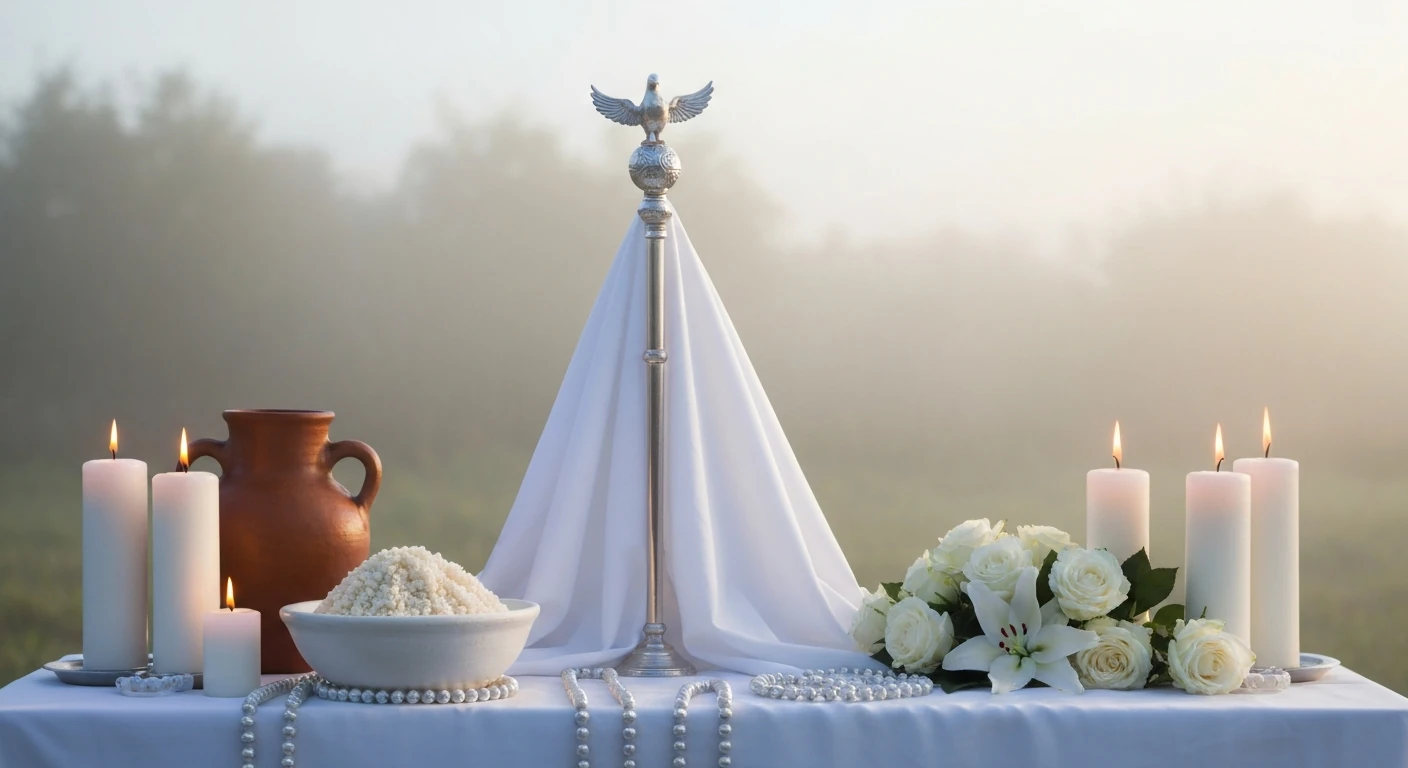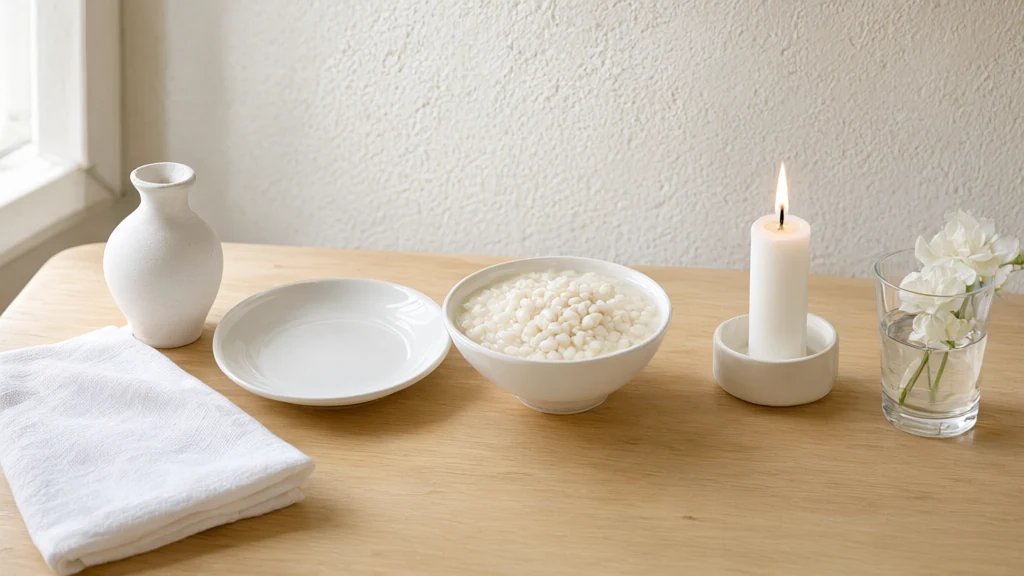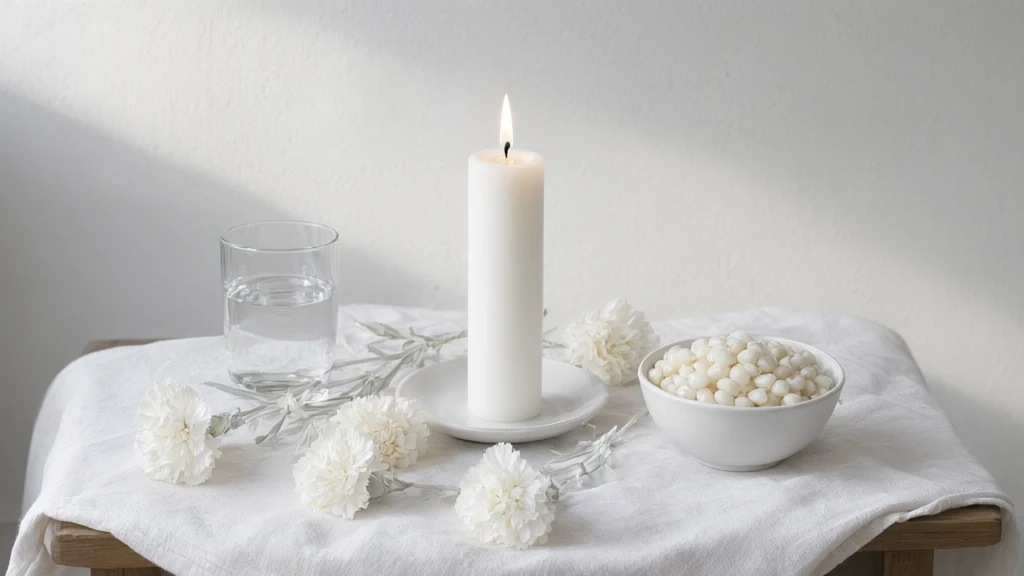
The prayer for Oxalá begins with the greeting Epa Babá and asks for peace, calm, and blessing for the house. There is no single text for all houses. Below is a prayer to pray at home, written by Joia Mística, with the meaning of the greeting and what tradition records.
Friday is the day of Oxalá in Candomblé Ketu, and the candle is white. In 2026, Christmas also falls on a Friday.
Prayer for Oxalá: the text to pray at home
The prayer below was written by Joia Mística Laroyê for those who pray alone, at home. It does not come from a tradition or a terreiro: if your house has its own words, stick with the house's words. The requests follow what the Umbanda houses cited here teach to ask Oxalá: peace, reconciliation, and blessing for the family.
Epa Babá, my father Oxalá. Lord of the white cloth, I arrive in silence and with a clean heart. You who molded the body of each one in clay, take care of who I am. Put peace in this house and calm in my thoughts. Undo the fights that I do not know how to undo and teach me to wait. Avenge my parents, my family, and my paths. Take away the illness and what takes away my peace. Receive this white light as my gratitude. Epa Babá!
Pray slowly, in a low voice. The images in the text have a basis. Verger calls Oxalá “King of the White Cloth”. He also says that he modeled the bodies of human beings in clay and therefore he is called Alámorere, the “owner of the good clay.” Who is the orixá (orisha) to whom one prays is in who is Oxalá.
What does Epa Babá mean?
Epa Babá is the greeting of Oxalá, and the translation that a named source gives is “Long live the Father”: the FUCESP, federation of Umbanda and Candomblé of São Paulo, writes “Êpa Êpa Babá! (Long live the Father)”. In the federation's translation, Babá is the Father, and Oxalá is treated as the great father: the IPHAN dossier on the Festa do Bonfim says he “symbolizes peace” and is “the great father in the nations of religions of African tradition”.
The spelling changes from source to source:
| Who writes | How to greet |
|---|---|
| Reginaldo Prandi, on Ketu Candomblé | Epa Babá! |
| IPHAN, Bonfim dossier | Èpa Bàbá! |
| FUCESP | Êpa Êpa Babá! (Long live the Father) |
| TUCTVC, Umbanda house | Êpa Babá!, Babá Okê, Exê Uepê Babá |
| NUSS, Umbanda house | Zambi is my father, or Epa Babá Oxalá |
Say the greeting at the beginning and at the end of the prayer. In Candomblé, Oxalá is always the last to be praised in the ceremonies, and the other orixás revere him. The greetings of the other orixás are in greetings of the orixás.
Is there a prayer of Oxalá in Yoruba?
We did not find a fixed prayer text to Oxalá in Yoruba, with translation, that applies to all houses. What open sources record are titles and requests. Verger describes the festival of Òrìsànlá in Ilê-Ifé, in Nigeria, where the crowd shouts “Gbákú lo, gbárùn lo!”, which he translates as:
Take death away, take diseases away.
In Ifon, the city of the cult of Oxalufã, the dignitaries greet the local king, dressed in white, with "wishes of long life, of calm, happiness", fertility, prosperity and protection. It is a greeting to the king, not a prayer. But it shows the tone of what is requested in the cult of the white orixás.
The chants of the gira are something else: they are in ponto de Oxalá. The prayers to the other orixás follow the same mold as this: prayer for Iemanjá, prayer for Oxum and prayer for Obaluaê. The two forms of the orixá, the old Oxalufã and the young Oxaguiã, are in qualidades de Oxalá.
What to ask of Oxalá?
From Oxalá, one asks for peace, faith and calm. TUCTVC, an Umbanda house, lists "Peace, reconciliation and dissolution of conflicts" and "Blessing for parents, families and paths". The same house says that, "when one does not know which force to turn to, many traditions guide the request to Oxalá". FUCESP calls him "The Orixá of peace, of white".
Three short requests, also written by Joia Mística, to add to the main prayer:
For the peace of the family: Epa Babá, my father. Calm this house, undo the fight and put gentle words in the mouth of those I love.
To calm the mind: Epa Babá, my father. Cool my thoughts, give me patience and let me sleep in peace.
In gratitude: Epa Babá, my father. Thank you for life, for bread and for those who walked with me until here.
A request to imprison someone or to harm another person does not enter the prayer. It also does not promise a miracle: it asks for peace and firmeza for whoever prays.
When to pray to Oxalá?
The day to pray to Oxalá is Friday in ketu Candomblé, in Verger, in Prandi, and in the IPHAN dossier. In umbanda houses it changes: FUCESP gives "Friday or Sunday", and TUCTVC, Sunday. The detail of each house is in Oxalá day.
On Friday, custom calls for white clothing. Verger writes that this habit "extends to all people affiliated with Candomblé", even those of other orixás. Prandi records it as a taboo for the son of Oxalá to use non-white clothing on Fridays.
Three nearby dates fall on Friday:
- December 25, 2026. TUCTVC has December 25 as the "worship date" of Oxalá, and a bill in Curitiba proposes "Oxalá Day" on that date. It is a house position. In Candomblé, the babalawô Ivanir dos Santos says that Christmas "reminds more of a family gathering". Already an umbanda house in Rio makes the "Oxalá canjica" on the last gira of the year. See Christmas in umbanda.
- January 1, 2027, which is also Friday. For the turn of the year, the specific prayer is in prayer for the new year.
- January 15, 2027, Friday after the Lavagem do Bonfim. By rule, the Lavagem is on the Thursday before the Bonfim Sunday, the second Sunday after January 6: in 2027, Thursday, January 14. The Basilica programming has not been released yet. See Senhor do Bonfim and Oxalá and Lavagem do Bonfim.
With what candle to pray to Oxalá and what to put with it?
The candle to pray to Oxalá is white, in TUCTVC and in FUCESP, which puts "White candle, pink and white flowers" among the main offerings. The Núcleo Umbandista São Sebastião (NUSS) lists white candles, "white carnations, pure water" and honey. And warns: the candle is for those who know what they are doing with it.
A simple way to pray at home:
- Wear white, if you can, and clean a corner of the house.
- Place a glass of pure water and white flowers, such as carnations or roses.
- Light the white candle on a firm plate, away from curtains and children.
- Be silent for a moment, say Epa Babá, pray and give thanks.
No salt and no dendê near Oxalá. Verger writes that the wine and the oil that come from dendê and salt are "the main prohibitions" of the white orixás, to whom white foods are offered. Therefore, the canjica, when the house instructs to put it, goes without salt and without seasoning. The FUCESP lists cooked white canjica among Oxalá's foods, and the NUSS says the opposite, that the orixá does not eat and the canjica is not necessary. Follow your house. The step by step is in offering for Oxalá.
Silence is also his. In the Oxalá Waters cycle of Ilê Axé Opô Afonjá, Pinheiro records the rule, quoting Juana Elbein dos Santos: "cannot speak loudly, cannot eat salt, dendê". At home, it is enough to pray in a low voice.
Those who do not have a candle can light the virtual white candle. To check the candle or the statue of Oxalá that your house requested, Joia Mística Laroyê can be reached via WhatsApp.
Frequently asked questions
Is there an official prayer for Oxalá?
There is no single text: each terreiro has its own words. The TUCTVC, for example, publishes its own prayer on the house's Oxalá page. What is repeated in the sources is the greeting Epa Babá and the request for peace. The prayer of this article is from Joia Mística and is stated as such.
Is Oxalá Jesus?
Syncretism brings the two closer, but the houses do not say they are the same figure. The TUCTVC writes that this "does not mean that the two figures are exactly the same deity," and the NUSS calls Jesus the "supreme chief of Umbanda, syncretized with Oxalá". The other positions are in Oxalá in Umbanda.
Do I need to be a child of Oxalá to pray to him?
No. Oxalá is revered by all orixás, and Verger says that the white of Friday is even for those consecrated to another orixá. Anyone who wants to know which orixá they are can take the discover your orixá test, remembering that only the house's game confirms it.
Does the prayer of Oxalá protect or perform miracles?
It does not promise miracles, neither healing, nor the return of love. It asks for peace, calm, faith, and blessing for the family, which is what the cited houses teach to ask of Oxalá. Illness requires a doctor. The prayer accompanies it.
References
- Pierre Verger, Orixás (Corrupio, 1981): Google Books entry
- Reginaldo Prandi, Horizontes Antropológicos (1995): African gods in contemporary Brazil
- Érika Pinheiro, UERJ (2008): The spectacle of the waters
- IPHAN: dossier of the Festa do Bonfim
- FUCESP: Oxalá
- TUCTVC, Umbanda house: Oxalá
- NUSS, Umbanda house: Oxalá
- ICL Notícias (2024): Christmas for different religions
- Bem Paraná (2026): orixás dates in the Curitiba calendar
- Bahia Notícias (2025): Bonfim programming