The prayer for Iemanjá does not have a fixed text: each person prays with their own words and ends with the greeting Odoyá, which means "mother of the river". The people of santo also keep her oriki and chants. Below are these texts with sources, three prayers to recite, and the dates when it is most prayed.
Pray at home or by the seashore on Saturday, which is her day, or on the major dates: December 8, New Year's Eve, and February 2.
Is there an official prayer for Iemanjá?
There is no official prayer for Iemanjá, and a report by O Povo that heard a filho de santo summarized it like this: "There is no fixed prayer for Iemanjá." The prayer shows the feeling and the moment of the one who asks. The chant of the gira is another matter: see ponto de Iemanjá.
What exists with verified text are three things:
- The greeting, which closes any prayer and has a registered translation.
- The oriki, a poem of praise from Candomblé, and the chants of the circle.
- The prayers of the houses. TUCTVC, an Umbanda house in São José dos Campos, publishes its own on the Iemanjá page.
The three prayers in this article were written by Joia Mística, as a suggestion for those who want to pray and do not have a house, and they do not come from tradition or from a terreiro. To know the orixá (orisha) before praying, see who is Iemanjá.
What is the greeting of Iemanjá?
The greeting of Iemanjá is Odoyá. It appears in Reginaldo Prandi's table about queto Candomblé and in the Umbanda of TUCTVC. Researcher Armando Vallado translates Odoiyá as "Mother of the River". The word recalls the origin: in Brazil she is worshipped in the sea, but was born from a river that flows to the sea.
The São Paulo federation FUCESP registers a second greeting, Erù Iyá. It speaks of the foams that form where the river meets the sea.
Greeting: Odoyá, Erù Iyá | Day: Saturday | Color: light blue and white | Flower: white rose
Say the greeting at the end of the prayer, in a low or high voice. The greetings of the other orixás are in greeting of the orixás.
The oriki and chant of Iemanjá in Candomblé
The oriki is a text of greeting to the head: in Yoruba, "orí is head and kì is greeting". The orikis of the orixás are spoken and chanted and are usually said in rituals in the terreiros.
The most well-known oriki of Iemanjá in Portuguese comes from a text that Pierre Verger collected in 1957. Antonio Risério recreated it in Portuguese, and the researcher Julia Alquéres reproduced it in the magazine Bakhtiniana, from PUC-SP. It is a poetic recreation, and not a word-for-word translation, which begins with these verses:
Iemanjá who extends in the vastness Aiabá who lives in the deep water Makes the forest turn into a road Drinks cachaça from the gourd Remains full in the presence of the king. (...) Sea, owner of the world, who heals any person. Old lady of the sea.
The chants of Candomblé ketu say the same in another way. A study by UERJ and other universities analyzed the Portuguese lyrics in the book Cantando para os Orixás, by Altair Bento de Oliveira. In one passage, the chant asks and answers:
Who is the owner of the rivers? It is Yemanjá to whom we address ourselves, expressing sympathy, mother of the rivers, mother of the rivers.
Iemanjá also takes care of the head. In the myth told by Vallado, she heals the head of Oxalá (Obatala) and gains the power to take care of all heads. For this reason, she is remembered in the bori, which is done by the house, and the prayer at home does not take the place of this care.
Three prayers to pray to Iemanjá
The prayers below are suggestions from Joia Mística. The requests follow what the houses teach to ask of Iemanjá: protection of the family and the home, emotional balance, and unity between parents and children. Those who bathe in the sea ask her for health, strength, and courage, as well as abundance.
Prayer to Iemanjá for the family
Pray on Saturday, in front of a glass of water, asking for the home.
Mother Iemanjá, lady of the waters, I come to ask for my home. Care for those I love, put peace between parents and children, and calm what is agitated inside us. May my family find in you a lap and direction. Odoyá!
Prayer to Iemanjá for the head and for calm
Pray at night, before sleeping, with your hand on your head. Iemanjá is the lady of the heads and the sanity of the children.
Iemanjá, mother of the heads, I put my hand on mine and ask for calm. Take away the weight of my thoughts, clear my choices, and give me strength to move forward. May I sleep in peace and wake up firm. Odoyá!
Prayer to Iemanjá on the seashore
Pray with your feet in the water, after delivering the flowers. For the filhos de santo, the sea purifies body and spirit.
Mother Iemanjá, I arrive at the shore of your sea with white flowers and an open heart. Thank you for what I have lived until now. I ask for health, courage, and abundance on my table. Take in your waves what I no longer need to carry. Odoyá!
Do not ask Iemanjá for anyone's harm, nor for her to change another person's will. The prayer is a conversation with the mother, without love binding ritual (amarração) and without a guarantee of results. On New Year's Eve, there is another prayer to her within the sequence of the prayer for the new year. When each city celebrates Iemanjá, it is Iemanjá's day.
When to pray to Iemanjá?
Pray to Iemanjá on Saturday, which is her day at FUCESP and at TUCTVC. During the year, the date changes with tradition and the city, because each place followed a different Our Lady.
| Date | Who prays | Where |
|---|---|---|
| December 8 | more syncretized umbanda and candomblé terreiros | inside the terreiros; festival in São Paulo and in Recife |
| December 31 | all religions, on the turn | Southeast beaches |
| February 2 | candomblé; big day in the Northeast | Salvador, Rio and São Paulo |
| August 15 | Rio umbanda; obligations in terreiros | Rio de Janeiro |
The December 8th is the day of Our Lady of the Conception. TUCTVC celebrates Iemanjá on this date and remembers that syncretism does not make both the same deity. In Salvador, the Conceição da Praia is linked to Oxum (Oshun). See December 8th, Oxum's day and the prayer for Oxum. In Salvador, this cycle of festivals begins on December 4th, with Saint Barbara and Iansã (Oya): see the prayer of Saint Barbara and Iansã.
In umbanda, it is rare for Iemanjá to descend in the gira. The prayer goes directly to her, and who descends is the people of the sea. More about this in Iemanjá in umbanda.
How to do the prayer for Iemanjá at home or at the beach?
At home, set up a simple corner and pray calmly, and at the beach pray after delivering the gift, without leaving any trash.
At home
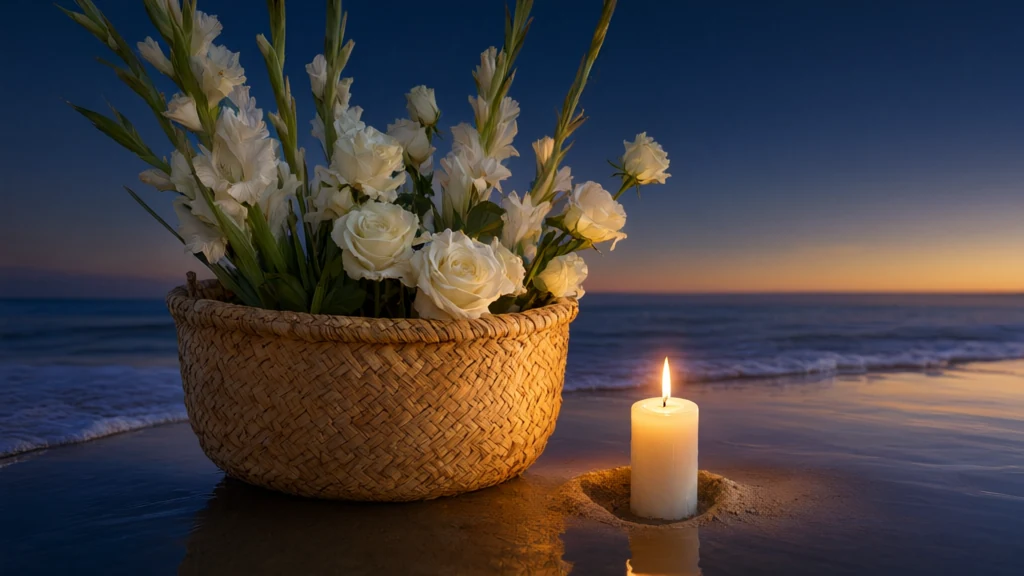
- Light a light blue or white candle. These are the candle colors of Iemanjá at TUCTVC.
- Place a glass of water next to the candle. Those who have it, use sea water.
- Place white roses, which FUCESP lists among her offerings. If you have a plaster statue of Iemanjá, it can stay behind the candle.
- Pray one of the prayers and finish with Odoyá.
Those who cannot light a candle at home can light the virtual candle of Iemanjá. If your home asked for another candle color, Joia Mística helps check via WhatsApp.
At the beach
- Bring white roses without perfume. Cici de Oxalá, egbomi of a terreiro in Salvador, warns: do not perfume with lavender, "otherwise it kills the roses".
- Do not throw bottles, soap, or plastic. The fishermen of Rio Vermelho say that lavender and soap in the sea harm marine life. The Balaio Verde movement also asks for no mirrors, dolls, plastic combs, and perfume glass.
- Enter the water up to your feet, deliver the flowers, and pray.

What else to bring is in offering for Iemanjá and, for the turn of the year, in Iemanjá on New Year.
Frequently asked questions
What to ask for from Iemanjá in prayer?
Ask for protection for the family and the home, emotional balance, support during pregnancy, and unity between parents and children, as taught by the Umbanda house TUCTVC. In the sea bath, the filhos de santo ask for health, strength, courage, and abundance. Ask for yourself and for your loved ones, with calm.
What should not be asked of Iemanjá?
Do not ask for anyone's harm, nor that she change another person's will. Amarração does not match the mother who welcomes. Also, do not promise what you will not fulfill. The prayer is conversation and surrender, without a guarantee of results, and what is of fundamento stays with the house.
Can someone who is not from a terreiro pray to Iemanjá?
Yes. The prayer at home or on the beach is open to anyone who arrives with respect. On the turn, people from many religions go to the sea to greet her. Those from the house follow what the pai or mãe de santo instructs, because bori and obrigação are done in the terreiro.
References
- Prandi (1995): African gods in contemporary Brazil
- Vallado, Le Monde Diplomatique (2010): Iemanjá, the powerful mother
- Alquéres, Bakhtiniana (2025): The Nagô heart and its reinvention
- Gomes et al., Reflexão (2024): The social representations of the orixás
- Barros, UFJF (2006): Iemanjá and Pombagira
- FUCESP: Iemanjá
- TUCTVC: Iemanjá
- O Povo (2024): Iemanjá, the queen of the sea
- Mongabay Brasil (2025): Iemanjá festival wants to become sustainable
- Wikipedia: Festa de Iemanjá