The most well-known qualities of Oxalá in Brazil are two: Oxalufã, the old man with the staff, and Oxaguiã, the young warrior of the mortar. Verger records that it is said in Bahia that there are sixteen.
Open sources bring the same base: white, Friday, and the greeting Èpa Bàbá. They diverge on three points. One is whether the forms are the same orixá, another is who Xangô is related to, and the third is who is Odudua.
How many qualities of Oxalá exist?
Two are the most well-known. Gaia and Scorsolini-Comin write that, for Yoruba culture, there would be another 16 forms. Only Oxalufã and Oxaguiã receive the name Obatalá or Oxalá in Brazil. The general view of the orixá is in who is Oxalá.
Verger records that "it is said in Bahia that there are sixteen Oxalás" and gives a list of names. Included in it are Odudua, "because of his presence in the creation myths," Ajaguna, one of the names of Oxaguiã, and Olissassa, the Jeje version of Lisa.
The list mixes Yoruba names, one Jeje name, and Odudua. Wikipedia brings another, of 16 names, which separates Ajagunã from Oxaguiã. In the sources consulted, there is no official number.
Oxalufã and Oxaguiã: the old man and the young warrior
“The old Oxalufã, tired and hunched, moving slowly, almost unable to dance; the young Oxaguiã, dancing fast like the warrior he is in the myth.”
Reginaldo Prandi, Candomblé of the Ketu rite, 1995
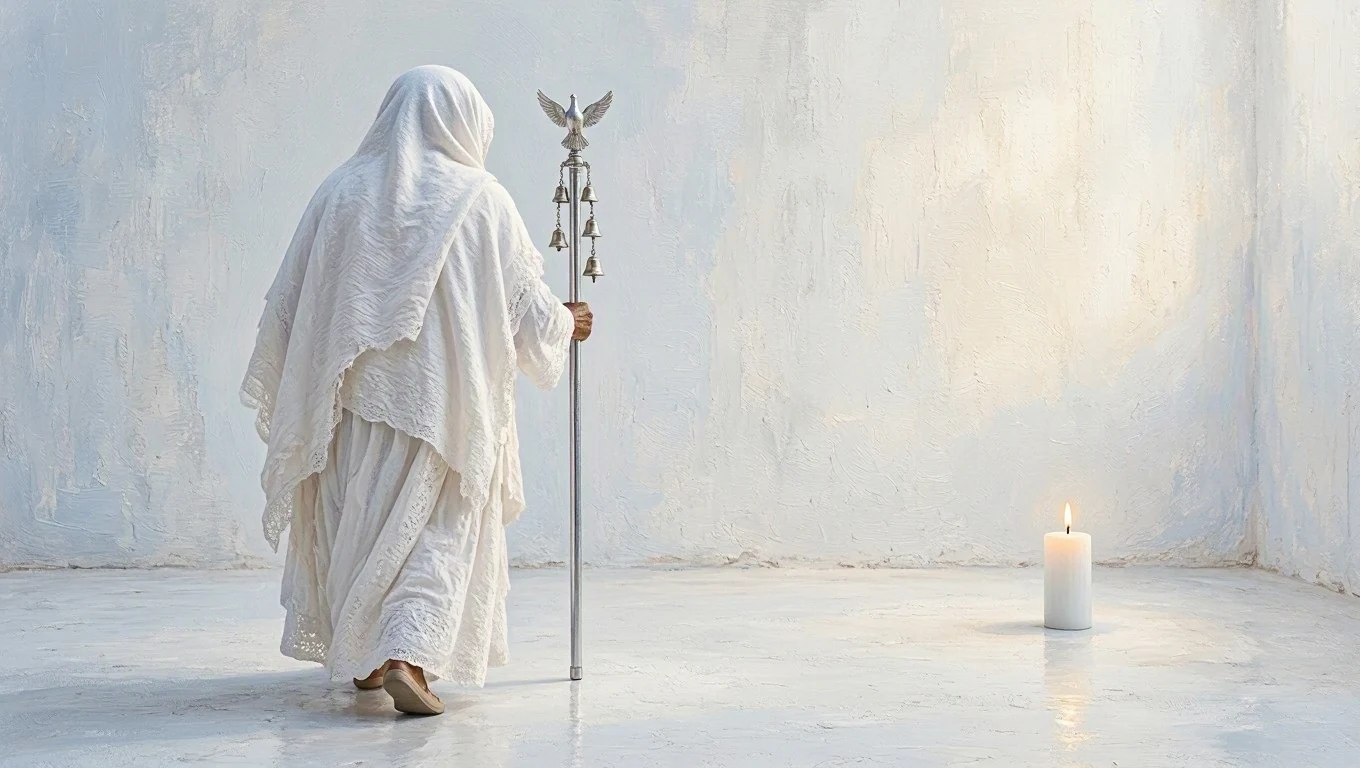
Oxalufã is the oldest of the orixás and the last one revered in the xirê, which goes from the youngest orixá to the oldest. In Verger, the other orixás surround and support Oxalufã in the dance that closes the xirê. The greeting is Èpa Bàbá, "Hail the Father".
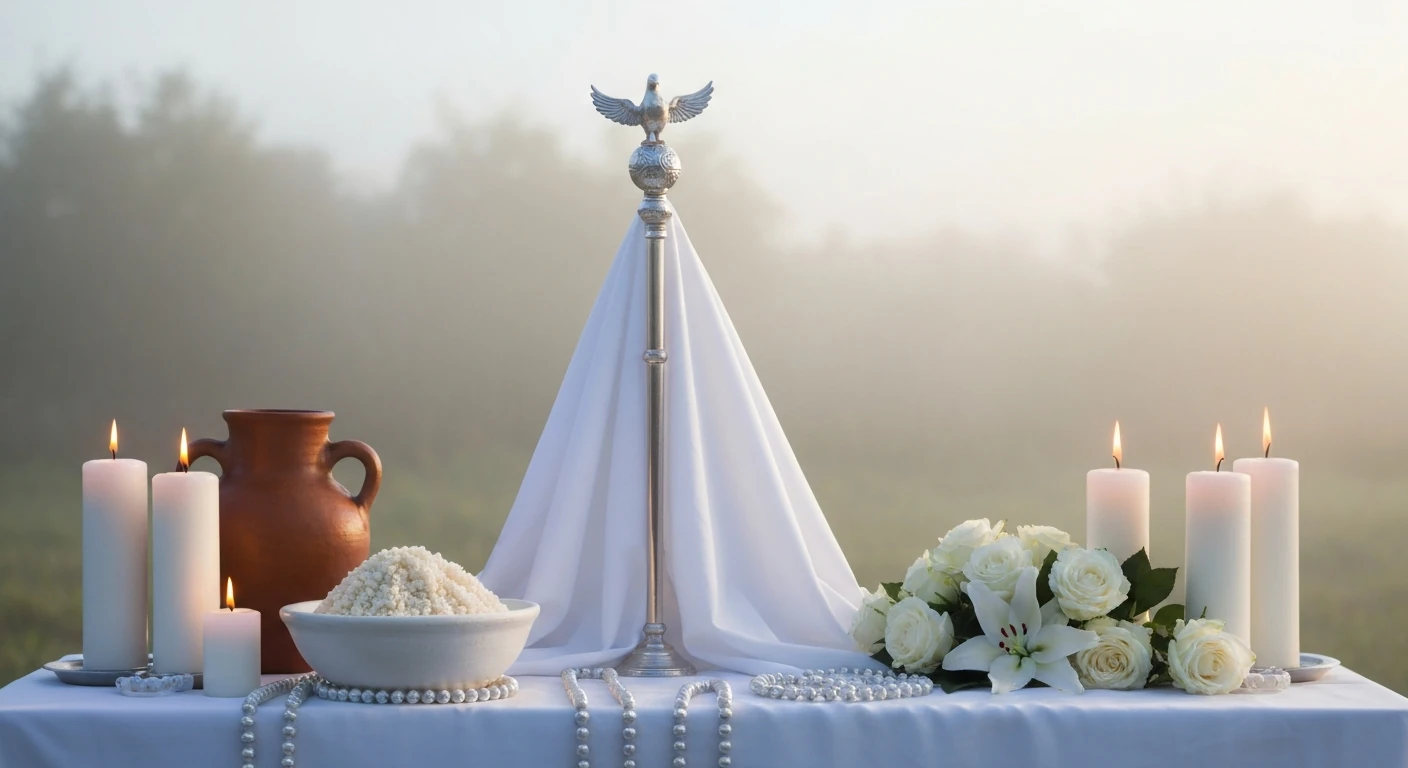
The symbol is the opaxorô, a decorated metal staff, with a dove on top. The Duke museum says it is specifically carried by Oxalufã.
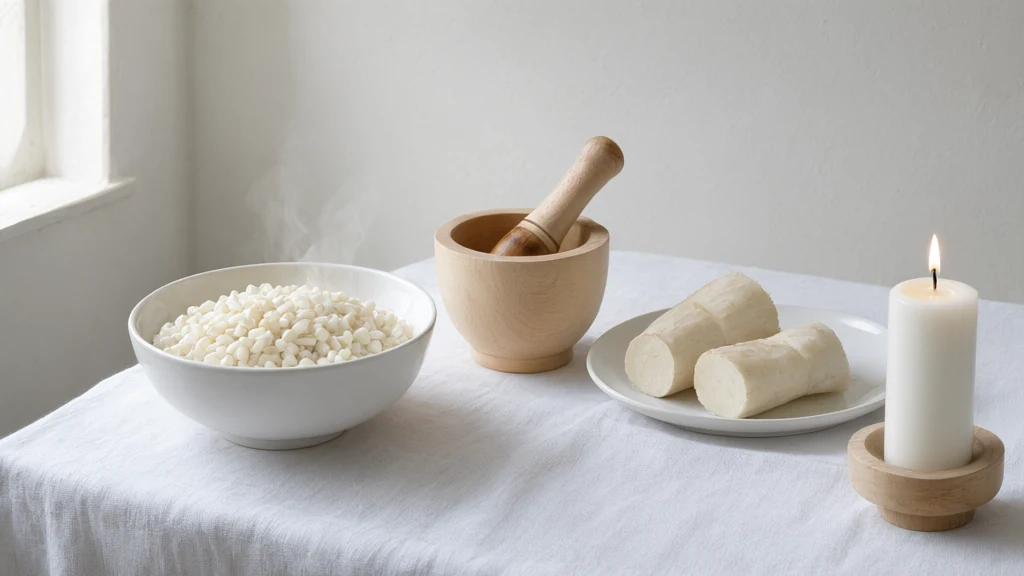
Oxaguiã is, in Verger, a funfun orixá "young and warrior." His taste for pounded yam earned him the nickname "Orixá-Eater-of-Pounded-Yam," and they say he invented the mortar. His annual festival is called Pilão de Oxaguiã.
The symbols, in IPHAN, are the idá (sword), the mortar hand, and the shield, and Gaia adds the atori.
Color, day, and food of each quality of Oxalá
Oxalufã (Prandi, rito queto): Color: white | Day: Friday | Food: canjica, rice with honey, pounded yam | Symbol: opaxorô
Oxaguiã (Prandi, Ketu rite): Color: white with "a minimum of royal blue" | Day: Friday | Food: pounded yam and canjica | Symbol: idá, pestle hand, shield
IPHAN describes the color of Oxaguiã as white "lightly blended with blue." Verger calls Friday the day consecrated to Oxalá. For him, the white of Friday extends to all people affiliated with Candomblé.
Wikipedia records, without a source, Sunday for the old Oxalá. The Sundays of the waters of Oxalá are for celebration. At Opô Afonjá, according to Pinheiro, the second is for Oxalufã and the third, the Day of the Mortar, is for Oxaguiã.
In food, the two forms appear with canjica and pounded yam in Prandi, who adds rice with honey to Oxalufã.
The prohibitions are dendê, wine, and salt in Verger, and Gaia adds charcoal.
Are Oxalufã and Oxaguiã the same orixá?
The sources give three answers. Prandi writes that Oxalá "presents himself in two forms," and IPHAN says he presents himself "in two ways," young and old.
Gaia and Scorsolini-Comin disagree: "It is not about variations of the same Òrisà," and Òṣàlá is the pantheon responsible for the cults of Oxalufã and Oxaguiã. They also write that it is possible that Oxalufã is Obatalá himself.
The third answer comes from an itã that Póvoas, babalorixá and professor, tells in a class at UESC. Ajagunã, son of Obatalá, is born without a head, and Ori makes him one of crushed yam, with a shield and a pestle hand. In the end, "Ajagunã became Oxalufã, the oldest of the oldest," and Ogum (Ogun) makes a staff for him to lean on.
In this version, the young and the old are the same figure at different times. Verger and Póvoas only coincide in the name, as Ajaguna is one of the names of Oxaguiã in Verger's list.
Relatives of Oxalá: Oxaguiã, Xangô, Airá and Odudua
In Verger, Oxalufã visits in Ejigbô "his son Oxaguiã", and Gaia, citing Verger, calls Oxaguiã the son of Oxalufã.
Regarding Xangô, the sources are divided into three. Verger calls him a "friend" of Oxalufã. Prandi and Vallado tell that he discovers "his father Oxalá" imprisoned, and call Airá Intilé "the rebellious son of Obatalá". Wikipedia records Xangô as "his other son", without a source.
Odudua yields four readings. Each author says one thing, and the text does not break the tie.
- Prandi: younger brother of Orixalá, the firstborn, and the one who takes the bag of creation.
- Verger: "more a historical character than an orixá", invader and founder of Ifé. Father Baudin feminilizes him to make him Obatalá's companion, and Obatalá's companion, in Verger, is Yemowo.
- Wikipedia and Gaia: female divinity, the bottom part of the gourd, and the "feminine part" of Olorum (Olodumare), sent to create the earth.
- Marins: in the current version of creation, Odùduwà is the protagonist, and Obatalá is left with the human beings.
The qualities of Oxalá in other nations
In the angola nation, open sources bring Oxalá close to the nkisi Lemba or Lembá. In an angola house in São Paulo, Barros describes Lembaringanga, linked to the nagô name of Oxalá, as "a very respected nkisi that closes all candomblé ceremonies." In an angola candomblé studied in the RACA journal, a taata says that "Lembá rejects dendê oil." The Inzo Tumbansi, an angola house, describes Lembá with white color and canjica with coconut.
Wikipedia says that Lemba "is equivalent to the orixá Oxalá," in its words, and here it serves as an approximation. The day, color, and food of Lemba in academic sources were not located. See the angola nations.
On the jeje side, Verger says that Lisa is, for the fon, the name of Òrìsàálá, and that Olissassa is the gêge version of Lisa in Brazil. In a tambor-de-mina house in São Paulo, Prandi records Lissá as the correspondent of Oxaguiã and Arronovissavá as that of Oxalufã. The same chapter describes Lissá as the vodum of the stars, who represents the sun. It is a correspondence of one house, without equivalence. The jeje candomblé of Bahia did not appear in open sources.
In batuque, a house in Rio Grande do Sul gives Sunday as the day of Oxalá, with Iemanjá (Yemoja) and Oxum (Oshun) as adjuncts. The Ilê de Obokun describes Obokun, "the youngest of the Oxalás," and Oromilaia, "a very old Oxalá," whose head some families did not deliver. Lia and Troglio record the rice with milk for Oxalá, in the recipe of a babalorixá from Caxias do Sul. The batuque has a separate article in Oxalá in batuque.
The foundation is from the house
The list above gathers what open sources record and does not replace the tradition of any house. A person's Oxalá quality is not discovered through text or testing. The head orixá is confirmed in the cowrie-shell divination, in a house of axé, and each nation names the forms in its own way.
Frequently asked questions
How many qualities of Oxalá exist?
In Brazil, the two most well-known are Oxalufã and Oxaguiã. Verger records that "it is said in Bahia that there are sixteen Oxalás" and provides a list, and Gaia and Scorsolini-Comin speak of other 16 forms in Yoruba culture. In the sources consulted, there is no official number.
Do Oxalufã and Oxaguiã have different days?
For Prandi and IPHAN, the day is Friday for both forms. Wikipedia records, without a source, Sunday for the old Oxalá, and a Batuque house in Rio Grande do Sul gives Sunday for Oxalá. The day of your house is worth more.
Are Obatalá and Oxalá the same orixá?
Gaia and Scorsolini-Comin write that only Oxalufã and Oxaguiã receive the name Obatalá or Oxalá in Brazil, and that it is possible that Oxalufã is Obatalá himself. Wikipedia lists Obatalá among the names of Oxalá. The answer varies with the house and with the author.
Is Oxalá the father of Xangô?
It depends on the source. Prandi and Vallado call Oxalá "father" in the myth of Xangô Baru, Verger calls Oxalufã a "friend" of Xangô, and Wikipedia records Xangô as "his other son," without a source.
References
- Reginaldo Prandi, Horizontes Antropológicos: African gods in contemporary Brazil
- Pierre Verger, Corrupio: Orixás, work record
- Gaia and Scorsolini-Comin, Memorandum (UFMG): Representations of Òṣàlá
- IPHAN: Festa do Bonfim, dossier
- Reginaldo Prandi, Companhia das Letras: Mythology of the orixás, excerpt
- Prandi and Vallado, Edusp: Xangô, king of Oió
- Luiz L. Marins, Africa (USP): Òrìsà dídá ayé
- Cristine Lia and Matheus Troglio, Revista Maracanan (UERJ): Sacred feeding in Batuque
- Érika Pinheiro, UERJ: The spectacle of the waters