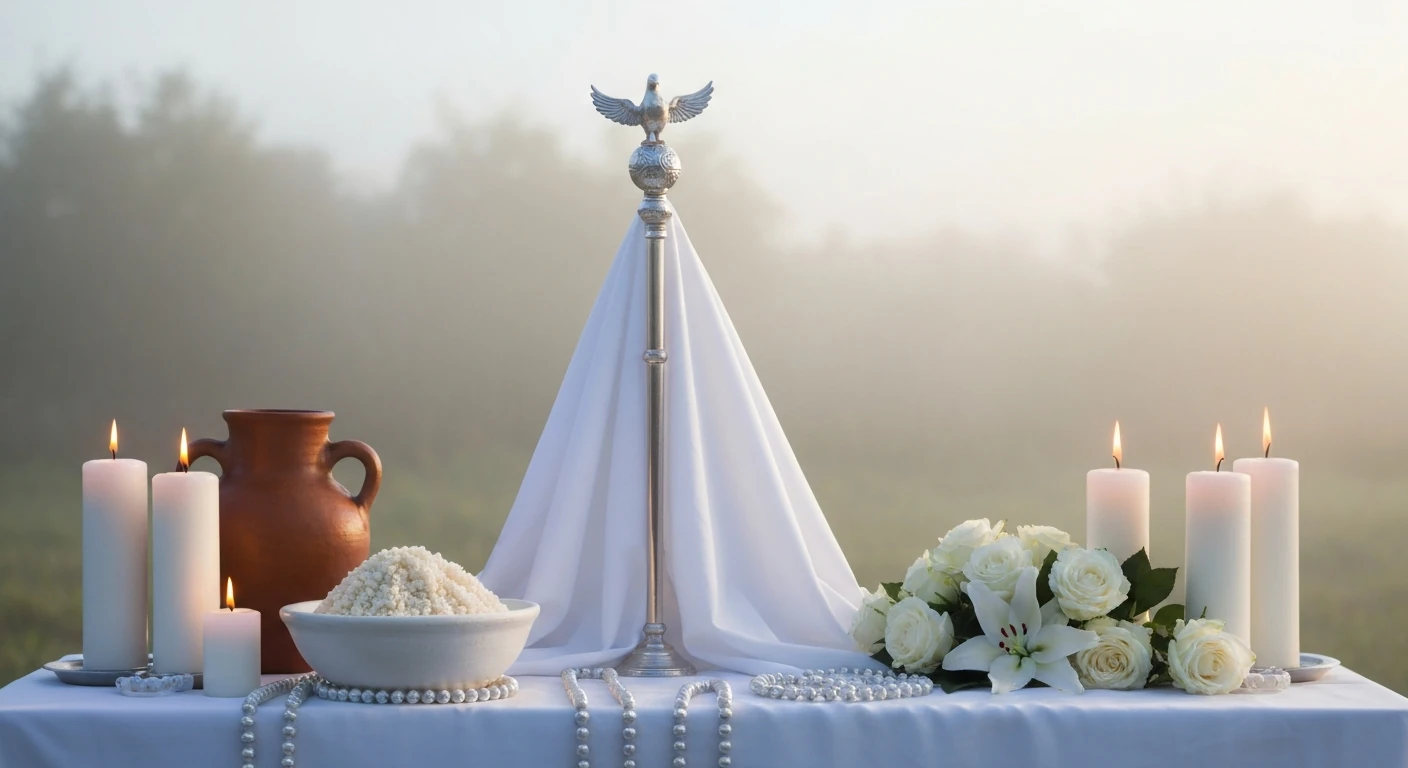
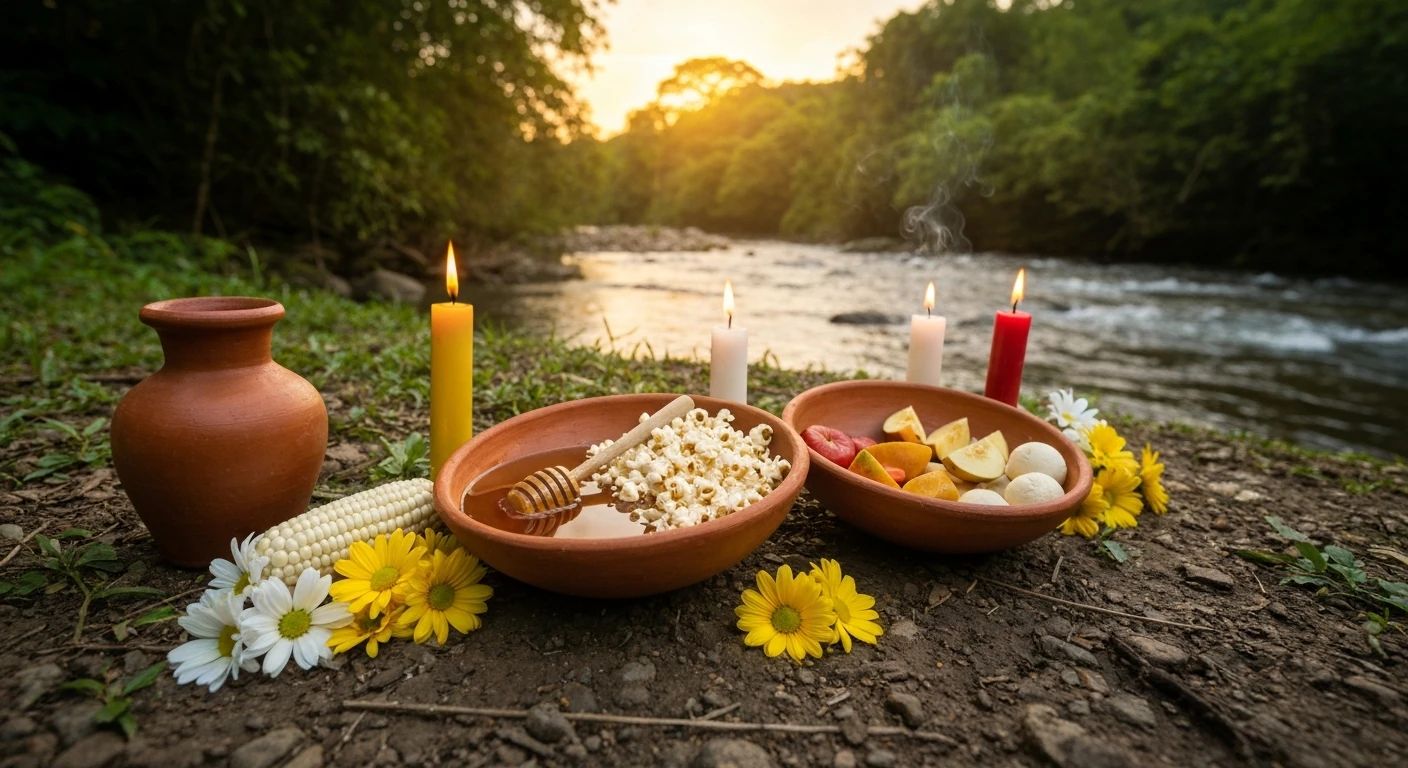
The offering for Oxalá is the only one in the house where the list of what is forbidden says more than the list of what is allowed. He is the funfun orixá par excellence, and funfun means white in Yoruba.
Here you see the three prohibitions and the reason for them, and what goes in place of each one. You also see the difference between the dish of the young Oxalá and the old one, and how to deliver the offering at home.
The three things Oxalá does not eat
The sources converge in a short and harsh list: salt, dendê oil and palm wine. Pierre Verger is cited by name in the entry about the funfun orixás, and his formulation is direct: the wine and the oil coming from dendê, and the salt, are the main prohibitions.
Dendê is the most severe case. The houses of terreiro teach that it must never stain the clothes, the sacred objects, nor the alá, which is the white cloth of the orixá. It is not a question of flavor, it is a question of fundamento.
Palm wine has its own itan. In Prandi, Obatalá, who did not make the offerings, is avenged by Exu (Eshu) with a great thirst, drinks palm wine and falls asleep. Upon waking, Olodumare forbids him from drinking palm wine forever. The complete myth is in who is Oxalá.
The concept behind all this is in quizilas in Candomblé. Quizila is not a matter of palate, it is that which offends the fundamento.
What goes in place
This is the point that almost no page explains: the sources record the three prohibitions, and what goes in place is, for the most part, house custom.
- In place of dendê: nothing, in most dishes. At home, some use sweet oil, which is olive oil, a house custom without an open source.
- In place of salt: nothing, in most dishes. When the recipe calls for some flavor, some houses use grated onion, also a house custom.
- In place of the drink: clean water, served in the quartinha. The container and its use are in what is a quartinha.
The tableware is also a requirement. The foods offered to the funfun orixás will always be in white tableware, and the same care applies to the alguidar, the subject of alguidar what is it for.
The white of Oxalá is not just a color. Researcher Juana Elbein dos Santos reads funfun in a double sense: the white of everything that is white, and also the colorless, the anti-substance, the nothing from which everything begins.
Oxaguiã or Oxalufã: two menus
Oxalá is not just one, and this partition does not exist in any other orixá in the series of offerings. He runs in two ages, and each one eats something different.
Oxaguiã is the young Oxalá, warrior and combative, the one who defends the unjust. His name means the orixá who eats pounded yam, and the itan tells that he was the one who invented the mortar to prepare the favorite dish. The Festa do Pilão celebrates this, and the record speaks of white canjica with eight balls of yam.
Oxalufã is the old Oxalá, delicate and sensitive to the cold, the one of the opaxorô, the white metal staff. He eats the ebô, the white corn canjica cooked only in water, without seasoning. The dish has its own page in what is ebô.
In the practice of home offerings, the choice is simple. To honor the young one, the dish takes cooked and mashed or pounded yam. To honor the old one, it takes canjica, covered with a tuft of cotton. In Prandi's tables, however, both forms eat canjica and pounded yam, and Oxalufã also rice with honey, so the separation is a custom that the house defines. Whoever has a house asks the leader which of the two is theirs, and the forms are in qualities of Oxalá.
In the angola nation, the corresponding energy is the inquice Lembá, with its own worship. In the Gaúcho batuque, it has its own foundation, a theme of Oxalá in the batuque.
The step by step offering
The domestic offering is simple in purpose. It does not replace comida de santo, which is made in the house with a leader, and the distinction between the two things is in how to make offering to the orixás.
- Cook the white corn only in water, without salt and without seasoning, until it becomes soft. It is the ebô.
- Serve in white chinaware, a deep plate or a clean alguidar, without mixing with other food.
- Cover with cotton, which is a sacred substance of the orixá, and arrange white flowers nearby.
- Light a white candle, of seven days when you want to accompany the whole week. Colors and use are in ritual candles.
- Put clean water in the quartinha, next to the plate.
- Say your request in a low voice and without haste, and close by greeting: Epa Babá.
Regarding quantity, no source fixes a measure, and be suspicious of those who set a specific weight. A deep plate, a handful of cotton, and a candle are enough.
Two real discrepancies worth knowing. Honey in the canjica appears in Umbanda sources: a study in Bocaiuva (MG) describes the Oxalá canjica of a terreiro "drenched with honey", and Prandi records rice with honey for Oxalufã in the Ketu rite. Umbanda houses vary, as shown in Oxalá in Umbanda. The rule that sources repeat is simply no salt. The rest is house precept.
The day, the white, and the silence
Oxalá's day is Friday in Ketu Candomblé sources, as it also appears in days of the week of the orixás. Some houses associate the orixá with Sunday: FUCESP writes "Friday or Sunday", TUCTVC gives Sunday, and one Batuque house does too. See Oxalá's day.
Wearing white on Friday is an old custom, and Verger recorded that people consecrated to him always dress in white. It is a sign of belonging.
And there is the silence, which in the case of Oxalá is a matter of rite. It comes from the itan of Oxalufã, who traveled to Oió against the babalawo's advice, refused to help Exu on the path, and ended up unjustly imprisoned. When Xangô (Shango) discovered who the prisoner was, he ordered his release, imposed silence on the kingdom, bathed the old man in pure water, and dressed him in new white.
From this myth were born the Waters of Oxalá, a rite that certain terreiros of Ketu origin celebrate every year. The children of axé leave the terreiro in silence, in white, carrying pots and moringas to fetch water. Keep this as reverence, not as a recipe: in many houses, participating requires borí or obi consultation, and the rite belongs to the house, with a leader. Dates vary between terreiros, and the calendar of the orixás helps to orient oneself.
The syncretism with Nosso Senhor do Bonfim has its own article in Senhor do Bonfim and Oxalá, and is not repeated here.
Where to deliver and how to discard
Oxalá is the orixá of the heights and the air, and his offering does not require a forest or a waterfall. The most cited place is the heights, a hill or an open point, and many people deliver it at home, in the cleanest and most airy spot of the house.
Leave the plate for the time your house instructs. Then collect it, return the food to the earth, at the foot of a tree or in running water, and wash the dishes separately. No common trash.
If you still do not know who your orixá is, start by discovering your orixá and take the result to a serious house. The cowrie shells of the house are what confirm, and the offering of other orixás is in the series that already brings offering for Oxóssi.
Frequently asked questions
What to offer for Oxalá at home?
White corn canjica cooked only in water, served in white dishes and covered with cotton, plus white flowers, a white candle, and clean water in the quartinha. If the intention is to honor Oxaguiã, the youth, cooked and mashed yam enters in place of the canjica.
Does Oxalá eat dendê?
No. Dendê is one of the three prohibitions recorded, alongside salt and palm wine. The houses teach that it cannot even touch the white cloth of the orixá. What enters in its place is a house custom, such as sweet oil.
Can you put honey on Oxalá's canjica?
It depends on the house. A study in Bocaiuva (MG) describes the canjica of Oxalá from an umbanda terreiro watered with honey, and Prandi records rice with honey for Oxalufã in the ketu rite. What no source allows is salt. If you have a house, ask your leader before sweetening.
What is Oxalá's day?
Friday in the sources of ketu candomblé, and it is the day when many people wear white. In umbanda houses and in a batuque house, Sunday also appears as Oxalá's day. The greeting is Epa Babá, and the symbol is the opaxorô, the white metal staff that he carries.
Where to leave the offering of Oxalá?
In a high and airy place, such as a hill or an open spot, or in the cleanest spot of the house itself. After the time your house directs, collect and return the food to the earth, at the foot of a tree or in running water. The dishes are washed separately, and nothing goes into the common trash.
Where to buy Oxalá material
At Joia Mística Laroyê, you find the material of the orixá of peace with provenance:
- White corn canjica: the right grain for the ebó, without mixture
- White candles: individual and seven day
- White dishes, alguidar and clay quartinha: for the plate and for the water
- Cotton, white pemba and white cloth: to cover, mark and line
- Bead necklace of milky beads and statue with the opaxorô: for the congá and for the present
Stop by the shop, at Rua Benedito Zingari, 460, Bela Vista, in Extrema-MG, or message on WhatsApp with delivery to all of Brazil.
A final word. The domestic offering is from the devoted person and is up to anyone. Assentamento, bori and the Waters of Oxalá are from the house, made with a leader, and the shop provides the material without replacing anyone's foundation.
References
- Reginaldo Prandi: the author's page at USP, with excerpts from Mythology of the Orixás and the myths of Oxalá, Faculty of Philosophy, Letters and Human Sciences
- Wikipedia: the entry for the funfun orixás, which cites Verger on prohibitions and Juana Elbein dos Santos on the dual meaning of white
- Reginaldo Prandi, Horizontes Antropológicos: African gods in contemporary Brazil
- Fábio da Silva Gonçalves, UFMG: The food in the terreiros of Bocaiuva
- Wikipedia: the Oxaguiã entry, with the pounded yam, the Festa do Pilão and the canjica with eight balls
- Wikipedia: the Águas de Oxalá entry, with the silent procession and the requirement of borí to participate