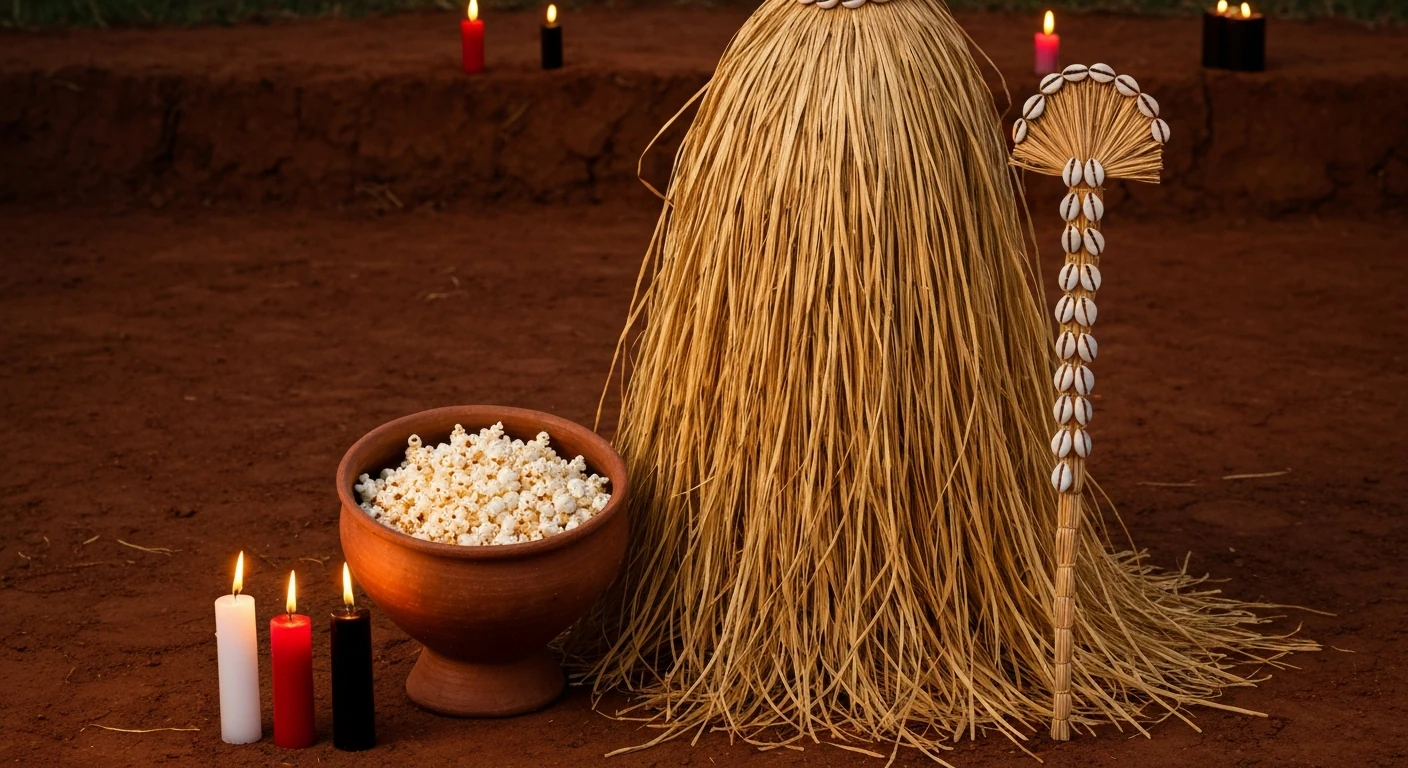
The prayer for Obaluaê, or Omolu, begins with the greeting Atotô and asks that he take away the illness. There is no single text for all houses. Below is a prayer to pray at home, verses from the oriki recorded by Pierre Verger, and a blessing text with translation.
Monday is his day, and August 16 and December 17 are the most widespread dates. The prayer does not replace a doctor or treatment: it accompanies the care.
Prayer for Obaluaê: the text to pray at home
The prayer below was written by Joia Mística Laroyê for those who pray alone, at home. It does not come from a tradition or a terreiro: if your house has its own words, stick with the house's words. The prayer request follows the sources: that he take the illness away.
Atotô, my father Obaluaê. Lord of the earth, I arrive in silence and ask for permission. Watch over this body and this house. Take away the illness, the pain, and the fear. Give patience to those who care and a firm hand to those who treat. Walk with me in the consultations and in the treatment. Receive this light as my gratitude. Atotô!
Pray slowly, in a low voice or in thought, and say the name of the person who is ill. Who he is is in who is Obaluaê.
What does Atotô mean?
Atotô is the greeting of Obaluaê, and the most repeated meaning is silence. But the sources diverge:
| Who says | What is written |
|---|---|
| Iyalaxé Marcela Ferreira, in Alma Preta | silence, he is among us |
| TUCTVC, Umbanda house | silence and profound respect |
| Pai Rodney, in CartaCapital, for "Atotô, Ajibeeru!" | Silence, He is the Lord who Shouts! |
| Samuel Abrantes, UFRJ | “‘We’ greet your presence”, and a prayer request for permission |
| Lucas Barreto de Souza, UFRGS, for "Atotô Obaluaê!" | Hail the King and Lord of the Earth |
None come from a Yoruba dictionary, and the exact translation remains open. All speak of respect before him.
The practice also varies. Verger reports that, when the orixá (orisha) manifests in an initiate, he is welcomed by the shout "Atotô!". Lourdisnete Benevides, from UFS, describes the gesture: conversations and laughter cease, and the Candomblé community touches their fingers to the ground and brings them to their head. Everyone says "Atotô, my father! Atotô, my old one!"
The forms change from house to house: Atotô Ajuberú in the São Paulo federation FUCESP, Atotô, my lord in the Núcleo Umbandista São Sebastião (NUSS) and Atotô Abaluaiê in the Santuário Nacional da Umbanda. The greetings of the other orixás are in greetings of the orixás.
The oriki of Omolu and the blessing text with source
The oriki is the praise of an orixá. In Abrantes' definition, orikis are "the songs of praise and calling of the gods." Verger records some of Xapanã, under the name of Omolu, gathered in Kêto and Abeokutá, in Africa. These are the first verses, in the book's translation:
My father, son of Savé Opara. My father who dances over money. He sleeps over money and measures his pearls in cauldrons. Black hunter who covers the body with coastal straw.
The following verses warn about those who insult Omulu and end with "No one should go out alone at noon." This tone explains the respect before any prayer request.
Samuel Abrantes studied the clothing of Obaluayê in Candomblé de ketu (UFRJ, 1996). The chapter of the songs ends with a blessing text in the language of the cult and in Portuguese. He does not say from whom he collected it, so it cannot be attributed to a house. The spelling is from page 86:
Atotô Obaluayiê! Írãn lowo Itojú owon lojô Júmó Irãn lówó elêyi Ará ré wá lorí firé imó wabúkun ni omon bêko ni iberú bukún Axé!
Obaluayê protects your son Takes care of him every day Protect his body Come over his head to bring wisdom Bless your son so that he has no fear Amen
The column of babalorixá Pai Rodney in CartaCapital (2020) brings other translated verses, such as "In his small gourd, He brings enchantments / To free us from diseases". The chants of the gira are in ponto de Obaluaê.
What to ask of Obaluaê?
One asks Obaluaê to take the disease away. The babalorixá Sidnei Barreto Nogueira, a doctor in semiotics from USP, says it is disrespectful to ask for health from the "orixá-of-disease". In the same column is the teaching of Pai Pérsio de Xangô (Shango):
Do not ask Omolu for health. Omolu has no health to give to anyone. From Him we ask to take the disease away.
FUCESP says the same: "despite not bringing health, he has powers to take diseases away". In Olubajé, according to Alma Preta, "the followers ask the lord of the land to remove diseases from the community". In Umbanda, TUCTVC lists "Healing and strengthening during illnesses", and the Santuário invokes him "for the healing of the sick". Follow the custom of your house.
Three short requests, also written by Joia Mística, to add to the main prayer:
For those undergoing treatment: Atotô, my father. Take away what makes this person sick and give strength to those who care for them.
In gratitude: Atotô, my father. I thank you for the health I have and for those who helped me cross the disease.
For those who have already departed: Atotô, my father. Receive this soul with calm and give comfort to those who remained.
The last one is based on Umbanda: at the Cross of Souls of the Santuário, "this type of prayer is delivered to Abaluaiê".
Prayer does not replace a doctor or treatment. TUCTVC itself writes: "Your strength does not replace medical treatments or healthcare." A wound that does not close, fever, and pain that does not pass require a consultation. Prayer against enemies does not belong here.
When to pray to Obaluaê?
The day to pray to Obaluaê is Monday, in Verger, at FUCESP, at the Sanctuary, and at TUCTVC. The dates of the year depend on the house:
- August 16, Saint Roque day, in the month of Olubajé for most terreiros of candomblé. See month of Obaluaê and Saint Roque and Obaluaê.
- November 2, together with All Souls Day, at FUCESP and at the Sanctuary.
- December 17, Saint Lazarus day. The Catholic prayer to the saint is another text: see Day of Saint Lazarus.
Saint and orixá are close on these dates, but they are not the same figure. In Bahia, Verger saw the ground of the courtyard of the Church of Saint Lazarus covered with pipocas, which people passed over their bodies to protect themselves from contagious diseases. The recipe and the ritual bath are in pipoca of Obaluaê.
With what candle to pray to Obaluaê?
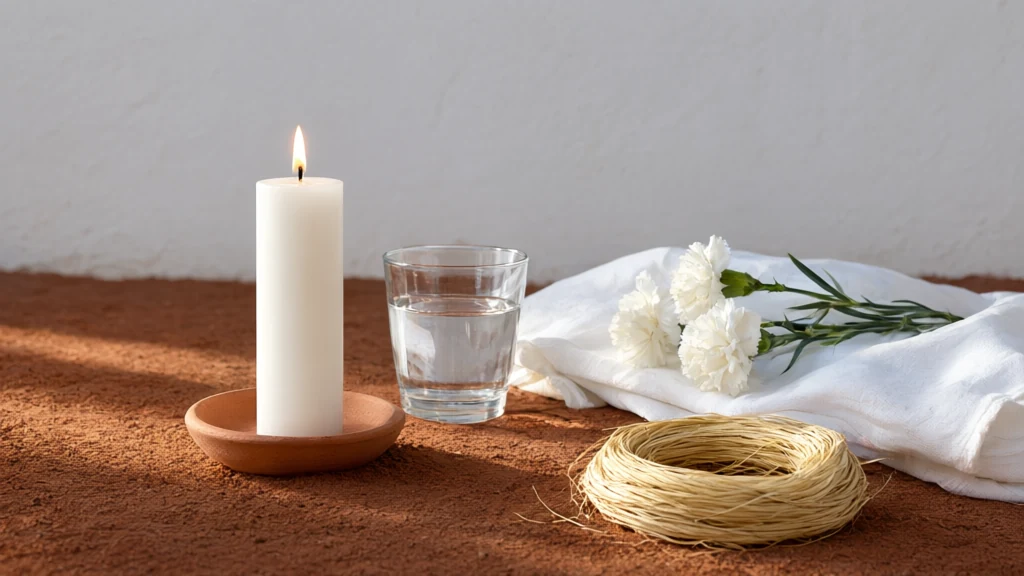
The candle to pray to Obaluaê is white, or white and black, according to NUSS, the Sanctuary, and FUCESP. TUCTVC records black, white, and straw. NUSS warns that the two-color one is only for those who know how to handle candles: "If you do not know, use only the white color." In candomblé, FUCESP adds red to his colors.
A simple way to pray at home:
- Clean a corner and place a glass of pure water.
- Place white flowers, such as carnations, if you have them.
- Light the candle on a firm plate, away from curtains and children.
- Be silent for a moment, say Atotô, pray and give thanks.
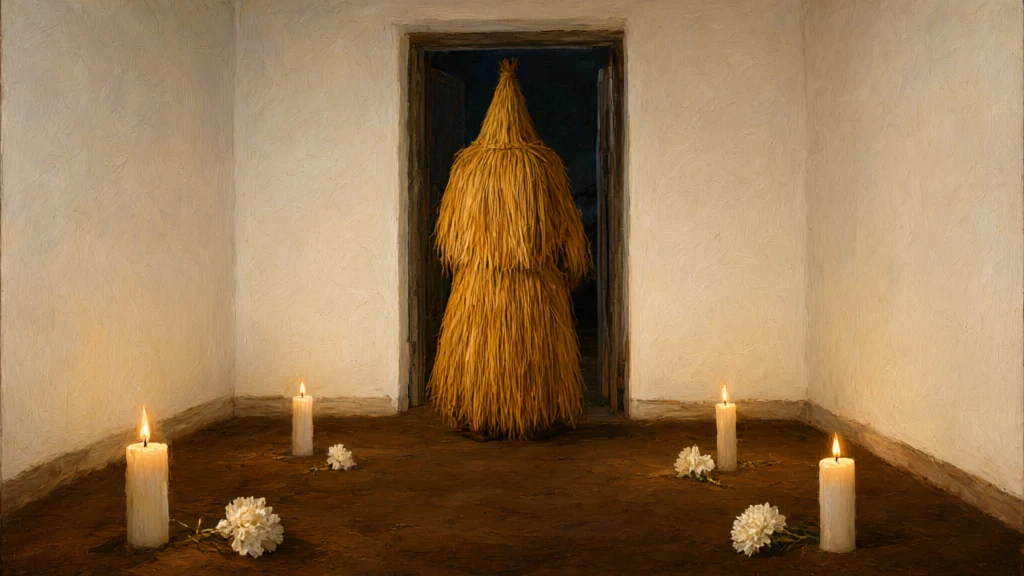
Those who have a plaster statue of Obaluaê, covered in straw, can pray before it. Those who do not have one light it by name, and the virtual candle of Obaluaê serves those who are far away. If in doubt about the color, use the which candle to light tool. What is most offered to him is in offering for Omolu. To check the candle or the statue that your house requested, Joia Mística Laroyê can be reached via WhatsApp.
Frequently asked questions
Is there an official prayer for Obaluaê?
There is no single text: each terreiro has its own words. TUCTVC, for example, publishes its own prayer on the house's Obaluaê page. What is repeated in the sources is the greeting Atotô. In Umbanda, also see Omolu in Umbanda.
Do Obaluaê and Omolu have different prayers?
You can pray the same one. Agenor Miranda Rocha, cited by Abrantes, says he usually calls Obaluayê the young man and Omolu the old man, but that they are "just two names for the same spirit." If your house separates them, follow your house.
Does the prayer for Obaluaê cure disease?
There is no promise of cure. The prayer asks that he take the disease away and gives strength to those being treated, but it does not replace a consultation, exam, or medicine. The NUSS records that those suffering from ailments considered incurable turn to him. Even so, the doctor remains on the path.
Can I pray for another person or for an animal?
You can pray for another person: say their name in the prayer. Open sources do not provide text for Obaluaê for animals, so none appear here. A sick animal needs a veterinarian, and whoever wishes can light the candle by its name.
References
- Pierre Verger, Orixás (Corrupio, 1981): Google Books entry
- Samuel Abrantes, UFRJ (1996): Atotô Obaluayê Ajuberu
- Lucas Barreto de Souza, Photocronographies, UFRGS (2021): Olubajé at Ilê Axé Akaraizô
- Lourdisnete Benevides, Educon, UFS (2015): article in Educon
- Pai Rodney, CartaCapital (2020): Diálogos da Fé column
- Alma Preta (2023): Olubajé
- Alma Preta (2022): Omolu and health
- FUCESP: Obaluaê
- NUSS, Umbanda house: Omulú
- National Sanctuary of Umbanda: Abaluaiê and Cross of Souls (Cruzeiro das Almas)