In the Batuque of Rio Grande do Sul, every festival proceeds from the youngest orixá to the oldest, and it is Oxalá who closes the line. He is the father of all orixás, the lord of Alá, the owner of peace, wisdom, and white. When the chants reach him, the entire circle has already gathered in reverence.
This guide shows the role of Oxalá in Batuque in the south: why the father of creation closes the line, what his paths are in the southern tradition, the color, the day, the foods, and the syncretism with Senhor do Bonfim. All with respect to the variation of each nation and each house.
The oldest: who closes the Batuque line
The orixás of Batuque are greeted in their own order, going from the youngest to the oldest. The line always opens with Bará, who moves and unlocks the paths, and ends with the father of creation. That is why the lord of Alá occupies the last place: he is the oldest, the one from whom everything came.
The Batuque entry on Wikipedia records this logic. The worship begins with Bará, honored before anyone else, and rises in age until reaching the father of all. Closing the line is not a protocol detail. It is the way the Gaucho tradition says that the elder gathers and blesses everything that the younger ones set in motion.
In Batuque, it is customary to separate the orixás into "new" and "old". The lord of peace belongs to the old ones. According to Adalberto Ojuobá Pernambuco, in an article in the magazine Debates do NER, in the batuque of decades ago, the male orixás were called first and then the females, and the prayers ended with Yansã, Xangô (Shango), and finally Oxalá, although in some houses Oiá and Xangô were invoked after Oxalá. The order varies from house to house. Each one has its otá, the stone that guards the axé, and its quartinha, cared for by the babalorixá or the ialorixá.
The paths of Oxalá in Batuque
Like every orixá, the father of creation presents himself in paths (or qualities), each with its own history and its foundation. In the Batuque do Sul, as recorded by the nagô tradition houses, some of the most cited are:
- Obokun: the youngest of the paths, linked to the ancestor who founded Ijexá. He appears associated with shells and the sea.
- Olokun: the lord of the sea, present in the búzios and in the elements of the deep waters.
- Dakun: linked to cotton, the white material par excellence of the orixá.
- Oromilaia: one of the oldest, associated with the cowrie-shell divination. Some describe him as already very elderly.
- Oxalá Velho: represented bent over, leaning on the staff (the paxorô), an image of age and wisdom.
A note of precision is required. The names Oxaguiã (the young one, lord of the pounded yam) and Oxalufã (the elder of the paxorô) are the most famous pair, but they come mainly from baiano candomblé. In Batuque, the paths gain their own names from the gaúcho tradition. That is why it is always worth listening to the foundation of your house: the exact relationship changes from nation to nation.
Color, day, and foods of the lord of Alá
In Batuque, each orixá has signs that help the filho de santo recognize and honor them. Those of the father of creation are the most sober of the entire line.
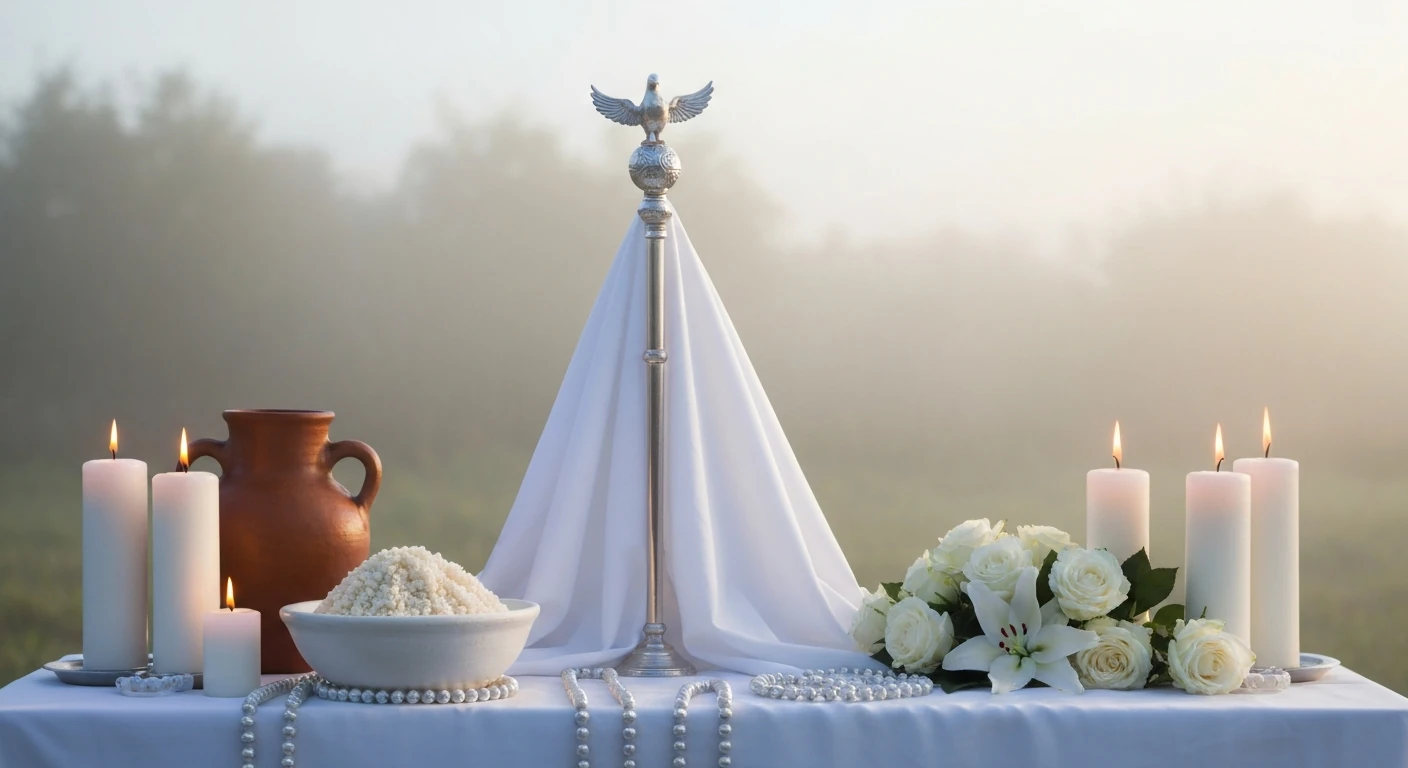
Color: white | Day: Sunday in a house in Porto Alegre (without an open source for Friday in batuque) | Domain: creation, peace, purity | Symbol: the Alá (white cloth) and the paxorô
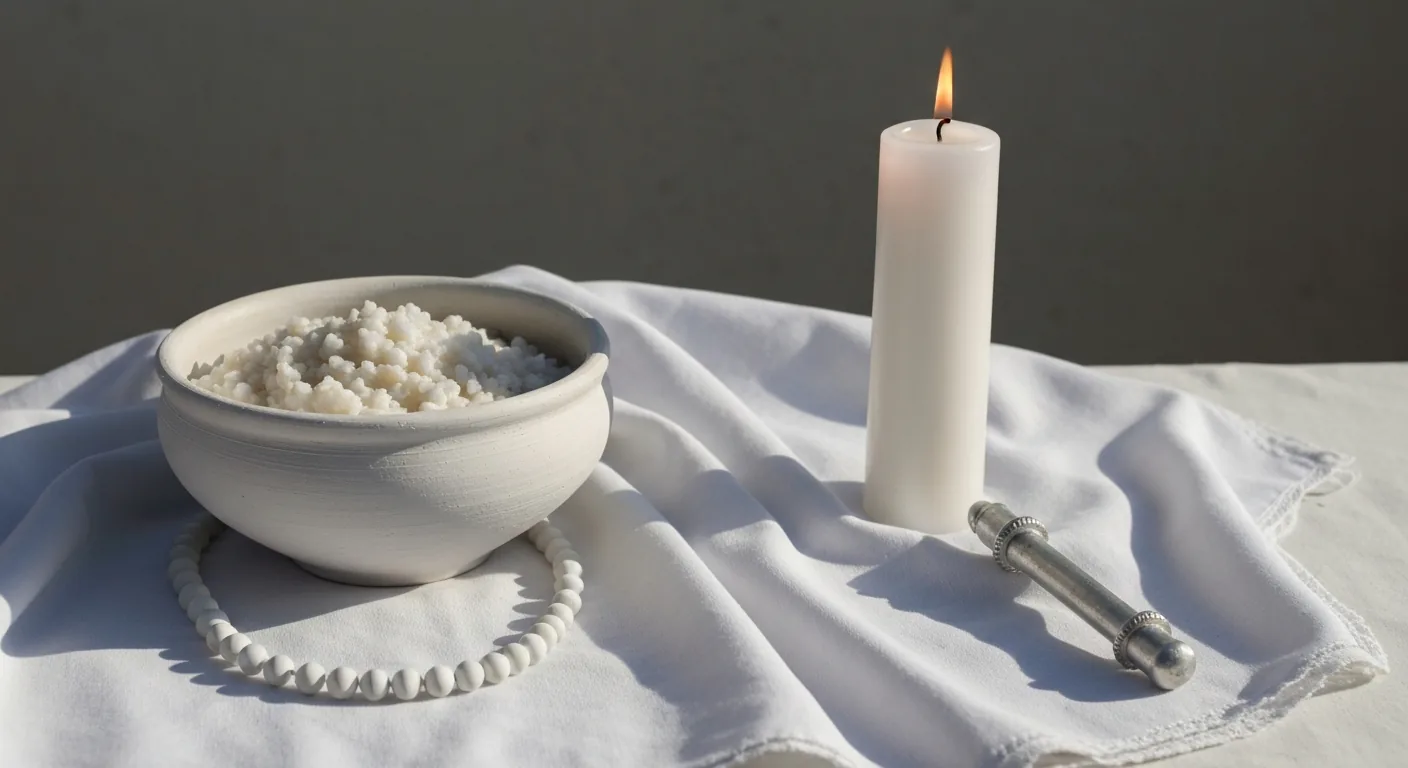
White is the absolute mark of the orixá. It is the color of purity, of the Alá that he extends over the world, and the only open batuque house that informs the day, Ilê Axé Odé Omialé, in Porto Alegre, gives Sunday. The white Friday is a custom that Verger describes for Candomblé, and the count of the sources is on Oxalá day. The foods follow the same sobriety. The Ilê of Obokun writes that "Oxalá eats white canjica", and Pernambuco records that "Oxalá's white canjica closed the table". The white canjica is prepared without dendê, and the rest of the menu is the foundation of the house.
The absence of dendê in the foods is not by chance. Dendê oil brings heat and movement, and the father of creation is from the field of peace, of cold, of serenity. Honoring this orixá is seeking the serenity that he represents.
White bead necklaces and candles accompany the devotion. As always, the correct recipe and the measure of the ritual offerings belong to the foundation of the house and the guidance of the zelador.
Why some houses do not give the head to Oxalá
A curious trait of Batuque is this: not every house settles the father of creation as head orixá. The explanation comes from the very nature of the orixá. Being the oldest of all, very elderly, some families of santo understand that he would have difficulty "ruling" the busy life of a child, and for this reason they prefer not to give the head directly to him.
Other houses, however, give the head normally, and worship them as a head orixá. There is no single rule: the decision belongs to the foundation of each nation and the reading of the búzios made by the babalorixá or by the ialorixá.
It is worth reinforcing a point of respect. Knowing who someone's head orixá is cannot be discovered by date of birth or by self-testing. This is defined in the cowrie-shell divination, inside a house of Batuque, with a zelador de santo (house caretaker). The assentamento and the feitura are from the world of the initiate, and are not done on one's own.
The syncretism: Senhor do Bonfim and Jesus Cristo
During slavery and the repression of African religions, the people of santo associated their orixás with Catholic figures to be able to worship without being persecuted. It was this way that the father of creation was linked to Jesus Cristo and, very strongly, to Senhor do Bonfim.
This syncretism is a historical strategy of resistance, it is not to say that orixá and saint are the same thing. They are figures of distinct traditions, which the faith of the people brought together by similarity and by the need for survival.
The association with Bonfim is described for Bahia, and the open sources about the batuque that we consulted do not speak of Bonfim. The white on Friday is a custom described by Verger for the Bahian Candomblé, and the house of batuque that informs the day gives Sunday.
Oxalá in Batuque, in Candomblé and in Umbanda: what changes
The same orixá appears in the three traditions, but each one has its own way. It is worth not confusing them.
- In Batuque (RS): he closes the line, is worshiped with paths of his own name (Obokun, Olokun, Oromilaia) and settled in the otá and in the quartinha, according to the nation.
- In Bahian Candomblé: the best known pair is Oxaguiã (young) and Oxalufã (old), and there is the famous ritual of the Águas de Oxalá.
- In Umbanda: open houses and research treat Oxalá as the greatest of the orixás, with the statue of Jesus at the top of the congá, and each house explains the syncretism in its own way, as shown in Oxalá in Umbanda.
To know the orixá beyond Batuque, with his Yoruba history and myths, it is worth reading the full profile of who is Oxalá. Here, the focus is the gaúcho house, where he reigns as the father who gathers the entire party.
Frequently asked questions
Who is Oxalá in Batuque?
Oxalá is the oldest orixá of Batuque, the father of all orixás, lord of peace, purity, and white. In the line of the religion, which goes from the youngest to the oldest, it is he who ends the sequence, after Oxum (Oshun) and Iemanjá (Yemoja). He represents creation and serenity.
Why does Oxalá close the line of Batuque?
Because the line follows the age order of the orixás, from the youngest to the oldest, and the father of creation is the oldest of all. Pernambuco records that prayers ended with Yansã, Xangô, and finally Oxalá, and the order varies from house to house.
What is the day and color of Oxalá?
The color is white, the mark of peace and purity that the orixá represents. The day varies: the only open batuque house that informs the day gives Sunday, and white Friday is a custom described for baiano Candomblé (see Oxalá day). His foods, such as white canjica, are prepared without dendê, following the same sobriety.
Why do some houses not give the head to Oxalá?
Because he is the oldest, very elderly, some families of santo understand that he would have difficulty governing the daily life of a child, and prefer not to consecrate him as head orixá. Other houses give him the head normally. This varies according to the foundation of each nation.
Is Oxalá in Batuque the same as in Candomblé?
It is the same orixá, but worshiped in different ways. In Batuque, he closes the line and receives paths with names specific to the Gaúcho tradition. In Bahian Candomblé, the best known pair is Oxaguiã and Oxalufã (see qualities of Oxalá), and there is the ritual of the Waters of Oxalá. Each tradition has its own foundation.
Where to find items to honor Oxalá
At Joia Mística Laroyê, you find what you need to worship the father of creation with respect to the foundation of your house:
- White candles: for Friday and for moments of prayer to the lord of peace
- White bead necklaces and strings: in the beads of the orixá, for those who have a connection with him
- Alá and white cloths: the white that is his greatest mark
- Pottery and quartinhas: for the foundations, always with the guidance of the babalorixá or the ialorixá
- Statues of Senhor do Bonfim and Oxalá: for the altar and devotion
Visit our physical store in Extrema-MG or receive at home with delivery to all of Brazil. To set the devotion with responsibility, always with your zelador de santo, speak with us via WhatsApp.
References
- Wikipédia: article about Batuque, Afro-Gaúcho religion
- Ilê de Obokun: article about Oxalá in the tradition of Batuque from Rio Grande do Sul
- Adalberto Ojuobá Pernambuco, NER Debates (UFRGS): African religions in Rio Grande do Sul (Batuque)
- Ilê Axé Odé Omialé: orixás, characteristics and peculiarities