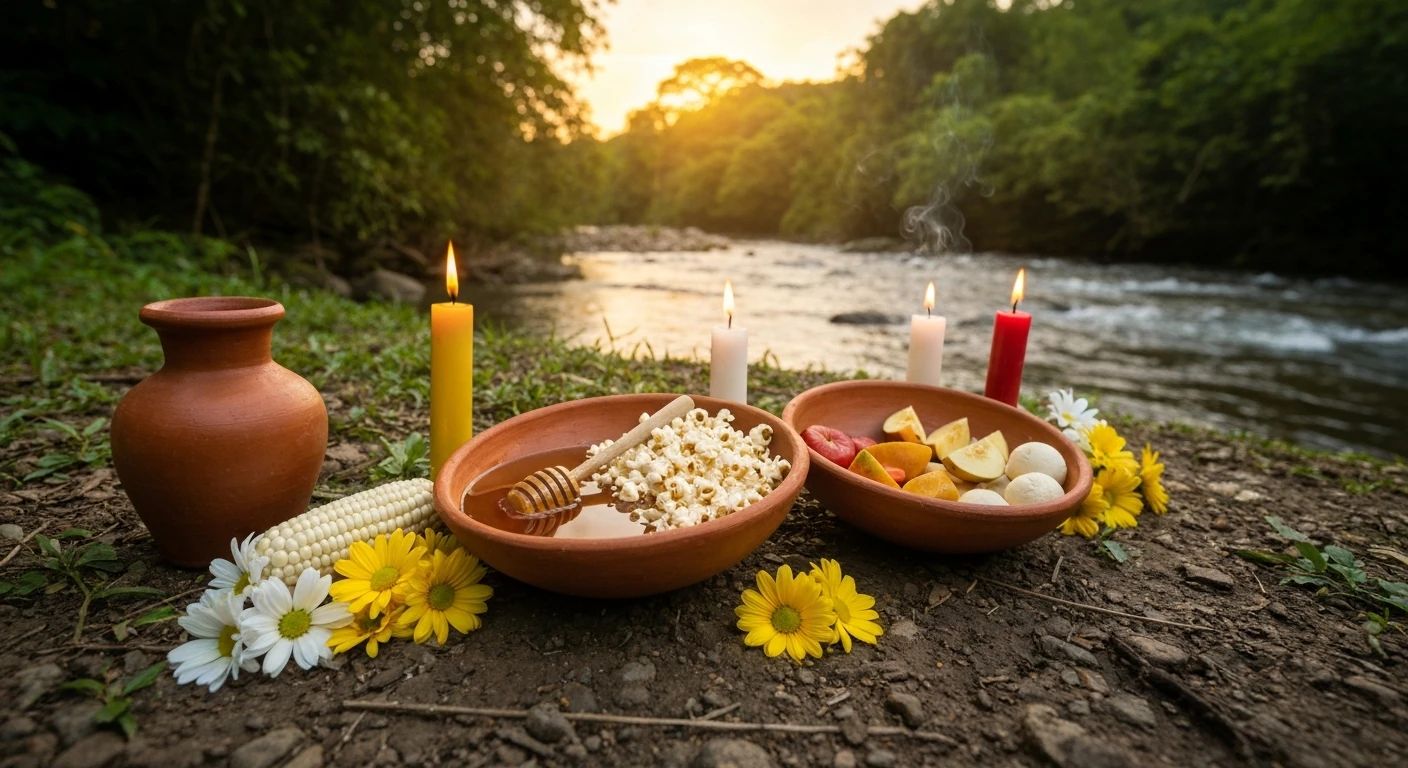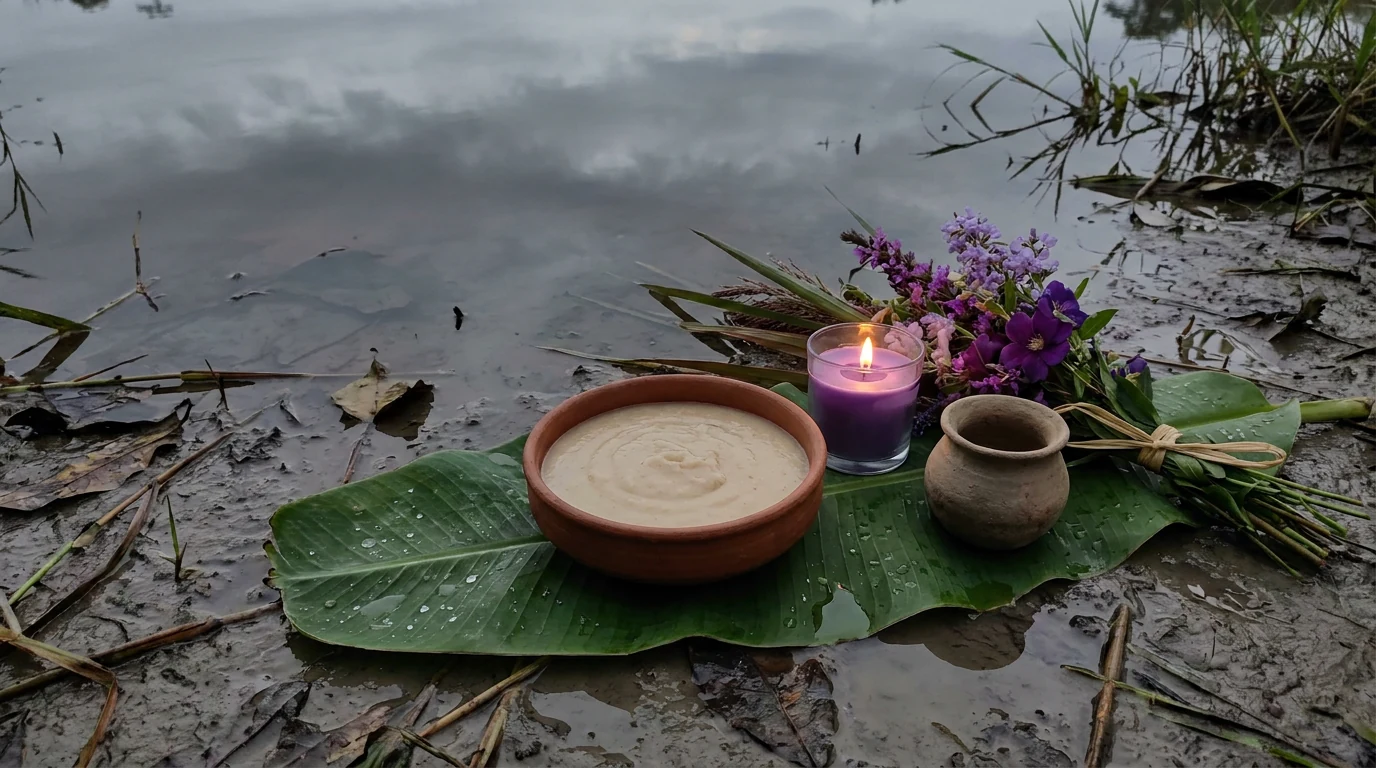
The offering for Nanã is assembled in clay, and without any metal pieces. This is the rule that separates her offering from that of any other orixá (orisha), and it has a registered foundation.
This guide shows what goes in the alguidar, what the metal quizila changes in practice, where it is laid down, and what is left for the house to do.
What to take for Nanã
The base of the domestic offering is short and entirely made of simple material.
Colors: purple, lilac, white, and blue | Element: the mud, the meeting of water with earth | Tool: the ibiri | Vodum jeje: Nanã
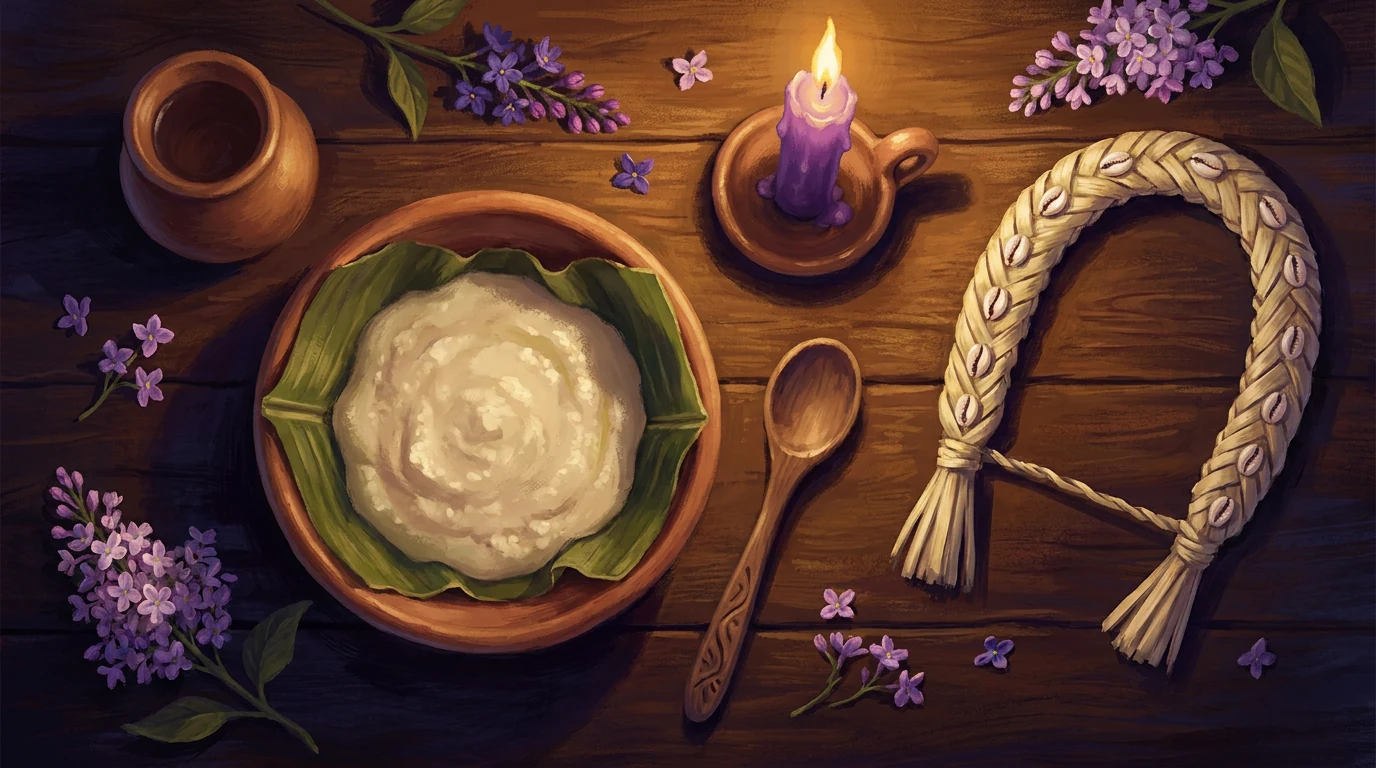
- Porridge or pirão made from cassava flour. It is the food that Reginaldo Prandi records as her favorite.
- Raw clay alguidar, also called oberó, which is the vessel in which the orixá's food is served.
- Purple or lilac candle, one or three. See the colors of ritual candles.
- Purple and lilac flowers, without plastic and without wire.
- Clean water in a clay quartinha.
- Honey, which the house usually uses.
Her tool is the ibiri, an arch-shaped scepter made of fibers from palm leaves, decorated with búzios. Notice that there is no metal there either: see the tools of the orixás and compare.
Her bead necklace follows the same logic. Prandi records white beads with cobalt blue stripes. The Duke University sacred art collection describes Nanã necklaces that combine bone beads with glass ones. The coastal straw, raffia used in her and Omolu (Omulu)'s adornments, completes the set: fiber, clay, bone, and búzios.
If you do not yet know the orixá, start with who is Nanã.
Metal out: what the quizila changes in the preparation
Prandi records the taboo of Nanã's children in one line: using metal knives. What follows is the explanation, and it is historical.
Pierre Verger maintains that the sacrifices made to Nanã and Obaluaê do not use iron instruments. For him, this points to a cult prior to the Iron Age, before the arrival of Ogum. A dissertation from UFPB says the same in another way: never cut animals with a steel instrument. And there is the reading of the fundamento: accepting metal would be submitting to the territory of power of Ogum.
The itan that the people tell completes the meaning. Nanã disagreed that Ogum was the most important and twisted the necks of the animals with her own hands.
Here is the correction that almost every webpage needs: it is not that the iron knife is replaced by a wooden one. The sources speak of the absence of a blade, not another blade. What is forbidden is the cut with steel.
In your kitchen, this is simple to respect: prepare with a wooden spoon, serve in clay, and leave the knife, fork, and aluminum pot out of the setup.
The quizila varies from house to house. The same study that records the rule heard Nagô-Ketu priests who confirm the use of the knife in sacrifices to Omolu. House precept always overrides internet text.
Understand the concept of quizilas in Candomblé.
Mungunzá or canjica: the corn dish and the cassava dish
Two confusions hinder those who are going to set up the agrado.
The first is of name. Mungunzá and canjica are the same white corn sweet, with different names by region: mungunzá in the North and Northeast, canjica in the South and Southeast. The word comes from the Kimbundu kandjica.
The second is of attribution. Corn appears in terreiro lists for Nanã and circulates a lot, but the food with academic backing is the cassava one: porridge or pirão of flour. FUCESP records pirão, peanut paçoca, and sarapatel, and the portal O Candomblé records efó, mungunzá, sarapatel, beans with coconut, and pirão with purple potato.
Choose what your house uses. If you do not have a house, the cassava dish is the one with the strongest source behind it.
How to set up the agrado, step by step
- Choose the day. Prandi places Nanã on Monday. There is a record of Tuesday in two terreiro sources. Our guide of the days of the week brings another attribution, a sign that this changes from house to house.
- Prepare the food without metal. Cassava flour scalded until it becomes pirão or porridge, stirred with a wooden spoon.
- Arrange the alguidar. The food in clay, lined with banana leaf if you have it. See what the alguidar is for.
- Light the candle purple or lilac beside, never on top of the food.
- Place the flowers and the water. Flower without plastic, water in the quartinha.
- Say what you came to say. Without a ready formula, and without asking for a deadline.
Where to lay the offering of Nanã
Her territory is the mud and the swamp. A university collection defines her as the oldest of the water deities and the owner of the mud. In practice, this means swamp, mangrove, lakeshore and still water, not waterfall and not sea.
There is institutional precedent. The National Sanctuary of Umbanda, in Santo André, maintains the Lagos de Nanã as a specific site for offering, where the obrigações are performed on floating mats.
The same sanctuary sets the rule for disposal, and it comes from within Umbanda. Natural material is requested: clay alguidar, flower without plastic, honey and perfume outside the original packaging. What is not biodegradable returns with whoever took it. Glass, styrofoam and bags do not belong to the swamp.
What belongs to the house, and what you do alone
What is above is domestic agrado: what any devotee can lay down on their own.
Comida de santo with fundamento, assentamento, obrigação and matança are something else. It is conducted by the house, with a leader, and is not learned in an article. If you are initiated, the precept of your house matters more than any list.
Nanã is worshipped as a vodun in Jeje Candomblé and as an orixá in Ketu, and the delivery changes according to the nation. Regarding the correspondence in the Angola nation, prefer to consult the inquices of Angola rather than repeating equivalencies that the sources do not confirm.
In syncretism, she corresponds to Santana, and the current date is July 26: the details are in Santana and Nanã and in the day of Nanã. If the series interests you, also see the offering for Oxalá.
Frequently asked questions
Can you use a knife to prepare the comida de Nanã?
Tradition records the taboo of cutting with metal, and sources speak of the absence of blades. For the domestic offering (agrado), prepare with a wooden spoon and avoid knives, forks, and metal pots during the assembly. The precept of your house decides the rest.
Can the offering of Nanã be served on a glass plate?
The registered vessel is the clay alguidar, also called oberó, and the terreiro kitchen works with wood and clay. Raw clay is the safe path. Glass and aluminum are out, and glass also should not be left in swamps or lakes.
What is Nanã's food?
Prandi records cassava flour porridge as the favorite. Terreiro sources add pirão, peanut paçoca, sarapatel, efó, beans with coconut, and mungunzá. The cassava dish is what has academic backing, and the rest varies by house and by nation.
Where to deliver the offering of Nanã?
In the mud and in still water: swamp, mangrove, lakeshore. She is not an orixá of waterfalls or the sea. The National Sanctuary of Umbanda maintains the Lakes of Nanã for this purpose, and asks for biodegradable material, with what does not decompose returning with you.
Where to buy the offering material
At Joia Mística Laroyê you find everything this assembly requires:
- Raw clay alguidares in various sizes
- Clay quartinhas for the water
- Purple and lilac candles, taper and seven-day types
- White bead necklaces with blue streaks, in her colors
- Cassava flour, white corn and honey
Stop by the shop, at Rua Benedito Zingari, 460, Bela Vista, in Extrema-MG, or message on WhatsApp with delivery to all of Brazil.
References
- Reginaldo Prandi: the table of Nanã attributes, with the ibiri, the tabu of metal knives and the cassava porridge, Horizontes Antropológicos, 1995
- Gildeci de Oliveira Leite: the passage in which Verger explains the sacrifice without iron, Fragmentos de Cultura, PUC Goiás, 2019
- Larissa Fernandes Caldas Souza: the dissertation on the existence of Nanã prior to the metal age, UFPB, 2015
- Santuário Nacional da Umbanda: the Lakes of Nanã and the material list for offering
- Faculdade de Saúde Pública da USP: why the same corn sweet is called canjica and mungunzá, 2023