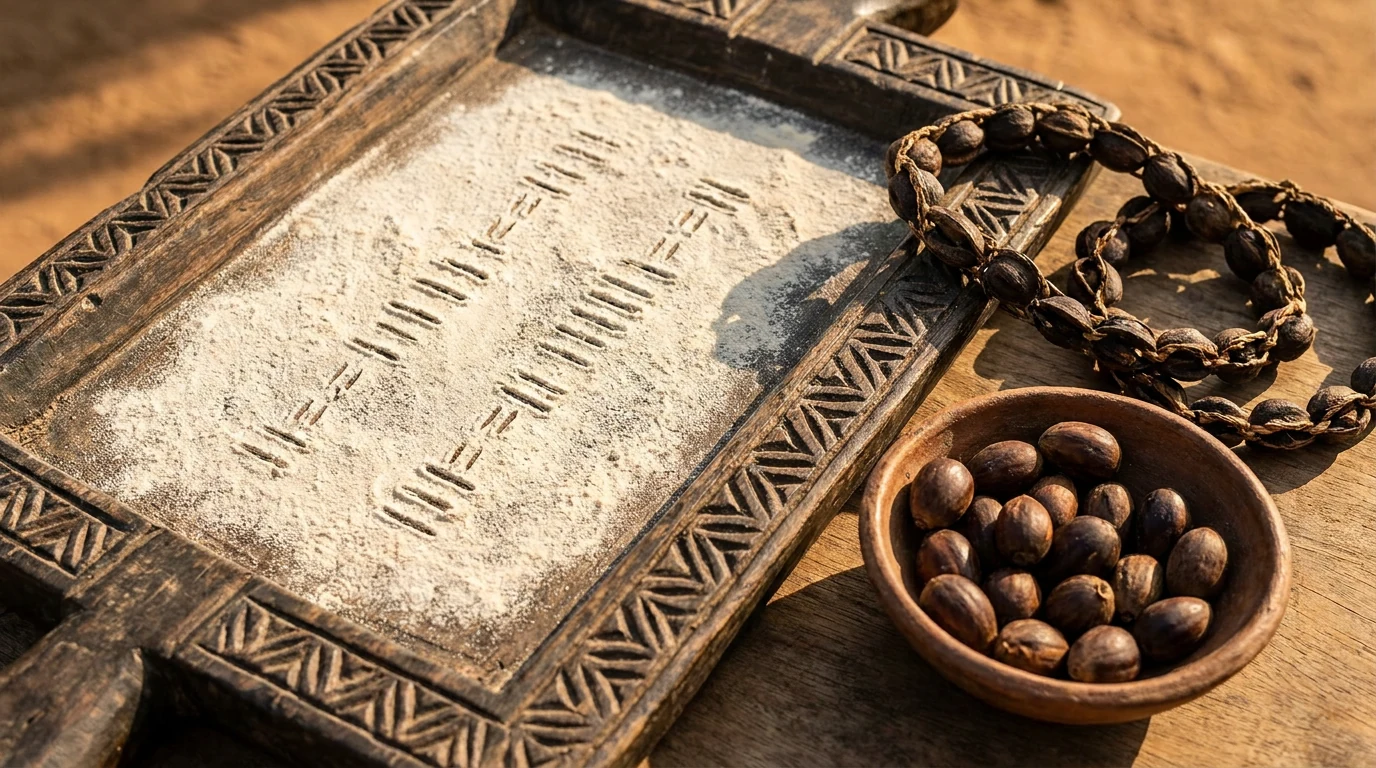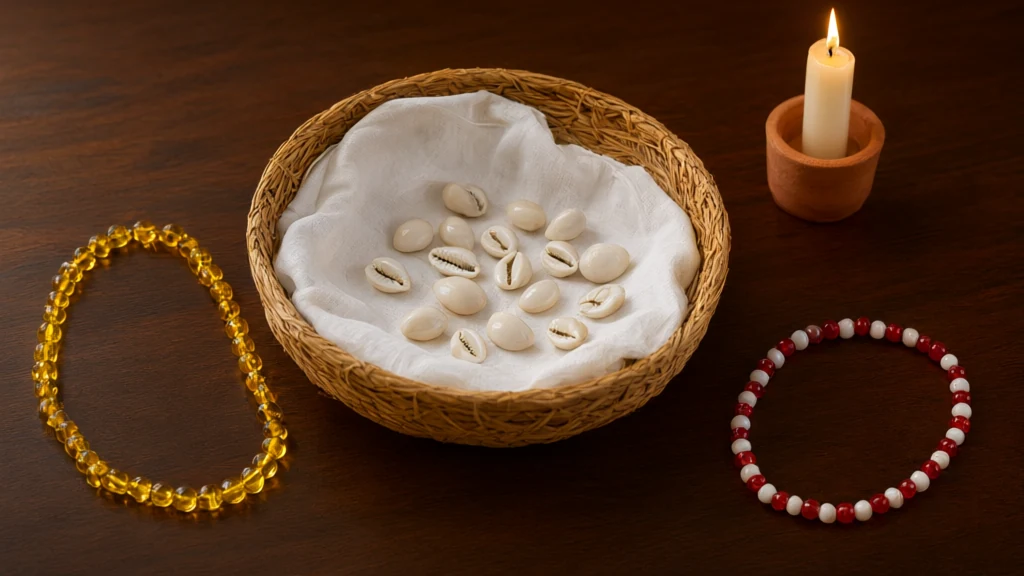
The numbers of the orixás, in Candomblé, are the numbers of the odu in which each orixá usually speaks in the cowrie-shell divination. Exu speaks in 1, Ogum in 3, Oxum in 5, and Xangô in 12. In the Gaúcho batuque, each orixá has its own number, such as the 7 of Bará and the 8 of Oxum. The lists change from house to house.
Numbers of the orixás: the cowrie-shell divination table
In the cowrie-shell divination, the position in which the búzios fall is the odu. There are sixteen, and each odu "determines the orixá" that responds, according to the dissertation by Daniel Sena Lopes (UFPA). The number of the odu is the quantity of búzios that fall open.
The order of the names is that of Beniste, cited by Lopes. The column of orixás is the list that circulates on Wikipedia. The entry has a warning about a lack of sources, which is why the discrepancy is shown next to it.
| Open cowrie shells (búzios) | Odu | Who answers, according to Wikipedia | What diverges |
|---|---|---|---|
| 1 | Okaran | Exu | |
| 2 | Ejiokô | Ibeji and Ogum | the same entry says later Ibeji and Oxalufã |
| 3 | Etaogundá | Ogum | |
| 4 | Irosun | Omolu (Omulu) and Iemanjá | |
| 5 | Oxé | Oxum and Iemanjá | |
| 6 | Obará | Oxóssi (Oshosi), Airá and Logunedé (Logun Ede) | |
| 7 | Odi | Exu, Ogum, Obá (Oba) and Oiá | Lopes dá Obaluaiê (Babalu Aye), Oxóssi, Exu or Oxalá (Obatala) |
| 8 | Ejionilê | Oxaguiã and Airá | |
| 9 | Ossá | Oiá, Obaluaiê, Obá and Iemanjá | |
| 10 | Ofun | Oxalufã and Airá | |
| 11 | Owarin | Oiá and Exu | |
| 12 | Ejilaxeborá | Xangô and Airá | |
| 13 | Ejiologbon | Nanã (Nana Buruku) and Omolu | Wikipedia swaps 13 and 14 between two entries |
| 14 | Iká | Nanã and Omolu | idem |
| 15 | Obeogundá | Ewá (Yewa), Ogum and Obá | |
| 16 | Alafia | Orumilá |
Table sources: Lopes; Wikipedia. In some odus, the list also includes Egum, the ancestors, and Iami, the ancestral mothers, who are not orixás.
Why do the houses not agree
Because the order and the names of the odus change from place to place. In Brazil, the most cited order is attributed to Bamboxê. In the list by Agenor Miranda Rocha, odus 15 and 16 "are never studied". In the collection by William Bascom, in Nigeria, 8 is Eji Ogbe and 16 is Irete. What each odu means and the Bamboxê order are in the 16 odus.
The table is a starting point. The odu in which your orixá speaks, and the number that counts in your house, is what your Pai or your mãe de santo teaches.
Where does the number of each orixá come from?
It comes from the odu. Lopes says that those who learn the game first memorize the odus, "represented by decimal numbers from 1 (1) to 16", and then their relationship with the orixás. From this comes what the internet calls the "orixá number": Exu 1, Ogum 3, Oxum 5, Oxóssi 6, Oxalá 8 and 10, Iansã (Oya) 9, Xangô 12.
The odu weighs heavily in the life of the initiate. Each person's taboos depend on their orixá and their odu. Reginaldo Prandi, in the magazine Novos Estudos, calls the odu "a kind of mythical original regency". The fathers and mothers of santo discover the odu that governs each situation, without learning the Ifá poems of the ancient babalaôs. What the game is and who can play it is in what is cowrie-shell divination.
An old source on the subject is the notebook of Agenor Miranda Rocha, dictated by Mãe Aninha, founder of Ilê Axé Opô Afonjá. Finished in 1928, it was only published as a book in 1999, with the title Caminhos de Odu.
The numbers of the orixás in Batuque
In the Batuque of Rio Grande do Sul, the number belongs to the orixá, not the odu. Jackson de Vargas, in a dissertation at PUCRS, writes that "each Orixá possesses a number, multiple and submultiple", and that this number "must be respected in all obligations".
The table brings Vargas's data for the ijexá nation and the number of each orixá in four houses that he compared.
| Orixá | Ficha (ijexá) | House 1 | House 2 | House 3 | House 4 |
|---|---|---|---|---|---|
| Bará | 7 | 7 | 7 | 7 | 7 |
| Ogum | 7 | 10 | 7 | 7 | 7 |
| Oiá (Iansã) | 9 and 7 | 6 | 7 | 9 | 7 or 9 |
| Xangô | 6 or 12 | 12 | 6 | 12 | 6 or 12 |
| Odé | 7 or 8 | 14 | 8 | 10 | 8 |
| Obá | 7 | 18 | 7 | 9 | 7 |
| Ossanha | 7 | 14 | 7 | 7 | 7 |
| Xapanã | 7 or 9 | 9 | 7 | 9 | 7 or 9 |
| Oxum | 8 | 8 | 8 | 5 | 8 |
| Iemanjá | 8 | 16 | 8 | 8 | 8 |
| Oxalá | 8, 16 and 32 | 32 | 8 | 10 | 8 |
All numbers mean "and their multiples." Only Bará's 7 is equal in all four houses. In one of them, Oxum has the 5, but uses the 8 "due to Iemanjá." For all interviewees, the 9 is linked to the eguns. The cards of each orixá are in orixás do batuque, Bará, Oxum no batuque and Xangô no batuque.
Does the number turn into a quantity in the offering?
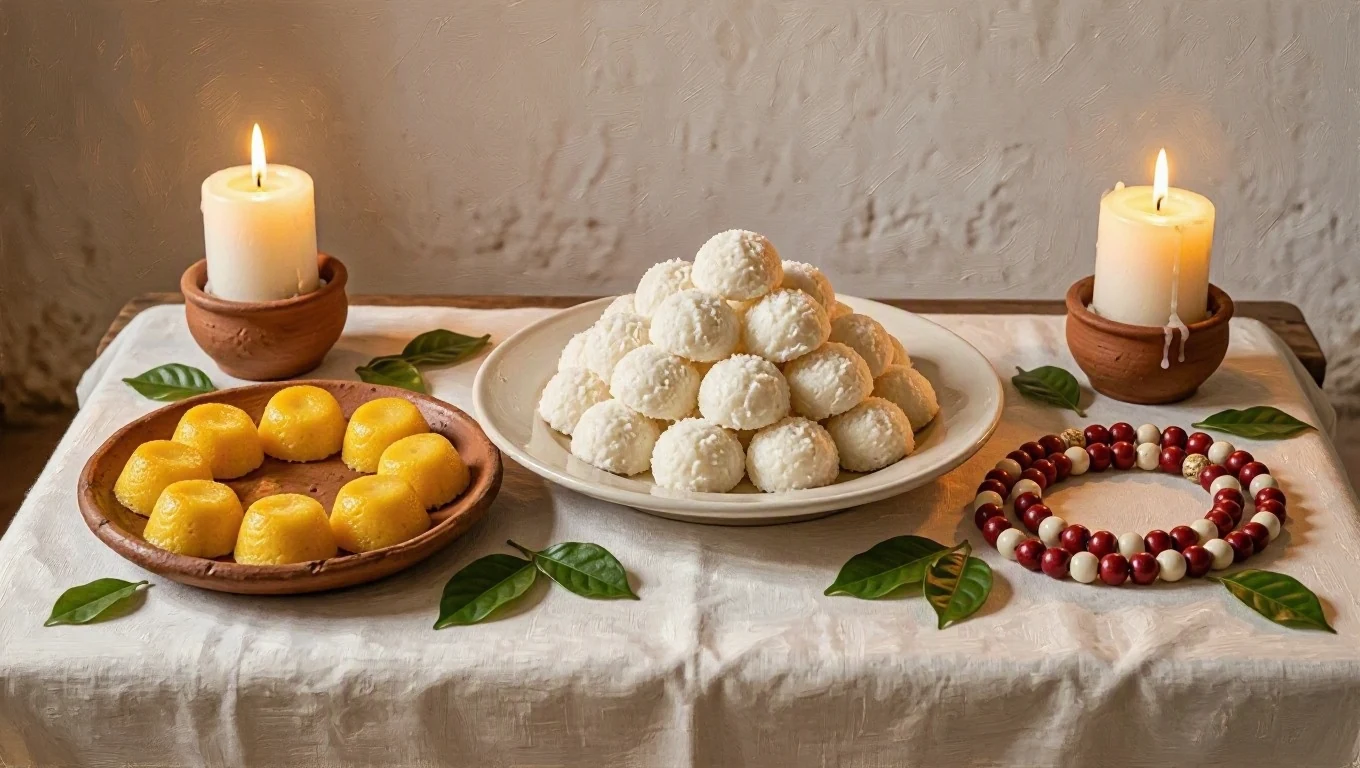
In batuque, it does. Vargas records that the number counts the offering, such as Oxum's eight quindins and Oxalá's 32 cocadas. A babalorixá told him that, if the number is changed, the orixá "will not respond as desired." Whoever cannot offer the full quantity uses a submultiple, such as two quindins instead of eight. Only with authorization from the pai or mãe de santo.
The number also counts the turns of the bead necklace, such as Xangô's imperial bead necklace, of 6 or 12 legs, and the days of seclusion after the obrigação. The recipes are in comidas de santo no batuque and the counts, in fios de conta no batuque.
In Candomblé, the open sources of this research do not provide a rule of quantity by the orixá's number. The quantity is what the house commands.
And in Umbanda?
Umbanda does not have a table of orixá numbers. A house in Paraná, the Casa do Vô Benedito, assembles the protection bead necklace with beads "in multiples of 7." It is a rule of that house. The seven of Umbanda appears more in the 7 linhas da umbanda.
Is it possible to discover your orixá by the number?
No. Adding the digits of the birth date to reach an odu and an orixá is numerology, called by some "Cabala de Odu." Tom Oloorê, on the site Historiando Axé, recalls that the calculation uses the Gregorian calendar. Yoruba culture has a four-day week. And the calculation does not define the initiation orixá.
The babalaô Marcos Arino goes further: in Ifá, "there is no relationship between Odù and numbers," because the odu is a graphic sign. On the internet, the odu number mixes with "lucky number" and zodiac signs, which none of the academic sources support.
The head orixá and the person's odu appear in the divination, performed by someone with a position in the house. How this works is in how to know which is my orixá. The Discover your Orixá test is an entry point through personality and does not replace the divination.
If your house asked for a candle, bead necklace, or quindim in the right amount and you want to check the material, Joia Mística Laroyê helps via WhatsApp.
Frequently asked questions
What is the number of Oxum?
In Candomblé, Oxum usually speaks in the odu Oxé, of five open cowrie shells. In the gaúcho batuque, her number is 8 and its multiples, such as the eight quindins. In a house studied by Vargas, she has the 5, but uses the 8 because of Iemanjá.
What is the number of Xangô?
In Candomblé, Xangô usually speaks in the odu Ejilaxeborá, of twelve open cowrie shells. In the batuque, his number is 6 or 12, with its multiples, and the imperial bead necklace has 6 or 12 strands.
What is the number of Exu?
In Candomblé, Exu speaks in the odu Okaran, of one open cowrie shell, and appears in other odus. In the batuque, Bará has the 7, the only number equal in the four houses studied by Vargas.
Do the numbers of the orixás have to do with the cabala?
No. The cabala and numerology are other traditions. The calculation with the date of birth is contested by priests of Candomblé and Ifá.
References
- Daniel Sena Lopes: Traditional knowledge from cowrie-shell divination in Candomblé, dissertation, UFPA, 2022
- Jackson Luís Santos de Vargas: An ethnomathematical approach to numbers in the Batuque of Rio Grande do Sul, dissertation, PUCRS, 2016
- Reginaldo Prandi: Ritual hypertrophy of Afro-Brazilian religions, Novos Estudos Cebrap, 2000
- Reginaldo Prandi: Candomblé and Tempo, Revista Brasileira de Ciências Sociais, 2001
- Andreas Hofbauer: review of Mythology of the orixás, Revista de Antropologia, USP, 2001
- Renata Barcelos: Order and names of the Odu Eérìndínlógún, Orisa Brasil, 2017
- Wikipedia: Merindilogum entry
- Marcos Arino: Odù of birth, Òrúnmìlà Ifá, 2015
- Tom Oloorê: How to discover my orixá by birth date in Candomblé?, Historiando Axé, 2024
- Casa do Vô Benedito: Guias