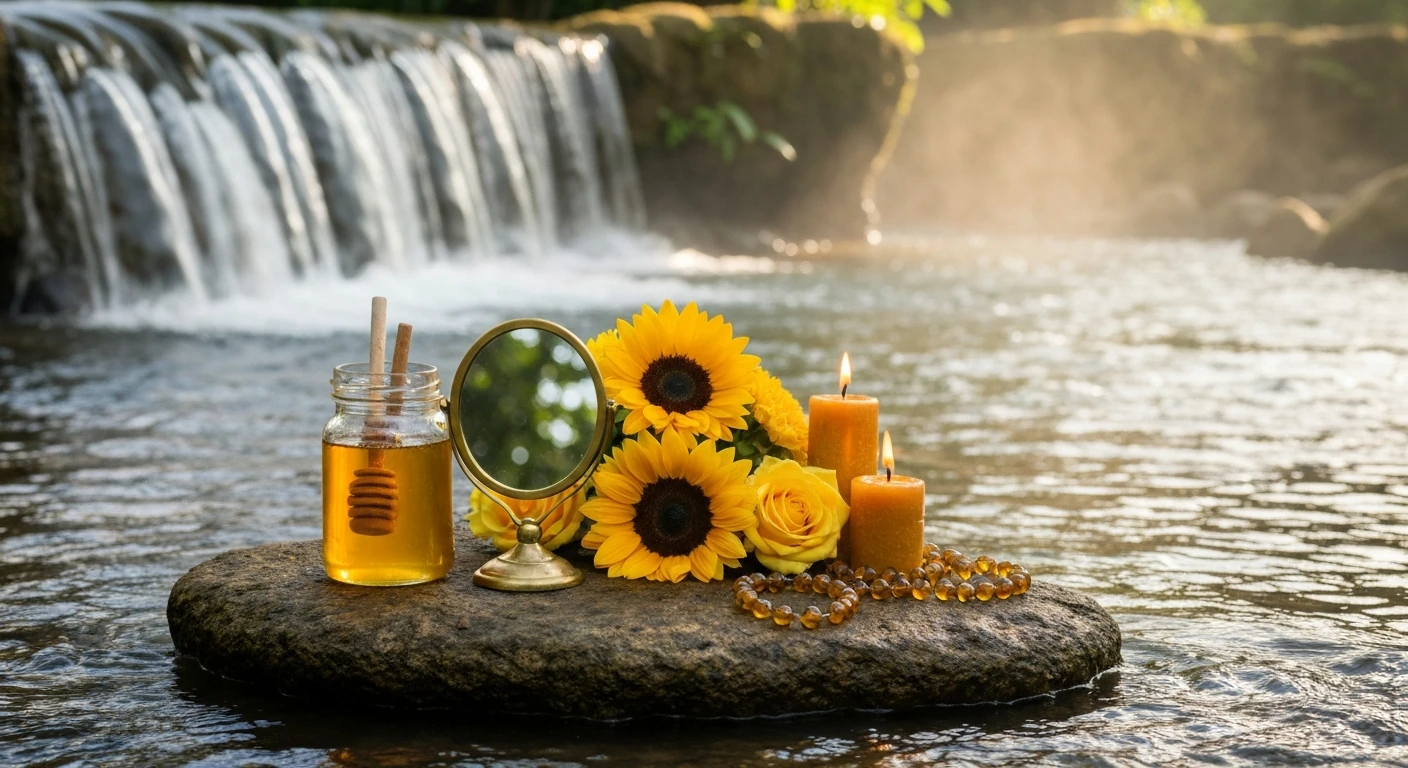
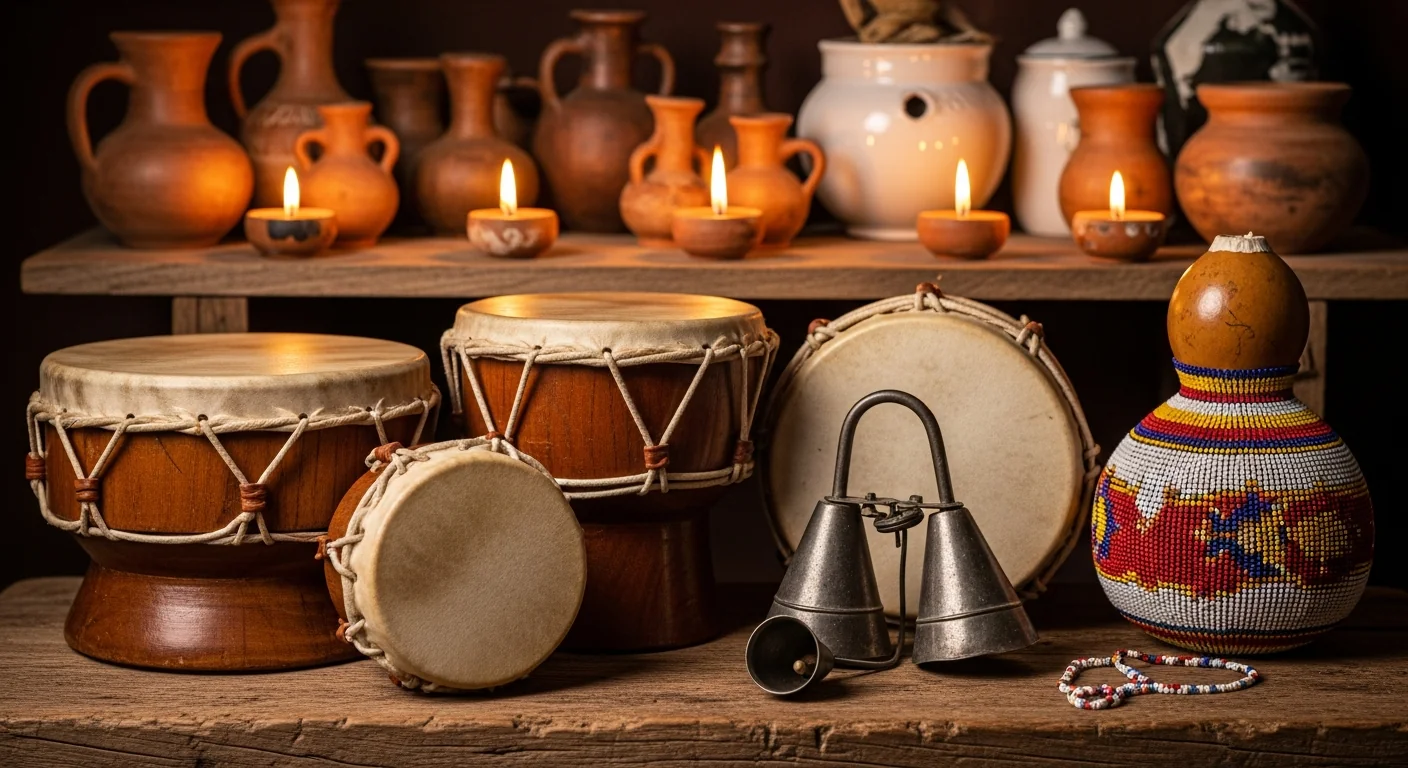
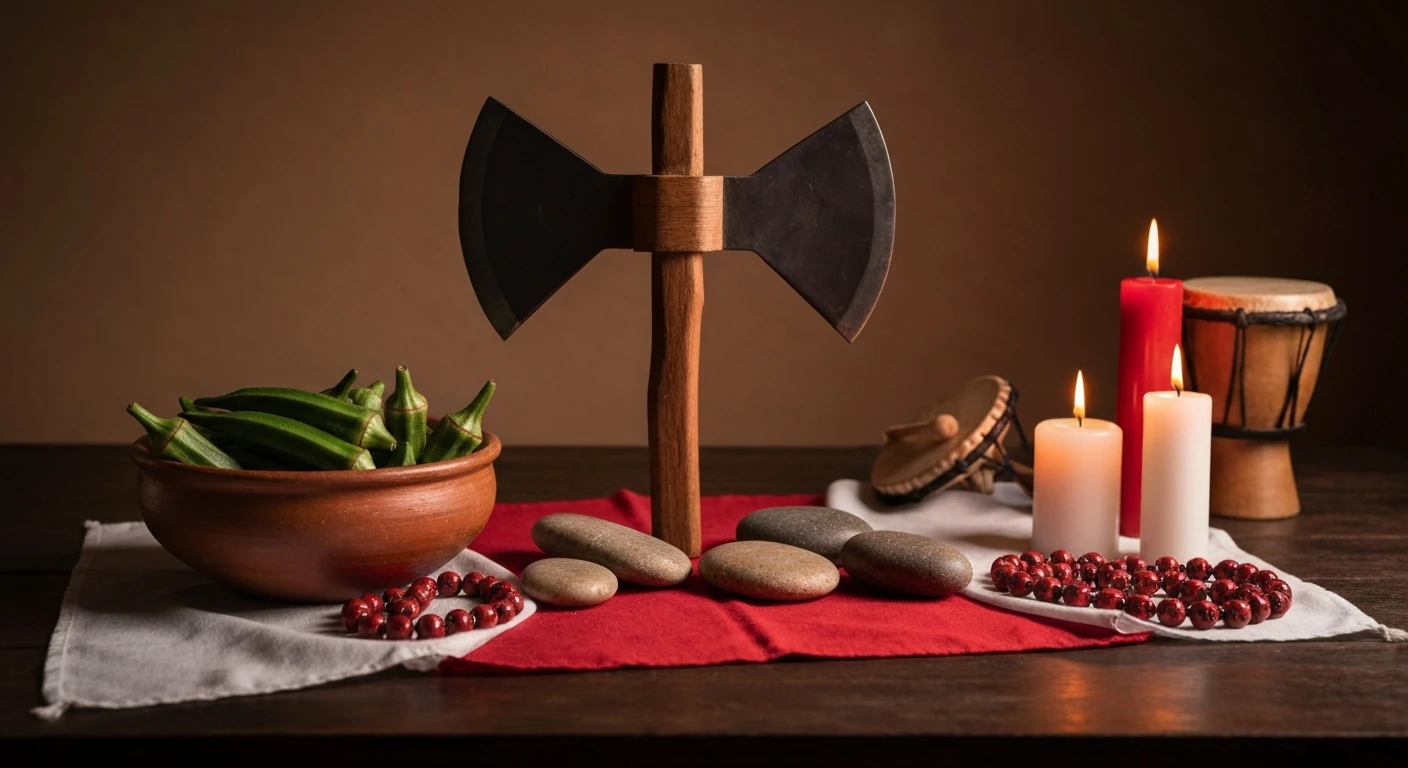
After the new orixás open the party, it is time for the elders to be greeted. It is at this moment that Oxum in Batuque descends the stairs of the house: the lady of sweet waters, gold, and fertility, queen of the Ijexá nation and one of the great mothers of the religion in Rio Grande do Sul.
This guide explains who Oxum is within the gaúcho batuque: her domain, the position she occupies in the axé, the qualities cultivated in the South, the colors, the day, the greeting, the foods, and the syncretism with the saints. As always, the final word on the foundation belongs to your house and your babalorixá or ialorixá.
The queen of sweet waters and the Ijexá nation
Oxum is the orixá of sweet waters: the rivers, lakes, and waterfalls that flow gently and give life to the land. She is the lady of gold, wealth, beauty, and fertility, the one to whom one asks for family, love, and abundance. Where sweet water is born and feeds, there is her axé.
In the batuque of Rio Grande do Sul, this domain takes a prominent place. Oxum is the queen of the Ijexá nation, the most widespread among the gaúcho houses. Therefore, in a large part of the terreiros in the South, she occupies a position of mother and reference, alongside Iemanjá (Yemoja) and Oxalá (Obatala). To understand this larger picture, it is worth knowing the nations of batuque and the way each one organizes its worship.
Ori Iê Ieô, my mother! Oxum's greeting echoes in the houses of batuque, also heard in the afro community as "Ora iê iê ô".
Oxum among the old orixás of the axé
In Batuque, the orixás are called in a sequence, the order of axé, which goes from the first to the last in each festival. Bará opens the paths, followed by the warrior Ogum and the other new orixás. Only then do the old orixás enter: Oxum, Iemanjá, and Oxalá, the oldest foundations of the house.
This order is a hierarchy of spiritual age, not of importance. Oxum is among the oldest because she represents the water that has already flowed a lot, the mature mother who welcomes and sustains. The sequence changes slightly from nation to nation, but the presence of Oxum near the closing is a constant. To see everyone together, learn about the orixás of Batuque.
The qualities of Oxum in Batuque
In Batuque, the same orixá manifests in different qualities (also called passagens), each with its own foundation and its own age. The most revered qualities of Oxum in Rio Grande do Sul are three:
- Oxum Pandá: the youngest, linked to love, romance, and seduction. She is the Oxum of passions and the heart's requests.
- Oxum Demum (or Ademum): the mature one, lady of money, of heritage, and of built wealth. She is asked for stability and prosperity.
- Oxum Docô: the oldest, linked to wisdom, balance, and ancestry. She is the Oxum of counsel and serenity.
Each quality has its own assentamentos, chants, and precepts, which vary from house to house. Therefore, these are the most cited, and not a closed list: your house is who says which passagem rules your head and how it is cared for.
Colors, day, and greeting
Knowing the orixá's profile helps the filho de santo to honor her in daily life. In Batuque, she is usually like this:
Colors: all shades of yellow, from light to gold | Day: Saturday | Number: 8 and its multiples | Greeting: “Ori Iê Ieô”
Regarding Oxum's metal, there is variation between the houses: some link the orixá to copper and gold, while others speak of amber, coral, gold, and silver. It is not a contradiction, but rather the richness of a living religion, in which each nation and each house keeps its own foundation.
Oxum's foods are also sweet and golden, just like her:
- Yellow canjica cooked, quindim and honey pure
- Omolocum, the preparation of black-eyed peas with eggs
- Yellow fruits such as melon, orange and banana-ouro
- Yellow roses, delivered to fountains, rivers, and waterfalls
A mark of the gaúcho Batuque appears even on the orixá's table: in some houses, the Italian influence from the South brought polenta alongside the offerings. It is a sign of how the religion took root in the local culture.
Offering has a foundation and is done with guidance. The list above shows the orixá's taste, but the way, the quantity, and the right moment are taught by the house. Oxum opens paths of love and abundance, but the journey is each person's own.
Oxum and the saints: the syncretism in the South
As in much of Brazil, in Rio Grande do Sul Oxum was syncretized with images of Our Lady. The mother of fresh waters immediately spoke with the mothers of popular Catholicism, and the association varied according to the quality of the orixá.
Oxum Pandá is usually linked to Our Lady of Fátima and Our Lady of the Rosary. As for the more mature qualities, such as Demum and Docô, they are close to Our Lady of Aparecida and Our Lady of the Conception, which are widely celebrated in October. This meeting between Oxum and the patron saint of Brazil appears strongly in the article about Our Lady of Aparecida and Oxum.
It is important to remember that orixá and saint are not the same spirit in their origins. Syncretism was born as a survival strategy: during slavery and repression, associating an orixá with a Catholic saint allowed for continued worship under another name. It is a historical bridge of resistance, not a theological equality.
How each tradition worships Oxum
The lady of the fresh waters is revered in various Afro-Brazilian traditions, but each has its own way. In batuque, she is the queen of the Ijexá nation, worshipped in the qualities and in the order of axé that we saw here. In Candomblé, she is the orixá of fresh waters worshipped in Yoruba, with her own qualities by nation. In Umbanda, she rules a line of ritual work linked to love and motherhood.
A trait of Gaucho batuque, studied by the anthropologist Norton Corrêa, is precisely this adaptation to the culture of the South, from the use of yerba mate to the presence of polenta. If you want the general profile of the orixá, beyond batuque, see who is Oxum. The important thing is not to treat batuque, Candomblé, and Umbanda as synonyms: they are distinct paths that, each in its own way, revere the same mother of the waters.
Frequently asked questions
Who is Oxum in Batuque?
She is the orixá of fresh waters, gold, beauty, and fertility, and the queen of the Ijexá nation, the most widespread in the gaúcho batuque. She is among the old orixás, greeted near the closing of the order of axé, alongside Iemanjá and Oxalá. She is asked for love, family, and abundance.
What is Oxum's greeting?
In batuque, the registered greeting is "Ori Iê Ieô", also heard as "Ieieu" in houses of the Jêje-Ijexá nation. In the Afro-Brazilian community in general, the form "Ora iê iê ô" is common. All exalt the orixá of fresh waters. The exact greeting may vary according to the house and the nation.
What are the qualities of Oxum?
The most cited in batuque are three: Oxum Pandá, the youngest, linked to love; Oxum Demum, the mature one, mistress of money and assets; and Oxum Docô, the oldest, linked to wisdom and balance. Each quality has its foundations, and the list varies according to the house.
What is the day and the foods of Oxum?
Oxum's day in batuque is Saturday, and her number is 8. The foods are sweet and yellow: yellow canjica, quindim, honey, omolocum, and fruits like melon and orange, as well as yellow roses. In some gaúcho houses, polenta also enters the offerings.
With which saint is Oxum syncretized?
It depends on the quality of the orixá. Oxum Pandá links to Our Lady of Fátima and of the Rosary; the more mature qualities approach Our Lady Aparecida and of the Conception. Syncretism was a historical strategy of resistance, and not an equality between orixá and saint.
Where to find Oxum items
At Joia Mística Laroyê, you find what you need to honor the mother of fresh waters in your home:
- Bead strands and bead necklaces (guias): in the tones of yellow and gold of Oxum
- Statues of Oxum and of Our Lady: for the altar and the assentamentos
- Yellow candles: to set requests for love and prosperity
- Hand fans, mirrors, and golden fans: symbols of the queen of the waters
- Herbs and yellow flowers: for baths and offerings in the waters
Visit our physical store in Extrema, Minas Gerais and we ship to all of Brazil. For guidance on the correct use of each item, talk to us via WhatsApp.
References
- Wikipedia: entry on Batuque, an Afro-Rio-Grandense religion
- Instituto Humanitas Unisinos (IHU): interview with anthropologist Norton Figueiredo Corrêa about Batuque