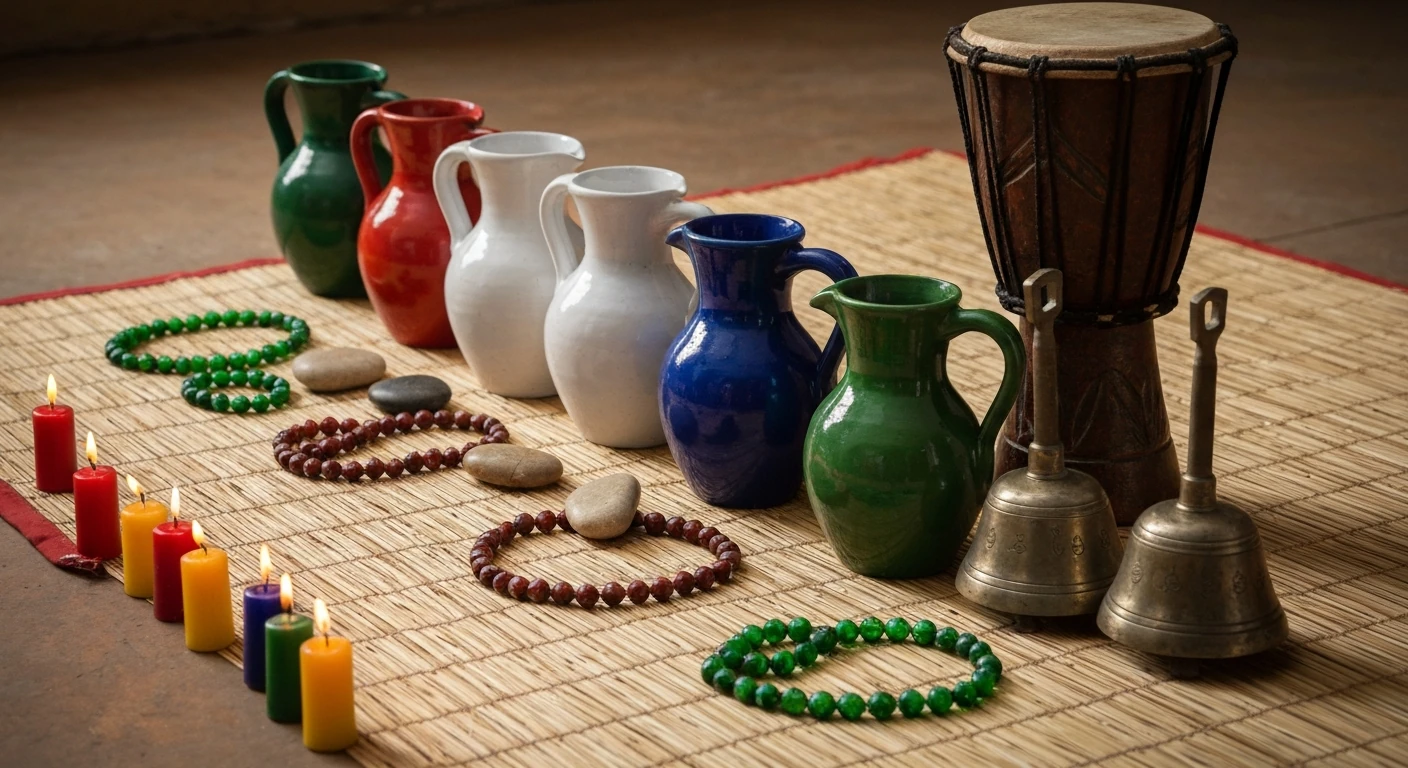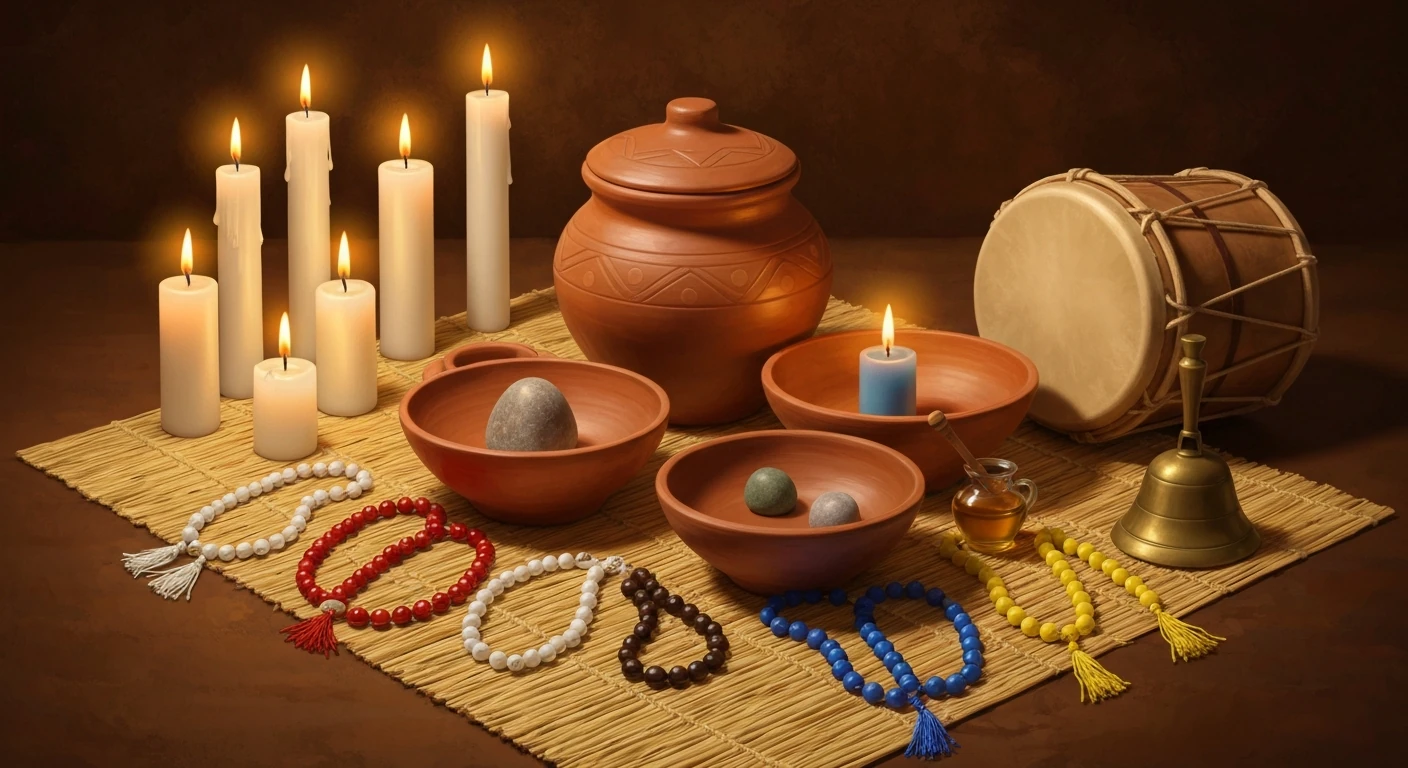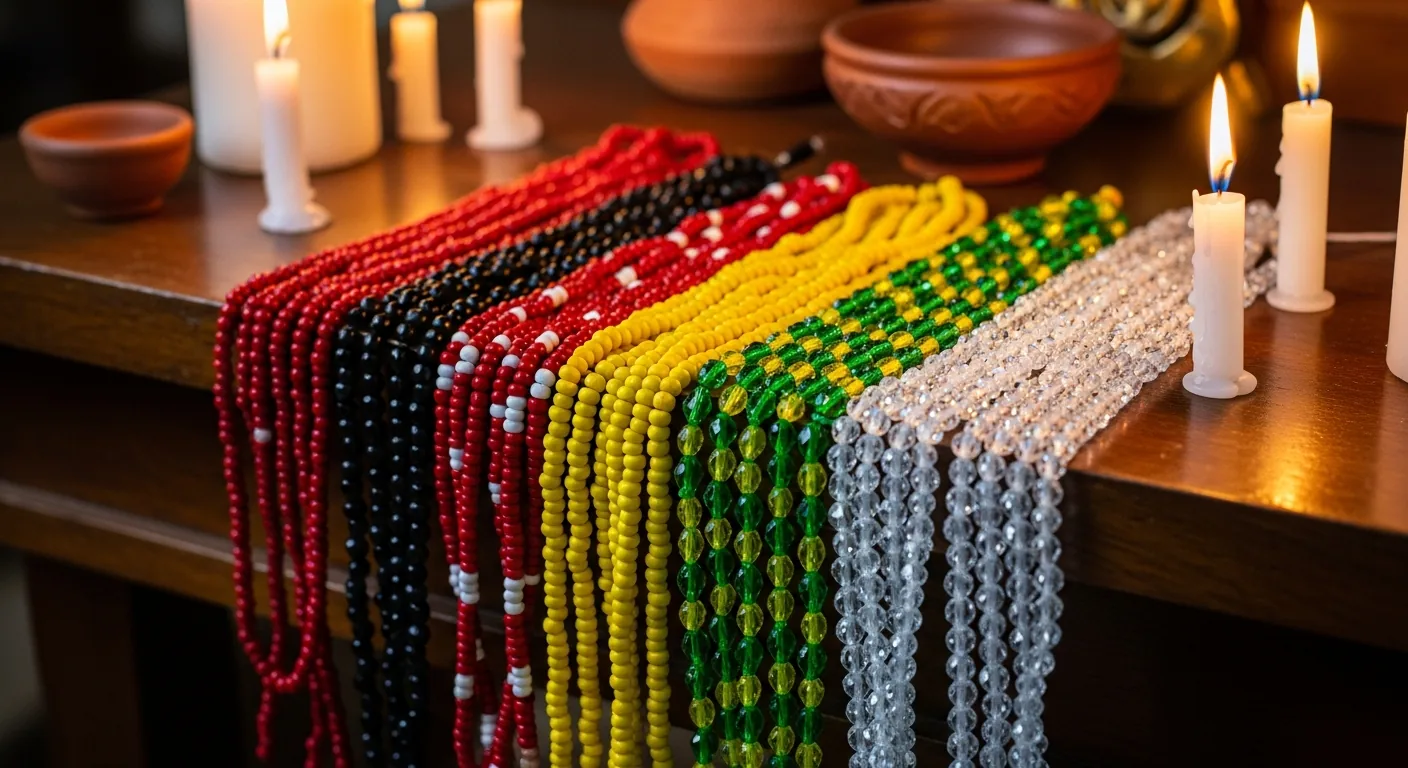
In a house of Batuque, you look at someone's neck and already know a lot. The color of the beads tells a story: which orixá that person belongs to, what point of the journey they are at, and what nation their root comes from.
This necklace has a name. The fios de conta, also called guias, are the spiritual identity card of the filho de santo in the Gaucho Batuque. This guide explains what they are, what they are for, the colors of each orixá, and what should never be done with your bead necklace.
What are the fios de conta in Batuque
Fio de conta is the bead necklace assembled in the colors of an orixá. In the Batuque of Rio Grande do Sul, it is also called a guia. It is not costume jewelry or a fashion accessory: it is a piece of fundamento, consecrated inside the house.
The bead necklace (guia) carries three pieces of information at the same time:
- To whom the person belongs: each orixá has its own color combination
- Where they are in the process: the bead necklace (guia) accompanies the stages inside the house
- From which root they come: the nação changes colors and number of beads
Besides identity, the bead necklace (guia) is protection. It connects the filho to the axé of their Orixá and functions as a spiritual shield in daily life. For this reason, it is not bought ready-made at a fair and worn immediately. It is washed and crossed in a ritual before going around the neck.
In the fundamento of Batuque, the bead necklace (guia) is the orixá near the body. It walks with the person, and for this reason, it is treated with the same respect as the orixá.
A bead necklace (guia) usually has a firma: a central piece, often a larger bead or a pendant, that closes and "firms" the necklace. Each house has its own rule for assembling the firma.
The colors of each Orixá in Batuque
Here is the most sought after point. The colors below follow the most common pattern of gaúcho Batuque. Keep one reservation from now on: color and number of beads change from nation to nation and from house to house. The final word is always from your babalorixá or your ialorixá.
The Batuque line goes from the youngest Orixá to the oldest. Let us follow this order, which begins with Bará and ends with Oxalá.
- Bará: red and black, the colors of the owner of the paths
- Ogum: red and green (green and white in the Mejê path)
- Oiá (Iansã (Oya)): red and white, with a classic bead necklace of 7 red beads and 7 crystal white beads
- Xangô: red and white, the colors of the king of thunder
- Odé: navy blue and white, and in some houses navy blue and pink
- Otim: royal blue, pink and white, or royal blue with orange, depending on the house
- Obá (Oba): pink, with pink and brown in some houses
- Ossanha: green and yellow in Ijexá, green and white in Cabinda and in Jeje-Ijexá houses
- Xapanã: red and black in the most warrior qualities, lilac or purple in the Sapatá quality
- Oxum: yellow, from light tones to gold
- Iemanjá: white, light blue, crystal, silver and pearls
- Oxalá: white, the color of peace and creation
Notice how red appears in various hot Orixás, and white closes the line in Oxalá. The colors are not random: they speak of the nature of each energy.
Bead necklace (guia), firmeza and the differences by nation
Not every bead necklace (guia) is the same. Within the same house, you find simpler threads for daily life, and threads of obrigação, assembled for a specific precept. The number of turns and the size of the beads also have a reading of fundamento.
The nações of Batuque, Oyó, Jeje, Ijexá, Cabinda and Nagô, keep their own traditions. A Cabinda house may assemble the bead necklace of Otim with three beads of each color. An Ijexá house prays Ossanha in green and yellow. None of this is an error of one or the other: it is a different ancestral root.
Therefore, the guidance of this text is for understanding, not for copying. Each casa de Batuque has its own way, and the fundamento belongs to it.
How the bead necklace (guia) is prepared and crossed
The bead necklace (guia) only becomes a true guia after passing through ritual. Assembling the beads is the easy part. What gives it axé is the preparation, done inside the house, by the hands of those who have fundamento.
The common path is this:
- Assembly: the beads are threaded in the colors and number of the Orixá, with the firma in the right place.
- Washing: the bead necklace (guia) is bathed in omieró, the sacred water of the leaves, in a process close to the amaci of the head.
- Crossing: the babalorixá or the ialorixá crosses and firms the bead necklace (guia), linking it to the Orixá.
- Delivery: the bead necklace goes around the son's neck, now charged with axé.
Without this path, the necklace is just a pretty necklace. It is the ritual that makes the difference, and it is never improvised at home.
Bead strands in Batuque and Umbanda bead necklaces (guias)
Many people mix the two things, and it is worth separating them. In Umbanda, the guias are also bead necklaces with the colors of the spirits and the Orixás, used in the giras and in mediumship development.
In Batuque, the worship is done only to the Orixás, and the bead necklace (guia) follows the house's initiation structure. The colors follow the gaúcho pantheon, which has its own combinations, such as the red and white of Xangô and the pink of Obá.
They are distinct traditions, each with its own liturgy. One bead string is not worth the same as the other, and the bead necklace (guia) of one is not exchanged for the other without foundation.
What to never do with the bead strings
Do not buy a ready-made bead necklace (guia) and start wearing it as consecrated. The store necklace is just the raw material. It needs to be washed and crossed in your house to have axé.
Do not lend your bead necklace (guia). It is linked to your axé and your path. Lending it mixes energies and disrespects the foundation.
Do not wear the bead necklace everywhere. Tradition asks you to remove it for sleeping, taking a bath, and during intimate moments. Keep it in a clean and reserved place.
Do not make up colors or the number of beads. If you have doubts about your bead necklace (guia), the answer is with your babalorixá or your ialorixá, never in an internet test.
Frequently asked questions
What are the bead strings in Batuque?
They are bead necklaces, also called guias, assembled in the colors of each Orixá. In Batuque, they function as the spiritual identity of the filho de santo: they show who the person belongs to, what stage of the house they are in, and from which nation their root comes. They also serve as protection.
What is the color of each Orixá in Batuque?
In general terms: Bará red and black, Ogum red and green, Oiá and Xangô red and white, Oxum yellow, Iemanjá white and crystal, Oxalá white. Colors change by nation and by house, so always confirm with your zelador de santo (the leader who looks after your orixá).
Can I buy a ready-made bead string and use it?
The store necklace is only the raw material. To become a true guia (consecrated bead necklace), it needs to be washed in omieró and crossed by the babalorixá or the ialorixá inside the house. Without this ritual, it is a beautiful necklace, but without the axé that protects.
Is the Batuque bead strand the same as the Umbanda bead necklace (guia)?
No. Both are bead necklaces, but from distinct traditions. Umbanda uses the guia in the giras and in mediumship development. Batuque follows the gaúcho pantheon and the initiation structure of the house, with its own color combinations.
Do I need to remove the bead necklace for sleeping and taking a bath?
Yes, it is the custom in most houses. The bead necklace (guia) is a consecrated piece, and tradition asks to set it aside in these moments, keeping it in a clean place. The exact guidance on use always comes from the foundation of your Batuque house.
Where to buy bead strands and bead necklaces (guias)
At Joia Mística Laroyê, you will find:
- Beads in the colors of the Orixás: red and black of Bará, yellow of Oxum, white of Oxalá and others
- Crystal beads and seed beads: for assembly in the pattern of your house
- Central pieces (firmas) and pendants: the central pieces of the bead necklace (guia)
- Candles in the colors of the Orixás: to accompany your devotion
- Statues and tools of the Orixás of Batuque: for your axé
Visit our shop in Extrema, Minas Gerais or buy via WhatsApp with delivery to all of Brazil.
To deepen your knowledge of the gaúcho tradition, it is worth reading the “Batuque (religion)” entry on Wikipedia and the material from the portal Historiando Axé about gaúcho Batuque.
References
- Wikipedia: Batuque (religion)
- Historiando Axé: Batuque, batuque gaúcho