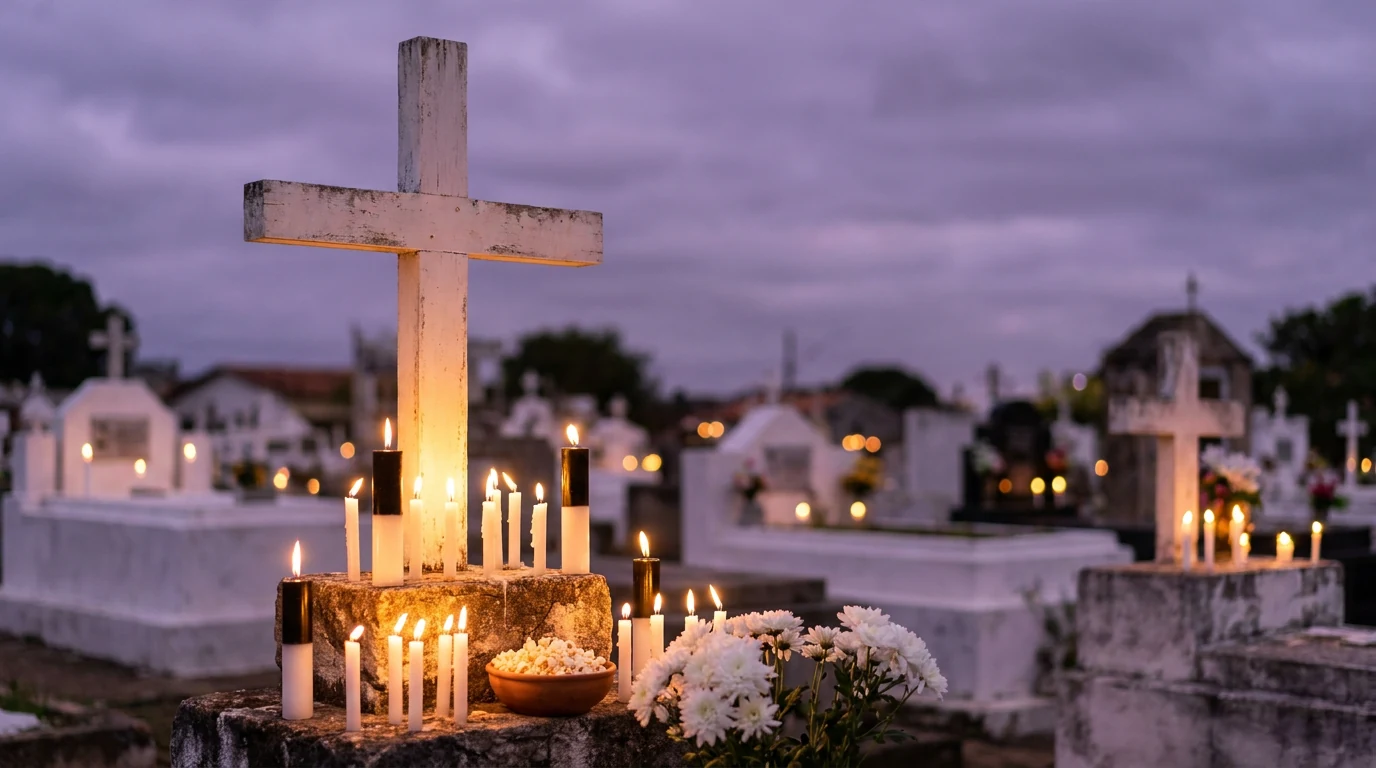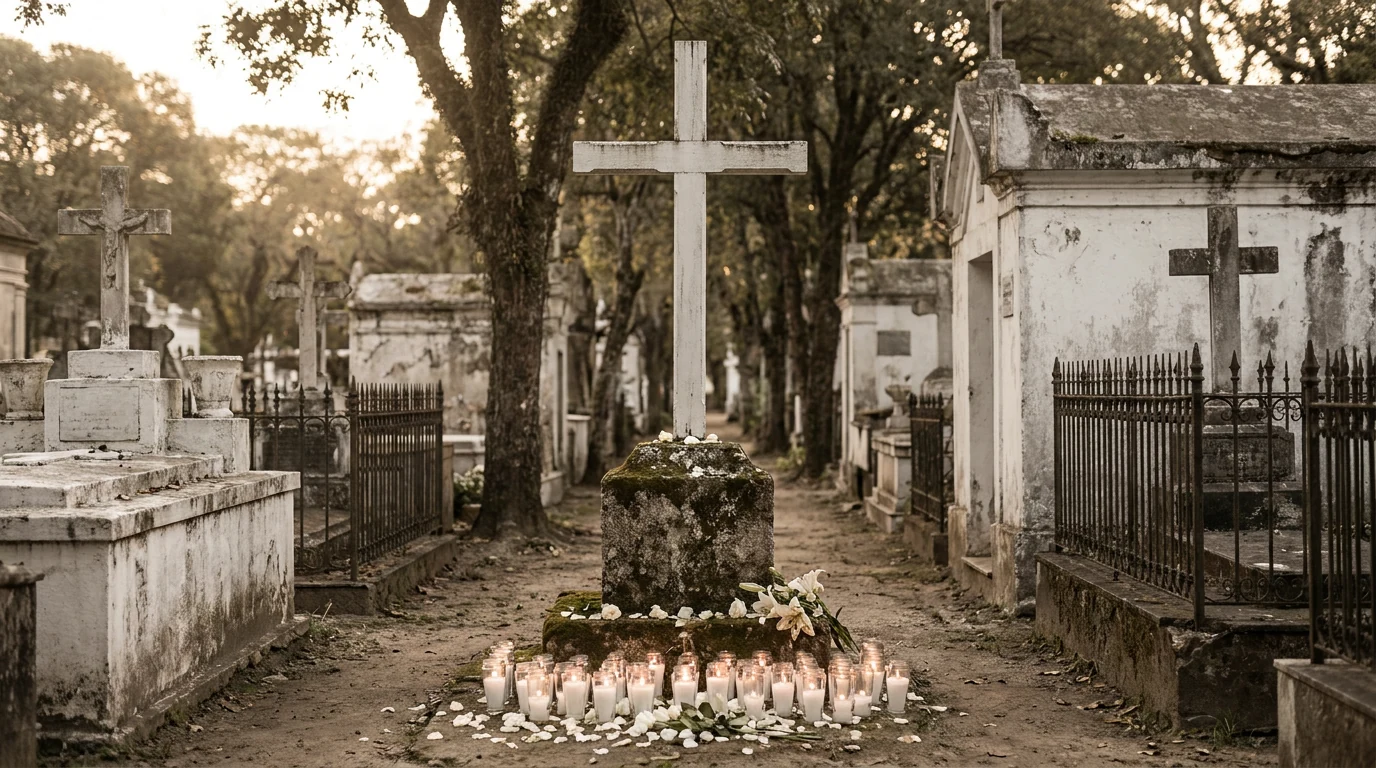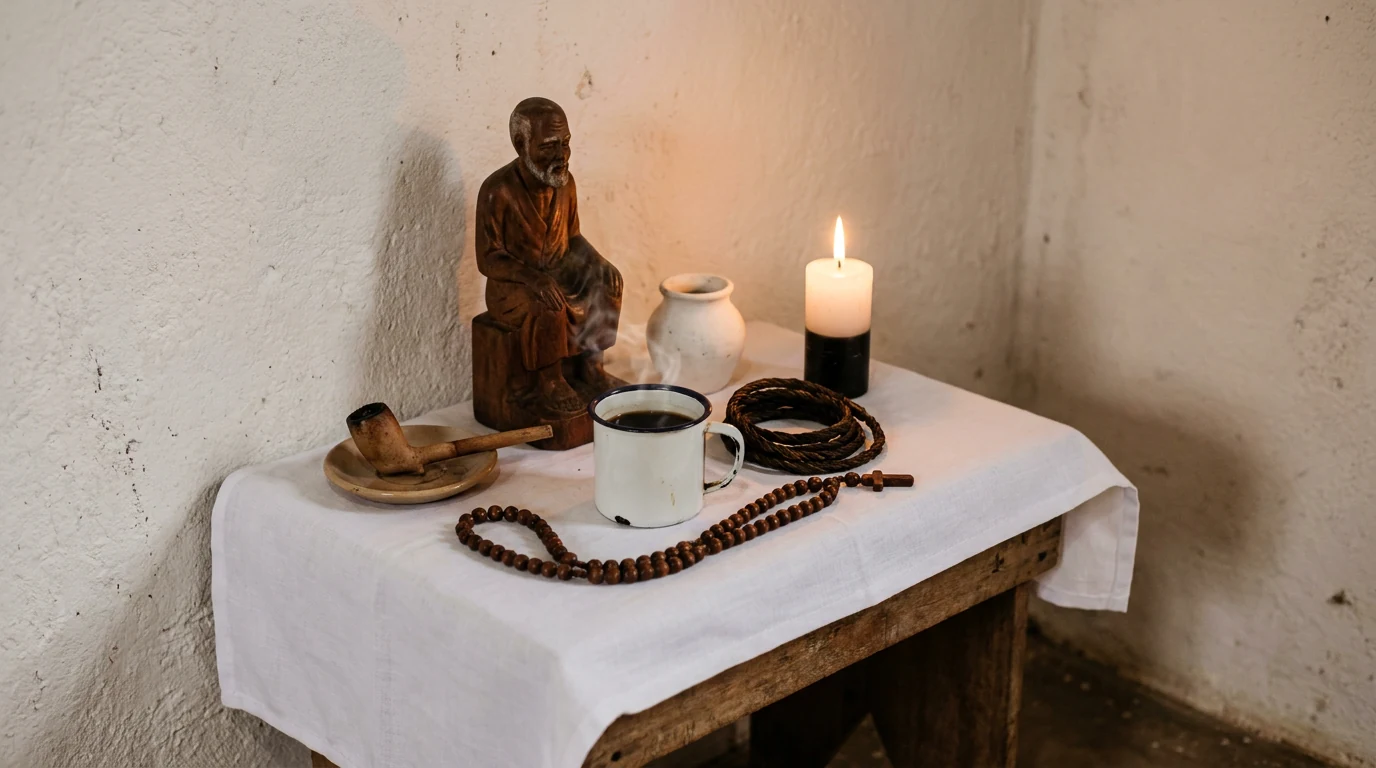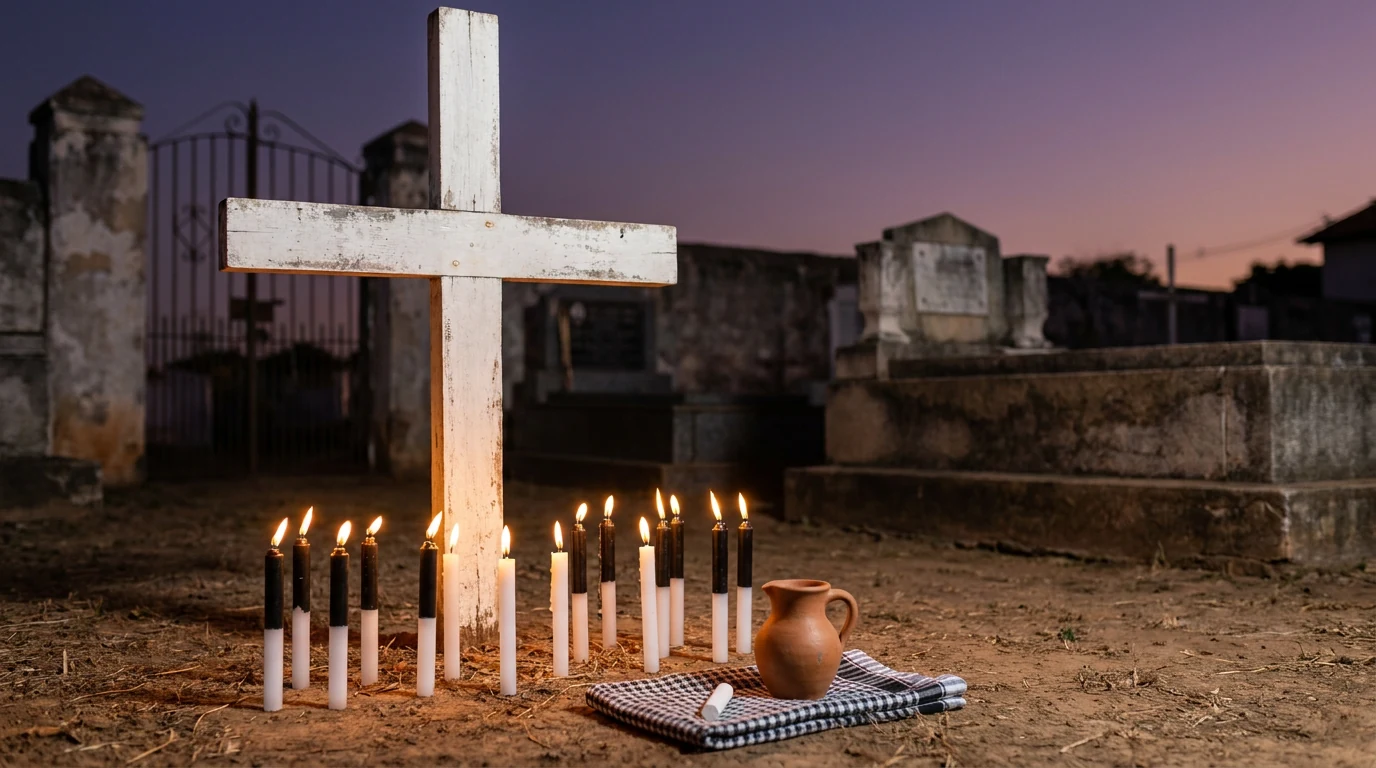
Exu das Almas is not just one Exu. In houses of Umbanda and Quimbanda, "das Almas" functions as a surname of a spiritual legion (falange). It says that this Exu works in the cemetery, at the crossroads, and in the passage between the living and the dead.
In a house in Curitiba, the same title applies to three different Exus: Tranca Ruas, João Caveira, and Mangueira. This is why so many people search for "Exu das Almas" and find names that do not match each other.
Exu das Almas: a surname, not a biography
The question "who is Exu das Almas" usually expects a life story, with birth, death, and legend. No open academic research brings this biography. What the sources show is something else: a surname that applies to several Exus.
The clearest example comes from the points booklet of the Terreiro de Umbanda Pai Maneco, in Curitiba. There is a sung chant (ponto cantado) for "Exu Tranca Ruas das Almas" and a sung chant (ponto cantado) for "Exu João Caveira das Almas". And there is a sung chant (ponto cantado) that sings "long live Exu das Almas, who is Seu Mangueira de fé". Three Exus, one surname.
In Bocaiuva (MG), in a house of Umbanda with Quimbandeiro worship studied by UFMG, the first name on the list of the main Exus is Tranca-Rua das Almas. The spelling changes from house to house (Tranca Rua, Tranca Ruas, Tranca-Rua), and the surname accompanies it.
This surname becomes more visible on a date. In 2026, November 2 falls on a Monday, and there is a record of Umbandistas who go to the cemetery on All Souls' Day. What is done, and what is not done, is in the dia de finados na umbanda.
Why the name of the Exu speaks of a place
Because most of the names of Exu in Umbanda describe a domain of ritual work. The anthropologist Vagner Gonçalves da Silva, from USP, conducted this survey in the Revista de Antropologia in 2012.
“the vast majority refer to points of passage (crossroads, gates), of intercession between the world of the living and the dead (cemeteries, catacombs, skulls), to the intermediate states of matter (sludge, mud, shadow)”
Vagner Gonçalves da Silva, Exu do Brasil, 2012, p. 1091
For the author, these names show continuity with the African Exu, who is a being of mediation. “Das Almas” belongs to the same family as “da Encruzilhada”, “da Porteira”, and “do Lodo”: it is an address, not an adjective.
Field research in Vitória (ES) shows the address functioning in practice. On All Souls' Day in 2016, an Umbanda practitioner told researcher Barbara Thompson, from UFBA, that he went straight to the cruzeiro. The reason: the pombagira of his mãe de santo is Maria Padilha do cruzeiro preto. He has an Exu Tranca Rua das 7 Catacumbas, and therefore his offering goes to the seventh catacomb after the gate.
In other words: the surname says where one works with that Exu. The complete list of names, organized by location, is in nomes de Exu. Here the focus is only on “das Almas”.
Exus das Almas with records in research
Three names appear with “das Almas” in sources that can be opened and verified.
Tranca Ruas das Almas
It is the name with the most records. In Bocaiuva, it opens the list of the house's main Exus, and the research brings a photo of an offering to him requested to protect an Umbanda practitioner from persecution at work. In the same house, the cemetery foods go to Obaluaiê (Babalu Aye), pretos-velhos, and to the Exus João Caveira and Tranca-Ruas das Almas.
In Curitiba, a sung chant describes him like this: "You are seeing this man / Who is at the cruzeiro / He is Exu Tranca Ruas / Son of the souls also". The general profile of the Exu of the crossroads is in who is Exu Tranca Ruas.
João Caveira das Almas
He has his own sung chant in the Curitiba booklet, with this full name. In Bocaiuva, João Caveira appears among the main Exus and among those who receive food in the cemetery. Who he is, the legend that circulates, and what its source is can be found in Exu Caveira.
Mangueira, the "Exu das Almas" of a sung chant
This is the case that most helps to understand the surname. No research describes Exu Mangueira. Even so, the sung chant from the Curitiba house calls him by the title: "Long live the souls, long live the crown and the faith / Oh, long live Exu das Almas / Who is Seu Mangueira of faith". Another sung chant of his settles "at the foot of the cross of the souls".
And the pombagiras of the Almas
The surname also applies to the feminine. In Bocaiuva, Maria Padilha das Almas receives food in the cemetery. In the pombagiras booklet of the Curitiba house, her sung chant says that "The cemetery is your place". The general profile is in who is Pombagira.
Tiriri, Marabô, Veludo, Mirim and Rei das Almas
These names appear together in the search. The short answer: there is no general record. No open research describes Tiriri das Almas, Marabô das Almas, or Veludo das Almas with this surname. The names exist in the houses, and each house records its own.
The logic, however, is the same as the three cases above. An Exu who has a name of a spiritual legion (falange) (Tiriri, Marabô, Veludo) gains the surname when the house receives him working in the field of the souls. The general records are in Exu Tiriri, Exu Marabô and Exu Veludo.
- Mirim das Almas: we did not find the name in open sources. What exists is a sung chant of Exu Mirim in a house in Curitiba that opens with "Oh! My Lord of Souls / Do not make little of me".
- Rei das Almas: is the title that appears in the seven kingdoms model of quimbanda, described in reinos da quimbanda. The model itself changes between houses and currents.
If you received an Exu with "das Almas" in the name in your house, the leader is the one who can say which spiritual legion (falange) he belongs to. The teste de Exu e Pombagira on the site shows affinity, and does not replace the house.
Where the Exu das Almas works: calunga, cruzeiro and Monday
The field of the Exu das Almas is the cemetery, which in the umbanda studied in Vitória is called calunga pequena. The same research records the exus and the pretos-velhos of the souls line as the spirits (entities) that act there. The entire line, right and left, is in the linha das almas, and the question of whether the preto velho is Exu is in preto velho é Exu.
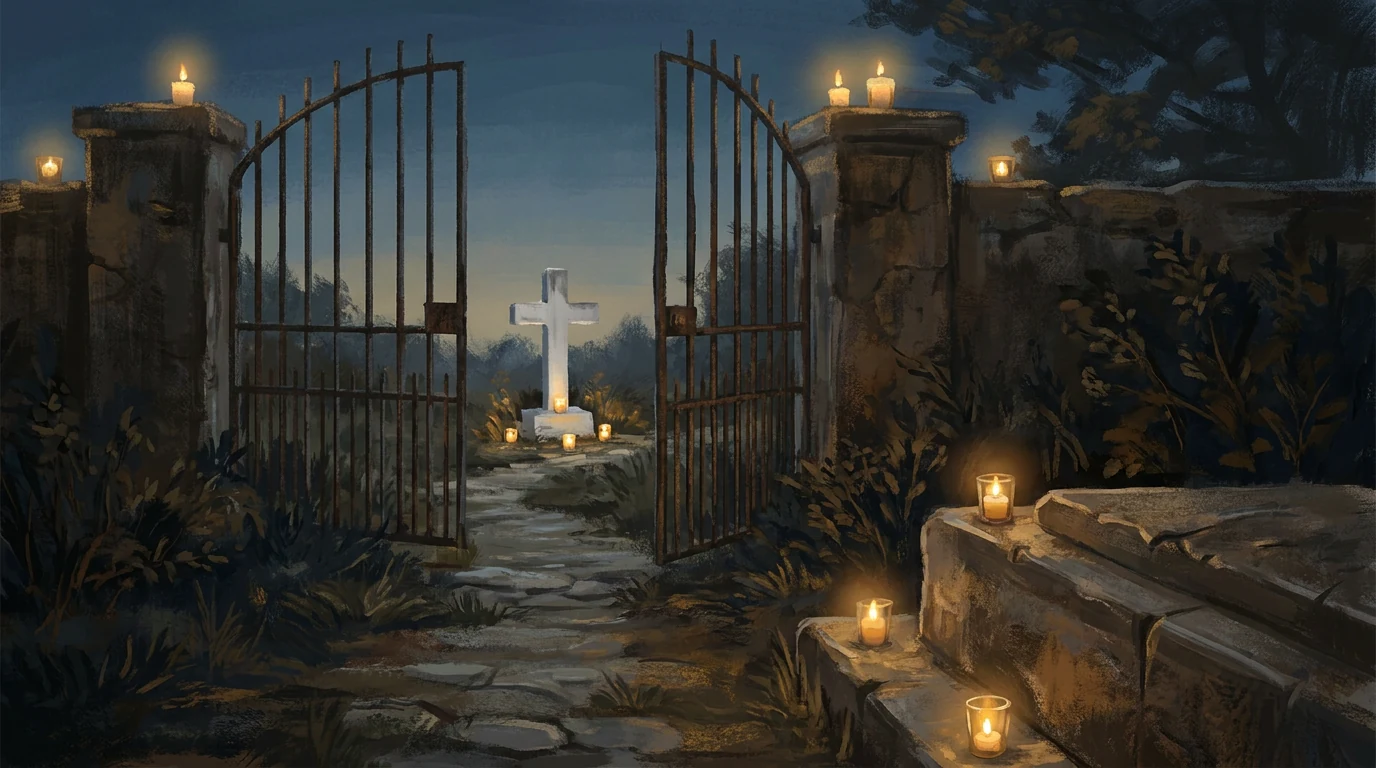
Three details from the Vitória field help to situate the surname:
- The cruzeiro: in the studied cemetery there are two cruzeiros, one "of the white line" and another "of exu or black line". The author warns that only some cemeteries have more than one. The object is in cruzeiro das almas.
- Where each one receives: pretos-velhos only receive in the white cruzeiro; the exus receive in gates, cruzeiros and tombstones.
- The day: the interviewees say that Monday is Exu's day, and for Catholics it is the day of the souls. The researcher reads this as a sharing of symbol between the two religions.
And who rules this field? It depends on the house. In Bocaiuva, Obaluaiê/Omolu is “owner of the Calunga Pequena”. In the Umbanda literature that Reginaldo Prandi analyzed, a group of Exus works “under the orders of the orixá (orisha) Omulu, the lord of the cemeteries”. This applies to part of Umbanda and Quimbanda, not to all houses.
Exu das Almas is not a demon
Exu das Almas is not a demon, and working with the souls does not make him an evil spirit. The confusion comes from outside the terreiros and has a recorded history.
The list of Exus "under the orders of Omulu" cited above comes from a table assembled from Umbanda books, including works from 1989 and 1990. This table placed names from European demonology alongside the Exus. Prandi describes the table to show the demonization of the orixá, and not to endorse it. The title of his article already states the path: "Exu, from messenger to devil".
The house of Bocaiuva, which has Tranca-Rua das Almas at the top of the list, speaks for itself:
“in Zambi-Iris, Exu is not the personification of evil, he is a path to be walked, in which man is the one who decides”
Fábio da Silva Gonçalves, dissertation, UFMG and Unimontes, 2017, p. 296
For the Umbanda studied in Vitória, the cemetery is a sacred place, a home for orixás and spirits. The Exu who works there deals with the passage, and that is what the surname preserves.
Sung chant, ponto riscado and statue of Exu das Almas
The pontos cantados with "das Almas" exist in print, and those that appear in this text are in the booklet of the Curitiba house, with the source listed next to them. There, several pontos bring the name of the composer, and each house sings its own.
The ponto riscado is something else. It is the firmeza of the spirit in the house, drawn with pemba, and each terreiro has its own. Therefore, this blog does not publish drawings of the ponto riscado of Exu das Almas: a drawing copied from the internet is not the point of your house.
The statue follows the same rule. Since "das Almas" is a surname, the statue that is purchased is that of the Exu of the falange: Tranca Ruas, Caveira, or another. In the white cruzeiro of Vitória, pretos-velhos receive white and black candles. For the Exu das Almas, the color, number, and location of the candle, including the 7-day candle, are instructions from the leader.
Frequently asked questions
Who is Exu das Almas?
It is not just one spirit. "Das Almas" is a surname of a falange: it marks Exus who work in the cemetery, at the cruzeiro, and in the passage between the living and the dead. In a house in Curitiba, the title applies to Tranca Ruas, João Caveira, and Mangueira. Which Exu das Almas works with you is determined by your house.
What are the names of Exu das Almas?
With records in research or in printed points: Tranca Ruas das Almas, João Caveira das Almas, and Mangueira, called "Exu das Almas" in a point. In the feminine, Maria Padilha das Almas. Tiriri, Marabô, and Veludo das Almas appear in houses, but without description in open research.
Is Tranca Ruas das Almas the same as Tranca Ruas?
It is the same falange name, with the surname of those who work in the field of the souls. In a house in Curitiba, Tranca Ruas das Almas is sung as the "son of the souls" who is "at the cruzeiro". The same booklet has points from other paths of Tranca Ruas.
What is the day of Exu das Almas?
In Vitória's survey, Umbandistas point to Monday as the day of Exu, the same day that Catholics dedicate to the souls. On All Souls' Day, there are records of Umbandistas who go to the cemetery and make an offering to the exus of the cruzeiro. Specific dates vary by house.
If your house requested a candle, pemba, or statue for the gira of the souls, Joia Mística Laroyê, in Extrema, Minas Gerais, checks with you via the store's WhatsApp.
References
- Vagner Gonçalves da Silva: Exu do Brasil: tropos de uma identidade afro-brasileira nos trópicos, Revista de Antropologia (USP), v. 55, n. 2, 2012
- Reginaldo Prandi: Exu, de mensageiro a diabo, Revista USP, n. 50, 2001
- Barbara Thompson (UFBA): Nos portões, lápides e cruzeiros das almas, anais do IV SCS, PGCS-UFES, 2019
- Fábio da Silva Gonçalves: a comida nos terreiros de Candomblé, Umbanda e Quimbanda em Bocaiuva/MG, dissertation, UFMG and Unimontes, 2017
- Terreiro de Umbanda Pai Maneco: apostila de pontos de Exu, Curitiba
- Terreiro de Umbanda Pai Maneco: apostila de pontos de Pomba Gira, Curitiba
- Terreiro de Umbanda Pai Maneco: apostila de pontos de Exu Mirim, Curitiba