The offering for Exu is exchange and courtesy, not payment. Those who already frequent a terreiro know this, but the internet insists on teaching the opposite: take so many roses, deliver at midnight, it resolves in three days. This text takes another path.
Here you find what is offered and where to deliver each type of offering. Also where what you do alone ends and what belongs to the leader begins. And what needs to come back in the bag when you go home.
Exu Orixá and Exu guardian are not the same thing
Before any item, a correction that almost no text makes. Exu is a word that names two distinct religious realities.
In Candomblé, Exu Orixá is a divinity of the Yoruba tradition. He is the messenger between the orum and the aiê, the first to eat in any obrigação (ritual obligation). He carries the request; he is not the one who resolves it.
In Quimbanda and in Umbanda, the Exus are spirits, guardians, the povo da rua. They work in legions, with legion chiefs and proper names, as you see in the realms of Quimbanda. The Wikipedia is explicit in saying that these Exus should not be confused with the Orixá.
The word is the same due to proximity of function: movement, path, border. Not by identity.
The association of Exu with the Christian devil came from appearance and Catholic syncretism, not from his function in the Yoruba religion. The sociologist Reginaldo Prandi documented this in depth.
If you are still firming up this understanding, it is worth reading before who is Exu and who is Pombagira.
What is offered: the items that appear most frequently
There is no fixed table. What is offered changes according to the line, the entity, and the house. What follows is the most recurrent repertoire, not a recipe.
For the Exus:
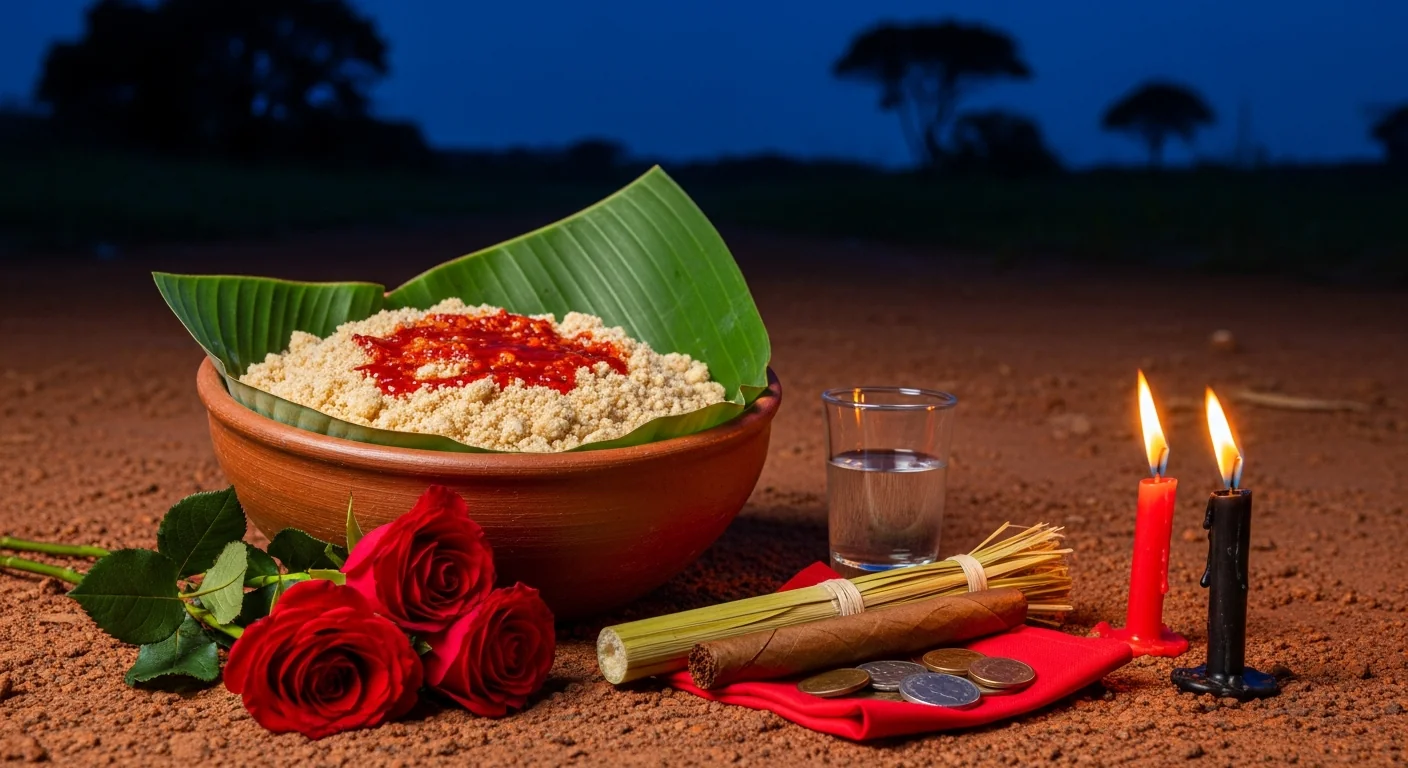
- Cachaça (marafo): the classic drink, linked to movement and vitality.
- Cigar or straw cigarette: the tobacco leaf works as a greeting and connection.
- Dendê oil: marks the food as comida de santo.
- Cassava flour and pepper: the base of the padê and strength to break stagnation.
- Red and black candles: the colors most associated with the worship.
- Coins and clay alguidar: prosperity and the traditional container.
For the Pombagiras:
- Champagne, cider, or anise: the most cited drinks.
- Red roses: the number varies by house, and many require an open rose, not a bud.
- Perfume, lipstick, mirror and comb: the repertoire of vanity and femininity.
- Red cloth and cup: for lining and serving.
- Red and black candles: check the color with the house beforehand.
About the food: the padê, the ritual farofa of flour with dendê, is only part of the offering. The offering is the set of food, drink, tobacco leaf, candle, flowers, coins, location, intention and disposal. Many people call everything padê and that is why they deliver it incorrectly. The detailed preparation is in the article about farofa de dendê.
Where to deliver and what each location means
The location is not a logistical detail. It is part of the fundamento.
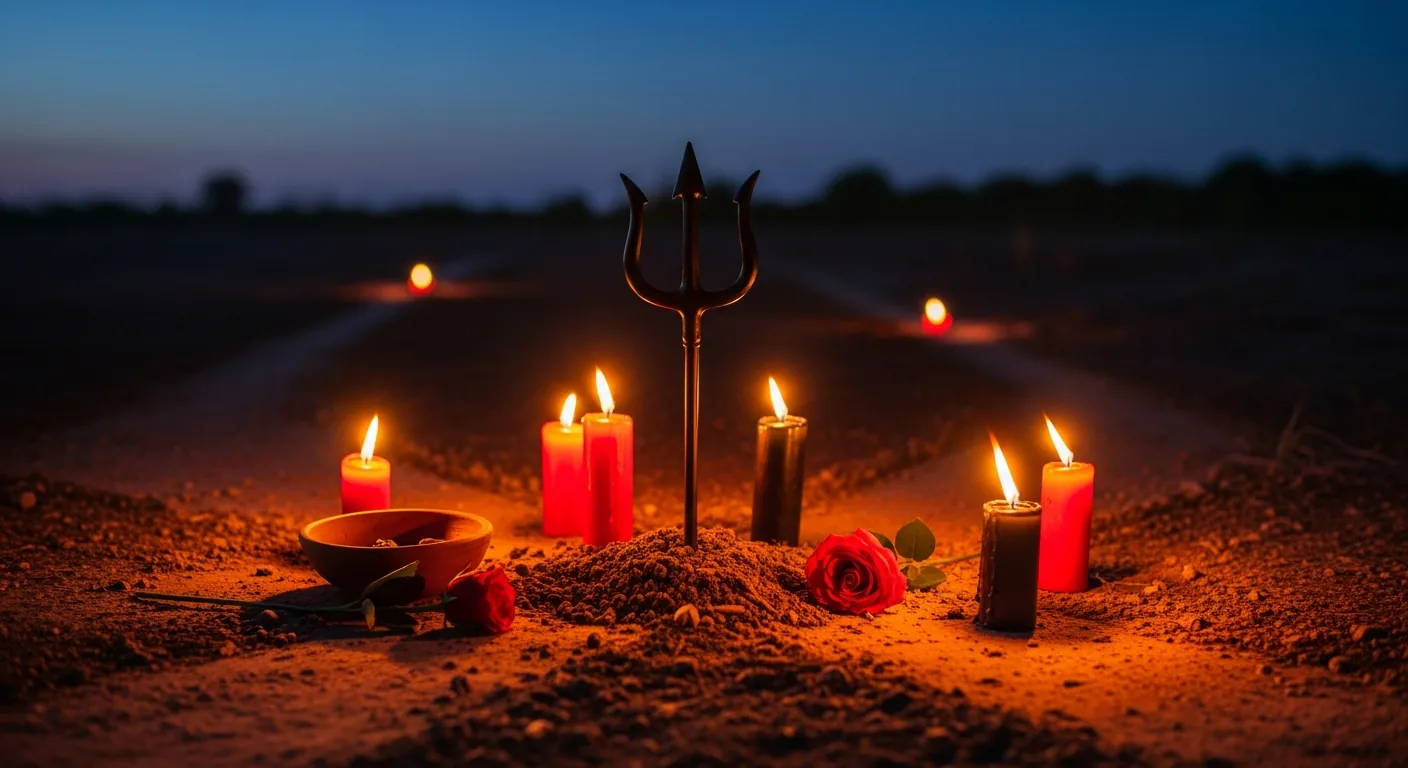
- Encruzilhada: the location par excellence. A point of transit, of decision, of frontier between paths.
- Cruzeiro das almas: linked to passage and requests for intercession.
- Mata: for spirits linked to the woods and for cleaning ritual work.
- Cemetery, the Calunga Pequena: space of passage between matter and spirit, linked to the line of the souls and to names like Exu Caveira.
- Beach, the Calunga Grande: the great mystery of life and death, more linked to the water people.
- Pedreira: strength, firmeza and justice.
- Tronqueira: the house of Exu at the entrance of the terreiro. Those who belong to the house usually deliver there.
An honesty that is missing in the rest of the internet: many houses classify crossroads as male, female, and mixed by shape, whether cross, T, or X. Sources contradict each other about which shape is which. The Wikipedia itself records that this typology does not work as a normative rule and varies by terreiro and region.
Do not make things up. Ask at your house.
And there is an important caveat: delivery at a cemetery is what most requires the guidance of a leader. It has its own license protocol and is not a place to experiment on your own.
Firmeza and assentamento: where what you can do ends
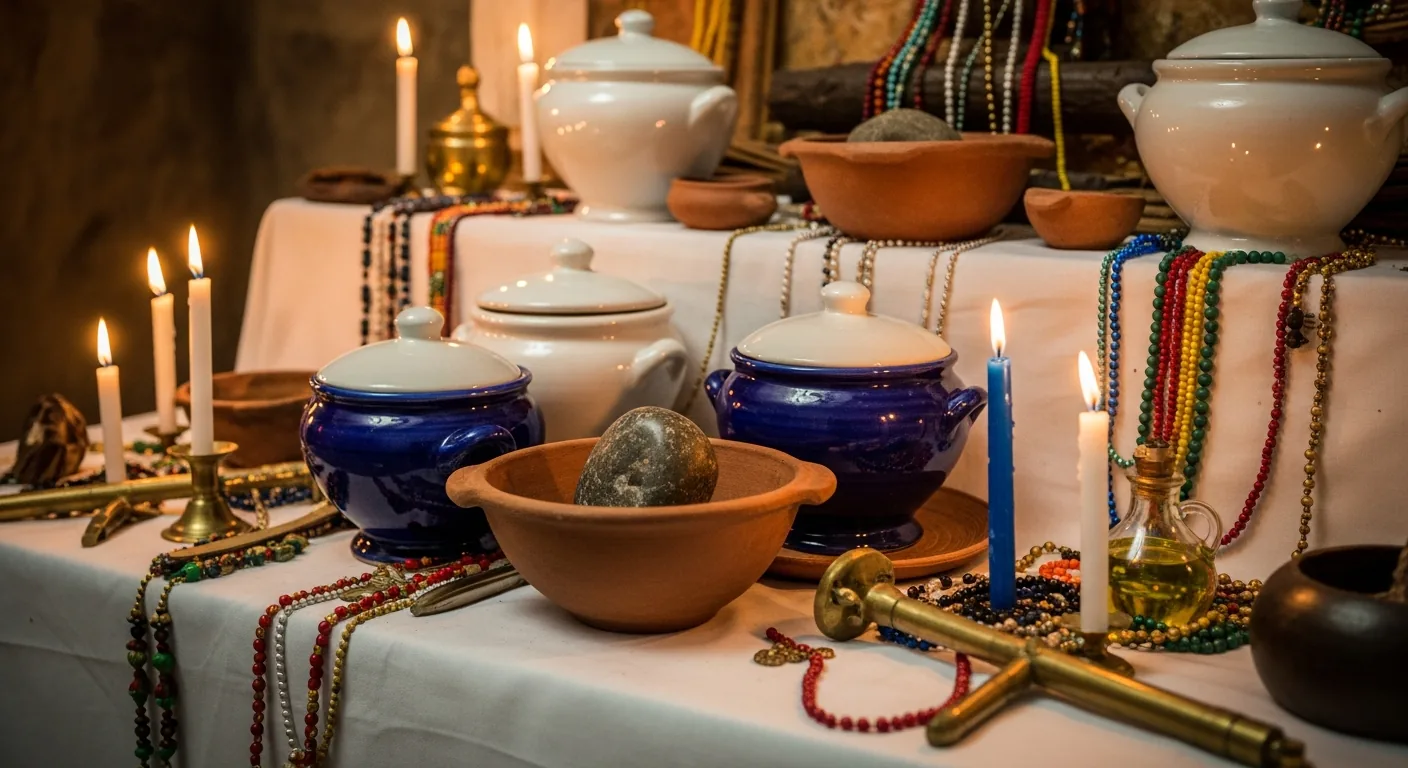
Firmeza is a simple support point, made and maintained by you. The most basic form is lighting a candle: the force vibrates while the candle is lit and ends when it goes out. It can receive drink, some elements, and a reserved corner or a small house. It is temporary or renewable.
Assentamento is a permanent structure. It remains alive and active even without a lit candle, because of the structure itself. It requires defined elements, periodic food, and maintenance.
Rubens Saraceni uses an image that explains it well: the assentamento (consecrated seat of a force) is the fortress that houses an entire army, and the firmeza (a smaller point of spiritual anchoring) is the forward outpost of a division.
The practical conclusion is straightforward. Anchoring a candle and a glass (firmar) is something you can do. Consecrating a seat (assentar) is not. An assentamento is a foundation of the terreiro, set up and fed by a pai or mãe de santo, and it does not come from internet videos or from a ready-made kit. On this topic, it is worth reading what an assentamento de santo is.
Step by step of a simple and responsible offering
Monday is the most cited day for Exu in Umbanda, and Friday also appears. The most common time goes from late afternoon to night. This is a house and lineage custom, not an efficacy requirement. If you want to go deeper into the calendar, see the day of Exu.
- Define the intention clearly. If you belong to a house, notify or consult the leader. If the request touches the house's ritual foundations, the decision is his.
- Prepare yourself. Cleansing ritual bath, clean clothes, no rush.
- Gather the items. Prefer clay, pottery, gourd, coconut bowl, or leaf. Avoid plastic and styrofoam from the time of purchase.
- Assemble the offering. Prepare the padê with your hands, greeting. Arrange the drink, tobacco leaf, candle, and the rest with care.
- Ask for permission upon arrival. Greet the location and its guardian before any gesture.
- Deliver. Set the candle in a safe place, away from trees and dry brush. Say the request in a clear and simple voice.
- Wait and leave. Wait for the candle to go out whenever it does. Leave without commotion.
- Collect. Alguidar, glass, plastic, packaging, bag, and match return with you.
- Give thanks. And do not stay demanding a deadline.
Regarding the candles, the choice of color follows the lineage and the spirit. The article on ritual candles and their meanings helps to avoid mistakes.
The errors that appear most
- Leaving trash in nature. Glass, styrofoam, plastic, and broken dishes. It is the number one mistake and what most feeds prejudice against the religion.
- Offering without knowing the spirit's line. The wrong item for the wrong spirit is not neutral, it is a lack of care.
- Treating the offering as a transaction. "I paid, now solve it" is not fundamento, it is a bill.
- Promising what you will not fulfill. Promising annual delivery and disappearing is worse than not promising.
- Offering with the intention to harm someone. This is not what this house guides and it is not what Quimbanda teaches.
- Messing with someone else's offering. It was not placed for you. Ask for permission and follow the path.
- Leaving a candle lit near dry brush. The risk of fire is real.
The ecology of the offering is not a trend, it is coherence
Whoever delivers in the woods, on the beach, or at the crossroads is delivering in the house of a force. Dirtying the house is not a delivery, it is carelessness.
This discussion is already inside the terreiros, it did not come from outside. The anthropologist Giovanna Capponi documented in research published in 2024 the ritual adaptations in progress. Among them: natural leaf instead of plastic container, removal of packaging before delivery to the sea, and dried flowers instead of artificial ones. The same study shows the debate among priests about how far to adapt without losing the ritual foundation.
There are also public spaces intended for offerings, with clear rules for materials and for collecting the leftovers. The city of Torres, in Rio Grande do Sul, maintains an Afro-Brazilian space in the municipal cemetery with prior scheduling.
The castor bean leaf or banana leaf serves exactly for this: to leave the food and take the dishes back. The foundation of the rite is not in the plastic.
Frequently asked questions
What is offered to Exu?
Cachaça, padê or farofa de dendê, cigar or straw cigarette, red and black candles, flour, pepper, coins and, depending on the spirit, specific foods. For Pombagira, champagne, roses, perfume and mirror are included. What is offered changes according to the line, and the one who confirms is the leader of your house.
What is the difference between a T-shaped crossroads and a cross-shaped one?
Many houses classify crossroads as male, female and mixed by shape. However, there is no national consensus on which shape corresponds to which polarity, and sources contradict each other. The typology varies by terreiro and by region. The honest answer is to ask at the house you attend.
Can I consecrate Exu alone at home?
No. Assentamento is a permanent foundation of the terreiro, set up and fed by a pai or mãe de santo. What you can do alone is a firmeza: a lit candle, a drink, a reserved corner. You can make and renew a firmeza. To consecrate an assentamento requires preparation and a mission that do not come from a ready-made kit.
What to do with the remains of the offering?
Collect everything that is not biodegradable: dishes, glass, plastic, packaging, bags and matches. The food and flowers can stay or be buried, according to the custom of the house. If the location has its own rules, such as Afro spaces in municipal cemeteries, follow what is defined there.
Can I touch someone else's offering?
No. That offering was not placed for you and does not belong to you. If you cross paths with one, ask for permission, follow the path and, if you wish, say a prayer. Kicking or dismantling someone else's offering is religious disrespect, and in Brazil this conduct has already been classified as intolerance.
Where to buy items for offering
At Joia Mística Laroyê, you find the delivery material with quality and without improvisation:
- Alguidares and clay dishes: in the sizes used in deliveries
- Red and black candles: sticks, seven days, and large candles
- Cigars, straw cigarettes, and dendê: the basics of tobacco and food
- Bead necklaces, firmas, and pontos riscados: for those who already have guidance from home
- Herbs, incense burners, and perfumes: for the preparation of the environment and the person
Visit our physical store in Extrema, Minas Gerais or talk to us via WhatsApp and we ship all over Brazil. For everything that involves ritual foundations, spiritual anchoring, and consecrated altars (assentamento), always seek the guidance of your house's leader.
References
- Wikipedia: Exu in Umbanda, distinction between the orixá of Candomblé and the guardian spirits
- Wikipedia: Crossroads in Umbanda, typology of macho, fêmea, and mista and their regional variations
- Giovanna Capponi (SciELO, Religion and Society): 2024 research on ritual adaptations and the ecology of offerings