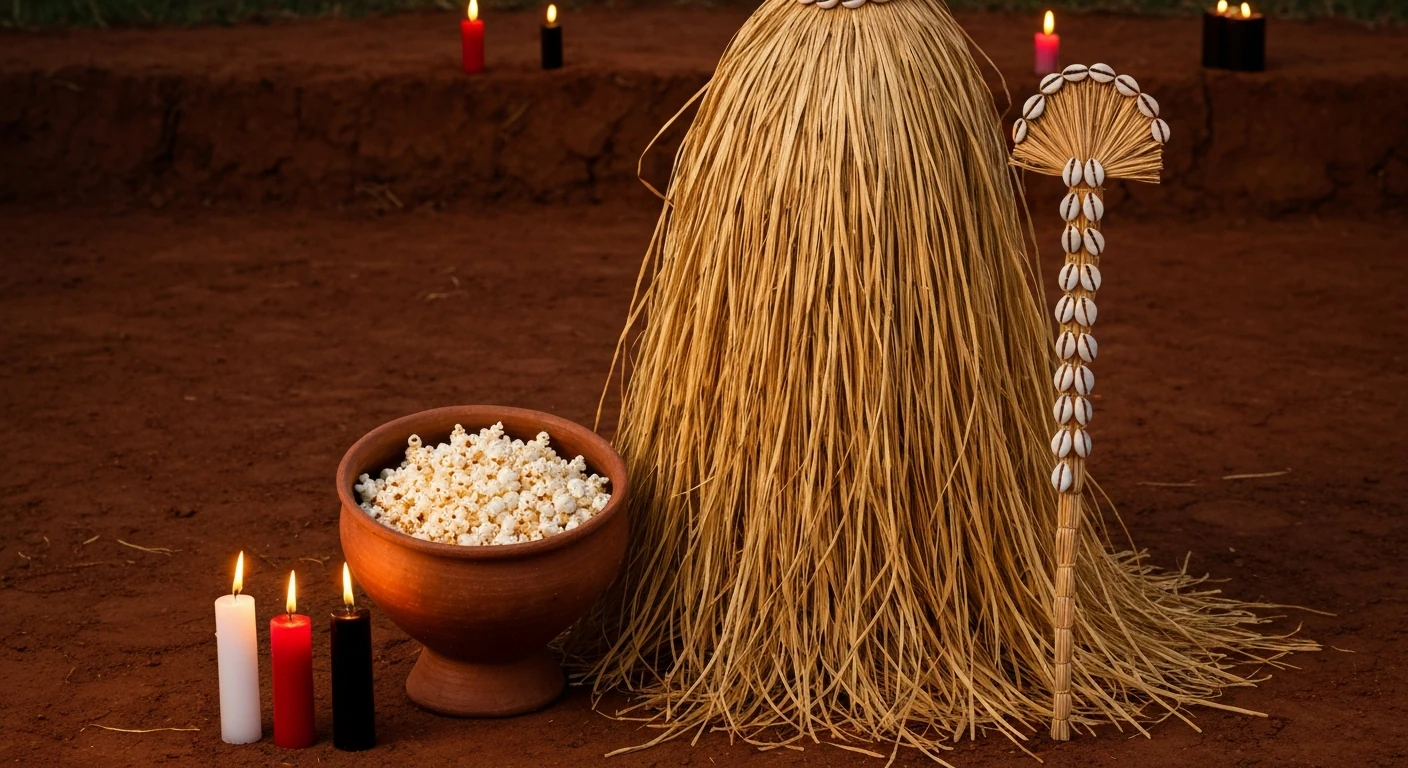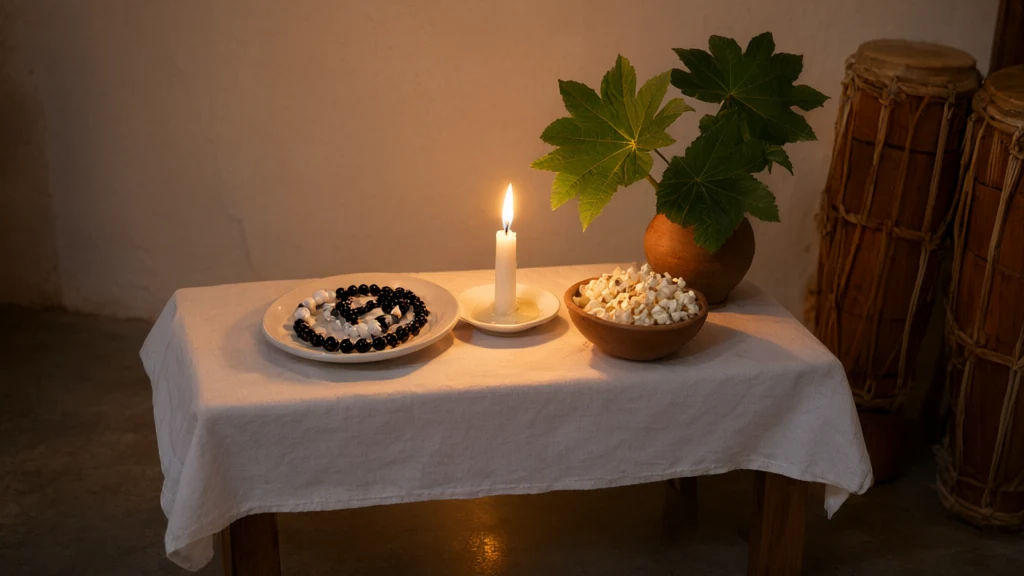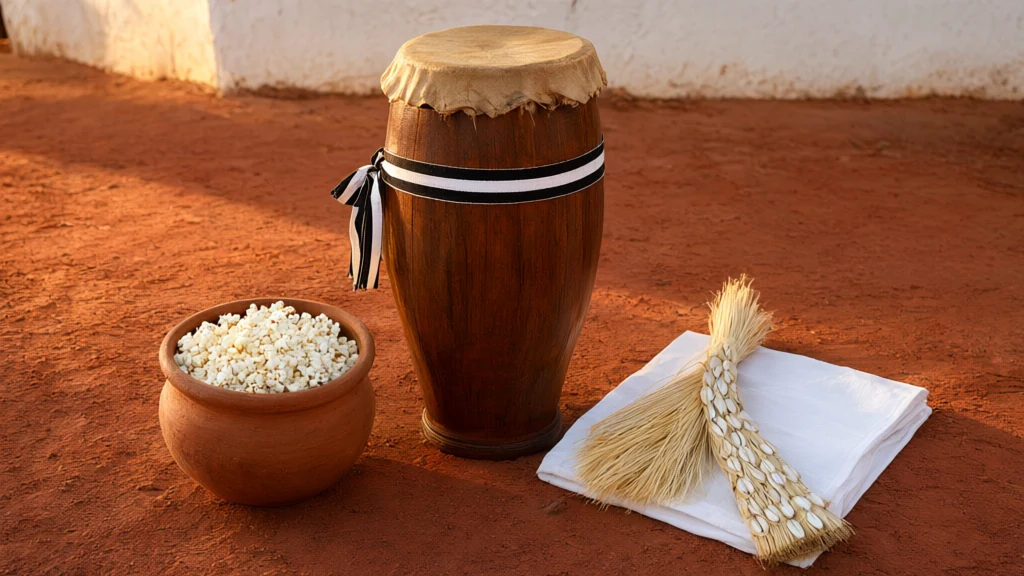
The ponto de Obaluaê is the Umbanda chant that greets Omolu, the orixá of the earth, of disease, and of healing, and it usually brings the Atotô in the refrain. The open-source verses portray him as an old man who walks along the road and ask that he take away the pains. The lyrics change from house to house.
What is the ponto de Obaluaê and when is it sung?
The ponto de Obaluaê is the ponto cantado of Omolu, also called Omulu or Abaluaê. In the sources, it appears in two moments. One is the greeting to the orixás that opens the gira. The other is a section only of his, like the one of Pai Maneco. Who the orixá is can be found in who is Obaluaê.
The Terreiro de Umbanda Pai Maneco publishes the lyrics in booklets. In the opening one, a ponto asks permission from Exu and passes through each orixá until Omulu. In the Quimbanda one, the section "Ponto do Seu Omolu" comes right after the opening of that gira. They are four pontos, without a marked composer.
In the Ilê de Obaluaê, a house of Omolokô in Juiz de Fora (MG), he is the regent. There it is sung to the toque of the atabaques. His line and those who descend through him change from house to house: see Omolu in Umbanda.
Greeting: Atotô | Where it is sung: opening and own section | Dates: 08/16 and 12/17
What are the pontos de Obaluaê with source records?
Four pontos de Obaluaê have records in house booklets or in research, without a marked composer. Here are only short excerpts.
O Velho Omolu, Atotô Abaluaê
It is the first of the Omolu section of Pai Maneco. It begins by calling Oxalá (Obatala), "Meu Pai Oxalá, é o rei", and then greets the old man.
O Velho Omolú, Atotô Abaluaê / Atotô Abaluaê, Atotô Babá / Atotô Abaluaê, Atotô é Orixá
The last verse speaks of whom: an orixá.
”Who sees the old man on the path”
It is the third sung chant (ponto cantado) of the same section.
“Who sees the old man on the path / Asks for the blessing / Abaluaê Atotô”
His neighbors follow the same idea. The second says he had been looking for him for a long time. The fourth sees a little bird fly, but it was an old man walking along the road.
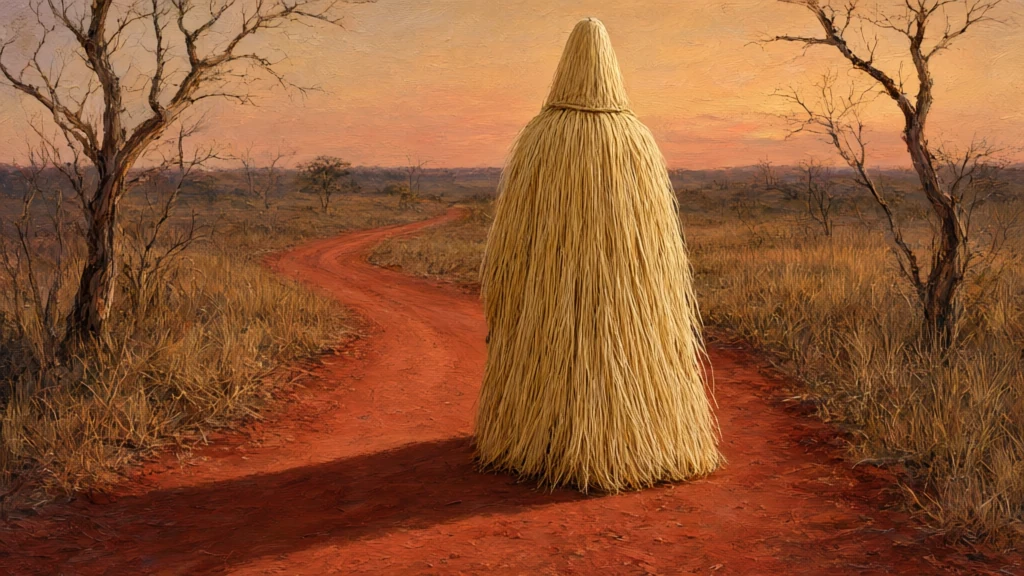
“Son walks along the path”
This comes from another house. Roziel Benvindo dos Santos, from UFS, transcribed the Omolu track from a CD of sung chants (pontos). The disc is from a center in Aracaju, from 2017.
“Son walks along the path / Sees an old man and a staff / Takes the blessing and gives his hand atotô my father”
The chorus repeats that Omolu is Orixá. A caveat: the ritual work warns that the tracks are not the original sung chants (pontos) of the house, but versions. The image, however, is that of Pai Maneco: the old man on the road and the blessing.
”Pai Omulu, take away the pains at this hour”
This verse is in the greeting to the seven lines, in the opening booklet of Pai Maneco. The sung chant (ponto) passes through each orixá and reaches Nanã (Nana Buruku) and her son:
“Nana, capurucaia who consoles everyone / Pai Omulu, take away the pains at this hour”
The same chant is repeated in the opening of the Quimbanda of this house.
What do the verses of the sung chant say about Obaluaê?
The verses of the Obaluaê sung chant speak of an old man, of the road, of blessing, of pain, and of silence.
- The old man and the road. In both places, the son finds an old man on the path and asks for the blessing.
- The pain. The opening verse asks that he take away the pains. In a Nanã sung chant, in the hours of agony, it is her son who comes to prevail. In the UFS monograph, he is the orixá of contagious diseases and "Lord of the earth".
- The Atotô. The greeting is in almost every sung chant. For TUCTVC, "Atotô expresses silence and profound respect". Alma Preta records the formula "Silence, he is among us. Atotô". In NUSS, the greeting is "Atotô, my lord".
- The straw. The sung chants with sources do not speak of it, but it appears in the descriptions of the orixá. The straw clothing hides the wounds, says NUSS. In the Ilê de Obaluaê, he appears covered in straw from head to toe.
Asking for relief in a sung chant is a plea, not a treatment. TUCTVC itself writes that the force of the orixá "does not replace medical treatments". The popcorn of the cult is in pipoca de Obaluaê. What is taken to him, in oferenda para Omolu.
Why does the Omolu sung chant appear in the Quimbanda gira?
The cited houses do not say the reason in all its letters, but they link Omolu to the cemetery, where the Quimbanda line also works. In Pai Maneco, the Omolu section is inside the Quimbanda booklet, just before the Nanã section.
Renata Gomes studied an Umbanda terreiro in Pelotas (RS). A member says that there, they honor "Omulú inside the cemetery".
This does not make the orixá an Exu. NUSS warns that Omulu "should not be confused" with Exu Omulu, head of the cemetery line of quimbanda. Pai Maneco's verses also call him an orixá: "Atotô is Orixá". In the same house in Pelotas, the exu linked to the cemetery is Exu Caveira, called "Exu of death". He has his own article in Exu Caveira, and the one who rules the souls is in the linha das almas.
Whom does the Obaluaê ponto belong to?
The Obaluaê ponto has no single owner: some come from oral tradition, without an author, and others have a composer. Diamantino Trindade, cited by Lourival Andrade Júnior, calls the first ones root pontos, "brought directly by the incorporated entities". The others are "very common in curimba festivals".
Graminha and Bairrão, from USP, gathered about 1,200 terreiro pontos. Many have the influence of popular music. For those created within a house, it is "impossible to date or determine their authorship". And there are houses that sing pontos from other houses, says a leader interviewed in the UFS research.
And the most sought after pontos, such as "Ele é curador" or "Era um velho muito velho"? We do not find them in house booklets or in open research, only on lyrics pages, without a composer or terreiro. Therefore, the lyrics remain outside of here, as in the ponto de preto velho. The types of ponto are in pontos cantados na umbanda.
What is the difference between ponto cantado, ponto riscado, and cantiga?
The ponto cantado is voice and atabaque, the ponto riscado is a drawing, and the cantiga belongs to candomblé. All three have similar names, but only the first is the chant that the umbanda curimba pulls in the gira.
Ponto riscado. For Andrade Júnior, the riscado is a set of symbols that says who the spirit is: "It is as if it were his signature." In the cited sources, no house publishes the riscado of Obaluaê. The foundation is in ponto riscado na umbanda. To check the white and black candle or the pemba that the house requested, speak with Joia Mística via WhatsApp.
Cantiga do candomblé. Those seeking the point of Omolu in Yoruba look for the cantiga do candomblé ketu. The magazine Reflexão, from PUC-Campinas, read the cantigas of 13 orixás, Obaluaê among them, through the translation of the book Cantando para os Orixás. One of his cantigas, translated, is in Obaluaê igan igan, and the game De qual Orixá é a cantiga? asks for the owner of the lyrics.
For December 17, one of the most widespread dates of the orixá, the day is Dia de São Lázaro. Those who prefer to pray alone find the texts in oração para Obaluaê.
Frequently asked questions
What is the most well-known point of Obaluaê?
There is no measurement of which is the most sung. In open sources, the statue that repeats the most is that of the old man on the path, to whom one asks for a blessing. It is in Pai Maneco's booklets and on a record from a center in Aracaju.
Does the point of Obaluaê cure disease?
No. The point asks for relief from pain, as in the verse "Pai Omulu, take away the pains at this hour," and it is a sung prayer. TUCTVC reminds that all spiritual support "must walk together with the necessary medical care." Those who are sick should follow the treatment and can ask for the house's prayer.
What does Atotô mean?
Atotô is the greeting of Obaluaê and Omolu, linked to silence and respect. TUCTVC says that it "expresses silence and profound respect." Alma Preta records "Silence, he is among us. Atotô." In the points, it comes attached to the name of the orixá, as in "Atotô Abaluaê".
References
- Pai Maneco: Quimbanda booklet, Omolu points
- Pai Maneco: opening booklet
- Santos, UFS: From the terreiro to the stage
- Epprecht e Carvalho, Apotheke: Chanted points and Omolokô
- Andrade Júnior, Mneme: Os caboclos
- Graminha and Bairrão, Memorandum: Torrentes de sentidos
- Gomes, Per Musi: the Quimbanda line of the Kingdom of Light
- Gomes et al., Reflexão: As representações sociais dos orixás
- NUSS: Omolu
- TUCTVC: Obaluaê and Omulu
- Alma Preta: what Omolu teaches us