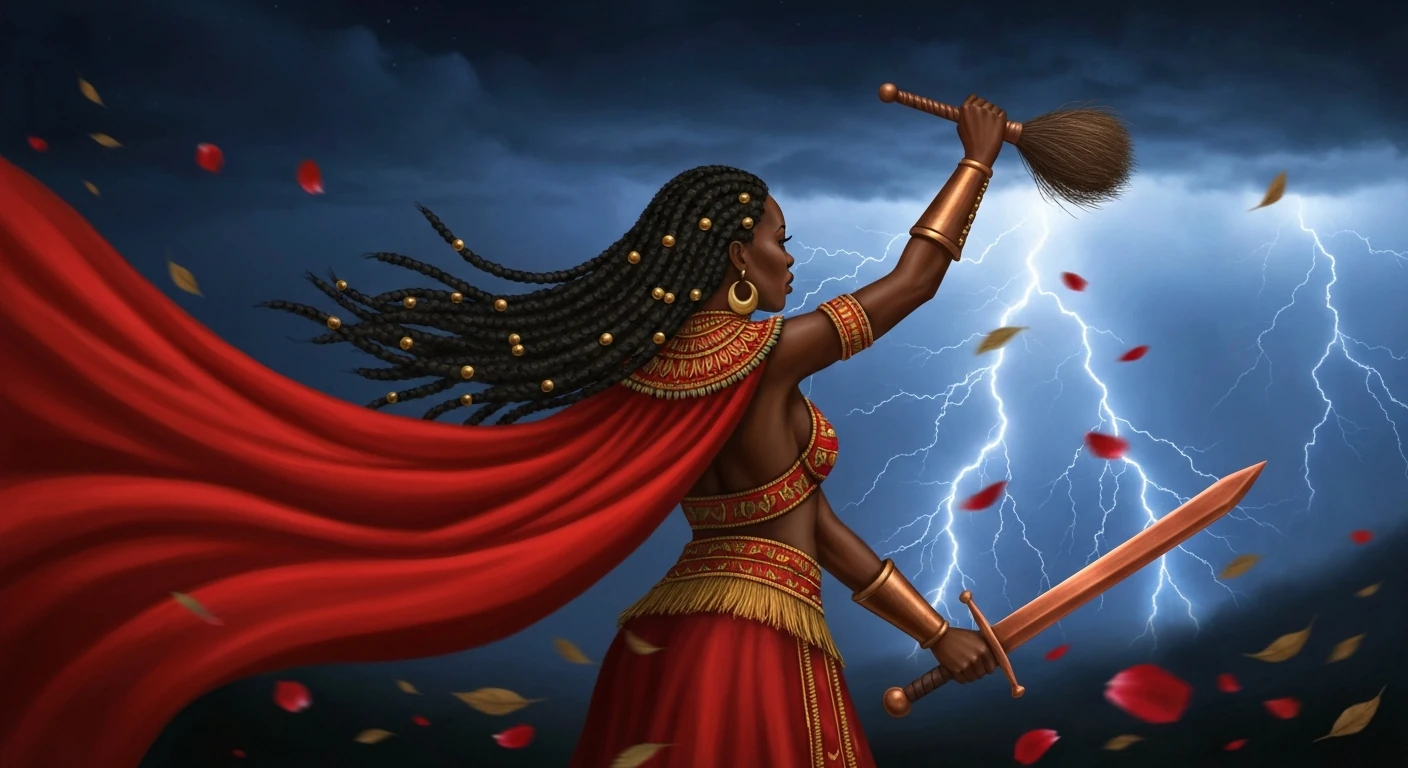
Saint Barbara and Iansã walk together in the Brazilian religious imagination: the Catholic saint protector against lightning and the warrior orixá of the winds and storms. On December 4, churches and terreiros celebrate, each in its own way, and in Salvador, the entire city stops for the procession and the caruru.
But ultimately, is Saint Barbara Iansã? The answer is richer than a simple yes or no. This article tells who the saint was, who the orixá is, why the two were associated, and how all of this turns into a festival in the Bahian calendar.
Who was Saint Barbara
Saint Barbara was a Christian virgin and martyr, situated by tradition in the 3rd century, in the city of Nicomedia, in present-day Turkey. The best-known legend tells that she was the daughter of Dioscorus, a pagan nobleman who kept her locked in a tower to protect her from the world.
Converted to Christianity in secret, Barbara ordered a third window to be opened in the tower, in honor of the Holy Trinity. Discovered by her father and reported to the Roman authorities, she was tortured and, for refusing to renounce her faith, was beheaded by Dioscorus himself.
The detail that explains everything that follows: immediately after the crime, a lightning bolt struck Dioscorus. Because of this, Saint Barbara began to be invoked as a protector against lightning, thunder, storms, fire, and sudden death, and became the patron saint of artillerymen, firefighters, and miners.
A fair note is worth mentioning: in 1969, the Catholic Church removed Saint Barbara from the General Roman Calendar, understanding that there is a lack of reliable documents about her life. Popular devotion, however, never cooled. She continues to be one of the most beloved saints in Brazil.
Iansã, the orixá of the winds and lightning
Iansã, or Oyá in African lands, is the feminine orixá of the winds, storms, lightning, and fire. A fearless warrior, she is also the lady of the eguns, the spirits of the dead, whom only she has the courage to lead. Her greeting is "Eparrei, Oyá!"
Here we present only the essentials, because the blog already has her complete profile. To learn about the mythology, colors, offerings, and the archetype of Iansã, it is worth reading who is Iansã. What interests us now is understanding why this orixá of lightning found Saint Barbara.
Why Saint Barbara became Iansã
The meeting of the two was not by chance, and it was also not a free choice. During slavery, Africans were forbidden from worshipping their orixás. The solution was to hide the orixá behind the statue of a Catholic saint with a similar domain. In this way, the terreiros could revere Iansã while, in the eyes of the plantation owner, they prayed to Saint Barbara.
The link that united the two is the lightning. Saint Barbara is the saint who protects from storms, remembered by the lightning that killed her executioner. Iansã is the orixá who commands the winds and lightning, who sees her strength in the storm. Given such a close domain, the association was natural.
Therefore, syncretism is not a fusion or a theological equivalence. It is a strategy of resistance, the way enslaved Africans found to keep their faith alive. Saint Barbara continues to be Saint Barbara for the Catholic, and Iansã continues to be Iansã for the people of santo. The same day houses two devotions that respect each other. It is the same mechanism that unites Our Lady Aparecida and Oxum and that appears in the June saints and the orixás.
Iansã is not Xangô (Shango): the difference in lightning
Since we are speaking of lightning and thunder, it is necessary to clear up a common confusion. In the pantheon of the orixás, the thunder and the lightning stone belong to Xangô, the orixá of justice. Iansã is his companion and masters the wind and moving lightning, the fire she carries in battle.
In other words: both deal with the storm, but in different ways. Saint Barbara is today associated with Iansã, but until the 1930s she also appeared with Xangô, according to Vagner Santos, from UFBA, and Verger records the connection in Cuba. Xangô has his own saint, Saint Jerome in Bahia. For the couple, see Iansã and Xangô.
The correspondence varies from house to house
Although the association between Saint Barbara and Iansã is strong, especially in Bahia and in the ketu nation houses, it is not a universal rule. The syncretism changes according to the tradition of each terreiro.
In the angola nation, for example, the lady of the winds and lightning is Bamburucema, and it is she who approaches Saint Barbara on that day, not Iansã. In other regions, the calendar and the correspondences may change again. Therefore, the golden rule remains valid:
The correspondence between saint and orixá is not fixed. What defines it is the foundation of the house. The custom of your terreiro always has the final word.
To situate the date within the cycle of Afro-Brazilian celebrations, see the calendar of the orixás.
December 4: the festival and the caruru
In Salvador, the Festival of Saint Barbara has existed for more than three centuries and is immaterial heritage of Bahia. It opens the cycle of popular festivals of the Bahian summer, which continues until the washing of Bonfim and the festival of Iemanjá (Yemoja).
The day begins with fireworks at dawn, continues with mass at the Rosário dos Pretos Church, in Pelourinho, and a large procession that travels through the Historic Center. The procession makes a point of stopping at the Fire Department headquarters, since the saint is the patron of the corporation. In the afternoon and at night, the festival spreads through the terreiros.
The dish of the day is caruru, the okra offering, the same food foundation that appears in the amalá de Xangô. Sources diverge on who it goes to: Santos gives the caruru to the saint and the acará to the orixá, and Couto, from UFBA, calls it the food of Iansã. The calendar question is in Iansã day. The Fire Department even distributes about 1,500 portions of caruru to the public, and groups like the afoxé Filhos de Korin Efan have served Iansã's caruru for over twenty years. The colors that dominate the day are red and white, of Saint Barbara and of the orixá.
Devotion and prayer to Saint Barbara
Even outside the official Church calendar, devotion to Saint Barbara remains intense, and the prayer to the saint is one of the best known in Brazil. The faithful invoke her when the sky darkens, when it thunders, in requests for protection against fire and sudden dangers. The classic statue shows the saint with a tower in the background, a martyr's palm, and, often, a sword, symbols that dialogue with the warrior Iansã.
On the side of the terreiros, the tribute is made with caruru, with red and white candles, and with the greeting to the orixá. The two forms of devotion coexist on the same day, without canceling each other out. Those who pray to Saint Barbara and those who greet Iansã are, each in their own way, asking for the same thing: strength (firmeza) in the face of life's storms.
It is important to remember that devotion is not a magic guarantee. Neither prayer nor caruru work as an automatic formula. They are gestures of faith, of belonging, and of respect for a history of resistance, not promises of results.
Frequently asked questions
Is Saint Barbara Iansã?
For most houses of the Bahian tradition, yes, Saint Barbara is the saint associated with Iansã in syncretism. But the two are not the same divinity: they are figures from different religions that were brought together by their common dominion over lightning and storms. The correspondence varies according to the nation and the terreiro.
Why is Saint Barbara linked to lightning?
Because, according to Catholic tradition, a lightning bolt struck Dioscorus right after he decapitated his own daughter. Since then, Saint Barbara has been invoked as a protector against lightning, thunder, storms, and fire, and she is the patron saint of firefighters and artillerymen, professions linked to fire.
What is the day of Saint Barbara and Iansã?
The date is December 4. On this day, churches celebrate the saint with mass and procession, while terreiros honor Iansã with caruru and a festival. In Salvador, the celebration opens the cycle of popular festivals of the Bahian summer and brings the two devotions together.
What is the caruru of Saint Barbara?
It is a ritual dish based on okra, offered to Iansã on December 4. More than food, caruru is an offering of abundance and sharing, distributed to the public in the streets, in the terreiros, and even by the Salvador Fire Department, in a gesture of devotion and collective celebration.
What is the difference between Iansã and Xangô?
Xangô is the orixá of thunder, the lightning stone, and justice. Iansã is the orixá of the winds and the lightning in motion, Xangô's companion, who carries his fire in battle. Both deal with the storm, but Saint Barbara syncretizes with Iansã, and not with Xangô.
Where to find items for Iansã
At Joia Mística Laroyê, you find what you need to honor Iansã and Saint Barbara on December 4:
- Red and white candles: the colors of the saint and the orixá
- Red bead necklaces and beads: for those who are children of Iansã
- Statues of Saint Barbara: for the home altar
- Ingredients for the caruru: okra and dendê oil
Visit our shop in Extrema, Minas Gerais or talk to us via WhatsApp and we ship all over Brazil.
References
- Wikipedia: Barbara of Nicomedia, entry about the saint and her removal from the General Roman Calendar
- Wikipedia: Feast of Saint Barbara, history and tradition of the celebration in Salvador
- Salvador City Hall: report on the three centuries of the Feast of Saint Barbara and the distribution of caruru