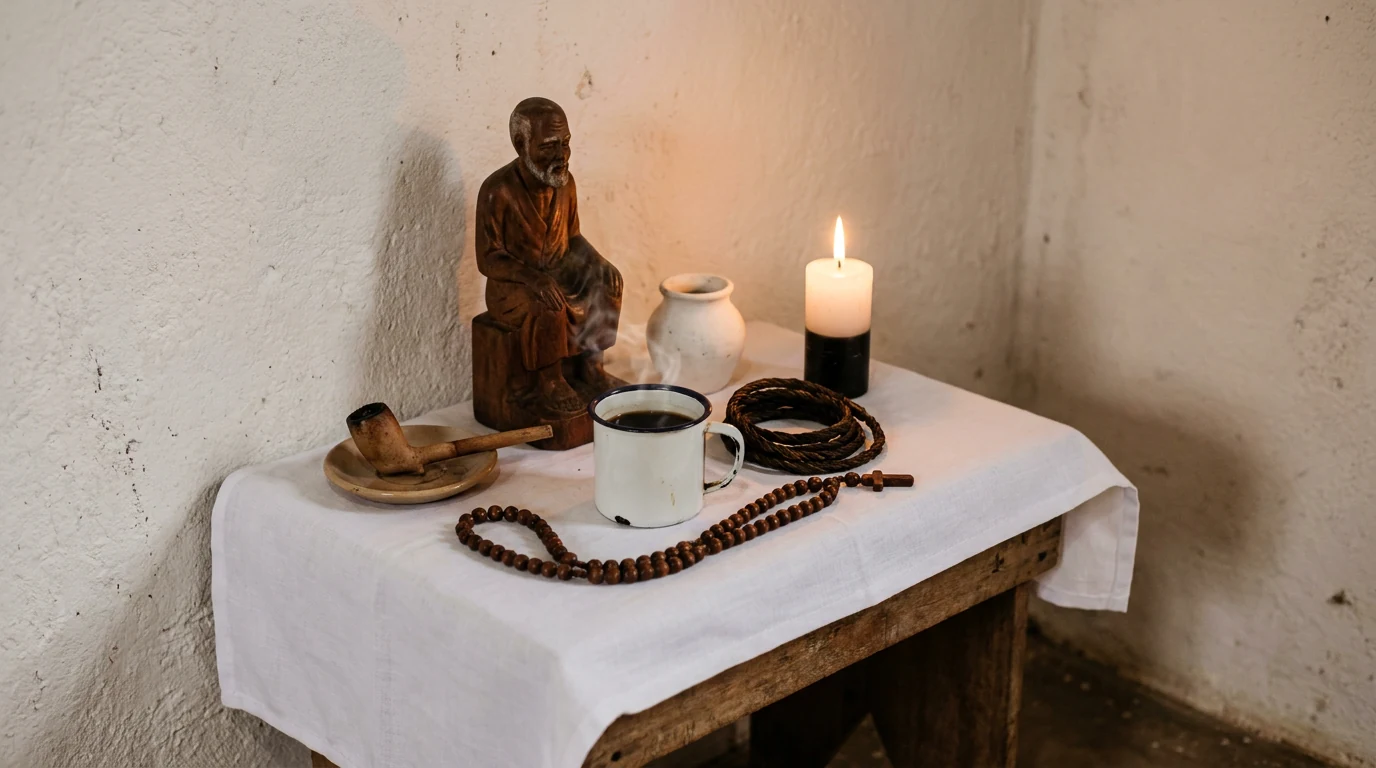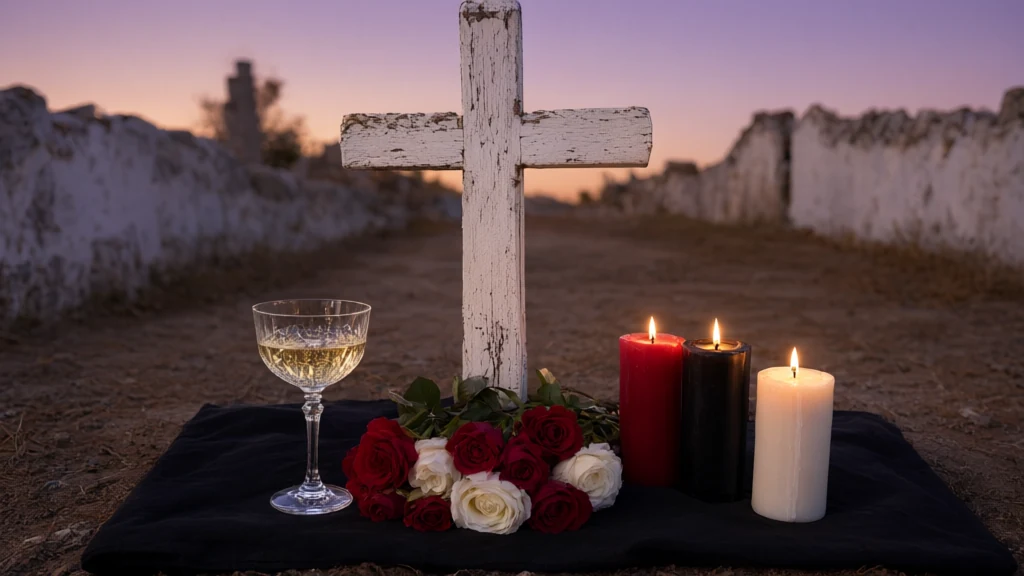
Maria Padilha das Almas is a quality of Maria Padilha "crossed with the souls": the Pombagira of the Padilha spiritual legion (falange) who works in the cemetery, in the calunga pequena, and at the Cross of Souls (Cruzeiro das Almas). She also appears as Maria Padilha do Cruzeiro das Almas. The orixá most linked to her is Omolu, and the colors add white to red and black.
Who is Maria Padilha das Almas?
Maria Padilha das Almas is a Pombagira, that is, a feminine Exu, and not an orixá. She is part of the spiritual legion (falange) of Maria Padilha, whom Reginaldo Prandi, from USP, calls "perhaps the most popular Pombagira".
Prandi explains that Pombagira "is singular but is also plural": there are many, "each one with a particular name, appearance, preferences, symbols, and chants (cantigas)". Among the best known, he cites Maria Padilha and the Pombagira das Almas.
The "das Almas" is a spiritual legion (falange) surname. Researcher Nilza Lagos heard from houses in Porto Velho (RO) and noted that Maria Padilha "presents herself with various adjectives to the name": of the cemetery, of the calunga, of the fire, of the souls.
Ana Laura Brito and Nara Takaki, from UFMS, give her example: each name is a spiritual legion (falange) that subdivides, such as "Maria Padilha do Cabaré and Maria Padilha do Cruzeiro das Almas".
Type: sub-spiritual legion (falange) of Maria Padilha | Place: cemetery, calunga pequena, and Cross of Souls (Cruzeiro das Almas) | Most cited orixá: Omolu, depending on the house | Colors: red and black with white | Registered greeting: Laroyê, Maria Padilha
Why is she "das Almas"?
She is "of the Souls" because she works crossed with the souls, in the cemetery field. The dissertation by Cristiane Barros, from UFJF, records pombagiras in the Umbanda doctrine as such: those of the Cross, of the Cemetery, of the Calunga, Rosa Caveira, of the Souls "and, even, a quality of Maria Padilha".
In an Umbanda terreiro in Curitiba, the booklet of Pombagira sung chants opens the individual chants with her name. The first chant says:
“Maria Padilha das Almas / The cemetery is your place / It is in the Calunga that Padilha lives”
Calunga, here, is the cemetery, the small calunga. The difference between the two calungas is in large calunga and small calunga.
In Bocaiuva (MG), the researcher Fábio Gonçalves, from UFMG, accompanied the foods of the small calunga. They go to Obaluaiê (Babalu Aye), the pretos-velhos, the Exus João Caveira and Tranca-Ruas das Almas and the Pombagiras Rosa Caveira, Maria Padilha das Almas and Maria Quitéria. They are the spirits whose history "refers to the cemetery, death, souls".
An Umbanda practitioner heard by Barros separates the paths. The pombagiras that come "on the path of the souls" are considered eguns, spirits of the dead. Those of the crossroads and the cabarets, as "Exus". The path of the souls is in the line of the souls in Umbanda. [D6b]
Which orixá is Maria Padilha das Almas?
Maria Padilha das Almas appears, in most records, in the irradiation of Omolu, the orixá owner of the small calunga. There is no single answer: there are houses that also chant Iansã and Ogum Megê. Whoever states her line in their house is the leader.
| Where | What the house chants or records | Source |
|---|---|---|
| Candomblé from Campo Grande (MS) | sung chant: she is "daughter of your Omolu" | Garcia and Romizi, UFMS |
| Umbanda in Curitiba (PR) | sung chant (ponto cantado): "the force of Omolu", "the strong arm of Ogum Megê", "the ray of light of Iansã" | Pai Maneco |
| Umbanda in Bocaiuva (MG) | Obaluaiê/Omolu, owner of the small calunga, receives the foods with it | Gonçalves, UFMG |
| Umbanda practitioner book cited on Wikipedia | Omolu-Obaluaê/Iansã line | Wikipedia |
At Axé Nascente, a Candomblé terreiro in Campo Grande, she is the central spirit of the Exu room. Her sung chant (ponto cantado) says she "is blonde with blue eyes" and also "daughter of your Omolu". Her festival opens the house calendar, between January and February.
In the cemetery of Vitória (ES), researcher Barbara Thompson heard that the orixás who act there are Omolu, Iansã of the souls, Nanã (Nana Buruku), Ogum Megê and Ogum de Ronda. They are the same as the ones from the Curitiba sung chant (ponto cantado). The cemetery orixá is in who is Obaluaê and Omolu.
Which Exu works with Maria Padilha das Almas?
There is no fixed Exu of Maria Padilha das Almas with a record in research. The pair belongs to the medium and the house. The two records that exist are a couple in a house in Fortaleza and the place she shares with the Exus of the souls in Bocaiuva.
In Fortaleza (CE), researcher Elita Cavalcante, from UFC, accompanied Mãe Iara, from the Centro de Umbanda Rei Dragão do Mar. At a 2018 festival, the house's Padilha presented herself: "I am: Maria Padilha das Almas". For Mãe Iara, "every medium possesses a couple of exus", and hers are Maria Padilha and Sete Encruzilhadas.
In Bocaiuva, her food goes to the cemetery along with that of Tranca-Ruas das Almas and João Caveira. It is the same field of ritual work, not marriage. The Exus of the calunga are in Exu das Almas.
On the internet, answers circulate that give her a correct "husband". None have a source from the house or from research.
How does she present herself and what does she receive?
Maria Padilha das Almas presents herself with the red and black of the pombagiras, added to the white of the souls. It is the record of Barros for the pombagiras crossed with the souls, "both in the attire, as well as in the bead necklaces of the mediums and candles offered to them".
There is variation among mediums. Mãe Iara wears hers in purple: "I know that my Maria Padilha likes the cemetery very much", she says, "so I like the color purple very much". In Porto Velho, Lagos noted that the Padilhas in general "like red, black, and gold".
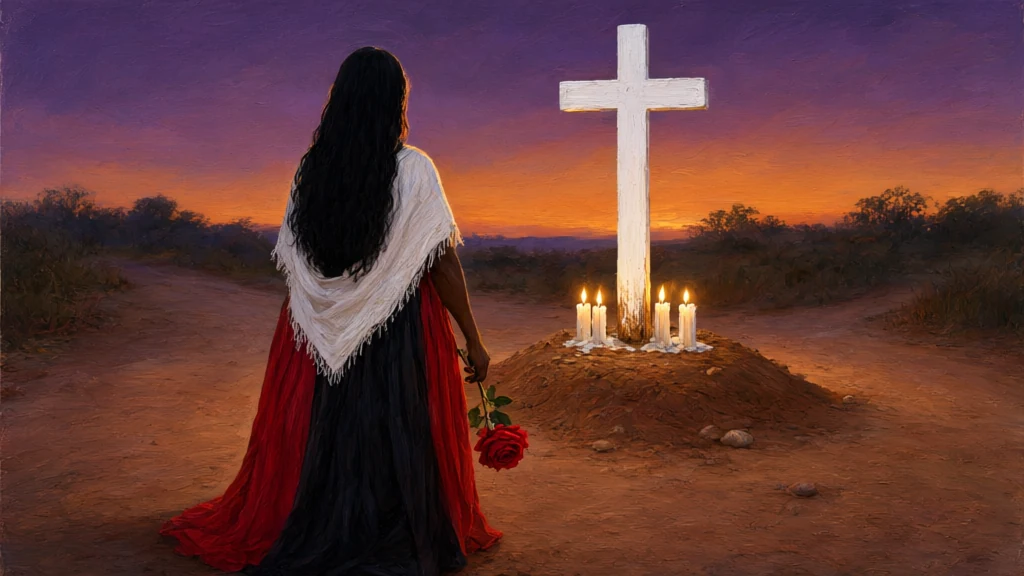
What she receives also comes from this house in Fortaleza. Mãe Iara takes "her champagne, the cigarette". In the consecrated foundation (assentamento) there is a champagne glass, a cigarette, perfumes, and jewelry. It is the record of a medium, not a table. The drinks of the pombagiras are in bebida de Pombagira.
What is requested: Mãe Iara says that she asks for "protection for my house" and that she wishes for the Padilha to come "in the line of love bringing love to people, peace, prosperity". It is the words of a devotee, not a promise of results.
In Bocaiuva, food in the cemetery serves to "promote healing," because Obaluaiê "is also the owner of healing." An offering in the calunga is a serious matter and is done with the leader, never alone. The candle requested by the house (red, black, white) can be confirmed with Joia Mística via WhatsApp.
Is there a story of Maria Padilha das Almas?
There is no single life story of Maria Padilha das Almas in house sources or research. Brito and Takaki explain why: "two mediums of Maria Padilha, even if both are from the Cruzeiro das Almas, do not necessarily possess the same Pombagira."
Traditions say that all "have already lived as people" at some point. But each Padilha of the spiritual legion (falange) tells her life to the medium and the house.
The story that circulates with the most strength is that of Maria Padilha in general, linked to the mistress of King Pedro I of Castile. Prandi recalls that the scholar Marlyse Meyer told this story without proving "that one is the other." It is in the article on Maria Padilha.
Frequently asked questions
Is Maria Padilha das Almas the same as the one from the Cruzeiro das Almas?
Sources use both names for the Padilha crossed with the souls: Curitiba and Fortaleza say "das Almas"; Porto Velho and Campo Grande, "do Cruzeiro das Almas." But Lagos lists, in the same city, the one from the Cruzeiro das Almas, the one from the Cemetery, and the one from the Calunga separately. Who says if they are the same is the house.
What is the difference between Maria Padilha das Almas and Maria Mulambo das Almas?
They are different spiritual legions (falanges) of Pombagira. Both work crossed with the souls, but one is from the spiritual legion (falange) of Maria Padilha and the other from Maria Mulambo. In Bocaiuva, those who share the cemetery with the Padilha das Almas are Rosa Caveira and Maria Quitéria.
What is the sung chant (ponto cantado) of Maria Padilha das Almas?
The most well known sung chant is that of Curitiba, which opens with "Open this Grave / I want to see it shake" and says that "the cemetery is your place". Her block in the same house greets: "Hail Maria Padilha / Laroyê, it is mojibá". Other sung chants of Pombagira are in pombagira sung chant.
References
- Reginaldo Prandi, USP: Pombagira and the unconfessed faces of Brazil
- Cristiane do Amaral de Barros, UFJF: dissertation on Pombagira in Umbanda
- Nilza Menezes Lino Lagos, UMESP: Move man, for a woman is coming
- Fábio da Silva Gonçalves, UFMG: the food in the terreiros of Bocaiuva
- Elita Maria Mendonça Cavalcante, UFC: Ía Mulher! The performance of Maria Padilha in Umbanda
- Barbara Thompson, UFES: At the gates, headstones and crosses of the souls
- Garcia and Romizi, Revista Sede de Ler: Between words and sung chants
- Brito and Takaki, Revista Sede de Ler: Between words and sung chants
- Wikipedia: Maria Padilha (spirit), list of sub-phalanges from an Umbanda practitioner book
- Terreiro de Umbanda Pai Maneco: handout of Pomba Gira pontos