The erês in Umbanda are the child spirits of the Ibejada line, spirits who descend in the gira with the manner, speech, and will of a child, and the day of the erês is September 27, the date of Saint Cosme and Saint Damião.
Line: Ibejada, or the Children line | Day of the year: September 27 | Festival cycle: until October 12 and 25 | Food: sweets, in abundance | Greeting: “Hail the Children!”
They play, ask for sweets, and act playful, but they work seriously: they bless, give a spiritual pass, and advise. In Candomblé, the word erê has another meaning, and this difference is further down.
Who are the erês in Umbanda
The erês are the infant spirits of Umbanda, also called Children or Ibejada. Alongside caboclos, pretos-velhos, exus, and pombagiras, they form the set of spirit guides that work in the terreiro. They arrive joyful, sweet, and playful, sometimes stubborn, and are treated with great respect by the other spirit guides.
Regarding their origin, the houses do not speak the same language. The research by Morena Freitas, conducted in an Umbanda center, records two readings: the erês can be spirits who passed away while still children, or evolved spirits who choose the form of a child to manifest. Pai Alexandre Falasco, in the text reproduced by Giras de Umbanda, also mentions those who see them as beings who never even incarnated, and calls the line “the most spontaneous and simple manifestation that exists.”
The traditions diverge, and this is inherent to Umbanda, which was never a one-size-fits-all religion. What all houses repeat is the function: the erê is a messenger and protector, and their purity opens doors that adult energy does not open.
Greeting: “Hail the Children! Hail the Ibejada!” It is with this joyful call that the terreiros receive the arrival of the Erês in the gira.
What is the day of the erês?
The day of the erês in Umbanda is September 27, the same as Saint Cosme and Saint Damião, and the celebration does not end there. Many houses continue with Children's giras until Children's Day, on October 12, and even Saint Crispim and Saint Crispinian, on October 25. During the week, some dedicate Sunday to the Children.
| Date | What is remembered | What usually happens |
|---|---|---|
| September 27 | Saint Cosme and Saint Damião, Ibeji | Children's gira, candy table, and little bags |
| October 12 | Children's Day | new gira or party in some houses |
| October 25 | Saint Crispin and Saint Crispinian | closes the cycle in some houses |
| Sunday | day of the week cited for erês and Ibeji | varies from house to house |
The cycle of three dates appears in Freitas' research, which also shows the difference in rhythm between the houses: in some centers the Children descend only once a year, and in the studied center they appear at least once a month, in the consultation sessions. Sunday as the day of the erês and of Ibeji is what brings the Brasil Escola, with Ibeji festivals throughout September.
The Church moved the memory of the saints to September 26 in 1969, but the people and the terreiros stayed on the 27th. The document and what each tradition does on the date are in day of Cosme and Damião.
Erê in umbanda and erê in candomblé: it is not the same thing
In umbanda, the erê is a entidade, a spirit with a name and history, that incorporates into the medium. In candomblé, erê usually names a state of child trance linked to the orixá (orisha) of the initiate themselves. The word is the same, the foundation is another.
| Umbanda | Candomblé | |
|---|---|---|
| What is it | spirit of the Children line | state of child trance, linked to the person's orixá |
| Does it have its own name? | yes, such as Pedrinho da Cachoeira or Rosinha | the behavior follows the way of the orixá of the head |
| When they appear | in children's gira, often on festive dates | after the orixá trance, in moments of the terreiro's life |
Freitas summarizes the distinction: in candomblé terreiros, the erês are understood as orixás or as an intermediate state of trance, and the ibejadas are the spirits worshipped in umbanda centers. The article by Ana Maria Urpia and Leandro Conceição, in the magazine DESIDADES from UFRJ, describes the state of erê as a trance different from the state of orixá: when the orixá leaves the body of the iaô, the person begins to behave like a small child, and the erê functions as a mediator between them and their orixá.
And there are still two names that mix with these. The Ibeji is the orixá, the divine twins. Saint Cosme and Saint Damian are the Catholic twin saints that the black people associated with Ibeji during slavery to keep the faith alive under repression. Syncretism brought the devotions closer, but one is not the other. The third boy who appears in many statues of the saints has his own article: who is Doum.
How the Erês work in the gira
Anyone who has seen a children's gira recognizes the scene. Freitas describes the ibejadas eating, drinking, playing, and dancing through the hall, asking for a blessing, a toy, a sweet, a hairstyle. In the midst of so much joy, the serious ritual work happens. See what they usually do:
- Blessings: they bless children and adults, with a special reputation for childhood ailments, such as "quebranto".
- Passes and cleansing: they apply energetic passes that undo weight and sadness.
- Protection and health: according to Brasil Escola, people seek the erês for health issues and to recover joy.
- Counseling through simplicity: they tell direct truths, in the way that only a child has the courage to say.
Play is not a distraction. It is the way the Erê has of working. While playing ball or jumping rope, he is reading the person and moving energy. Lightness is the method, not a lack of care.
Each Erê has their own name. In Umbanda, the first name almost always comes in the diminutive and the surname says where the Child comes from, like Pedrinho da Praia or Rosinha da Pedreira. The complete rule is in names of erês.
Sweets and offerings of the erês
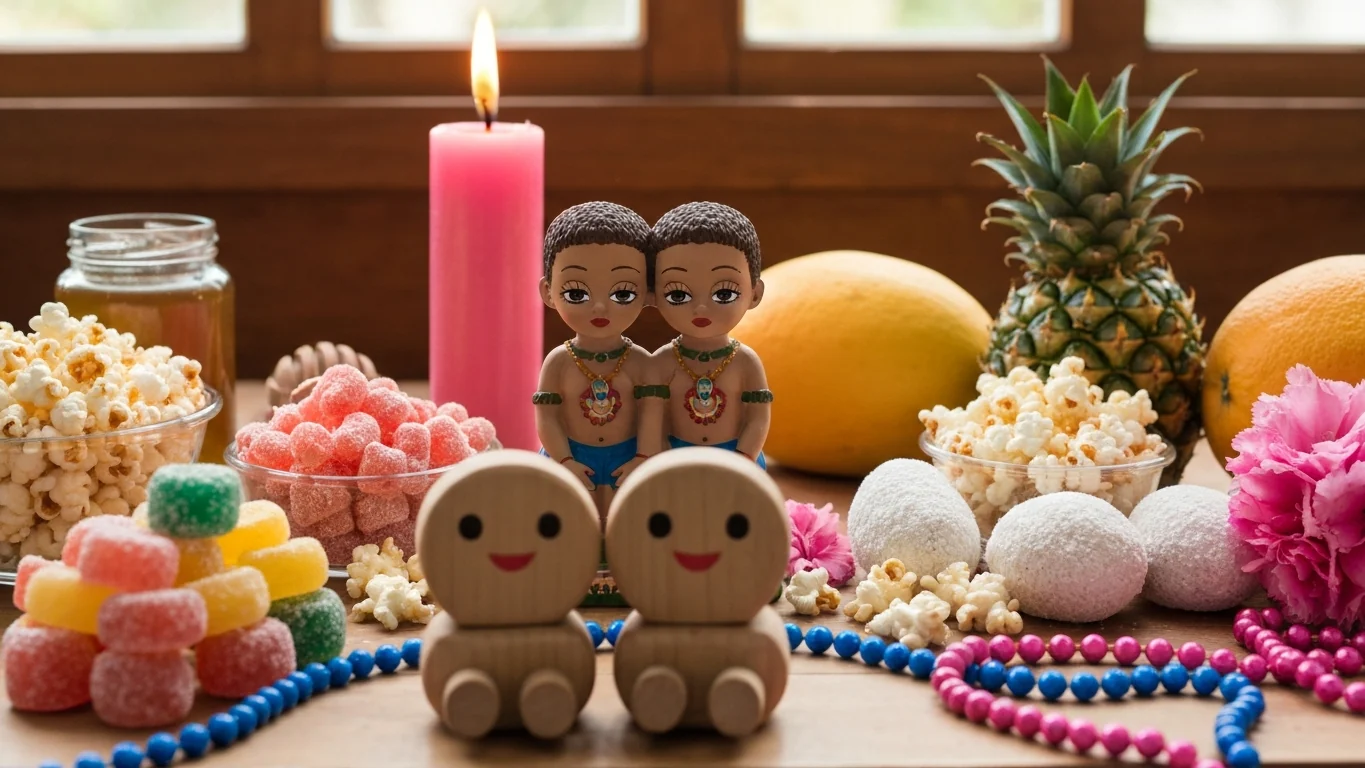
To speak of Erê is to speak of sweets. In Freitas' research, in the ibejada giras the sweets are the main offering and come in abundance: the sweet is food, and not an extra treat. White sweets, such as suspiro, cocada, manjar, and maria-mole, have a place of prominence, and guaraná soda accompanies the table.
Besides sweets, the Erês like toys, fruits, and traditional Afro foods, such as mugunzá and caruru. Brasil Escola records the birthday cake as the central offering in Umbanda, and caruru as an essential dish in Candomblé, the subject of caruru de Cosme e Damião. Each house establishes its offerings according to the fundamento, always with the guidance of the leader.
On September 27, many centers distribute little bags of sweets to the neighborhood children. In the center studied by Freitas, each child took only one bag, delivered by the Child of the leader. The difference between the bag, which is for taking, and the sweet from the orixá's plate is in doce de Cosme e Damião. The Estado de Minas records how this sharing turns into a community festival in the terreiros.
An offering to erê is a gesture of affection and sharing, not a coin of exchange for a guaranteed result. The sweet is delivered with joy and devotion, always guided by the house, never as a promise to "solve" life.
The respect behind the playfulness
It is easy to look at the Children's gira and think it is just a party. But reducing the Erês to "mess" is not understanding Umbanda. Their innocence is precisely the key to the strength they carry.
Because they lack malice, the Erês reach places that adult energy, heavier and full of defenses, does not reach. That is why the great spirit guides respect them so much. An experienced preto-velho knows that, when the Child arrives, something delicate will be treated with a sweetness that only they have.
This line teaches something simple and profound: faith is also lived with lightness. To situate the Erês in the larger set of the religion, it is worth knowing the seven lines of umbanda and the role of the spirit guides in the house.
Frequently asked questions
What are erês in Umbanda?
The erês are child spirits of Umbanda, also called Ibejada or the Children's line. They are spirits that present themselves with the manner of a child, joyful and sweet. For some houses, they were children who passed away; for others, they are evolved spirits in the form of a child. Despite the playfulness, they bless, give a passe, and advise.
What is the day of the erês?
The day of the erês is September 27, the day of Saint Cosme and Saint Damian. In many Umbanda houses, the Children's giras continue until October 12, Children's Day, and October 25, the day of Saint Crispim and Saint Crispinian.
What is the day of the week for the erês?
The most cited day of the week for erês and Ibeji is Sunday. But each house has its own calendar: there are centers where the Children descend only during the year's festivals and others where they appear once a month, in the consultation sessions.
Is the erê of Candomblé the same as the one in Umbanda?
No. In Umbanda, the erê is a spirit with its own name that incorporates into the medium. In Candomblé, erê is usually the state of childhood trance that comes after the trance of the orixá, linked to the orixá of the initiate themselves, and functions as a mediator between the person and their orixá.
What is the difference between erê and Ibeji?
Ibeji is the orixá, the divine twins linked to the energy of childhood. The erê is the spirit, or, in Candomblé, the childhood state of the initiate. The orixá Ibeji was associated with Saint Cosme and Saint Damião during slavery as a strategy of resistance, without one being the other.
What is the offering for the erês?
The main offering is sweets, offered in abundance, because for the Ibejada, sweets are food, not just a favor. They also include guarana, fruits, toys, cake, and Afro foods like mugunzá and caruru. Each house sets its offerings according to the foundation and the guidance of the leader.
Where to find items for the Erês
At Joia Mística Laroyê, you find what you need to set your devotion to the Children line with respect to the foundation of your house:
- Ritual candles: in the colors of the Children and of Cosme and Damião
- Statues of Cosme and Damião and of the Ibeji: for your altar and your point
- Bead necklaces and strands of beads: in the colors of the Ibejada, for those who have a connection with the line
- Offering items: to set up the sweets table with care
- Incense burners and herbs: for the cleansing and the firmeza of the environment
Visit our physical store in Extrema, Minas Gerais and we ship to all of Brazil. For guidance on how to consecrate your devotion to the Crianças with responsibility, talk to us via WhatsApp.
References
- FREITAS, Morena B. M. Religião & Sociedade, v. 42, n. 2, 2022. Child's Food: sweets (and) ibejadas of Umbanda
- URPIA, Ana Maria de O.; CONCEIÇÃO, Leandro dos Santos. DESIDADES, n. 32, 2022, UFRJ. The state of erê as a playful-transformational experience
- Brasil Escola: Erê: what it is, representation, names, stories
- FALASCO, Pai Alexandre. Umbanda de Barracão, reproduced in Giras de Umbanda: Who are the Erês in Umbanda?
- Estado de Minas: report on the festival of Cosme and Damião and the Erês in Umbanda terreiros
- Band: report on what the Erês are in Umbanda and the connection with Cosme and Damião