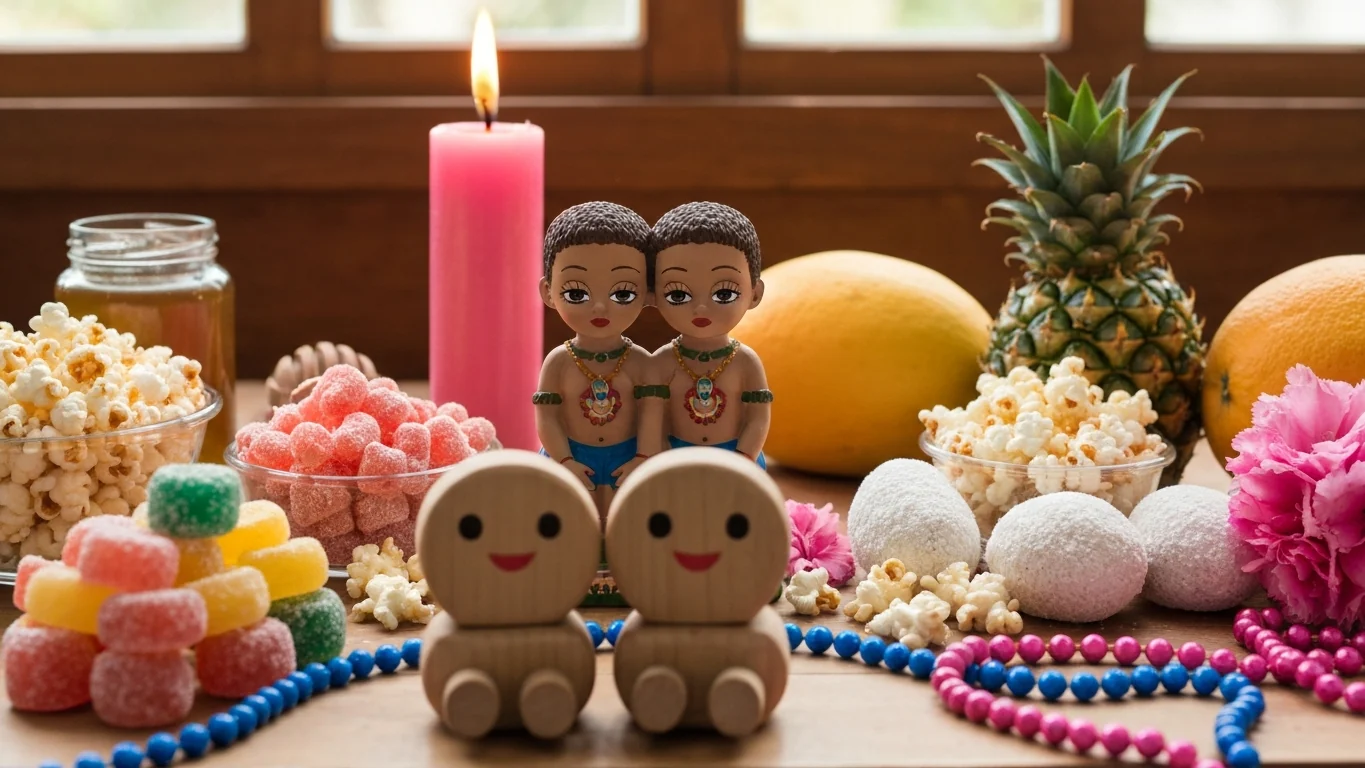
The caruru of Cosme and Damião is the okra, dried shrimp, and plenty of dendê dish that Bahia offers in September. It honors the twin saints and Ibeji. Before any adult tastes it, the food goes to the saint and then to seven children, who eat together and with their hands.
Here you see where the precept comes from, who eats first, what goes into the complete caruru, and why so many families do not stop once it begins.
What is the caruru of Cosme and Damião
The caruru is the feast and the dish at the same time. IPHAN registers other names for it, such as omalé de Ibeji and carirui. In Cachoeira, the feast is also called "caruru de sete meninos" or "mesa dos sete".
Date: September, with the 27th as the highlight | Fixed dish: okra caruru | Who eats first: the saint and seven children | Where it is served: gamela, clay bowl, or basin
Three traditions meet at this table. Cosme and Damião are Catholic saints, adult brothers from the 3rd century who cared for the sick without charging. Ibeji is an orixá, a child divinity protecting children in Candomblé of Yoruba origin, the ketu. In the angola nation, the approximation is with the inquice Vunji. The erê is the child state of the initiate, and in umbanda it names the child spirits.
In the GIS journal, from USP, Yuri Prado points out the child side of the erê as the bridge between Ibeji and the saints. The approximation was born in Brazil, and saint and orixá remain distinct. The profile of the orixá is in who is Ibeji.
The African root is in the worship of twins. Among the Yoruba, women fulfill an obrigação when twins are born into the family, as recorded by Vivaldo da Costa Lima. In 1940, a text by Edison Carneiro cataloged by IPHAN already treated caruru as a family worship for Nagô Ibejis.
Who eats first at the caruru
Order is the rule that carries the most weight. The caruru goes first to the owners of the feast, Cosme and Damião or Ibeji. Then seven chosen children eat, and only when they finish do the adults serve themselves. This is what researcher Júlio Cesar Tavares Dias summarizes in the magazine Ciências Sociais e Religião.
Luísa Mahin do Nascimento saw the same sequence in Cachoeira, in the Recôncavo, for the dissertation she defended at UFRB. The food went to the foot of the orixá and then to the children. Finally, it reached the other children and the public.
In the terreiro, the elders usually serve themselves first. In the caruru, the turn is the children's, as observed by a UFRB student to Brasil de Fato.
The seven children represent seven siblings: Cosme, Damião, Doú (or Doum, from Idowu), Alabá, Crispim, Crispiniano and Talabi. Idowu is the name the Yoruba family gives to the child born after twins, and Alabá and Talabi come from the same naming system. Who is Doum and what the date has of September 26 and 27 have their own articles.
Why the seven boys eat with their hands
The precept commands serving the caruru in a wooden gamela or round clay bowl. The children eat with their hands, without cutlery, and special portions go to the peji.
In the Bahian house, the vessel is usually the basin. A devotee heard in the USP research says that, in Bahia, the children called in the street eat with their hands in a basin. In São Paulo, his family uses a mat and an alguidar for each child.
In Cachoeira, UFRB recorded the scene from the 1980s and 1990s:
- Seven children circled a basin placed on a white cloth.
- Three chants came before. Only then did they eat, together and with their hands.
- The chants continued during the meal.
- At the end, everyone cleaned their hands and mouths on the white cloth.
It is the record of a city and an era. Brasil de Fato noted another variation: cleaning hands on the skirt of whoever offered the caruru.
What goes into the complete caruru
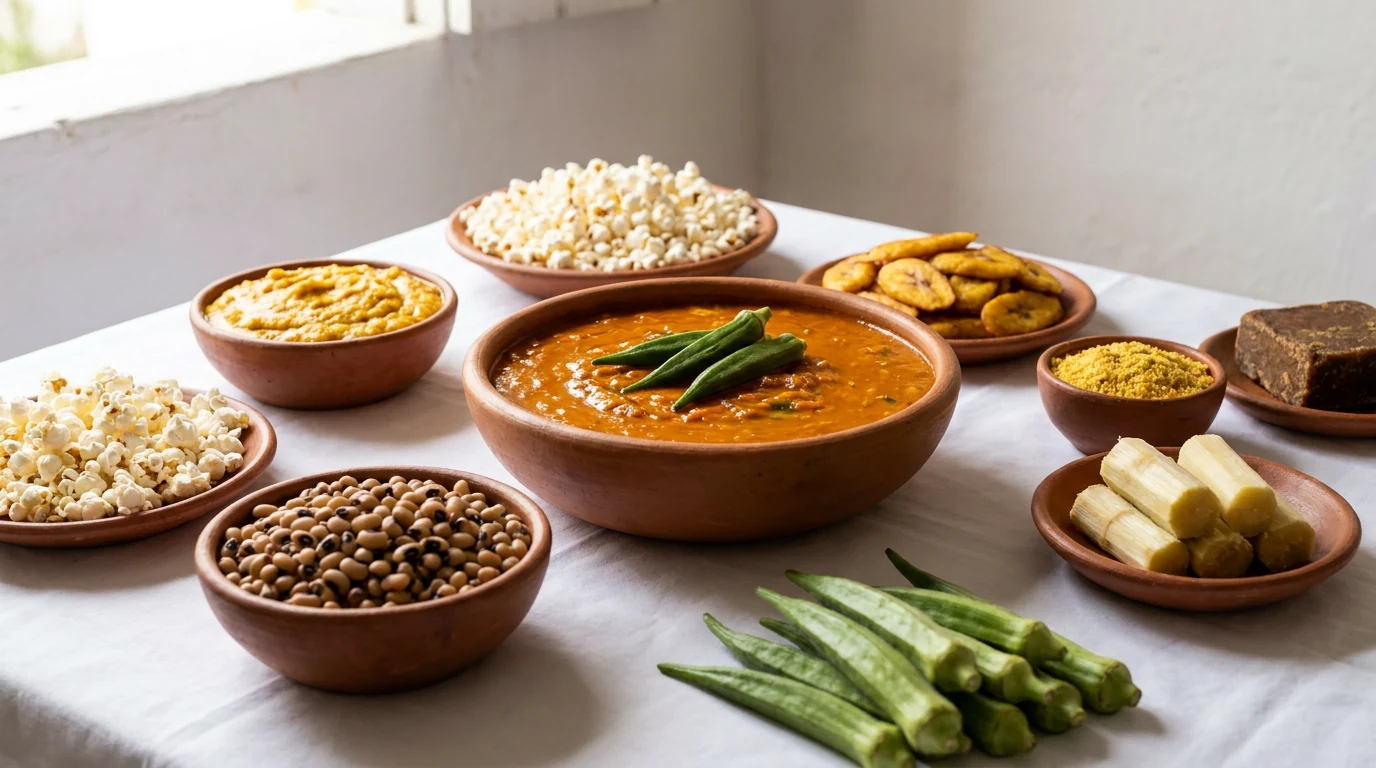
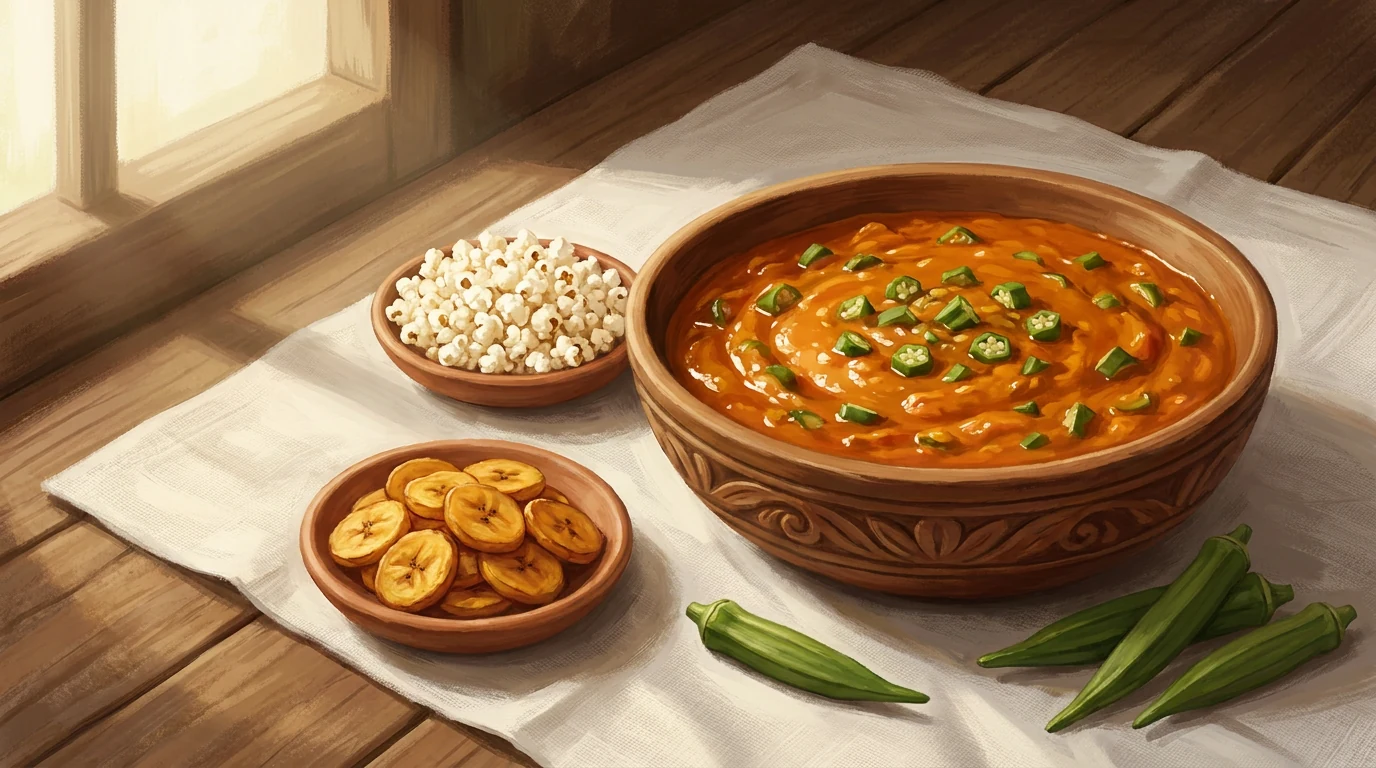
The dish that gives the festival its name is the caruru de quiabo. It takes finely chopped okra, salt, dried shrimp, onion, peanuts, cashews, and plenty of dendê. It is tradition to put three, seven, or twelve whole okra in the caruru, even outside of September.
Around it, the banquet changes. Prado records that only the okra stew is fixed. Two documented tables:
- Cachoeira (UFRB): caruru, vatapá, xinxim de galinha, three farofas, rice, feijão-fradinho, black beans, boiled egg, cane, rapadura, corn, fried plantain, and yam.
- Bahian family in São Paulo (USP): caruru, vatapá, xinxim, beans cooked in dendê oil, acarajé, rice, farofa de dendê, cane, coconut, popcorn, fried plantain, and rapadura.
The vatapá is on both tables and in the IPHAN entry about Cosme's caruru. To Agência Brasil, Professor Ricardo Freitas linked some dishes to orixás: the popcorn to Omolu (Omulu)'s flowers, the farofa de dendê to Exu (Eshu), and the fried banana to Oxumarê.
Inside the terreiro, the Ibeji food follows the house's preparation rules. If you belong to a house, the caruru of obrigação is made with the guidance of your Pai or your mãe de santo.
Caruru of promise: the obrigação passed from hand to hand
One of the names of the festival, registered by Agência Brasil, is Caruru de Promessa. In popular Catholicism, the promise works as a contract. The devotee asks for help from the saint and commits to repaying, and many continue paying for years.
In Cachoeira, the whole okra carries this obrigação. Whoever finds one on their plate begins to offer the caruru, or continues if they already do. The city keeps the rules in the form of sayings:
“whoever has twins and does not want to celebrate, will not enter heaven”, “if it started, it cannot stop”, “whoever is born on the saint's day, must offer the caruru”
Sayings from Cachoeira recorded in the UFRB dissertation
There, the caruru lives more in the houses than in the terreiro. Each family fulfills the precept in their own way.
September, the 27th day, and what changes in Umbanda
The caruru runs through the month of September, with the 27th as the highlight. In 1969, the Church moved the festival of the saints to the 26th. The people and the Afro-Brazilian religions kept the 27th.
The region also changes the offering. In Rio de Janeiro, the children go after the bag of sweets, and in Bahia the festival is the caruru.
In Umbanda, September is also the festival of the erês, with the sweets table. A devotee from an Umbandista family in Salvador told Brasil de Fato that the house alternated: “One year it was caruru and another year sweets table”. The sweets table is in Cosme and Damião in Umbanda, and the children's line is in erês in Umbanda.
Frequently asked questions
What is the date of the caruru of Cosme and Damião?
The caruru is offered throughout the month of September, and the strongest day is the 27th. The Church celebrates the saints on September 26th since 1969. The vast majority of the population continues to celebrate on the 27th, as do the Afro-Brazilian religions.
Is the caruru of Cosme and Damião a heritage of Bahia?
Yes. The State Council of Culture approved the title unanimously on September 19, 2024, with studies from IPAC. The decree was published in the Official Gazette on September 27, 2024, and the asset entered the books of Events and Celebrations and of Knowledge and Ways of Doing.
Can someone who is not from Bahia offer caruru?
They can. A Bahian family heard by the USP research offers the caruru in São Paulo, with the children on a rug and an alguidar for each one. Outside of the terreiro, each family fulfills the precept in their own way. In the terreiro, the house's preparation rule applies.
Where to buy what goes on the caruru table
At Joia Mística Laroyê you find what the table of Cosme and Damião and of Ibeji requires:
- Clay alguidares, for those who serve the caruru in portions
- Statues of Cosme and Damião and of Ibeji for the saints' place at the party
- Candles for the orixá's table
- Dendê oil and gamelas: check availability via WhatsApp before coming
Stop by the shop, at Rua Benedito Zingari, 460, Bela Vista, in Extrema-MG, or message on WhatsApp with delivery to all of Brazil.
References
- IPHAN: Ofício das Baianas de Acarajé, Dossiê Iphan 6, 2007
- Luísa Mahin do Nascimento: domestic worship of Cosme and Damião in Cachoeira, UFRB, 2016
- Yuri Prado: article on devotion and Bahian identity in caruru, GIS, USP, 2022
- Júlio Cesar Tavares Dias: The sweet of Cosme and Damião, 2015
- Agência Brasil: Bahia honors Cosme and Damião, 2024
- CNN Brasil: caruru becomes heritage of Bahia, 2024