Ibeji is the orixá of twins and children, the force of childhood within the Afro-Brazilian pantheon. Unlike the deities linked to an element of nature, he guards a principle: purity, joy, and the magic of those who play. Anyone who wants to understand who Ibeji is discovers a double orixá, sweet and, at the same time, owner of great power.
This guide brings together the profile of the orixá of twins: the technical sheet, the itan that links Iansã and Oxum to his history, and the syncretism with Cosme and Damião. It also separates Ibeji from the erês and from the Catholic saints, which is the most common confusion about the theme.
Who is Ibeji, the orixá of twins
Ibeji is the orixá who rules childhood, twin births, and everything that is born in pairs. The name comes from the Yoruba ìbí, "to be born," and èjì, "two," and for this reason he is usually remembered in the plural, as if speaking of twins. He is the lord of joy, innocence, and play, but he also guards a foundation of magic and strength that the devotees respect.
In the body of Afro-Brazilian traditions, Ibeji occupies a unique place. He is the divine child who crosses Candomblé and Umbanda, protector of the little ones and of those who are born together. To situate him among the other deities, it is worth reading the overview on what the orixás are. The entry on Ibeji, referenced in Prandi and Verger, brings together the Yoruba origin and the syncretism that accompanies him in Brazil.
The energy of Ibeji is that of renewal through joy. Where there is a child's laughter, there is his presence. Therefore, many terreiros invoke him in requests linked to fertility, the protection of children, and the lightness that heals the weight of adult life.
Technical sheet of Ibeji
Before deepening the history, it is worth fixing the elements that identify the orixá. The correspondences below follow the most consensual among the houses, with nation variations signaled.
- Domains: childhood, twins, joy, purity, fertility and magic
- Colors: pink and blue are the most used; some houses adopt the colors of the parents, Xangô (Shango) and Iansã
- Day of the week: Sunday
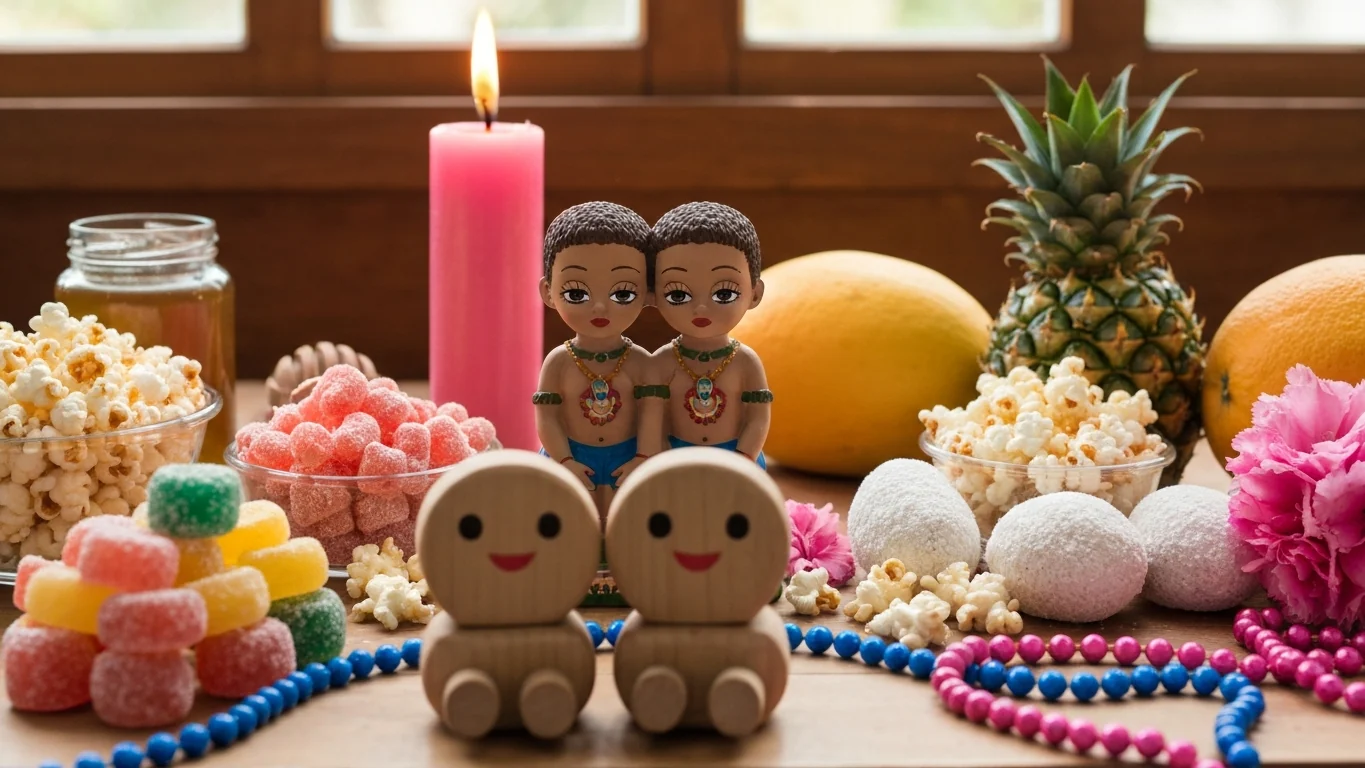
- Symbols: the two twin figures, the toys in pairs and the sweets
- Greeting: “Bejirô!” or “Beji Orô!”, hail the sacred twins
- Offerings: caruru, sweets, fruits, popcorn, cocada and plenty of honey
- Syncretism: Saint Cosme and Saint Damian, on September 27
- Origin: Yoruba, with a strong Jeje-Nagô presence
Bejirô, my Ibeji! Greeting the twins is recognizing the strength that lives in simple joy. The child who laughs disarms evil and opens a path where the adult only saw a wall.
Regarding the colors, the marking varies greatly from house to house. Pink and blue became the popular standard, but the foundation of each terreiro may call for other combinations. The spelling also appears in different forms, such as Ibejis, Ibeji or Ibêji, all accepted in Brazilian sources.
The itan of Ibeji: the twins of Iansã raised by Oxum
No story explains who Ibeji is as well as the itan of their birth. According to oral tradition, it was Iansã who gave birth to the twins, the fruit of her union with Xangô. The warrior of the winds, however, did not see herself in the role of mother to two children at once, and left the boys by the waterside.
It was there that Oxum found them. The lady of the fresh waters, moved by her motherly love, gathered the twins and raised them as if they were her own. Since then, Ibeji has been deeply linked to Oxum. In many houses, the twins receive offerings along with her and are greeted in their rituals.
This itan carries a lesson of fundamento. It shows that the motherhood of axé is not only that of blood, but also that of care. Oxum did not give birth to the Ibeji, and yet she is the mother that traditions recognize. The child needs someone to welcome them, and the orixá of the twins is born precisely from the gesture of welcoming.
Ibeji, erê, and Cosme and Damião: three childhoods that are not confused
Here lies the most common confusion, and it is worth clearing it up calmly. Ibeji, erê, and Cosme and Damião speak of childhood, but they are not the same thing.
Ibeji is the orixá, the divinity of the twins that spans Candomblé and Umbanda. He is a greater force, with his own worship, offering, and fundamento.
The erê is something else. The word comes from Yoruba and means something like "playfulness." The erê is the child side of each orixá, the infantile state that manifests in the filho de santo, functioning as an intermediary between the person and their divinity. Every initiate has their erê, which is not confused with the orixá Ibeji.
Cosme and Damião are the Catholic twin saints. In the syncretism formed during slavery, Africans associated Ibeji with these saints so that the worship would survive repression. As the material from Itaú Cultural about the twins' festival tells, the statues of Cosme and Damião in Brazil became more childlike than the European ones, often with a third figure called Doum. In Umbanda, this childhood energy appears in the line of the children, linked to Cosme and Damião.
To syncretize is not to equate. Ibeji and the Catholic saints are distinct spirits, each in its own tradition. Syncretism was a strategy of resistance, not a theological fusion.
How to honor Ibeji: offerings and the caruru of the seven boys
Devotion to Ibeji is made of sweetness. The offerings of the twins' orixá are those a child would love: sweets, fruits, popcorn, cocada and, above all, honey. The sweeter, the better. Many devotees accompany the offering with toys, always in pairs and of equal value, so that neither of the twins feels left out.
The highlight of the devotion is the caruru, a Bahian dish of okra, dendê oil, shrimp and onion. In the twins' festival, the caruru is served first to the children, reversing the common hierarchy of the tables. The tradition of the caruru of seven boys invites seven humble children from the community to eat before everyone else, in a gesture of sharing and abundance.
The main date is September 27th, when the syncretism with Cosme and Damião fills houses with sweets distributed to the little ones. It is customary to set up a small altar with the statues of the twins, candles and the treats of the offering. To choose the right color of the candle, it is worth consulting the guide of ritual candles and their meanings.
Foundation tip: never offer a toy that is better than the other to the Ibeji. The twins are equal, and the offering in a pair of the same value is a sign of respect for their dual nature.
Frequently asked questions
Who is the orixá Ibeji?
Ibeji is the orixá of the twins and children, the force of childhood in the Afro-Brazilian pantheon. The name comes from Yoruba and means "two births." He rules joy, purity, and fertility, and is syncretized in Brazil with the saints Cosme and Damião. He has Yoruba origin and a striking presence in Candomblé and Umbanda.
What is the difference between Ibeji and erê?
Ibeji is the orixá, the divinity of the twins, with its own worship. The erê is the child side of each orixá, a childhood state that manifests in the filho de santo and functions as an intermediary between the person and their divinity. Every initiate has their erê, which is not confused with the orixá Ibeji.
Is Ibeji Cosme and Damião?
Not exactly. Ibeji is the Yoruba orixá of the twins, and Cosme and Damião are Catholic saints. In the syncretism of colonization, the two were associated so that African worship could survive. They are distinct entities, each in its own tradition, united by the common image of the twins and the protection of children.
What is the greeting of Ibeji?
The most recorded greeting is “Bejirô!”, also written as "Beji Orô!" It is the traditional way to revere the sacred twins, recognizing the force that lives in joy and innocence. As it is an oral tradition greeting, it appears with small variations depending on the house and the nation.
What is the offering of Ibeji?
The Ibeji love sweetness: sweets, fruits, popcorn, cocada, and lots of honey. The greatest offering is the caruru, served first to the children. Toys can accompany them, always in pairs and of equal value. The main date is September 27, in syncretism with Cosme and Damião.
Where to buy items for Ibeji
At Joia Mística Laroyê, you find everything to honor the twin orixás with respect and devotion:
- Statues of Ibeji and of Cosme and Damião for your altar
- Candles in the colors of childhood, pink and blue, for the tributes
- Bead necklaces and firmas linked to the energy of the sacred twins
- Honey, ritual sweets, and offering items for the Ibeji table
- Herbs and incense for the cleaning and lightness of the environments
Visit our physical store in Extrema, Minas Gerais or receive at home with delivery to all of Brazil. For guidance on how to prepare the twins' offering and to consecrate your devotion with responsibility, talk to us via WhatsApp.
References
- Wikipedia: entry about Ibeji, based on Prandi and Verger
- Itaú Cultural: report on the twins' festival, Ibeji and Cosme and Damião