Doum is the third figure that appears between Cosme and Damião in a large part of Brazilian statues. The name comes from Ìdòwú, which in the Yoruba family names whoever is born right after a twin birth.
This part is documented. As for the brother part, it is another story: researchers who study the devotion write "brothers" in quotes, or say "according to popular belief." It is worth separating the layers one by one, because almost everything circulating about Doum comes without a source.
Ìdòwú: the Yoruba name behind Doum
In the Yoruba tradition, there is a set of names given by the circumstance of birth, and not by the family's choice. The twins are Táíwò, the first to be born, and Kẹ́hìndé, the second. Whoever comes after them receives Ìdòwú. After Ìdòwú comes Àlàbá.
Two details that usually get lost along the path. Ìdòwú is valid for boys and girls, and that is how linguistics records the name. And it carries a reputation of a naughty child: the current expression among the Nagôs is esu lehin ibeji, which can be translated as the mischievous one who comes after the twins. In the source, it is a playful compliment.
The etymology is uncertain. The researcher from Bahia, Vivaldo da Costa Lima, raised the hypothesis that the name came from owú, jealousy, and that is how it should be read: as a hypothesis by an author, not as a closed fact.
There is still a belief recorded in various researches: among traditional Yorubas, the third needs to come into the world after the double birth. Anthropology collects the strong formulation that, without him, the mother of the twins would go insane. It is a recorded belief about the weight that falls on the mother of twins, and that is how it needs to be read.
From Ìdòwú to Doum: how the name crossed over
It passed through the people's mouths. Sacred art researcher Tadeu Mourão, in a chapter of the book Doces Santos, from the National Museum of UFRJ, summarizes the passage in a dry sentence: "Here, Idoú became Doum".
The spellings vary. Doum is the most common form today. Doú appears in a good part of the bibliography. Dohú is found in old baiano records. And there is still Dois-Dois, which in some sources names Doum and in others the pair itself, which suggests caution with the term.
The name was also already outside the terreiro for a long time. In 1951, a valsinha called "Cosme e Damião", by Roberto Martins and Ari Monteiro, recorded by Gilberto Alves, sang: "Cosme, Damião, Doum / Crispim, Crispiniano / Caboclinho da mata / Doces pra vocês eu dei".
Doum in the statue: a miniature, and sometimes a vase
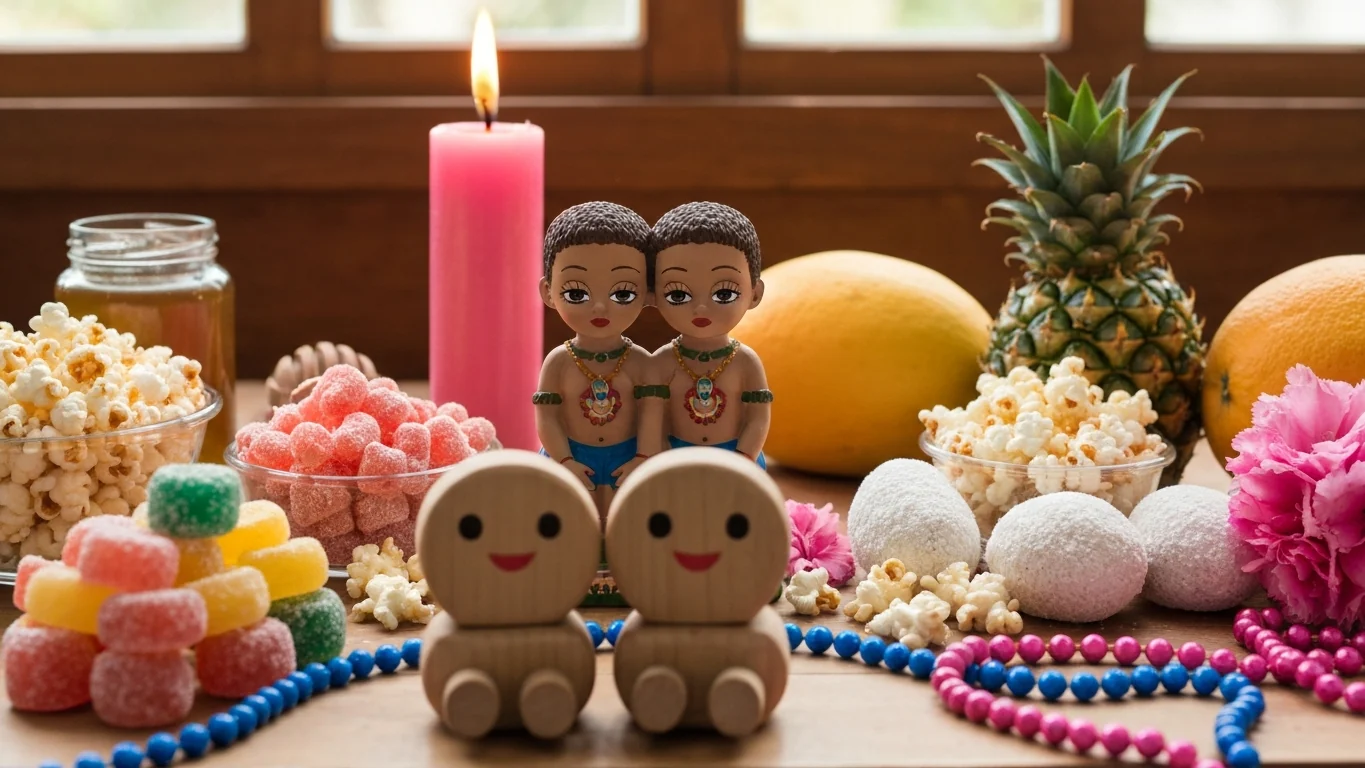
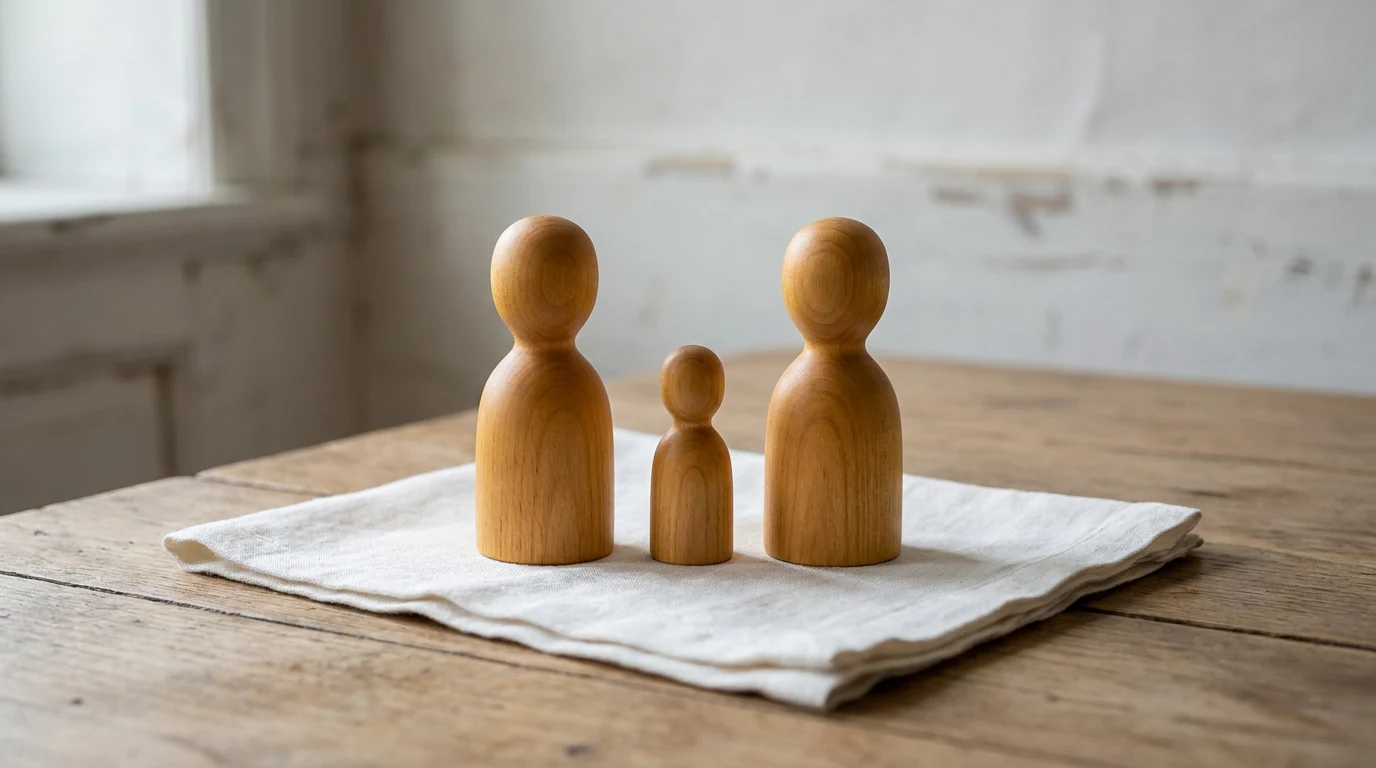
The most well-known Brazilian sculptures show Cosme and Damião as chubby boys, dressed identically, with a cap and cape in the 18th-century style. When a third figure appears, it is identical to the two, in miniature, always placed between them.
Anthropologist Stefania Capone records a variant that almost no one mentions: sometimes Doum is not a figure, but rather a small vase placed between the twins. In the same passage, she calls him the "guardian" of the Ibejis, and not the third twin.
In Brazil, the statues of the saints became rejuvenated and infantilized, unlike the European ones. The third figure was born from this same transformation.
What is said about Doum, and what each version has behind it
This is the part that is missing everywhere. Separating what supports each claim, it remains as follows:
| What is said | What sustains |
|---|---|
| Ìdòwú is the name of who is born after the twins | documented in Yoruba linguistics and in the baiano bibliography |
| Doum and Doú come from Ìdòwú | documented; the most serious sources write "seems to derive" |
| Doum receives the first part of the offering | documented, in two independent studies |
| In the statue, it is an identical miniature between the two | documented as iconography |
| Doum is the third brother of Cosme and Damião | Brazilian devotion; the researchers note "according to popular belief" |
| Doum is orixá (orisha), or Doum is Ibeji | it is not sustained: the research treats him as a guardian, not as orixá |
| Doum died as a child due to lack of a doctor | was not found in any source consulted |
It is worth opening the last line. Doces Santos has 534 pages, brings together ten researchers and is the largest field research published about this devotion. The entire book was scanned in this investigation by crossing mentions of Doum, Doú and Idowu with words linked to death. Zero occurrences. The 64 mentions to the name deal with birth name, iconography, ritual and music.
This does not disparage those who tell the story. It circulates, has value for those who keep it, and is part of the devotion. It is just not a document, and it should not be presented as such.
Doum is not in the Catholic hagiography
And the one saying this is a researcher who went there to look. The Golden Legend, a 13th-century compilation that spread the lives of saints throughout medieval Europe, narrates the story of Cosme and Damião and names three of their brothers: Antimo, Leoncio, and Euprepio. No Doum, nor any similar name. The book also does not mention any miracle linked to the child.
It makes sense: in Europe, the function of the two saints was never linked to childhood, but rather to medical practice. Childhood entered here.
And, to make it clear that this standard is not harsh only toward the African side, it is worth looking at the other two names on the Baiano list. Regarding Crispim and Crispiniano, the Catholic Encyclopedia writes: "It is stated that they were brothers, but the fact has not been positively proved". They were not even twins, and the brotherhood is not proven. The Church itself calls the narrative a legend, with details of little historical probability.
The seven brothers of the caruru
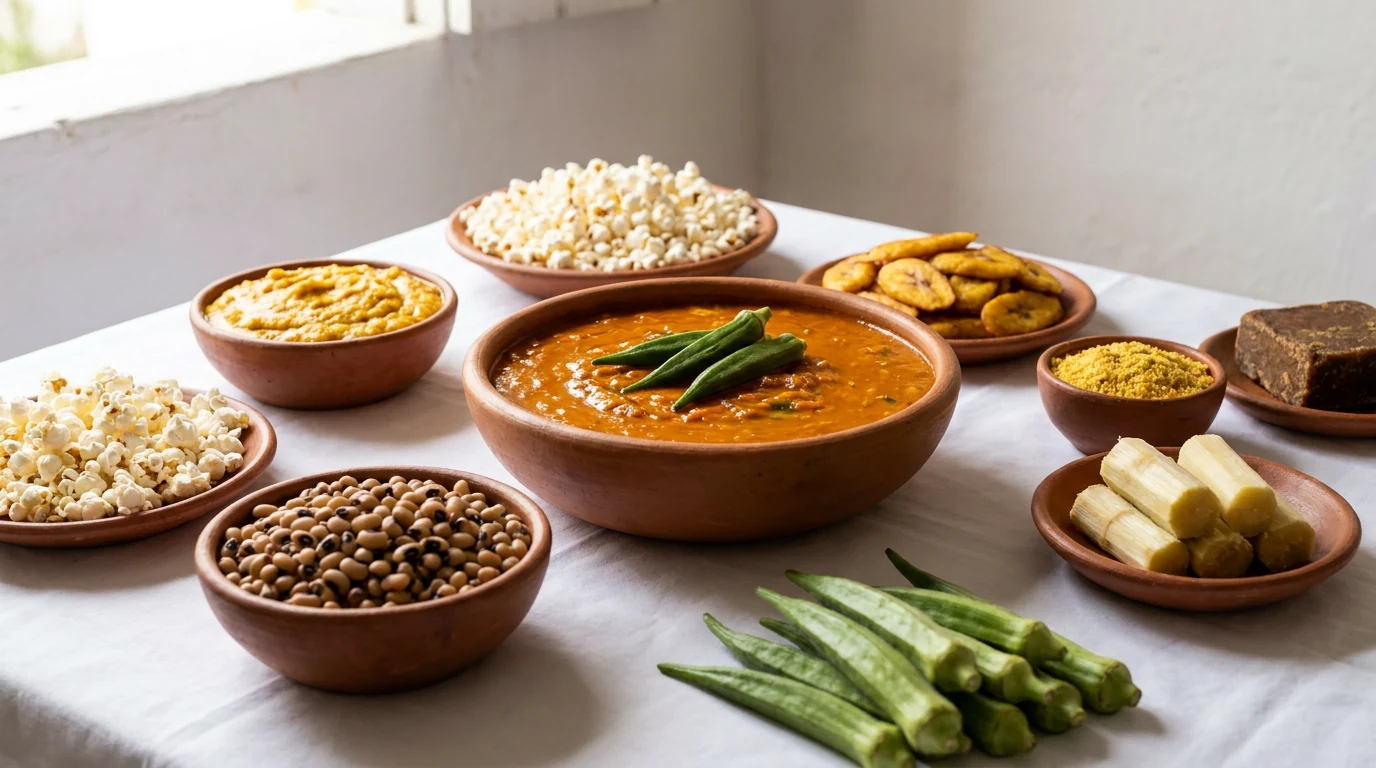
In the baiano caruru, seven boys eat first, and they represent seven brothers: Cosme, Damião, Dou, Alabá, Crispim, Crispiniano, and Talabi. The precept is in the seven boys of the caruru.
Pay attention to where the names come from. Alabá is the Yoruba Àlàbá, the one born after Ìdòwú. And Talabi is the Tàlàbí of the same system: the child born in a bundle, with the head covered by the membrane. In Nigerian records, for instance, it appears as a female name. In other words: the Bahian list did not only preserve the sequence of the twins, it preserved almost the entire Yoruba system of birth names. Crispim and Crispiniano come from the other side, from the Catholic calendar, and have their own day on October 25, also celebrated in an Umbanda terreiro.
And the list varies. In the 1940s, Edison Carneiro registered six names, without Talabi: Cosme, Damião, Crispim, Crispiniano, Doum and Alabá. The list of seven that became the standard came later.
Doum, the Ibejis and the Children
They are different things, and the confusion is common. Ibeji is the double orixá of childhood, with their own profile and itan in who is Ibeji. Doum is not an orixá: research treats him as the third one who accompanies the twins, the one who eats first at the parties. In Umbanda, he appears linked to the line of the Children, and the day of Cosme and Damião is when this becomes most visible.
An honest caveat to close. The very link between Ibeji and the twin saints is a subject of open academic debate: there is recent research suggesting that 19th-century Afro-Bahian devotion functioned as an aggregating devotion of various African groups, rather than a syncretized cult to Ibeji. Syncretism, here as always, is not equivalence.
Frequently asked questions
Who is Doum?
He is the third figure who appears between Cosme and Damião in Brazilian statues. The name comes from Ìdòwú, which in the Yoruba family names the one born immediately after a twin birth, boy or girl.
Is Doum the brother of Cosme and Damião?
In Brazilian devotion, yes. Historically, there is no document that supports this: Catholic hagiography names three other siblings of the twins and no Doum. Researchers usually write "siblings" in quotes or mark "according to popular belief".
What does Idowu mean?
It is the name given to someone born right after twins, within the Yoruba set of names linked to the circumstances of birth. The etymology is uncertain, and one of the hypotheses raised links the name to owú, jealousy.
Is Doum an orixá?
No. Research does not treat him as an orixá nor as the third twin of the Ibejis. He appears alongside them, as a guardian, and receives the first part of the offerings during the festivals.
Did Doum die as a child?
This version circulates a lot, but it was not found in any of the sources consulted in this investigation, including a 534-page book from the National Museum dedicated solely to this devotion. It is devotional tradition, not a historical record.
If your house asked for a statue or material for the 27th and you were in doubt about what to bring, you can check via the shop's WhatsApp.
References
- MENEZES, Renata; FREITAS, Morena; BÁRTOLO, Lucas (orgs.). Sweet Saints: devotions to Cosme and Damião. National Museum/UFRJ, 2020. Open access
- FAKUADE, Gbenga; FRIDAY-OTUN, Joseph; ADEOSUN, Hezekiah. "Yoruba personal naming system". Sociolinguistic Studies, v. 13, n. 2-4, 2019. PDF
- BÁRTOLO, Lucas. "Cosme and Damião: the plot of a city". Ponto Urbe, n. 23, 2018. Article
- MEIER, Gabriel. "Saints Crispin and Crispinian". The Catholic Encyclopedia, v. 4, 1908. Entry
- SIMAS, Luiz Antônio. The boy on Jorge's "horse"
- FREITAS, Morena B. M. Religion & Society, v. 42, n. 2, 2022. Child's Food