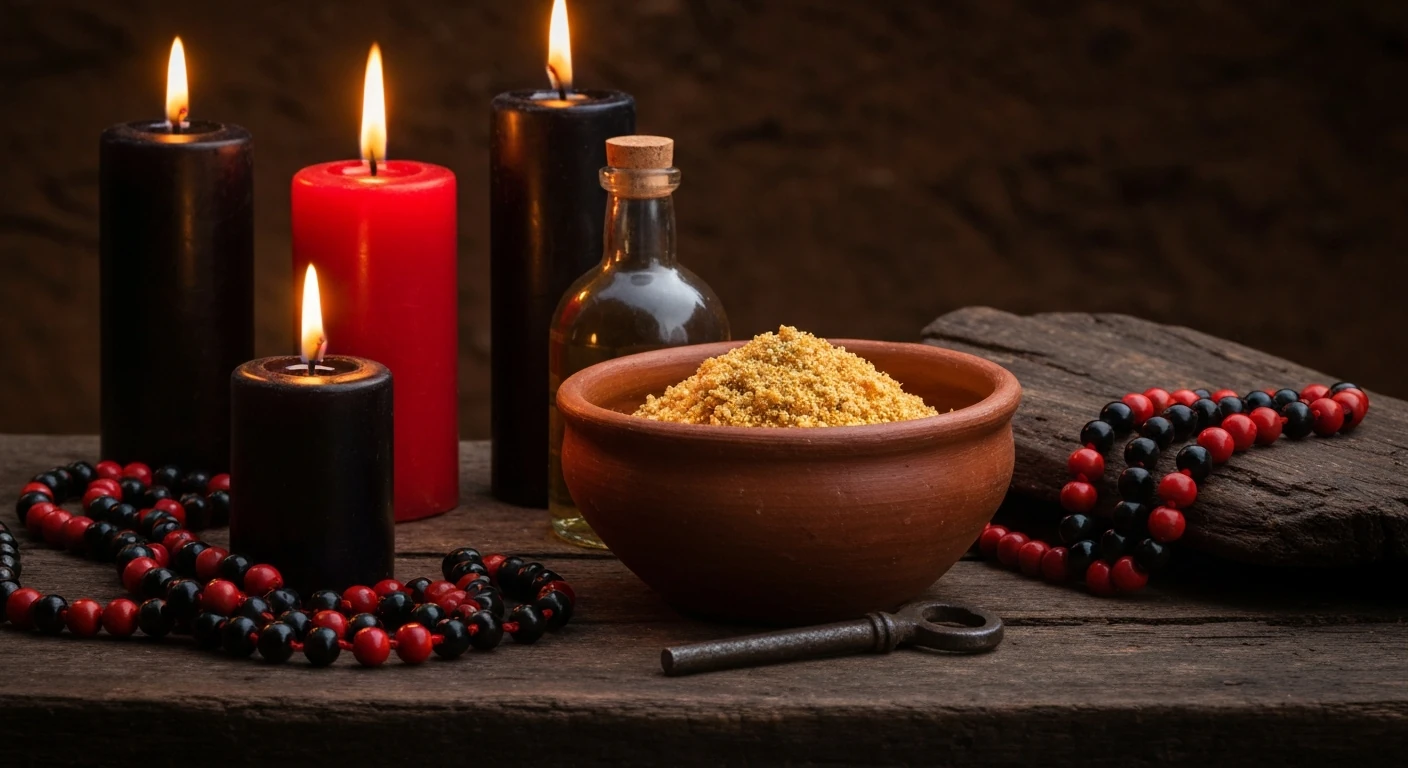
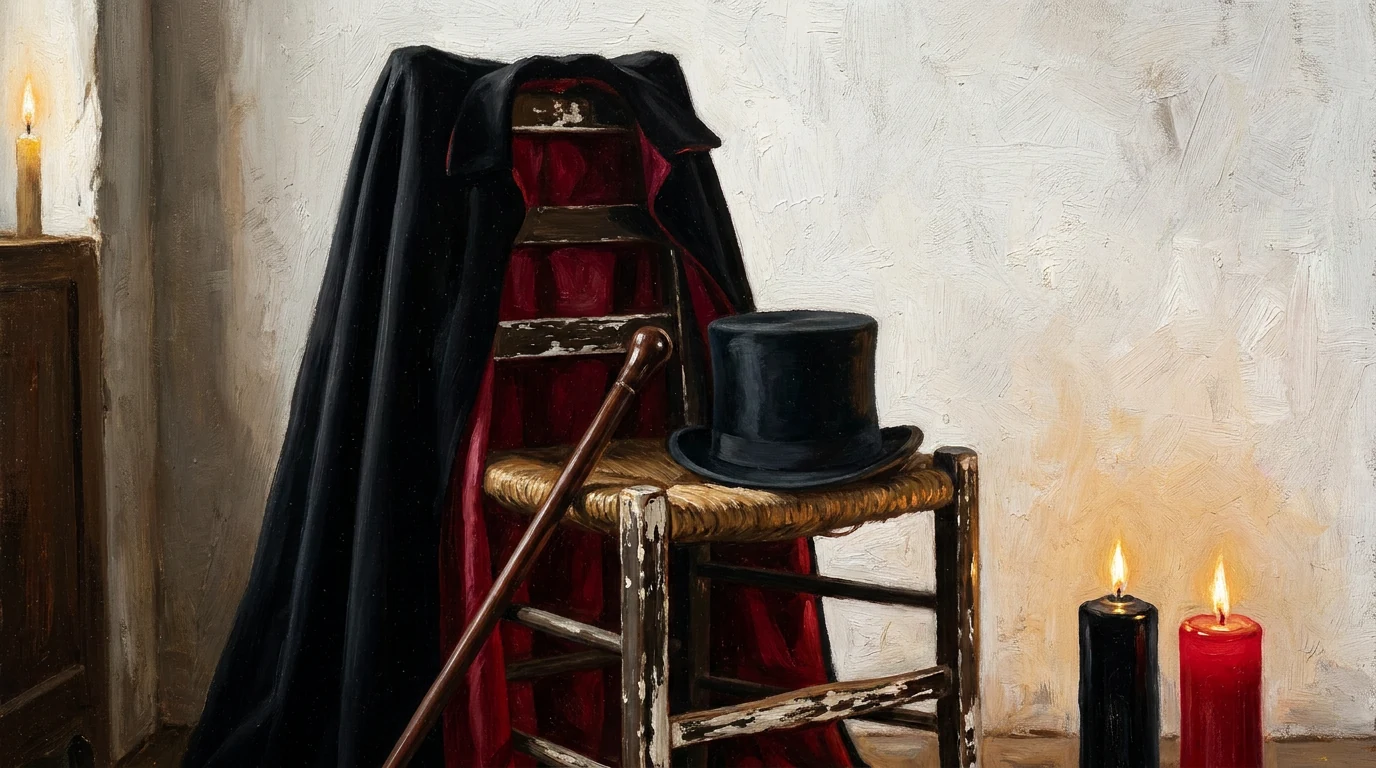
The symbols of Exu in Candomblé are the ogó, the laterita, the búzios, the gourd, the key and the colors red and black. In Umbanda and in Quimbanda, they are the trident, the cape, the top hat and the skull. The list changes because there are two layers: the orixá and the guardian.
What are the symbols of Exu
Each layer has its own. In Candomblé, Exu is an orixá; in Umbanda, the exu is the guardian of the left line. The difference lies in who Exu is.
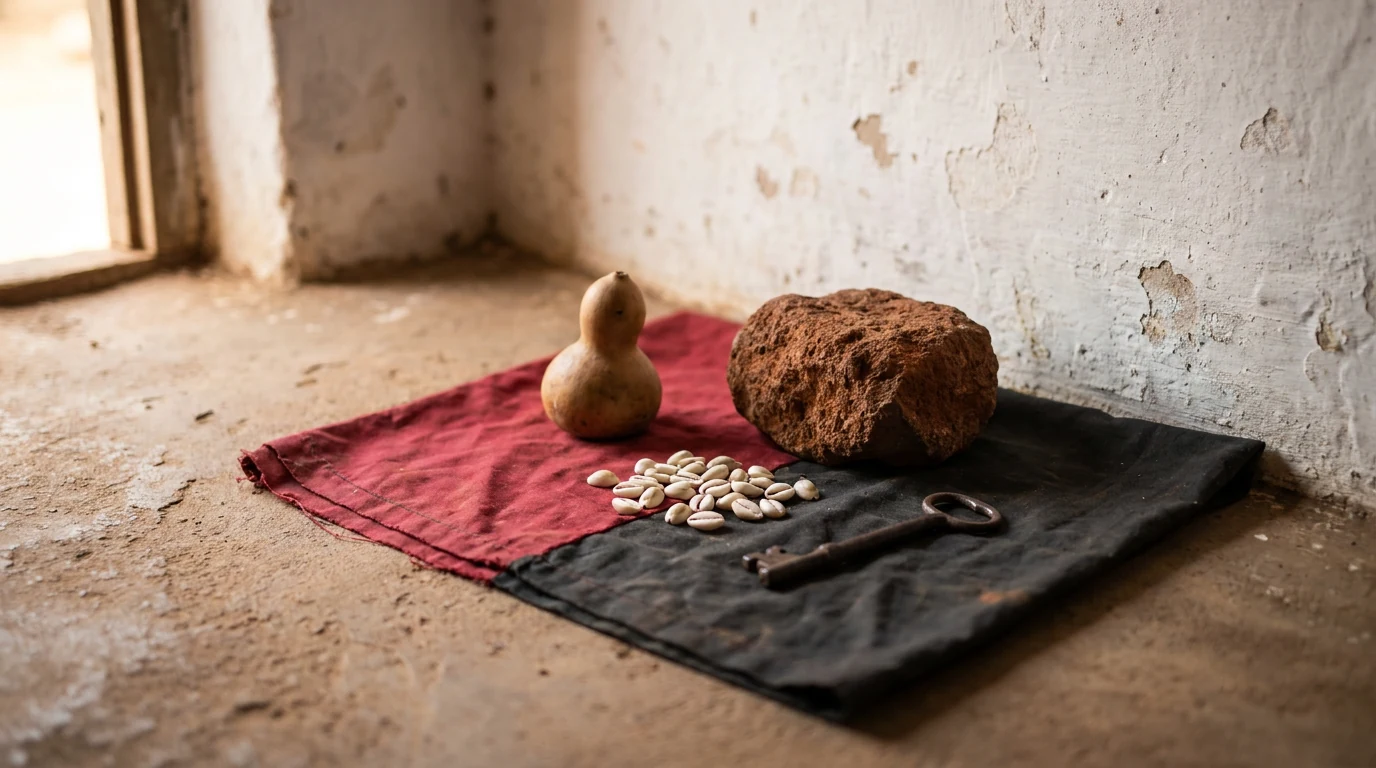
- Of the orixá, in Candomblé: ogó, laterita, gourd, shell, búzios, key, the colors red and black and the two-colored hat [C25, D1, D2, D7, D10, D14, D4].
- Of the guardian, in Umbanda and in Quimbanda: trident, black and red cape, top hat, cane, skull, cross and the ponto riscado of each one [C11, D9, D17, D20, C12].
Reginaldo Prandi summarized the symbols of the orixá, in Candomblé, in a line of Horizontes Antropológicos: "His symbols are a phallic club and iron tridents".
The ogó: the staff of Exu
The ogó is the staff that Exu carries in his hand, the symbol of the orixá. Prandi calls it a club. In Candomblé festivals, with the increase in initiations for Exu, the orixá appears with a conical hat, a red and black skirt embroidered with búzios and the staff in his hand.
The sources do not give a single definition:
- Knobby staff. In 1884, Father Baudin recorded one of the names of Exu: "Ogongo Ogó, the genius of the knobby staff".
- Phallus of the mound. Vagner Gonçalves da Silva describes the worship in Africa, among the Fon and the Yoruba. There, Exu is worshipped on a mound of earth in the shape of a head, "from which a large phallus (ogó) projects".
- Dance staff. The Cleveland Museum of Art keeps a Yoruba dance staff for Exu, from the 19th century, made of wood, leather, cowrie shells (búzios), and seeds. The museum explains that the abundance of cowrie shells (búzios) means that Exu brings wealth.
The description of the ogó as "staff with gourds" circulates, but comes from Wikipedia. Academic sources describe the staff without gourds. The tools of other orixás are in tools of the orixás.
Laterite, gourd, snail, and cowrie shells
These symbols appear less than the trident, and all are from the orixá.
- Laterite. Iangui, "the first of Creation," is "represented by laterite," a reddish stone. In Ketu Candomblé, the assentamento of Exu is "buried laterite and iron forks in a clay alguidar". Who makes it and where it stays are in assentamento of Exu.
- Gourd. Igbá Quetá is "the Exu of the gourd-assentamento".
- Snail. Ocotó is "the patron of evolution, represented by the snail".
- Cowrie shells (búzios). In Africa, Exu is also worshipped in a statue "decorated with cowrie shells (búzios)". In ancient assentamentos in Brazil, there was a clay ball in the shape of a head, "with the eyes and mouth made by cowrie shells (búzios)".
The three names, Iangui, Igbá Quetá, and Ocotó, are in the list that Prandi registered in the article Exu, from messenger to devil, with the ogã Gilberto de Exu [D1, D2]. The other names are in names of Exu.
Colors, day, greeting, and the two-colored hat
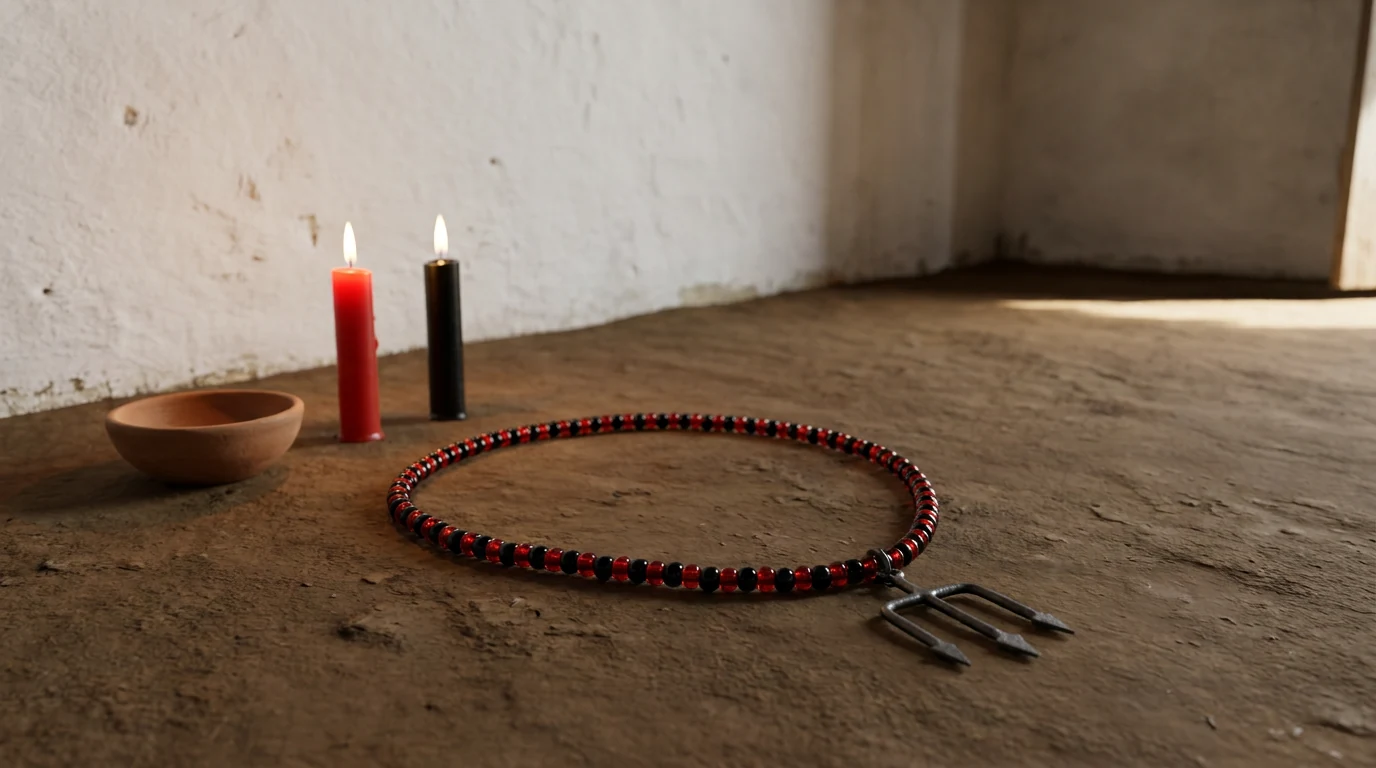
Colors: red and black | Beads: alternating red and black | Day: Monday | Greeting: Laroyê [D14, D15, D16]
The color of the bead necklace (guia) and the variations by house are in bead necklace (guia) of Exu. The annual date is in day of Exu.
The two-colored hat comes from a myth that Prandi says is very well known in candomblés. Exu passes between two friends with a cap of one color on each side. The two fight because each saw a different color. In the version recorded by Baudin in 1884, the cap was "of brilliant whiteness on one side and completely red on the other".
The key: from Saint Peter to the Bará do Mercado
The key reached Exu through two paths. The first is syncretism. In it, Exu was linked to saints who open paths, among them Saint Peter, "the doorkeeper who carries the keys of heaven".
In the gaúcho Batuque, Exu is the Bará, who has a specific article in who is Bará. The anthropologist Vitor Queiroz, from UFRGS, told the Nonada magazine: "He is associated with the key, because if he does not open or close, nothing happens".
In the center of the Mercado Público de Porto Alegre, seven keys form a stone mosaic, built in 2013, in the place where the Bará is settled. In 2020, the Bará do Mercado was listed as historical-cultural heritage of the city.
The trident, in a few words
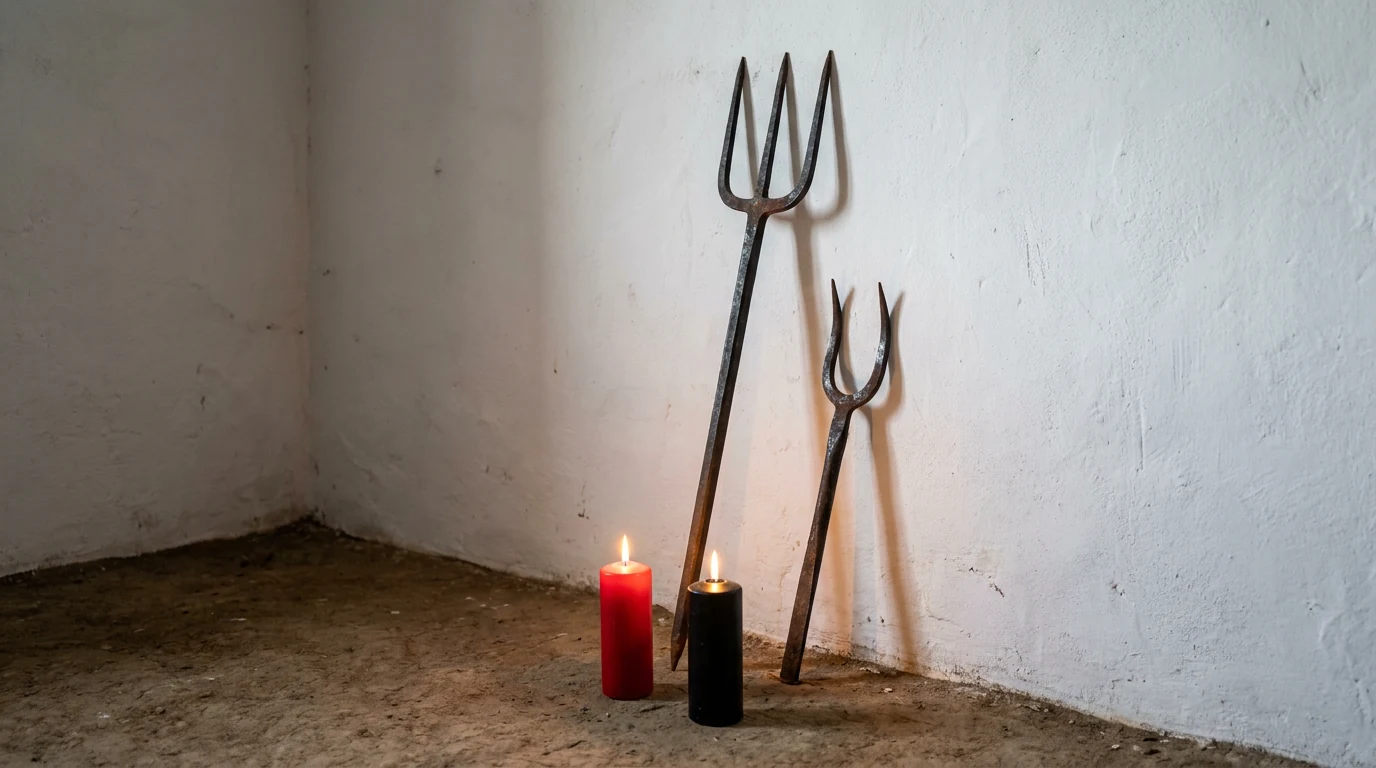
The trident is the symbol of the most well-known guardian, and the fork of the pombagira has two points or is rounded [C11, C27]. In a study of 318 pontos riscados of Exu, only two did not have a trident.
The origin is disputed. For Prandi, Exu received the iron trident, which in Christianity was the symbol of the devil. For Silva, there are statues of Exu with horns in West Africa since at least the 19th century. Both readings, with the iron and the shape, are in trident of Exu.
Cape, top hat and cane: the guardian's clothing
The guardian's cape is black on one side and red on the other. Silva reads the cape through its duality. It is thus "like the bicolor hat that Exu wears". The guardian inherits the double side from the myth of the orixá.
The hat, cane, and shoes have a date. Emerson Giumbelli and Leonardo Oliveira de Almeida studied a house in Porto Alegre for the Journal of Anthropology. From the 1960s onwards, the house began to construct the image of the "exu rei":
“He would ask and he would gain clothes, a cape, a top hat, shoes, a good cigar, good whiskey. 50 years ago he had none of that”
Leader of a house in Porto Alegre, based on the studies of Giumbelli and Almeida
In 1967, in the same house, cape, hat, cane, and shoes were given to Exu as axé, by merit, for the ritual work performed. Cape, Exu statue, and black and red candle are purchased at the shop. What goes to your house, the leader decides.
Skull, cross and the ponto riscado: the symbol of each Exu
Whoever seeks the symbol of Exu Caveira, Tranca Rua, or Tiriri almost always wants the ponto riscado of the spirit. Silva defines the pontos riscados as "emblems elaborated by the Exus to identify themselves when they incorporate into their children," especially in Umbanda.
Luiz Andrade Júnior studied 318 pontos riscados of Exu in the magazine Mouseion. In them appear the star, cross, skull, snake, moon, top hat, crown, padlock, horseshoe and the trident, among others. The cross is in 142 of the pontos, and the names with cemetery, calunga and skull mark the Exu linked to death.
The blog does not publish guardian pontos to be copied. What a ponto is and how to read it is in ponto riscado in Umbanda, what research says about the traits of Exu is in pontos riscados of Exu, and the cemetery falange is in Exu Caveira.
Frequently asked questions
What is the symbol of Exu orixá?
The ogó, the staff that Exu carries in his hand, and the laterite, the stone that represents Iangui, the first of Creation. In Ketu Candomblé, Prandi also lists the iron tridents. Cowrie shells, a gourd, and the colors red and black complete the set of the orixá.
What is the purpose of Exu's ogó?
In Candomblé festivals, Exu appears with the staff in his hand, along with the conical hat and the red and black skirt embroidered with cowrie shells. In Africa, dance staffs for Exu decorated with cowrie shells speak of the wealth that he brings.
What is the difference between the symbol of Exu and that of Pombagira?
Exu's fork has three points. Pombagira's has two points or is rounded, depending on the source and the house. In Umbanda, both appear on the iron statues and in the ponto riscado.
What is the symbol of Exu Caveira?
It is his ponto riscado, the emblem that the spirit draws to identify himself. In the pontos of Exu linked to the cemetery, a skull and a cross appear. The blog does not publish a spirit's ponto for copying: the ponto is learned in the house.
What are the colors of Exu?
Red and black, in the clothes and in the alternating beads, in Ketu Candomblé and in Umbanda. The guardian's cape repeats the two colors, one on each side.
References
- Reginaldo Prandi: Deuses africanos no Brasil contemporâneo, Horizontes Antropológicos, 1995
- Reginaldo Prandi: Exu, de mensageiro a diabo, Revista USP, 2001
- Vagner Gonçalves da Silva: Exu do Brasil, Revista de Antropologia, 2012
- Emerson Giumbelli and Leonardo Oliveira de Almeida: The enigma of Quimbanda, Anthropology Journal, 2021
- Luiz Andrade Júnior: Pontos riscados and nominations, Mouseion, 2015
- Cleveland Museum of Art: dance staff for Exu, 19th century
- Revista Nonada: the Bará do Mercado, 2022