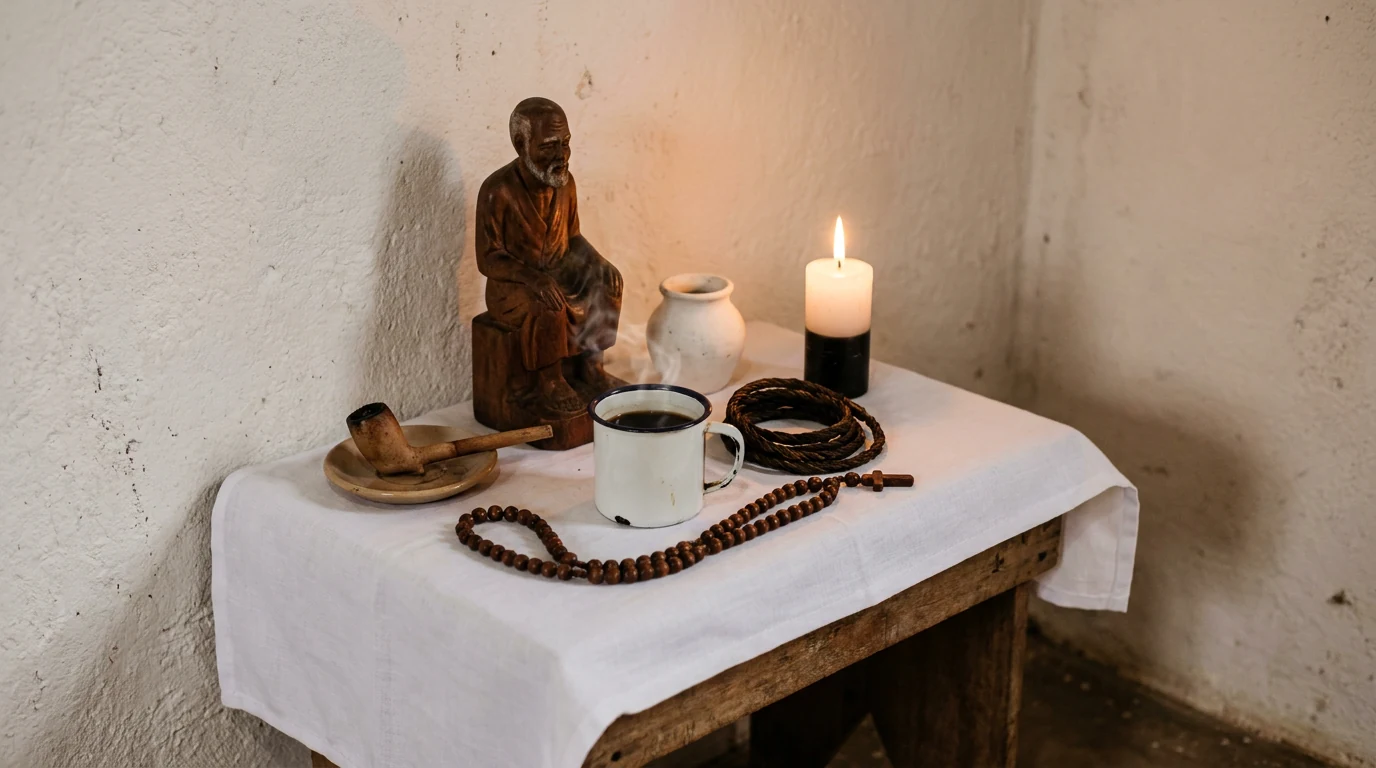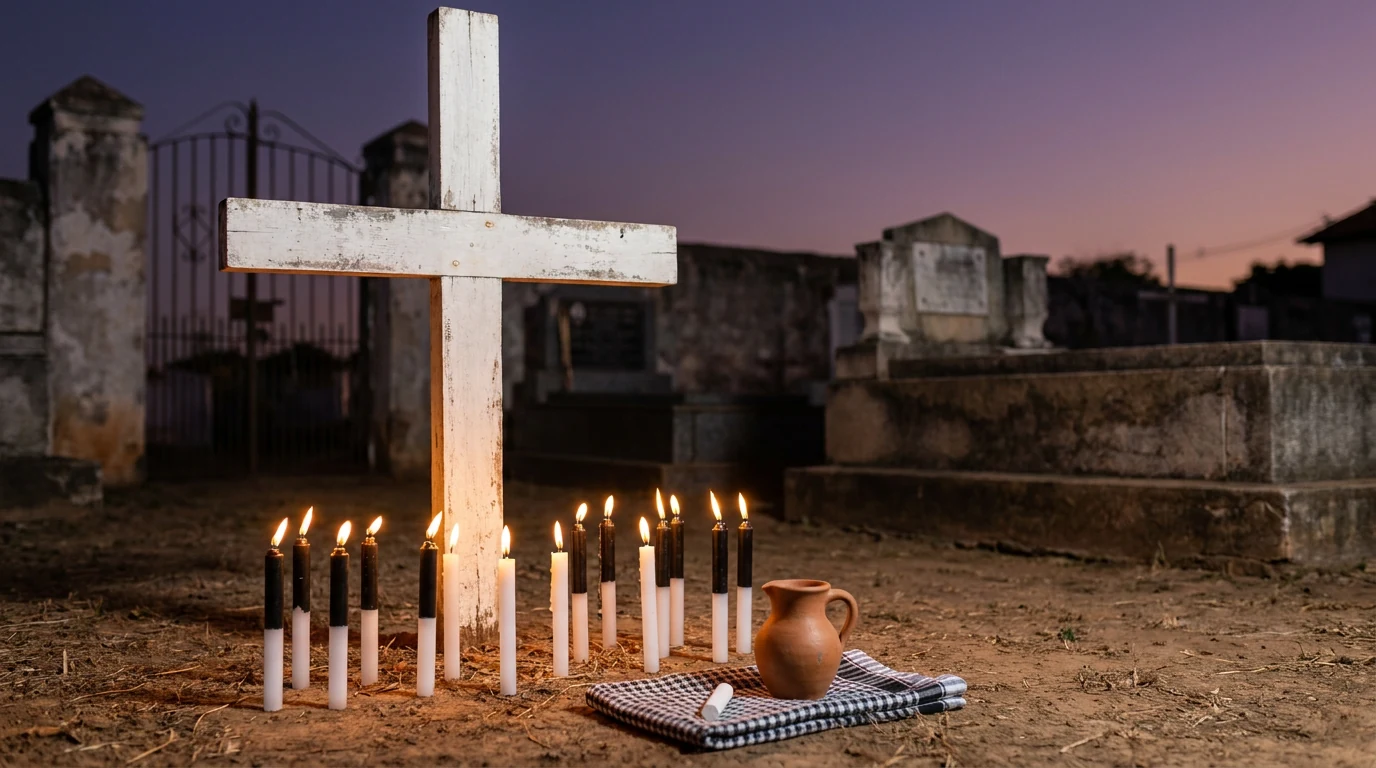
Is preto velho Exu? In general, no. In the most common classification of Umbanda, the preto velho is on the right line and Exu is on the left. A historian records that the preto velho descends under all orixás (orishas), except Exu and Ibeji.
Field research describes, however, exceptions in a few houses: the "da mata" preto velho, the "cruzado" preto velho and the "cruzado" Exu with preto velho.
Is preto-velho Exu? In the most common classification, no
No, in the most used classification. The sociologist Reginaldo Prandi, from USP, describes Umbanda in two lines, right and left. He places the preto-velho on the right side, as a “symbol of the African root and mark of the slave past”.
In Lima's classification (1997), summarized by Dias and Bairrão, the pretos-velhos are “disciplining” spirits and the exus are “cathartic.” These are labels from the author, not from the houses.
Prandi himself warns that the division weighs less than it seems:
“This division, however, may be merely formal, as a classificatory orientation strictly ritual and with loose ethical importance.”
Reginaldo Prandi, Herdeiras do Axé, 1996
In practice, he writes, “there is no Quimbanda without Umbanda nor quimbandeiro without Umbandista.” The difference between Umbanda and Quimbanda and who is Exu complete the picture.
Preto velho: right | Exu: left | Day: Monday, for both | Exceptions: from the forest, crossed
What the two have in common: day, space and cemetery
Monday is the day of the two, and the day of preto velho in the year is May 13. The Santuário Nacional da Umbanda says it is the day of the pretos-velhos, “the same day as Exu and Abaluaiê.” In a house in Ribeirão Preto, Monday is “simultaneously the day of the pretos-velhos and the exus.” In Vitória (ES), it is the day of offerings for “preto-velhos, spirit Exu and special cemetery dead.”
Space also brings the two together. In the house studied by Rafael de Nuzzi Dias, the correct one would be the house of the souls to the right of the entrance, in front of the tronqueira, the house of the exus, to the left.
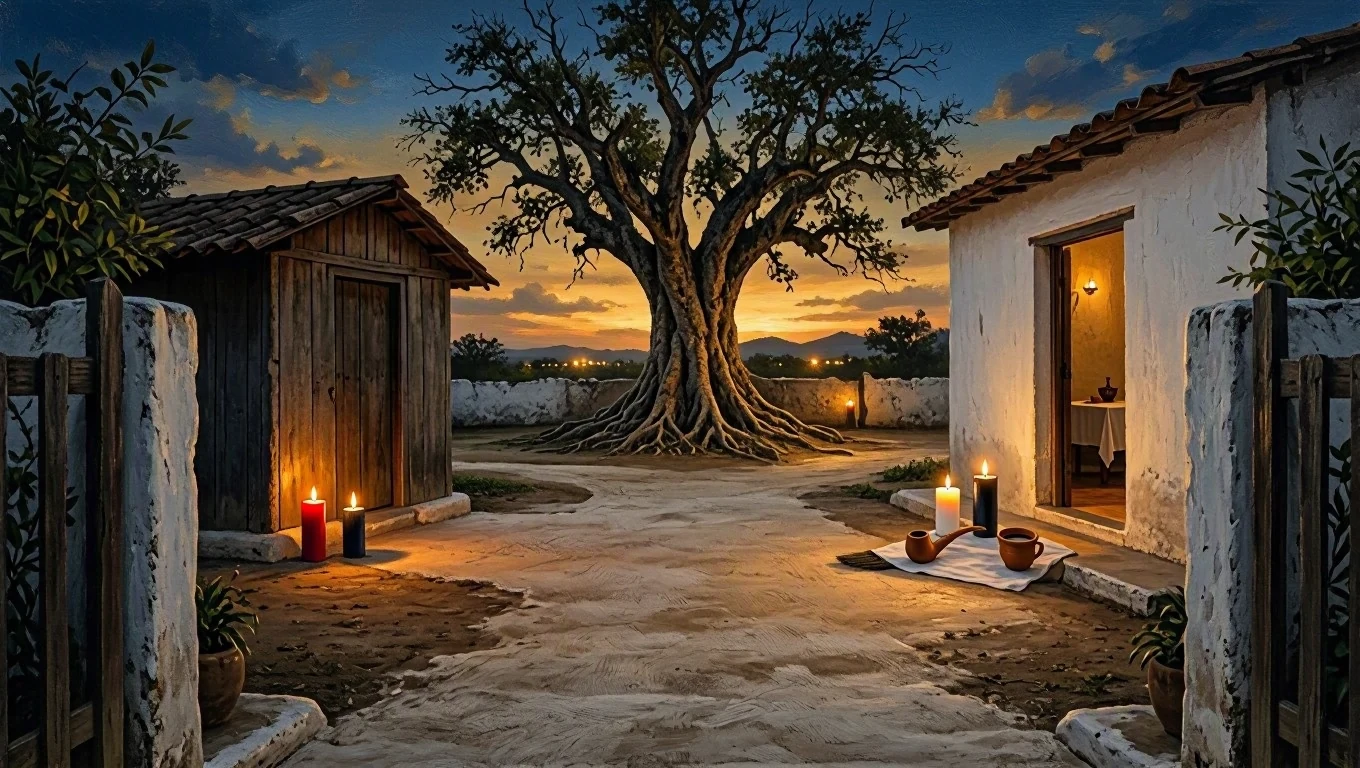
In the cemetery, the research diverges. In Vitória, Barbara Thompson (UFBA) noted that the pretos-velhos "work in a different way from the exus". The only place of offering for them is the Cross of Souls (Cruzeiro das Almas) of the white line, and the exus receive at gates, crosses, and headstones.
Already Lourival Andrade Júnior (UFRN) writes that exus, pombagiras, and pretos-velhos "harmoniously divide and coexist in the same niches within the sacred field". The line of souls and the Exu das Almas treat this in detail.
The exceptions: the preto-velho of the forest, the cruzado, and the quimbandeiro
Yes, the research records exceptions, in a few houses. Four have a name: the preto-velho "of the forest", the preto-velho "cruzado" or "of the tronqueira", the Exu "cruzado" with preto-velho, and the "quimbandeiro". Each one comes from a house or a research, and none applies to the entire Umbanda.
The preto-velho of the forest
In a house in Ribeirão Preto, Dias and Bairrão describe pretos-velhos "of the forest" who, for them, "defy dichotomies by merging pretos-velhos and exus into a single character". Their consecrated foundation (assentamento) is located near the domain of the left and the exus. That of the common preto-velho is on the altar, with caboclos and erês.
The pai-pequeno of the house summarizes them as follows: they are pretos-velhos "because they work with characteristics of the pretos-velhos; but with a denser energy, close to the exus". The authors contrast the common one, of "serene, calm, and welcoming spirits", with that of the forest, of "severe, direct, and imperative spirits". They are not taken as spirits of the left strictly speaking. The previous leader called his "compadre", a treatment that Umbanda uses for the exus.
The authors suggest that the boundary between pretos-velhos and exus is "perhaps even practically nonexistent," and they read the separation as part of an effort of "whitening" of the preto-velho. It is their interpretation, and not the house doctrine.
The preto velho cruzado or of tronqueira
Lívia Lima Rezende, in Afro-Ásia, writes that "crossed" pretos-velhos would act "between the lines of pretos-velhos and exus," with characteristics of both groups. They would combine wisdom, deliberation, and humility with a more incisive and less patient discourse.
The research heard mediums in São João del-Rei (MG) and Montevideo, where the cruzado is also called "de tronqueira".
Attention to the name: the "cruzado" of Rezende describes a spirit, and the Linha Cruzada of Rio Grande do Sul describes a house that worships batuque, Umbanda and Quimbanda in separate sessions.
The Exu crossed with preto velho
Dias and Bairrão define "cruzado" as a term used by umbandistas for spirits that are "at the intersection between the left and the right." According to Diana Brown (1994), whom they cite, an Exu can be "cruzado" with a preto velho and thus recover an African identity.
The preto velho quimbandeiro
A 1972 study by Lapassade and Luz would describe "pretos velhos quimbandeiros". In the 2011 revision, Dias and Bairrão say it is quite likely that the name belongs to the authors, and not to the umbandistas. They raise the hypothesis that "rebellious" pretos-velhos have been "(con)fused" with the exus in many places.
The left is a way of acting, according to a USP study
According to a study by USP, being on the left in Umbanda does not define a type of spirit. Juliana Barros Brant Carvalho and José Francisco Miguel Henriques Bairrão write that this:
it is not a property of certain types of this spirituality, but a mode of manifestation and action of any spiritual subjects
Carvalho and Bairrão, USP Psychology, 2019
In their description, the left line "also includes some pretos-velhos", although pretos-velhos are "attributed to the right line and reported as humble, lovable, and patient". The research is open on SciELO.
By this reading, the question "is preto velho Exu?" assumes two fixed types, and the houses described above show different arrangements.
Why the question matters: recognition and religious racism
Prandi notes that, "of all the classes of entities in Umbanda, which are many, certainly the preto-velho is the one with the greatest public recognition", and places it on the side of "good". Meanwhile, a dissertation from UFES, about pretos-velhos giras in Vitória, records that religious obligations in public places "evidenced the problems and conflicts of discrimination and religious racism". The subject is religious racism.
The cited studies treat right and left as a way to organize the house, and not as a scale of value. This blog describes what they record and does not teach or recommend preto velho cruzado. If your house has a preto velho like that, the leader is the one who explains what he is. The general overview is in pretos-velhos in Umbanda, and the naming system (the "de Angola", the "de Aruanda") in preto velho names.
Frequently asked questions
Do preto velho and Exu work together?
In the same house, yes: in a house in Ribeirão Preto, the house of souls and the tronqueira are in the same terreiro, one in front of the other, and Monday is the day of both. In the cemetery, one research sees offerings in different places and another, coexistence in the same niches. Attending together, in the same gira, depends on the house.
What is a preto velho cruzado?
It is the preto velho who, according to Rezende, would act between the lines of pretos-velhos and exus, joining humility and deliberation to a more incisive discourse. The research heard mediums in São João del-Rei and Montevideo, where the cruzado is also said to be "of tronqueira". It is a house concept, and not a rule of Umbanda.
Does Exu preto velho exist?
There are records of houses, and not a rule. Diana Brown (1994), cited by Dias and Bairrão, describes an Exu "cruzado" with a preto velho. The research from Ribeirão Preto describes the preto velho of the forest, which merges the two figures into a single character.
Is preto velho good and Exu evil?
The cited researches do not organize it this way. Prandi writes that the division between right and left can be "merely formal", of "loose ethical importance". For Carvalho and Bairrão, being of the left is a way of acting for any spirits.
References
- Reginaldo Prandi (USP): Pombagira and the unconfessed faces of Brazil, Herdeiras do Axé, 1996
- Rafael de Nuzzi Dias and J. F. M. H. Bairrão (USP): The cauldron of the insurgents, Memorandum n. 26, 2014
- Rafael de Nuzzi Dias and J. F. M. H. Bairrão (USP): On this side of and beyond the captivity of concepts, Memorandum n. 20, 2011
- Rafael de Nuzzi Dias (USP): Ancestral chains, dissertation, 2011
- Lívia Lima Rezende (UFJF): The ethics of love in Umbandista pretos-velhos, Afro-Ásia n. 66, 2022
- Juliana Barros Brant Carvalho and J. F. M. H. Bairrão (USP): Umbanda and quimbanda: black alternative to white morality, Psicologia USP, 2019
- Lourival Andrade Júnior (UFRN): Exus, Pomba-giras and pretos-velhos, Dialogues (UEM), 2021
- Maria Sampaio do Nascimento (UFES): Giras of pretos-velhos in an umbanda terreiro, dissertation, 2017
- Barbara Thompson (UFBA): Social Sciences Seminar, PGCS-UFES, 2019
- National Sanctuary of Umbanda: The House of the Pretos-Velhos